The Destruction of the Korolev
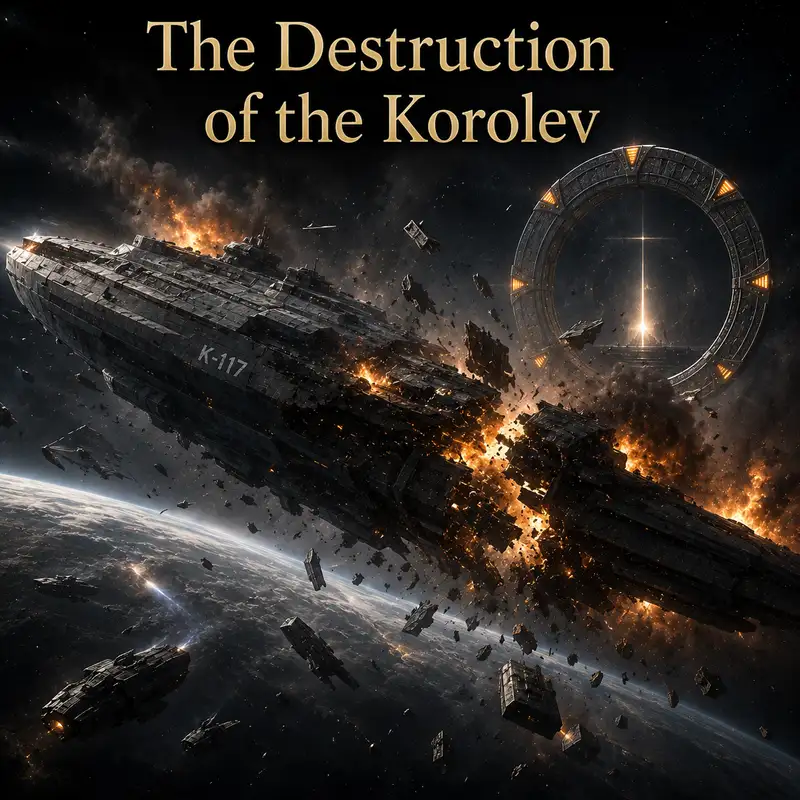
The Korolev had lost power, and the Ori warship outside was still firing. Colonel Chekov ordered damage-control teams to restore the ship while Cameron Mitchell prepared the F three-oh-twos for launch. Daniel Jackson moved a neutron bomb toward the ring platform, hoping to send it directly into the nearest enemy vessel. Another strike tore through the ship before the weapon could be positioned. The bomb slid away. Daniel stepped into the rings himself. Mitchell cleared the hangar in a fighter. Two more Ori beams struck the Korolev, and Earth's newest battlecruiser disappeared on its first mission.
The destruction lasted only moments. Understanding it requires a longer look at what the Korolev represented. It was not merely another hull in the allied formation at P three Y two twenty-nine. It was the first major Earth-built warship placed under Russian control, a diplomatic settlement made tangible in trinium, railguns, and Asgard systems. Its maiden deployment was intended to demonstrate that planetary defense had become an international responsibility. Instead, the ship entered battle before construction was complete and was destroyed before its crew could establish whether any of its weapons could injure the enemy.
The central question is therefore not simply how the Korolev was lost. The sequence is visible enough. Ori weapons overwhelmed its defenses and destroyed the ship. The harder question is why a new B C three-oh-four, equipped with some of the most advanced technology available to Earth, proved so vulnerable. The answer lies in the difference between owning advanced systems and possessing a mature military capability. Korolev had a strong design, a committed crew, and almost no margin for the kind of enemy it encountered.
Russia's path to the ship began years before the Ori war. Russian forces had recovered the original Stargate after it was lost in the Pacific, briefly operated an independent program, and later negotiated continued American use of the gate. Cooperation brought Russian participation at Stargate Command and access to recovered technology, but it never removed the leverage created by ownership of the operating gate.
The Gate Alliance Treaty broadened participation to other major governments, but Russia retained a strong bargaining position because the operating gate at Cheyenne Mountain remained Russian property under the established arrangement. When Moscow threatened to reconsider the treaty and establish a separate program with Chinese support, the United States offered a newly built B C three-oh-four. Russia renewed the agreement and received the Korolev.
The ship was named for Sergei Korolev, the principal architect of the early Soviet space program. The choice connected Russia's twentieth-century achievements to a classified future in which Russian personnel would operate beyond the solar system. It was a statement of national participation, not merely a courtesy label on an American-built hull.
Colonel Chekov became Korolev's first commander. He had represented Russian interests after failed joint missions, negotiated access to the Russian gate, supported disclosure to allied governments, and helped prevent a Goa'uld-directed nuclear confrontation. He understood both the value of cooperation and the cost of mistrust. Commanding Korolev placed him inside the capability he had spent years helping Russia obtain.
The appointment also reveals how quickly the crisis compressed normal institutional development. The surviving record does not describe a long workup period, a series of readiness exercises, or extended joint training with the Odyssey. Korolev was rushed into service with roughly a year of construction still expected. That does not mean it entered combat as an empty shell. Its hyperdrive, shields, weapons, hangars, transport systems, and command spaces functioned well enough for deployment. It does mean the ship had not received the time normally used to finish integration, identify faults, train a crew under realistic conditions, and build confidence in damage-control procedures.
An unfinished ship can be operational without being mature. Essential systems may work while redundancies, software refinements, spare assemblies, internal protections, or maintenance routines remain incomplete. The screen record does not identify one missing component that caused Korolev's destruction, so blaming the loss on a particular unfinished system would be speculation. The more defensible conclusion is that rushing the ship reduced its margin for recovery at the same moment it faced an enemy that left almost no margin at all.
Korolev belonged to the same B C three-oh-four family as Daedalus and Odyssey. Its design combined human construction with Asgard assistance. Asgard hyperdrive technology gave the ship interstellar and intergalactic mobility. Asgard shields and sensors provided defenses far beyond conventional Earth science. Beaming technology allowed personnel, cargo, and weapons to move without shuttles. F three-oh-twos gave the ship a fighter component. Railguns and missiles supplied its principal offensive firepower.
That list sounds formidable until it is placed in the correct era. Earth had not yet received the Asgard plasma beam weapons later capable of cutting through Ori warships. Korolev's most advanced systems were concentrated in movement, protection, sensing, and transport. Its guns remained human-built kinetic weapons, while its heaviest striking options depended on nuclear warheads. Against Goa'uld vessels and many regional threats, that combination made a B C three-oh-four dangerous. Against Ori shields, it proved inadequate.
Earth's early battlecruisers looked like products of one technological revolution, but they were integration platforms assembled from several civilizations. Earth could operate an Asgard shield without reproducing the industrial system behind it, install a hyperdrive while relying on specialized knowledge, and build a hull that still lacked a weapon equal to the next enemy's defenses. Korolev was advanced by Earth standards and outclassed by Ori standards at the same time.
Its first assignment offered no opportunity for gradual deployment. The Ori Supergate had been located near P three Y two twenty-nine, and allied forces were ordered to prevent an invasion by any means available. Korolev collected Daniel and Mitchell from Camelot while traveling directly toward the gathering fleet. Daniel immediately recognized that the ship had arrived much earlier than expected in its construction schedule. The mission had converted a commissioning process into a combat transit.
There was no realistic alternative once the Supergate was active. Earth possessed very few capital ships. Prometheus had already been destroyed. Daedalus was committed to the Pegasus galaxy. Odyssey was the only completed American B C three-oh-four available in the Milky Way. Holding Korolev back would have protected a valuable ship while weakening the only fleet positioned to stop the Ori at their entry point. Sending it risked an unfinished platform and its crew. Strategic scarcity made the risk unavoidable.
Korolev reached the battlefield shortly before the gate activated. That timing deprived Chekov of the chance to integrate his ship gradually into the formation or conduct detailed coordination with the other commanders. The force included Earth, Free Jaffa, Tok'ra, Asgard, and later Lucian Alliance vessels. They shared a threat, not a mature joint command. No single fleet commander had trained all participants, standardized their communications, or rehearsed concentrated fire against an Ori target. Korolev entered an alliance battle while still developing its own internal readiness.
The first allied volley established the technological imbalance. Missiles, railgun rounds, and energy weapons struck the approaching Ori ships without producing visible damage. The Ori returned fire with beams that tore through Ha'taks and rapidly depleted the protection of the Earth vessels. Korolev's Asgard-derived shields allowed it to survive impacts that would have destroyed weaker ships immediately. They did not provide immunity. Each hit consumed defensive energy, damaged internal systems, and moved the ship closer to a point from which no repair team could recover it.
The comparison with Odyssey matters. Odyssey was completed, experienced, and commanded by a crew already operating the class. It also lost sublight propulsion, suffered severe damage, and was left with critically reduced shields and limited life support. Korolev's unfinished status may have worsened its ability to absorb damage, but the battle does not support the convenient conclusion that a completed ship would have been safe. The Ori nearly destroyed both. One retained enough function to survive. The other did not.
Korolev soon lost power and became effectively dead in space. A warship without propulsion cannot control range, orientation, or exposure. A ship without stable power cannot move energy among shields, weapons, sensors, life support, and repair systems as the tactical situation demands. Chekov's crew was no longer deciding how to attack. It was deciding which remaining capability might delay destruction long enough to restore the others.
Mitchell proposed launching the F three-oh-twos. Chekov objected that the fighters could not damage the Ori warships, which was a sound assessment. Mitchell's purpose was different. He intended to draw fire while the crew tried to return Korolev to operation. Fighters that could not defeat the enemy might still divide its attention, complicate targeting, and create a few additional minutes for damage control. It was not an offensive solution. It was a survival measure disguised as an attack.
The disagreement illustrates the difference between platform command and small-unit improvisation. Chekov had to preserve a ship, crew, and national strategic asset. Mitchell saw an immediate tactical opportunity to use every functioning system before the hangar was destroyed. Both understood that the fighters were overmatched. Chekov evaluated them by the damage they could inflict. Mitchell evaluated them by the time they might purchase.
Mitchell launched as the ship deteriorated around him. His F three-oh-two was thrown clear when Korolev later exploded, leaving him unconscious but alive. The fighter did not save the battlecruiser, and there is no evidence that it inflicted meaningful damage on the Ori. It did provide one of the few available escape routes. A system intended to extend the ship's offensive reach became an individual lifeboat because the normal problem had become survival rather than victory.
Daniel remained aboard as the crew searched for another asymmetric option. Sensors had suggested that Ori shields fluctuated briefly when the ships fired their main weapons. The opening was too short for conventional attacks and too well protected for reliable Asgard beaming. Ring transporters offered a different path. Ori warships and Earth battlecruisers both carried ring systems derived from older interstellar technology. If Korolev activated its rings without selecting a cooperative receiver, the matter stream could seek the nearest compatible platform aboard an enemy vessel.
The proposal was to place a neutron bomb on the ring platform and send it through. It was an attempt to bypass protection rather than overpower it. An explosive delivered inside might destroy critical systems before the Ori could respond. The rings still had to connect through battlefield interference, and the warhead had to arrive, arm, and detonate before being removed or disabled.
It also required the Korolev to remain alive long enough to execute the transfer. Crew members moved the bomb into position while the ship shook under repeated strikes. Another hit threw personnel across the compartment and knocked the weapon away from the rings. The chance to test the attack disappeared. Daniel then made the only decision still available to him. He stepped onto the platform and activated it for himself.
The rings carried him into an Ori warship moments before Korolev was destroyed. His survival showed that the transport path was viable, but not that the bombing plan would have succeeded. A person could hide after arrival. A neutron bomb would have announced itself more directly. It was a plausible attempt developed inside a dying ship, not a proven victory denied only by bad luck.
Two major Ori strikes hit Korolev during its final moments. The battlecruiser broke apart in a fireball large enough to throw Mitchell's fighter across space. There was no controlled evacuation and no time for orderly abandonment. Lifeboats were not the answer to a ship disintegrating under beam fire in the middle of a fleet engagement. Survival depended on the few systems that could remove a person instantly.
Black-box data recovered after the battle indicated that six people had been beamed from Korolev to Odyssey before the loss. The logs also recorded ring activation, accounting for Daniel's transfer to the Ori ship. Mitchell survived separately in his fighter. The remainder of the crew, including Chekov, was presumed killed. The continuity does not establish a complete crew total, so the exact casualty count should not be invented. It was plainly the overwhelming majority of those aboard.
Chekov's death gave the loss a political as well as military dimension. He had been Russia's most persistent representative inside the Stargate relationship, often argumentative because his position required him to ensure that cooperation did not become American monopoly. He had defended joint action when it served both countries and demanded concessions when it did not. The ship he commanded was the largest concession Russia had secured. He died using it in the common defense before it completed a second mission.
It would be easy to frame that outcome as proof that the ship should never have deployed. That judgment benefits from knowing the battle's result. At the time, commanders knew an Ori fleet was preparing to enter the Milky Way and that every available ship might be necessary. They did not know that four enemy vessels could absorb the combined fire of the alliance without visible damage. Holding Korolev in reserve would have preserved it only if the allied force could stop the invasion without it, and the battle showed that they could not.
The better criticism concerns readiness and strategy at a larger level. Earth had built a small number of exceptionally capable ships but had no depth behind them. There was no reserve fleet, no standardized multinational task force, and no established weapon able to penetrate Ori defenses. A single emergency forced a not-yet-finished ship from construction into combat because every completed hull was already committed or lost. Korolev's destruction was therefore not only a shipboard failure. It was the predictable danger of a planetary defense system built around scarce, irreplaceable platforms.
The loss also exposed the limits of international technology sharing. Transferring one B C three-oh-four gave Russia command of a starship. It did not instantly create a Russian production line for Asgard systems, a decade of deep-space operational experience, or a separate supply network for every alien component. The ship remained part of a technology ecosystem developed largely through Stargate Command, Area Fifty-One, American industry, and Asgard assistance. National ownership had advanced faster than multinational sustainment and doctrine.
No surviving record describes a formal Russian inquiry, a replacement agreement, or a public dispute over responsibility. The Stargate Program remained secret, so the loss of a nationally controlled capital ship and most of its crew could not be debated openly. The screen record does not show what explanation the families received or how Russia accounted for the deaths. Secrecy protected the program while sharply limiting public accountability.
Militarily, the destruction reduced Earth's already small fleet at the moment the Ori gained freedom of movement in the Milky Way. Odyssey survived but required extensive repair. Daedalus remained tied to operations and support in Pegasus. Prometheus was gone. Korolev had existed as an operational asset for a matter of hours. Earth had crossed the threshold into starship production without crossing the threshold into numerical security. One battle could still remove a large percentage of everything it had built.
The survivors carried different pieces of the ship's final action forward. Mitchell's launch preserved a pilot and the commander of S G One. Daniel's ring transfer placed him aboard the enemy and reunited him with Vala, creating intelligence opportunities no one aboard Korolev had planned. The six people beamed to Odyssey represented the success of transport crews working while both ships were damaged. These outcomes mattered. None changed the fact that the ship, Chekov, and most of its crew were gone.
Korolev's destruction did not prove the B C three-oh-four design was a failure. Odyssey's later service, Daedalus's campaigns in Pegasus, and subsequent ships demonstrated the class's value. The battle proved that the class had entered service before Earth possessed weapons equal to every enemy its exploration had revealed. Later Asgard beam weapons would alter that balance dramatically. Korolev never received them. It fought with the version of Earth's fleet capability that existed, not the one later history makes easy to remember.
The ship's maiden voyage became its entire operational record: collect two members of S G One, join an improvised allied fleet, survive the opening exchange, lose power, launch fighters, attempt a ring-delivered nuclear strike, evacuate a handful of personnel, and be destroyed. That record is brief, but not meaningless. It shows a crew continuing to search for options after conventional firepower had failed and the ship could no longer maneuver. The final plan did not save Korolev. It did save Daniel, and the launch decision saved Mitchell.
The Korolev was destroyed because Earth mistook possession of advanced defensive technology for something close to technological parity. The ship's unfinished condition reduced its readiness, but the Ori's superiority defined the battle. Its loss revealed a fleet too small to preserve reserves, an alliance too new to fight as one command, and an industrial system unable to replace strategic assets quickly. Russia had finally received an interstellar warship of its own. It lost that ship in the first action fought for the defense of every nation on Earth.
The final image is not the explosion. It is the sequence immediately before it. A Russian colonel kept damage-control teams working. An American pilot launched from a collapsing hangar. An archaeologist stood beside a neutron bomb and a ring transporter because ordinary weapons had become irrelevant. For a few minutes, Korolev contained the entire character of Earth's early space program: international bargaining, borrowed technology, unfinished capability, professional courage, and improvisation under impossible pressure. The ship did not survive long enough to become a symbol of Russian power. It became a warning about how quickly a new fleet could be asked to fight a war it had not yet learned how to win.