The Evacuation to Destiny
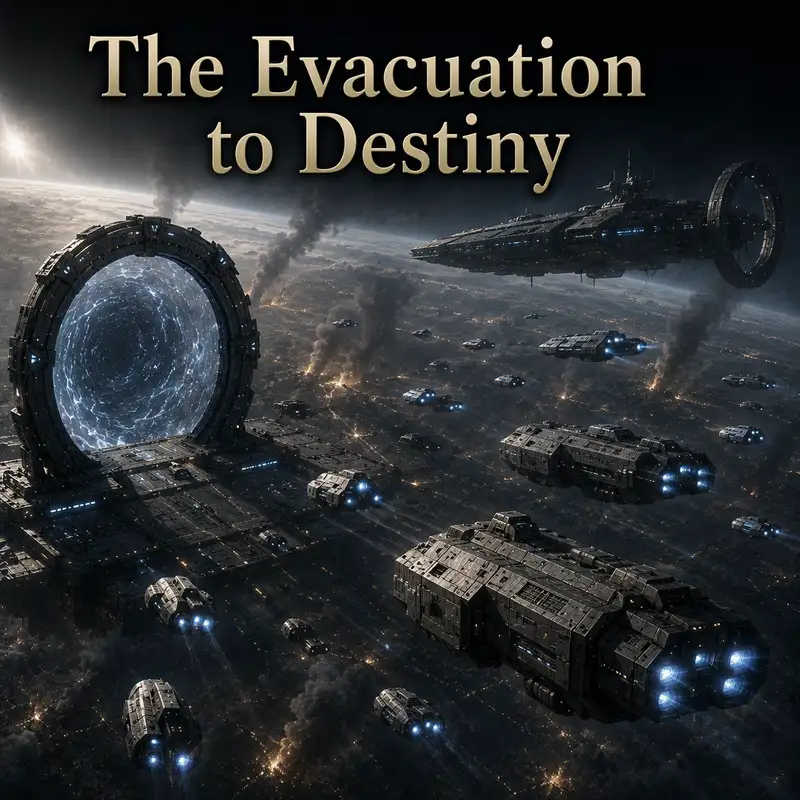
Lieutenant Matthew Scott came through the Stargate at a run and nearly collided with equipment already skidding across the floor. More personnel followed before the first arrivals could clear the ramp. Cases bounced through the event horizon. Wounded people fell among them. The room beyond the gate was dark, unfamiliar, and without a receiving team. Scott tried to call back and slow the flow, but the evacuation continued. Then Colonel Everett Young arrived last, hurled across the chamber by the blast consuming Icarus Base. The wormhole collapsed behind him. Within roughly six minutes, a protected military installation had become a smoking memory, and more than eighty people had been deposited on a ship they did not know existed.
The evacuation to Destiny was a tactical success and an operational disaster at the same time. It saved a large part of the Icarus Base population from certain destruction. It also carried them to an unknown destination without a prepared command team, reliable medical support, adequate supplies, or a confirmed route home. The people crossing the gate believed they were evacuating a battlefield. What actually happened was the involuntary formation of an expedition. The central question is how an evacuation designed to preserve life through speed and discipline became the founding event of a new society at the edge of the known universe.
Icarus Base had one obvious evacuation destination. Earth possessed hospitals, command authorities, replacement personnel, secure facilities, and the industrial resources needed to absorb casualties. When the Lucian Alliance attack broke through the base defenses and destabilized the planet’s naquadria-rich core, Young ordered the Stargate dialed to Earth. That was the correct decision under the plan everyone understood. The base could not be held, the surface fight was collapsing, and the George Hammond was engaged in orbit. The Stargate remained the only practical route for the personnel trapped inside the shielded underground complex. Beaming technology could recover people exposed on the surface, but the bunker’s protection also prevented the Hammond from transporting those still inside.
The planned evacuation began to change when Nicholas Rush and Eli Wallace revisited the ninth-chevron address while the base was under bombardment. Eli recognized that the final symbol might need to represent Earth, not Icarus, because the nine-symbol sequence operated more like a fixed code than an ordinary planetary address. Rush stopped the dialing sequence to Earth and entered the corrected address. His stated concern was that the energy from the failing planetary core might translate through an open wormhole and endanger Earth. That risk could not be tested in the available time. Young immediately identified the alternative Rush had bypassed. They could have dialed another uninhabited world. Rush instead selected the destination that represented the purpose of his entire project.
That decision remains the moral and command center of the evacuation. Rush did not create the attack or destabilize the core, but he chose where the survivors would go. His argument about protecting Earth was plausible enough that Young could not ignore it while the planet approached destruction. His selection of the ninth-chevron address was still unauthorized and strategically self-serving. Rush preserved the possibility of reaching the Ancient destination at the exact moment when normal review became impossible. He could claim that the address offered a way out. Young could answer that no one knew whether anything survivable existed on the other side. Both statements were true, which did not make the decision process sound.
Once the ninth chevron locked, the command problem became brutally simple. The gate would not stop, the base was failing, and the people inside needed somewhere to go. Young ordered everyone to wait while he assessed the situation, but there was no useful reconnaissance package ready for an unknown destination. A mobile analytic laboratory probe could normally check atmosphere, terrain, and local threats before personnel crossed. The destination might have been a planet, an installation, a vessel, or open space. The base lacked time for the survey that normally made Stargate travel tolerable. The evacuation would have to use a human advance party.
Scott became the advance party because he was available, armed, and within the chain of command. Young directed him to lead the evacuees and ordered everyone to carry as much expedition equipment as possible. Scott stepped through first, then instructed the others to follow at intervals. It was an attempt to impose flow control on a collapsing operation. The receiving side immediately exposed the limits of the plan. Scott entered a gate room with no lights, no guards, no marked safe area, and no information about the local environment. He had only seconds to move away before people and cargo began arriving behind him. A Stargate can move a force across extraordinary distance, but it cannot create space around the receiving platform or organize the people emerging from it.
Back at Icarus, the evacuation route was narrowing. Bombardment and structural failure filled corridors with dust, smoke, and debris. A collapse separated roughly a dozen people from the gate room, including Senator Alan Armstrong. Chloe Armstrong refused to leave without knowing whether her father had survived. Young and Master Sergeant Ronald Greer used C four to breach the obstruction, accepting the danger that the blast might bring down more of the roof. It was a local rescue conducted inside a base already being abandoned. The choice cost time, but it recovered the trapped group. Evacuation plans often look efficient on a diagram because diagrams rarely include a daughter standing beside the route and refusing to leave her father behind.
Lieutenant Tamara Johansen faced a different form of delay. Dr. Simms had suffered a catastrophic injury while helping pull people back from the surface. Johansen continued resuscitation until Young forced her to accept that the effort could no longer change the outcome. She was a trained military medic, not the physician the expedition would have selected for an isolated deep-space mission. She was also the most capable medical person still moving toward the gate. The death of Simms and the condition of other casualties meant that the evacuation carried medical emergencies forward rather than resolving them. There was no field hospital waiting beyond the wormhole. Every untreated injury became part of the cargo.
The people moving through the gate were not selected by an expedition roster. Colonel David Telford, the officer intended to command the ninth-chevron mission, was outside flying an F three-oh-two and did not enter the wormhole. The Hammond recovered him and other surface survivors before escaping the planet. Young went through, but he was critically injured during transit. Scott, a junior officer whose first Stargate Command assignment had been Icarus, became the functioning military commander. Greer had been released from detention because the base needed another trained fighter. Johansen had been preparing to leave the program. Eli had arrived only shortly before the attack. Civilians, technicians, scientists, political personnel, and support staff crossed because they were physically present, not because anyone had built a balanced crew.
This distinction defined everything that followed. A planned expedition would have assigned command authority before departure, established succession, selected medical specialists, calculated food and water requirements, organized maintenance teams, and packed equipment by priority. It would have rehearsed gate movement, casualty handling, security on the receiving side, and the loss of communications. The Icarus evacuees did none of those things because they were not launching the mission. They were fleeing a planet. Their organization was a snapshot of the base at the moment of collapse. The resulting crew contained exceptional scientific and military talent, but also gaps courage could not fill.
Supply loading was similarly improvised. Personnel took whatever cases could be placed in their hands while they approached the ramp. Scott’s instruction to carry expedition supplies was strategically important because Young already understood they were not going to Earth. Yet there was no time to verify manifests or create balanced loads. The cases reaching Destiny included weapons, medical items, testing equipment, communication stones, food, seeds, blank paper, and even toilet paper. Some equipment was damaged during the transfer. Other containers were identified only by bar codes, while the reader needed to interpret them had apparently remained behind. The military term for this is not a supply system. It is salvage with paperwork.
Young made the last visible logistical choice at Icarus. As electrical arcs spread around the overloaded gate, he emptied a sack of power bars from a container so that he could carry a protected case through instead. The case held five Ancient communication stones and their control device. The record does not establish how fully Young understood the case’s contents. The consequence is clear. The expedition lost useful food and preserved its only reliable means of communicating with Earth. In a crisis, a commander often chooses between what keeps people alive today and what might make survival possible tomorrow. Young made that choice in seconds while Greer shouted for him to move.
Greer and the remaining evacuees crossed before Young. The colonel stayed long enough to secure the case, then ran for the gate as the base came apart. The final shock wave struck him before he reached the event horizon under his own control. He was thrown through at high speed and crossed the Destiny gate room before hitting the deck. The wormhole shut down almost immediately. Flames briefly flared around the Ancient gate, and the room fell into deeper darkness. On Icarus, the planet’s core detonated and destroyed the attacking Ha’taks. On Destiny, no one knew any of that. The survivors had only the evidence in front of them: the gate was inactive, their commander was bleeding, and the destination was not Earth.
Scott’s first challenge was traffic control. People arriving at speed could not remain on the ramp because more evacuees and cargo were still incoming. He pushed the crowd outward, called for order, and tried unsuccessfully to communicate through the wormhole. The gate room became a casualty collection point, supply dump, defensive perimeter, and command post at once. Those functions compete for space even in a prepared installation. On Destiny, they occupied one dark chamber without maps or support staff. Scott could not know whether the ship contained enemies, automated defenses, decompression hazards, or toxic atmosphere. He still had to prevent panic while making sure no one was struck by the next case coming through.
Young briefly regained consciousness long enough to place Scott in charge, then lost consciousness again. That handoff was legally thin and operationally essential. Scott did not possess the experience expected of an expedition commander, but waiting for a committee would not have improved the air supply or treated the wounded. Greer began controlling the crowd and assessing weapons. Johansen moved to Young and the other casualties. Rush withdrew toward the ship’s systems, driven by the need to understand where they had arrived. Camile Wray, representing the International Oversight Advisory, began assessing the political and administrative vacuum. Destiny’s first command structure emerged from whoever was still standing and willing to act.
The ship itself provided no welcome. Destiny had detected the incoming connection and awakened enough systems to receive the evacuees, but it was ancient, damaged, and operating on limited reserves. Lights activated unevenly. Doors remained closed without explanation. Sections of the vessel were sealed because of hull damage. Air circulation began failing almost immediately. The survivors discovered that the ship was traveling faster than light without using a conventional hyperspace window, but that achievement offered no comfort when the atmosphere was deteriorating. They had reached a technological artifact beyond anything on Earth and inherited its maintenance backlog immediately. Advanced technology is impressive. Advanced technology with failing life support is still a damaged ship.
A star map eventually revealed the scale of the displacement. Destiny had departed from Earth long ago, crossed the Milky Way, passed the Pegasus galaxy, and continued from galaxy to galaxy. The evacuees were several billion light-years from home. That distance changed the meaning of every item carried through the gate. A radio battery was no longer something the supply section could replace. Scott restricted transmissions because once the batteries were depleted, they were finished. Flashlights had to be rationed. Greer counted only twenty-three weapons, including handguns, enough to arm search teams but not enough to equip every adult. Food, water, medical supplies, and spare parts had ceased to be base inventory. They were the expedition’s entire accessible reserve.
The initial search of Destiny demonstrated why the evacuation load mattered. Scott organized teams of three to inspect the ship, assigning weapons and requiring regular check-ins. The teams had to balance curiosity against hull integrity. A sealed door might conceal an engine room, supplies, or a compartment open to space. When one damaged section was opened, air immediately began rushing toward a breach until the door could be closed again. The ship’s automation had isolated dangerous areas, but the survivors could not read the warnings. Their scientific expertise was real, yet most of them were learning the interface while using it. The first operational rule became simple: do not touch anything unless the alternative is worse.
The supply inventory exposed the difference between saving equipment and building sustainment. The evacuees had meals and protein bars, but not enough food or water for an indefinite voyage. They had medical kits, but no fully equipped hospital and no specialist able to replace modern diagnostic equipment. They had testing devices, some broken, and scientific supplies whose purpose was unclear without proper cataloging. Seeds suggested future food production, but seeds are not calories until soil, water, light, time, and agricultural knowledge turn them into crops. Blank paper was not useless, though it looked absurd beside the food shortage. A stranded community still needs records, plans, labels, and procedures. Logistics is often the art of discovering that the ridiculous item was necessary, just not necessarily first.
The communication-stone case became the most strategically valuable cargo saved during the evacuation. Rush used the device to reach Earth by exchanging consciousness with a person at Homeworld Command. The stones could not transport supplies, repair Destiny, or reopen the wormhole to Icarus. They did prevent total isolation. Through them, the expedition could report survival, seek expertise, maintain political contact, and communicate with families. Preserving that capability partly justified Young’s final choice at the gate. It also created a new command problem because Rush controlled the first contact and claimed authority that others aboard could not independently verify. Even successful communications equipment can complicate a chain of command when one person controls the handset.
From Earth’s perspective, the evacuation initially looked like a mass disappearance. Colonel Samantha Carter reported that Icarus had been destroyed, twelve casualties had been recorded, and more than eighty personnel remained missing. The George Hammond’s sensors had observed the Stargate active for a full six minutes, yet no one arrived through Earth’s gate. Bunker shielding had prevented the Hammond from beaming out those inside. Homeworld Command knew the base population had entered a wormhole. It did not know where the wormhole ended. Until Rush activated the communication stones, the event could not be classified confidently as rescue, capture, accident, or death.
The tactical outcome was therefore better than Earth first understood. Most of the people trapped inside Icarus escaped the explosion. The operational outcome was worse than the survivors initially grasped. The power source capable of dialing Destiny had been destroyed with the planet. The gate aboard the ship could reach nearby worlds when Destiny permitted it, but it could not simply dial Earth using the ship’s available power. The evacuees had escaped one sealed bunker only to enter a moving strategic system they did not control. Their destination had a Stargate, yet that did not create a return route. Strategic mobility depends on access at both ends, sufficient power, correct addressing, and a usable destination.
No single person deserves full credit or blame. Rush made the decisive unauthorized choice and ensured that the Icarus project achieved its objective. Eli supplied the insight that made the address work. Young converted an unacceptable destination into an executable evacuation, rescued trapped personnel, and imposed supply priorities. Scott crossed first and established order on the receiving side. Greer helped recover survivors and controlled the final movement. Johansen carried medical responsibility beyond her intended role. The base population moved equipment and casualties through a failing structure. The Hammond fought in orbit and recovered those outside the bunker. The evacuation succeeded because many people performed useful actions inside a decision none of them had collectively approved.
It also succeeded because the alternative was annihilation. That fact should not erase the failures surrounding it. Icarus depended on one unique planet and had no equivalent backup site. The evacuation plan assumed Earth would be available, yet the base’s research director could override the dialing sequence. The expedition supplies were close enough to the gate to be salvaged, but not organized for rapid priority loading. The destination had never been reconnoitered. Command succession did not account for the intended leader remaining outside while the base commander arrived incapacitated. These weaknesses were understandable, but the crisis did not create them. The assault merely forced every unresolved planning problem to present itself at once.
The evacuation to Destiny changed the identity of everyone who crossed. Military personnel became ship security and command staff. Scientists became maintainers of systems they could barely interpret. A medic became the senior available medical authority. Civilian administrators became political representatives for people who had never elected to form a community. Visitors became permanent passengers. Supplies became strategic reserves. Personal relationships became part of crew cohesion and discipline. Most importantly, the survivors could no longer measure success by reaching the gate. On Icarus, the Stargate had been the exit. On Destiny, it was one subsystem aboard a vessel already following an Ancient mission.
The evacuation saved lives while abandoning nearly every condition that normally makes rescue meaningful. It provided no safe destination, no reunion with families, no hospital, no relief force, and no certainty of return. Yet the people who crossed were alive, together, armed, in possession of critical scientific equipment, and still connected to Earth through the case Young carried last. That was enough to create a chance, though not a plan. Icarus Base evacuated its personnel, but it did not deliver them to safety. It delivered them into responsibility for Destiny, transforming a crowd of survivors into the crew of an Ancient ship before any of them had agreed to serve aboard it.