The Fall of Sokar and the Escape From Hell
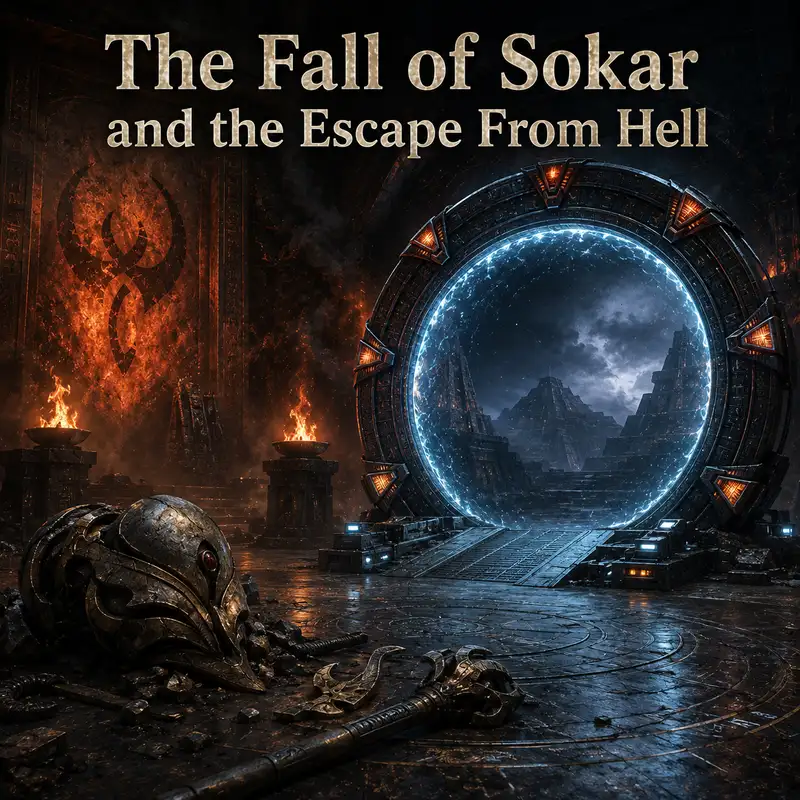
The Tok’ra weapon entered Netu’s atmosphere while S G One was still locked beneath the surface. It passed through one of the openings Sokar had blasted into the moon and descended toward the molten core. Once activated, the device would need approximately twelve minutes to force a catastrophic chain reaction. Netu would break apart. Sokar’s mothership, waiting in orbit, would be caught in the explosion. So would every prisoner below, including the Earth team and the Tok’ra operative the mission had originally been sent to rescue.
That decision defined the fall of Sokar. The Tok’ra did not defeat his fleet in open battle. They used his prison moon as a weapon against the ship commanding it. The rescue of Jacob Carter and Selmak became secondary to preventing Sokar from attacking six rival System Lords and emerging as the dominant Goa’uld power. The escape from Netu therefore began under a difficult condition. The people trapped inside hell were not waiting for an allied rescue force. Their allies had already decided that destroying the battlefield was strategically more important than recovering them.
Netu had been designed to make escape nearly impossible. The moon orbited Delmak, Sokar’s homeworld, and had no Stargate. Its atmosphere was too hostile for normal ship operations near the surface. Prisoners descended in small pods and were expected never to leave. The underground settlement remained connected to Sokar’s mothership by transportation rings, but the rings were controlled by the governor and led directly toward the authority enforcing the prison. That was not an escape route in any ordinary sense. It was a short road from confinement to a more powerful enemy.
S G One had entered Netu with Martouf to recover Jacob and Selmak, who had been captured while collecting intelligence on Sokar’s military buildup. Teal’c remained aboard the Tel’tak because only four descent pods were available. The surface party reached the prison by relying on memories Samantha Carter retained from Jolinar, the only known prisoner to have escaped Netu. The plan was already narrow. It depended on uncertain memory, a small cargo ship hiding in hostile orbit, and the assumption that the escape method Jolinar used could be repeated under current conditions.
The operation collapsed when Bynarr, Sokar’s governor, recognized Jolinar’s identity within Carter’s inherited memories. The team was captured and thrown into the pit with Jacob. Bynarr intended to punish Carter for Jolinar’s earlier betrayal, but his First Prime killed him before he could complete the revenge. That masked subordinate was Na’onak, the name given to a defeated prisoner whom Sokar had deliberately reduced to servitude. Beneath the damaged face was Apophis, restored by a sarcophagus after Earth had returned his body to Sokar.
Apophis immediately converted the prison into a temporary political base. He proclaimed Bynarr dead, promised liberation, and claimed that he would overthrow Sokar. Approximately three hundred prisoners followed him. Those who refused were driven onto Netu’s lethal surface, where conversion and death became nearly identical choices. Apophis called this deliverance, but he did not free the prison. He replaced its governor, appointed Kintac as his First Prime, and began using the captives as resources for his return to power.
His force could not defeat Sokar’s mothership. The prisoners possessed crude weapons and no space capability. Apophis understood that his real assets were S G One, Martouf, and Jacob. Between them, they held information about Earth, the Tok’ra, the Asgard, hidden Stargate addresses, and the wider struggle against the System Lords. If he could extract enough intelligence, he could offer Sokar something valuable, gain access to the mothership, and attack his former captor at close range. The uprising was less a conventional rebellion than a cover for one assassination attempt.
Apophis used a Tok’ra memory recall device taken from the prisoners and combined it with the Blood of Sokar, a powerful narcotic that produced intensely realistic hallucinations. The two systems allowed him to place familiar people inside altered memories and ask questions through voices the prisoners trusted. It was an intelligence technique built around emotional access rather than simple pain. The victim could know an interrogation was underway and still struggle to separate genuine memory from deliberate manipulation.
Carter was forced into memories involving her family and the death of her mother. O’Neill was confronted with his son, Charlie, and the guilt surrounding the child’s accidental death. Daniel faced an imitation of O’Neill seeking information about the Harsesis child. Martouf saw Carter as Jolinar, his former mate, while Apophis threatened to kill her. Each interrogation targeted a different vulnerability. The objective was not merely to frighten the prisoners. It was to create a moment when grief, love, or guilt became stronger than operational security.
The method produced limited results. Carter recognized inconsistencies before surrendering useful information. O’Neill understood that the questions did not belong in the memory he was seeing. Daniel refused to reveal the Harsesis location. Martouf, believing Jolinar was about to be killed, supplied the name Entac as the location of the Tok’ra resistance. It was false intelligence. The lie saved Carter in the immediate moment and gave Apophis exactly what he thought he needed for his approach to Sokar.
While the prisoners were being interrogated, Teal’c had already been forced away from Netu. Sokar’s death gliders detected the Tel’tak in orbit. Teal’c pushed the cargo ship’s hyperdrive at full power, escaped pursuit, and returned to Vorash. He carried two urgent reports. Sokar’s forces were far larger than the Tok’ra had estimated, and the rescue team was now in the hands of a revived Apophis. Teal’c requested help retrieving them before Sokar moved against the prison.
The Tok’ra High Council answered with a different mission. Sokar’s planned attack against six major System Lords threatened to unite much of Goa’uld territory under one ruler. The Tok’ra had survived by exploiting the rivalry and fragmentation of the System Lords. A victorious Sokar could destroy that strategic environment. No Tok’ra weapon available to Aldwin could penetrate the shields of Sokar’s mothership. The council therefore chose not to attack the ship. It chose to destroy the moon beneath it.
The weapon Aldwin carried was not a conventional bomb intended to overcome armor or shielding. It was a trigger. Sokar had already opened deep wounds in Netu’s crust when he transformed the industrial colony into a volcanic prison. Aldwin would send the device through one of those openings and into the core. There it would force the moon’s base elements into a chain reaction. Sokar’s own engineering had created the access required to kill him. The prison’s theatrical fires were about to become a real planetary-scale demolition system.
The plan depended on Sokar bringing his mothership into close orbit. Apophis’s uprising supplied the reason. Sokar could not permit a former rival to seize his prison, kill his governor, and publicly claim authority without response. He also knew that a hostile cargo ship had escaped the system, which meant his wider offensive might be exposed. Sokar accelerated preparations for war and moved personally to Netu. The ruler who presented himself as master of hell was drawn toward the one place where his shields could not protect him.
Teal’c accompanied Aldwin because remaining on Vorash would guarantee the loss of his friends. He had not accepted the council’s decision, but he understood that preventing the weapon from launching too early might preserve a chance for rescue. Aldwin understood his orders differently. Sokar’s destruction was the mission. Every minute spent waiting increased the possibility that the mothership would move beyond the blast radius. Their disagreement was not between courage and cowardice. It was between loyalty to trapped personnel and loyalty to a strategic objective affecting the entire Goa’uld balance of power.
The Tel’tak returned to the system and hid in Netu’s shadow. Below, Apophis contacted Sokar and claimed that his prisoners had revealed the location of the Tok’ra resistance. Daniel managed to steal a coded communicator before being returned to the pit. Carter used it to contact Teal’c. The signal proved that the surface party was alive and established a narrow communications link through the chaos. Aldwin launched the weapon anyway. From his perspective, survival of the prisoners did not change the strategic requirement.
The launch transformed every problem at once. S G One had twelve minutes to escape the pit, reach Bynarr’s former quarters, operate the ring system, and survive the transport. Teal’c had to remain close enough to recover them without being destroyed by Sokar’s ship or caught in Netu’s explosion. Aldwin had to ensure the target remained inside the blast radius. Jacob was feverish and barely able to move. O’Neill was wounded, drugged, and repeatedly losing consciousness. This was not a team at normal combat effectiveness. It was a group of injured prisoners trying to outrun the destruction of a moon.
Carter turned the instability beneath Netu into an escape tool. A volcanic vent inside the pit was releasing increasing pressure as the weapon disrupted the core. The opening above it was blocked by a barred cover. Carter ordered the others to pack the vent with rocks, cloth, and anything else available. The obstruction allowed pressure to build until the eruption blasted the cover away. It was an improvised breaching charge powered by the same geologic reaction intended to kill them.
The team still had to move its casualties. Daniel supported O’Neill. Carter and Martouf carried Jacob between them. They climbed from the pit while the underground settlement shook, fires erupted, and the population scattered. The escape route ran toward the quarters once occupied by Bynarr and now used by Apophis. The team did not control the prison, had no reserve force, and could not stop to help the wider population. Survival depended on reaching one transport platform before the structure around it collapsed.
In orbit, Aldwin warned that the normal ring path was blocked. Bynarr’s rings were aligned with the corresponding system on Sokar’s mothership. Activating them would convert the prisoners into a matter stream and send that stream directly toward the enemy ship. A Tel’tak could intercept the transfer, but only by flying between Netu and the mothership, matching the path precisely, and coming to a complete stop. A partial interception could leave part of a person outside the receiving system. The technical phrase for that outcome would have been transport failure. The practical phrase would have been considerably shorter.
Aldwin concluded that the attempt was impossible. Sokar’s ship occupied the route, its weapons covered the approach, and the remaining countdown left almost no margin. Teal’c took Aldwin’s zat, disarmed him, struck him, and locked him in the cargo compartment. It was a direct act against an allied officer carrying lawful orders from his own council. It was also the only decision that preserved a rescue attempt. Teal’c did not cancel the strike or move the ship out of danger. He accepted the strategic attack and added an extraction operation that the planners had rejected.
Aldwin’s response after being confined is important. He continued providing technical advice. He explained the need to align with the matter stream and stop completely at the correct instant. His objection had been to the risk, not to the people being rescued. Once Teal’c committed the ship, Aldwin used his knowledge to improve the chance of success. Coalition warfare often looks less like perfect agreement and more like professionals continuing the mission after losing the argument.
At the same time, Apophis transported to Sokar’s mothership. He approached without his ribbon device and presented himself as a submissive prisoner carrying valuable intelligence. His concealed forearm blade was intended for the moment Sokar came close enough to mark him as the new lord of Netu. Apophis had planned the attack since arriving on the moon. He understood that Sokar’s desire to display submission might override normal security. In a political system built around personal domination, ceremony could provide the final meters an assassin needed.
The plan failed because Sokar possessed better intelligence than Apophis expected. Martouf’s false location was Entac, a world Sokar had recently conquered. Sokar knew there was no Tok’ra base there. The supposed prize exposed the deception, and Apophis was restrained for a slow execution. His interrogation had produced information, but he had no means to validate it before staking his life on its accuracy. The ruler who treated torture as reliable collection discovered the familiar intelligence problem of receiving an answer the prisoner urgently wanted him to believe.
Sokar’s attention remained fixed on punishing Apophis even as Netu destabilized below. His sensors eventually reported that the moon’s core had become unstable. Sokar responded as though the report were a challenge to authority. He had created Netu, shaped its environment, and built his political image around controlling its fires. That did not give him control over its geology. By the time his officers urged the ship to move, the system had already entered its final reaction.
The warning also gave Apophis his escape. As Sokar’s guards were distracted, Apophis used the concealed blade, killed the men holding him, and fired a staff weapon at Sokar. The personal shield protected Sokar, but the attack created time. Apophis ran for the transport system and ringed away from the mothership. His destination was Delmak, where he survived the explosion and positioned himself to take control of the forces Sokar had assembled.
Below, Martouf operated Bynarr’s ring controls while Daniel maintained contact with Teal’c. The team crowded into the transport area with two severely weakened men and no confirmation that the Tel’tak was correctly positioned. Once activated, the rings did what they had been built to do. They converted the group into a matter stream and sent it upward toward Sokar’s ship. The technology contained no preference for friend, enemy, prisoner, or rescuer. It followed alignment.
Teal’c flew the Tel’tak into the path between Netu and the mothership. He had to approach under enemy fire, identify the transport beam, stop the cargo ship in exactly the right place, and hold long enough for the receiving rings to capture the entire stream. He succeeded. S G One, Martouf, and the blended pair of Jacob and Selmak materialized in the cargo compartment. Aldwin, who had regarded the maneuver as suicidal, immediately ordered Teal’c to accelerate away. There was no further debate. The extraction had worked, and the moon was still exploding behind them.
Sokar’s mothership opened fire on the fleeing Tel’tak, but its own escape was already too late. Netu broke apart in a blast large enough to destroy the ship in orbit. Sokar died aboard the command vessel from which he had intended to launch a campaign against the System Lords. His shields had been irrelevant because the weapon never attacked them directly. The Tok’ra had converted the target’s position, the moon’s damaged structure, and Sokar’s political need to appear in person into one integrated kill mechanism.
The rescue party survived with seconds to spare. Jacob and Selmak were recovered. Martouf escaped. S G One returned from a prison no one except Jolinar had previously left alive. Teal’c completed an interception maneuver that no one aboard the Tel’tak could guarantee would work. At the tactical level, the operation was an extraordinary success. It destroyed the enemy command ship and recovered every member of the rescue party who reached the rings.
The prisoners of Netu did not share that outcome. The surviving record does not establish how many remained on the moon, but there was no general evacuation. Some had followed Apophis. Others had been forced onto the surface. Many were still inside the underground settlement when the core reaction began. The Tok’ra decision destroyed Sokar and prevented his planned offensive, but it also killed the population he had imprisoned. The people used as scenery in Sokar’s manufactured hell became casualties of the operation designed to end his rise.
The mission also failed to secure the succession. Sokar died, but his fleet and territorial apparatus did not disappear. Apophis escaped to Delmak and took command of the forces his rival had assembled. The Tok’ra had prevented one System Lord from becoming dominant and unintentionally restored another. Earth and the Tok’ra did not know this when the Tel’tak entered hyperspace. Their after-action understanding was incomplete because the most important surviving enemy was outside their observation.
That result complicates any claim of strategic victory. The immediate offensive against six System Lords was disrupted. Sokar’s personal regime ended. The rescue succeeded. Yet the military power behind Sokar passed to Apophis, who combined it with a personal hatred of Earth and a renewed claim to authority. The operation solved the crisis identified by the intelligence report, but not the political structure that allowed a defeated ruler to inherit another ruler’s army.
Sokar fell because his methods created the vulnerabilities used against him. He turned an industrial moon into a volcanic prison and opened the route to its core. He preserved transportation rings between the prison and his ship. He kept Apophis alive to display his humiliation. He centralized power so completely that a prison revolt required his personal presence. Each decision strengthened the image of absolute control. Together, they placed him over an unstable moon with an assassin aboard and a Tok’ra weapon below.
The escape succeeded because the allied force refused to treat strategy and rescue as mutually exclusive, even after the High Council had done exactly that. Aldwin launched the weapon that made Sokar vulnerable. Carter used its geologic effects to breach the pit. Martouf operated the ring system. Daniel restored communication. Teal’c intercepted the matter stream. O’Neill and Jacob survived because the others carried them when speed mattered most. No single plan produced the result. A series of incompatible decisions happened to fit together before the countdown expired.
Netu had been built to demonstrate that Sokar controlled punishment, movement, and survival. His fall proved the opposite. The moon’s fires answered physics, not ceremony. The rings answered alignment, not ownership. The prisoners answered fear in different ways, and some chose resistance. S G One escaped hell because every system Sokar used to confine people could also be turned toward movement, deception, or destruction. Sokar died believing Netu was his instrument. In the final twelve minutes, it became everyone else’s.