The Fifth Race: How Earth Earned a Place Among Older Powers
Thor installed the final components of an Asgard computer core aboard the Odyssey while other Asgard technicians moved through a human warship their civilization had once considered impossibly primitive. Outside, the planet Orilla waited to be destroyed by its own people. The transfer included current Asgard technology, scientific records, and their complete recorded history. Then Thor gave the Tau’ri a title that had once been only a possibility. Earth was the Fifth Race.
The declaration was not a promotion inside an active interstellar council. The ancient alliance that inspired the phrase had disappeared long before Stargate Command entered the galaxy. No Furling delegation arrived to vote, no Ancient senate issued credentials, and the Nox did not open a new embassy beneath Cheyenne Mountain. The title was symbolic, but the responsibility attached to it was real. The central question is what Earth had done to earn that trust.
The answer was not age. Human civilization remained young beside powers that measured history in thousands or millions of years. It was not technological equality. Even after constructing interstellar ships, Earth still depended on captured components, borrowed knowledge, rare materials, and allies capable of repairing systems human engineers could operate but not reproduce. The Fifth Race was not the winner of a technology comparison. It was the civilization judged ready to carry strategic responsibility among older powers.
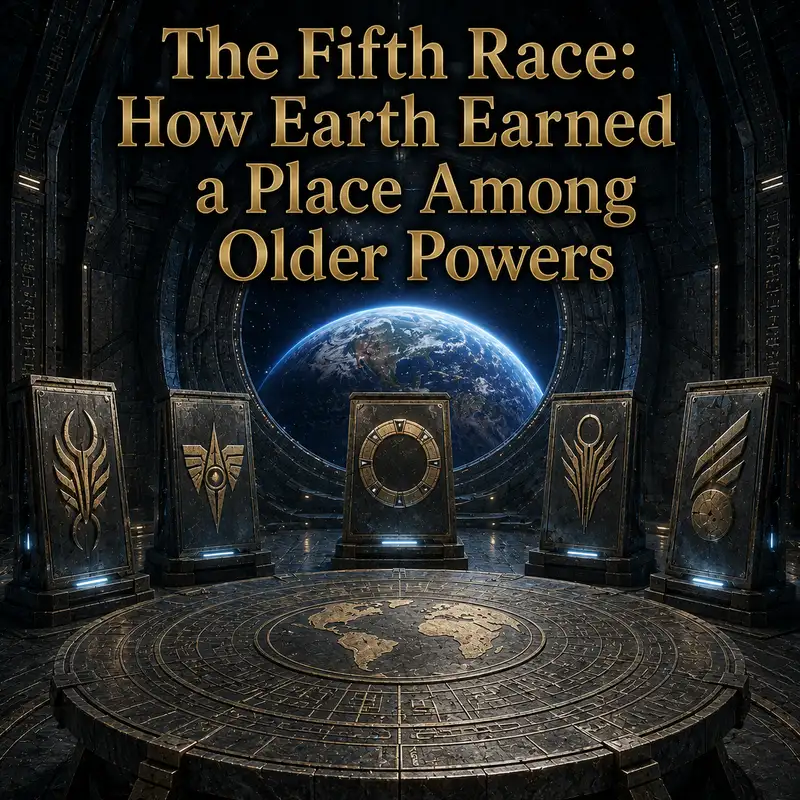
Earth first discovered the idea of the older alliance at the ruined meeting place where Ernest Littlefield had been stranded for decades. Four alien languages surrounded a chamber containing a shared representation of the natural elements. The site suggested communication among civilizations that had developed along different paths but could still exchange knowledge through a common scientific foundation. Stargate Command understood that four great powers had once met there. It did not know why they had formed the alliance, how it had been governed, or when it had ended.
The four were eventually identified as the Ancients, the Asgard, the Nox, and the Furlings. The surviving record says almost nothing reliable about the Furlings beyond their membership. The Nox remained deliberately distant from galactic power politics. The Ancients had departed the Milky Way, returned much later, and largely ascended beyond ordinary existence. The Asgard alone maintained a continuing strategic relationship with Earth. The phrase Fifth Race therefore came primarily through Asgard judgment, not a restored decision by all four civilizations.
That judgment began after Jack O’Neill activated an Ancient repository. The device placed knowledge into his mind faster than a human brain could organize or survive it. His speech changed, his behavior became increasingly automatic, and he began constructing equipment from concepts he could not consciously explain. The repository did not make Earth an Ancient civilization. It turned one officer into a temporary interface with information far beyond his species’ cognitive and industrial reach.
O’Neill used that knowledge to create a power source and modify the Stargate dialing system. The result established an intergalactic connection to Othala in the Ida galaxy, reaching the Asgard on a world Earth could not otherwise contact. The Asgard removed the knowledge before it killed him. More important, they observed what he had done with it. O’Neill had not built a weapon, seized command, or tried to preserve the information for national advantage. He had used it to find help.
An Asgard representative told him that humanity had taken its first steps toward becoming the Fifth Race. The wording mattered. It was a forecast, not certification. Earth had demonstrated curiosity, adaptability, and enough restraint to survive one encounter with Ancient knowledge. It still possessed one active Stargate program, no operational interstellar fleet, limited awareness of galactic politics, and almost no ability to defend the planet against a major Goa’uld attack.
The next phase was dependence. When the System Lords prepared an assault far larger than the attack Earth had already survived, Thor could not provide a battle fleet. Most Asgard military capacity was committed against the Replicators. Instead, he offered Earth entry into the Protected Planets Treaty. The agreement extended Asgard deterrence to the Tau’ri and prevented the immediate invasion, but it also revealed the distance between candidate and peer.
Earth was not negotiating as an equal great power. It was a vulnerable planet asking an older civilization to place its reputation between humanity and annihilation. The Goa’uld demanded restrictions, attempted to force surrender of Earth’s Stargates, and openly described humans as hosts and slaves. Earth survived the negotiation through Asgard sponsorship, Goa’uld rivalry, and O’Neill’s willingness to bluff when direct proof was unavailable.
The treaty bought time, and Earth used that time more effectively than the Goa’uld expected. Stargate Command expanded reconnaissance, built alliances, recovered technology, created off-world sites, and began developing aircraft and ships able to operate beyond the gate. That growth was uneven. One prototype might work once and spend the next year teaching engineers why prototypes are not fleets. Earth’s advancement depended as much on maintenance, classified funding, and industrial integration as on the dramatic moment when an alien system first powered up.
Technology alone could not justify the Fifth Race title. Several advanced human societies possessed capabilities beyond Earth and still failed strategically. The Tollans depended on a fixed defense that became obsolete. The Aschen used medicine and agriculture as instruments of demographic conquest. Earth’s distinction lay partly in its ability to combine military action, scientific inquiry, diplomacy, intelligence, and local alliances without treating any one method as sufficient in every crisis.
That ability was often learned through failure. Earth’s first encounter with the Nox began as an attempt to acquire invisibility for military use. S G One misread a simple forest settlement as evidence of weakness and tried to protect people who could hide an entire city, disarm attackers, and restore the recently dead. The Nox did not endorse Earth as a great power. They taught Earth that visible technology and willingness to fight were poor measures of civilization.
The lesson did not transform every Tau’ri institution. Elements of the National Intelligence Department stole allied technology, imprisoned or coerced visitors, and treated relationships as collection opportunities. The Trust later combined private power with Goa’uld infiltration. Earth’s claim to maturity was repeatedly damaged by its own secrecy, rivalry, and appetite for strategic advantage. Older allies trusted particular commanders, teams, and institutions more than they trusted humanity as a single unified political actor.
That distinction became especially clear in Thor’s relationship with Stargate Command. He trusted O’Neill’s judgment, Carter’s scientific creativity, Hammond’s command, and S G One’s record. When foreign governments were finally told the truth about the Stargate, Thor appeared before their representatives and supported Hammond’s continued leadership. He did not certify that every Earth government had become wise. He endorsed an organization whose conduct he had observed under pressure.
The decisive change from protected world to strategic partner occurred during the Replicator war. Thor’s ship, the Biliskner, reached Earth infested with machines capable of consuming its systems and reproducing from the material. S G One helped destroy the vessel rather than risk recovering it. The decision denied Earth an extraordinary technological prize and prevented that prize from becoming the seed of a planetary infestation.
Thor then returned because the Asgard needed help. Their advanced weapons and ships were becoming liabilities against an enemy that absorbed technology. He asked for a less sophisticated approach, and Carter supplied one. She proposed using the unfinished O’Neill-class vessel as bait, luring Replicator-controlled ships into hyperspace and destroying the prototype with them. The plan sacrificed the most advanced Asgard warship then available before it entered normal service.
This was more than a clever tactic. An older power had recognized that a younger ally possessed a form of military judgment its own doctrine had neglected. Earth personnel were accustomed to fighting from technological inferiority, destroying equipment to deny it to the enemy, and improvising with weapons simple enough to remain useful. The Asgard possessed superior science. The Tau’ri contributed a different relationship with risk.
The partnership became reciprocal. Earth teams rescued Thor after Anubis captured him and attempted to extract the knowledge stored in his mind. They helped protect Heimdall’s research into the Asgard genetic crisis. Later, when Replicators threatened Orilla, O’Neill again carried Ancient knowledge and used it through an interface with Thor’s ship to design a disruptor weapon. Thor manufactured and expanded the design, while S G One fought on the surface to recover Carter.
No participant could claim that victory alone. Ancient knowledge provided concepts O’Neill could not retain afterward. Human judgment shaped those concepts into a weapon. Asgard engineering reproduced the weapon at operational scale. The battle demonstrated the kind of coalition behavior the old alliance may have valued, even though the exact institutions of that alliance remained unknown. Different civilizations contributed what the others lacked without surrendering their identities.
Earth earned further standing by becoming useful beyond its own defense. Stargate Command supported the Tok’ra intelligence war, the Jaffa rebellion, refugee evacuation, resistance movements, and negotiations among powers with little reason to trust one another. These operations were not uniformly successful or disinterested. Earth wanted allies, resources, and technology. The difference was that many relationships eventually produced mutual obligations rather than one-way extraction.
The fall of the Goa’uld Empire showed how far the Tau’ri role had expanded. Earth did not defeat the System Lords through one national fleet or one decisive invasion. The empire collapsed under pressure from Jaffa rebellion, Tok’ra operations, internal rivalry, Replicator attacks, Ancient technology, and repeated Tau’ri intervention. At Dakara, Carter, Jacob and Selmak, rebel Jaffa, Ba’al, and Daniel Jackson combined capabilities to destroy the Replicators across the Stargate network.
The Dakara operation was strategically important to the Fifth Race idea because Earth did not control every part of it. The Jaffa held the ground. Ba’al possessed network knowledge Carter needed. Jacob and Selmak interpreted the Ancient device. Daniel delayed the machine collective from inside its own mental connection. Earth contributed science, command coordination, and the willingness to work with enemies long enough to prevent common destruction.
A civilization claiming a place among older powers had to do more than win battles. It had to operate inside a political order wider than itself. Earth gradually moved in that direction. Russia’s possession of a second Stargate forced cooperation. Major governments were brought into the secret. The Gate Alliance Treaty and later international oversight expanded participation, however unevenly. The Atlantis expedition became multinational because one country could not credibly claim sole ownership of a city built by the Ancients in another galaxy.
These arrangements were often tense, bureaucratic, and vulnerable to national agendas. That was not evidence that they were meaningless. A planet divided into competing states had begun creating institutions able to discuss off-world war, alien technology, and planetary defense collectively. The process remained incomplete and secret from the public, but it moved Earth away from the idea that one command could permanently speak for all humanity without consultation.
Earth’s growing fleet provided the visible evidence of change. The X three-oh-two became a reliable space fighter. The Prometheus gave Earth an experimental interstellar warship. The B C three-oh-four class turned that experiment into a more mature platform able to move teams, support Atlantis, contest orbit, and operate with allied systems. These ships were human-built, but they incorporated knowledge and components derived from several civilizations.
That mixed origin was a strength and a warning. Earth had learned to integrate Goa’uld, Tok’ra, Ancient, and Asgard concepts into a human industrial framework. It still could not manufacture every critical system independently. An advanced drive, shield, transporter, or weapon might rely on an ally, a recovered component, or a knowledge base few engineers fully understood. Possession had become capability. It had not always become mastery.
The Battle of Antarctica demonstrated both sides of that transformation. Earth used an Ancient control chair and drones to destroy Anubis’s fleet, saving the planet from an enemy no human ship could defeat. The victory changed how the Goa’uld assessed Earth and gave the Tau’ri a powerful deterrent. It also depended on O’Neill’s Ancient knowledge, a nearly depleted zero-point module, and a buried outpost Earth had not built.
The Tau’ri were becoming strategically dangerous before they became technologically self-sufficient. That was one reason older powers paid attention. Earth repeatedly combined limited assets in ways their creators had not intended, then accepted the political consequences when possible. The result was not elegant. It was adaptive, and in a galaxy filled with ancient systems whose original owners were absent, adaptation often mattered more than inheritance claims.
The war against the Ori proved that recognition did not eliminate inferiority. Earth’s battle cruisers, upgraded fighters, Jaffa fleets, and Asgard ships could not stop the first Ori force from breaking the allied line. The Tau’ri had become a major actor, but it still faced civilizations with power beyond its defenses. The Fifth Race title did not mean Earth had reached the end of development. It meant Earth had become responsible for confronting threats the older powers could no longer manage.
The final Asgard decision made that burden explicit. Their repeated cloning had produced irreversible genetic decline, and the last attempt at correction caused a rapidly progressing disease. The Asgard chose to end their lives and prevent their knowledge from falling into hostile hands. Before destroying Orilla, they installed a core aboard the Odyssey containing current technology, scientific knowledge, and the complete recorded history of their civilization.
Many on the Asgard High Council still believed Earth was not ready. Their concern was justified. Human governments remained divided, the Stargate Program remained secret, and Earth’s history provided no shortage of examples in which new technology reached the weapons office before the ethics committee found the conference room. Thor nevertheless concluded that the Tau’ri had earned his respect and friendship.
His declaration that Earth was the Fifth Race was therefore personal, political, and strategic at once. Personal, because it rested on years of trust between Thor and specific humans. Political, because the Asgard were selecting a successor to preserve their legacy. Strategic, because no other available civilization had Earth’s combination of expanding industrial power, access to Ancient systems, coalition relationships, and demonstrated willingness to fight enemies beyond its own immediate border.
The transfer did not instantly make Earth Asgard. The core had its own power source and could integrate with the Odyssey, but the crew still had to understand how to use it. The new systems created a signature the Ori could track. An inheritance meant to strengthen Earth immediately attracted an enemy, trapped the ship inside a time-dilation field, and forced Carter to spend decades searching the Asgard knowledge base for a way to survive.
That crisis was an appropriate first test. The Tau’ri had received the archive of an ancient civilization and discovered that ownership did not remove operational risk. Knowledge had to be interpreted, systems maintained, tactical effects understood, and unintended signatures managed. The Asgard had transferred more than weapons. They had transferred unfinished problems, including the history of mistakes that had led to their extinction.
The title also carried no automatic authority over other civilizations. Earth did not inherit Asgard treaty jurisdiction, Nox consent, Ancient ownership, or Furling representation. It could not claim command of the Milky Way because Thor used an old phrase. Every alliance still required negotiation. Every world retained its own interests. Every use of inherited technology created a new test of whether Earth intended partnership or dominance.
This is where the idea of earning matters most. Earth earned a place among older powers by becoming indispensable in several crises, not by becoming flawless. It offered projectile weapons when Asgard energy systems failed. It offered teams able to enter places fleets could not reach. It offered scientists willing to question assumptions, diplomats willing to negotiate with enemies, and commanders willing to destroy valuable technology rather than let it become a larger threat.
Earth also earned trust by learning, though never quickly enough to avoid every repeat lesson. It learned from the Nox that restraint could be power. It learned from the Tollans that superior defenses could create fatal complacency. It learned from the Aschen that gifts could become control. It learned from the Tok’ra that intelligence required patience, and from the Jaffa that liberation did not end when a ruler died.
Those lessons were unevenly applied. Earth still conducted unauthorized operations, concealed information from allies, and sometimes treated another civilization’s survival as secondary to planetary defense. The Fifth Race was not a moral exemption issued by the Asgard. It was an expectation that humanity could recognize those failures, correct course, and build institutions capable of carrying power without automatically reproducing the empires it had opposed.
The phrase also described a change in relationship. At first, Earth asked older powers for rescue, knowledge, and protection. Later, those powers asked Earth for ideas, soldiers, scientific work, diplomatic support, and preservation of their legacy. The movement from dependent to partner occurred long before Earth could match their technology. Equality began in shared risk before it appeared in hardware.
What Earth finally inherited was not the old alliance itself. The Ancients were absent or ascended, the Nox remained apart, the Furlings were almost entirely unknown, and the Asgard were gone. The Tau’ri inherited the position left by their disappearance: a civilization young enough to adapt, powerful enough to matter, and connected enough to carry knowledge between peoples that might otherwise face each crisis alone.
The Asgard core remained aboard a human ship because Thor believed Earth could do more than fire its weapons. He believed humanity could preserve memory, learn from failure, and accept responsibility for a future no older race was still able to guarantee. Earth earned a place among the older powers not when it became as old as they were, but when they began trusting it with what would remain after they were gone.