The Formation of SG-1
The permanent version of S G One was finalized beside the body of Major Charles Kawalsky. A Goa’uld symbiote had taken control of him, stolen security codes from his memory, and attempted to escape through the Stargate. Teal’c stopped him at the event horizon. Colonel Jack O’Neill then ordered the wormhole shut down while part of his friend was still inside it. In the silence that followed, Stargate Command faced a personnel decision no conventional selection board had ever considered. Should Earth’s most important field team include the former First Prime of the enemy ruler who had just attacked the planet?
That question captures the unusual character of S G One’s formation. The team was not assembled through a long training pipeline, a formal competition, or a carefully tested doctrine. It emerged from two emergency operations and a series of decisions made under incomplete intelligence. Its members included a recalled special-operations colonel, an Air Force astrophysicist, a civilian archaeologist searching for his abducted wife, and an alien defector carrying a larval Goa’uld inside his body. A conventional personnel system might have identified four separate security concerns. Stargate Command saw the only four people who collectively understood the mission.
The institutional requirement appeared after Apophis raided Cheyenne Mountain and then struck Abydos. Earth learned that the Stargate connected thousands of worlds and that Ra had not been the last hostile ruler capable of using it. The President authorized nine teams operating on a covert, top-secret basis, with knowledge limited to the highest national-security leadership. Their stated duties were reconnaissance, threat determination, and peaceful contact. Those three tasks sound orderly in a briefing. On another planet, they could become combat, diplomacy, scientific investigation, and emergency extraction before lunch.
A small team made sense because the Stargate offered extraordinary mobility through a narrow opening. Four people could move quickly, carry their own weapons and instruments, establish a perimeter, and withdraw without creating the signature of an occupying force. They could also fit into local settlements without arriving as a battalion. The available record does not show a formal study proving that four was the ideal number. The composition appears to have been an operational compromise between expertise and mobility. It was large enough to contain several specialties and small enough to survive on what its members could carry.
The first choice was Jack O’Neill. General George Hammond recalled him because he had led the Abydos expedition, fought Ra’s guards, and returned from another world. No other American officer had comparable experience. He understood that alien technology could overwhelm a modern force, that local civilians might determine the outcome, and that a mission order could become obsolete after the first contact. He also knew how to command people when higher headquarters could not communicate, reinforce, or even confirm that the team was still alive.
O’Neill was not a risk-free selection. He had concealed Daniel Jackson’s survival and the continued existence of the Abydos gate in his original after-action report. He had entered that mission while grieving his son and prepared to die beside a nuclear weapon. Hammond therefore placed the new command in the hands of an officer who was experienced, adaptive, and capable of withholding information when he believed the official decision would endanger people under his protection. Those traits could save a team. They could also make oversight unusually energetic.
His value lay in judgment more than technical knowledge. O’Neill did not need to understand every equation governing the Stargate. He needed to decide whether the team should advance, negotiate, withdraw, or fight while the experts around him disagreed. He understood weapons, concealment, field security, and the limits of a small unit. Just as important, he could recognize courage in people outside his own chain of command. That capacity had helped him work with the Abydonians and later allowed him to trust Teal’c before the institution was ready to do so.
Captain Samantha Carter was assigned by Hammond rather than selected by O’Neill. The colonel initially preferred to assemble his own team, but the general made her participation an order. Carter transferred from the Pentagon with two forms of credibility the program urgently needed. She was an Air Force officer with combat aviation experience, and she was a theoretical astrophysicist who had studied Stargate technology for two years before the first Abydos mission. She could operate within a military chain of command while interpreting machinery no ordinary combat officer could evaluate.
Carter’s presence prevented the team from depending on a scientist who remained safely behind the blast doors. The dialing computer, stellar-drift calculations, environmental readings, and alien devices all affected field survival. A technical decision on another world could determine whether the team had a return route or had activated something it could not shut down. Carter could examine those problems while still carrying a weapon, obeying orders, and assuming command if O’Neill became incapacitated. Earth had not yet developed a separate corps of combat-qualified gate scientists. It placed one inside its primary team.
The early friction between O’Neill and Carter was partly cultural. He saw another scientist entering an already uncertain mission. She saw an officer treating her technical credentials as separate from her military status. The issue was settled less by a conversation than by performance. Carter demonstrated that she could understand the gate, operate in the field, and function under pressure. O’Neill learned that technical expertise was not baggage carried by the team. It was one of the capabilities that kept the team alive.
Daniel Jackson presented the opposite problem. Hammond initially wanted him at Stargate Command as a consultant supporting all nine teams. That decision had clear logic. Daniel’s knowledge of ancient languages and cultures was too rare to risk on one patrol, and every address might produce inscriptions requiring interpretation. Daniel refused the safer role because Sha’re had been taken by Apophis. His personal objective was rescue, and he understood that staying at headquarters would separate him from the only route that might lead to her.
Allowing Daniel into S G One accepted both his value and his conflict of interest. He had no military rank, limited combat training, and a tendency to treat local people as political actors rather than merely terrain around an objective. That last quality was precisely why the team needed him. He could recognize when a ritual concealed authority, when a translation changed the threat picture, and when a society’s apparent simplicity reflected occupation rather than ignorance. He collected cultural intelligence that no sensor package could provide.
Daniel also became the team’s principal diplomatic bridge. Early Stargate missions did not arrive with ambassadors, legal advisers, development agencies, and regional experts. A four-person patrol often had to make first contact, assess a government, negotiate access, and determine whether an offer was genuine. Daniel could not provide complete diplomatic legitimacy for Earth, but he could keep a misunderstanding from becoming a firefight and explain why an apparently irrational local decision made sense within that society’s history. His presence made the team less likely to mistake unfamiliarity for hostility.
The original designation of S G One therefore referred first to O’Neill, Carter, and the likely addition of Daniel. Major Kawalsky received command of S G Two, which supported the mission to Chulak and protected the extraction route. This arrangement shows that the program did not expect S G One to operate without help. Other teams could hold the gate, establish defenses, provide additional firepower, and recover personnel. The four-person unit was the forward element of a larger command, not a self-contained army disguised as a patrol.
Teal’c entered that structure by defecting in combat. As First Prime of Apophis, he had served as the ruler’s senior Jaffa commander and had direct experience with Goa’uld authority, military practice, gate travel, and the use of religion as political control. On Chulak, he refused an order to execute prisoners and helped S G One lead an escape. O’Neill immediately understood the intelligence value of that decision. Earth had acquired its first senior source from inside the enemy’s military system.
His knowledge was valuable partly because it had limits. Teal’c understood who commanded, how Jaffa units behaved, what symbols and customs meant, and how the Goa’uld used slaves and human hosts. He did not possess unrestricted access to the physics behind their ships and weapons. Jaffa were deliberately denied much of that knowledge. This made him a credible military and cultural source rather than a convenient technical encyclopedia. He could tell Stargate Command how the enemy thought and fought. Carter still had to determine how the machinery worked.
Teal’c was also the most difficult member to approve. He had spent years serving Apophis, carried a larval symbiote, and belonged to a species category Earth had barely begun to understand. Hammond initially rejected O’Neill’s request to place him on S G One after higher authorities demanded interrogation and possible testing. Colonel Kennedy arrived to collect intelligence on enemy troop strength, weapons, ships, and technology. From a counterintelligence perspective, the caution was justified. From Teal’c’s perspective, the world he had chosen to defend appeared ready to turn him into a research subject.
O’Neill trusted him because he had witnessed the decision that mattered. Teal’c had stood before prisoners, received an order from the ruler he had served as a god, and chosen not to kill. That act cost him his position, home, and immediate safety. It did not prove that every fact he offered would be correct or that every future loyalty conflict had disappeared. It proved that his break with Apophis was real enough to place his life at risk. O’Neill judged character from action because the normal background investigation was unavailable in the Chulak personnel office.
The Kawalsky crisis then turned Teal’c’s candidacy into an operational test. A Goa’uld had entered Kawalsky during the withdrawal from Chulak and remained undetected inside Stargate Command. The infection exposed failures in quarantine, medical screening, and understanding of symbiote biology. Teal’c provided information that helped the medical team attempt removal. When the symbiote deceived them and retained control, he recognized what had happened before the human doctors did.
Kawalsky used the host’s memories to enter security codes, initiate the base self-destruct sequence, and dial Chulak. The event demonstrated that a Goa’uld host could become an insider threat with access to everything the victim knew. Teal’c confronted him in the gate room and prevented his escape. O’Neill then shut down the wormhole, killing the symbiote and what remained of his friend. Teal’c had not merely provided intelligence. He had defended the installation against a member of the enemy hidden inside an authenticated American officer.
Hammond’s final decision followed that crisis and a conversation with the President. Teal’c reported for duty, received a brief correction on American military forms of address, and was welcomed aboard. The completed S G One then departed on what Hammond described as a standard reconnaissance mission. The sequence is important. Teal’c was not admitted because the command suddenly stopped seeing the risk. He was admitted because his demonstrated value, his moral choice, and his conduct under attack outweighed the risk enough for the mission to proceed.
The final team had a clear command structure even though its composition was unconventional. O’Neill held command as the senior Air Force officer. Carter was the other commissioned officer and the team’s principal scientific specialist. Daniel served as a civilian consultant with unique linguistic, archaeological, and diplomatic expertise. Teal’c had no United States rank, but brought the experience of a senior Jaffa warrior and enemy insider. Their authority was not equal in the field. Their importance to the mission often was.
That distinction prevented specialization from becoming committee command. O’Neill made the final operational decision, but he required advice that could overturn his assumptions. Carter might identify that a device was unstable or that a dialing solution was impossible. Daniel might explain that the person appearing to command a settlement held only ceremonial authority. Teal’c might recognize a Goa’uld tactic or understand that a Jaffa patrol would interpret an action as rebellion. The team worked when expertise informed command without making every crisis wait for unanimous agreement.
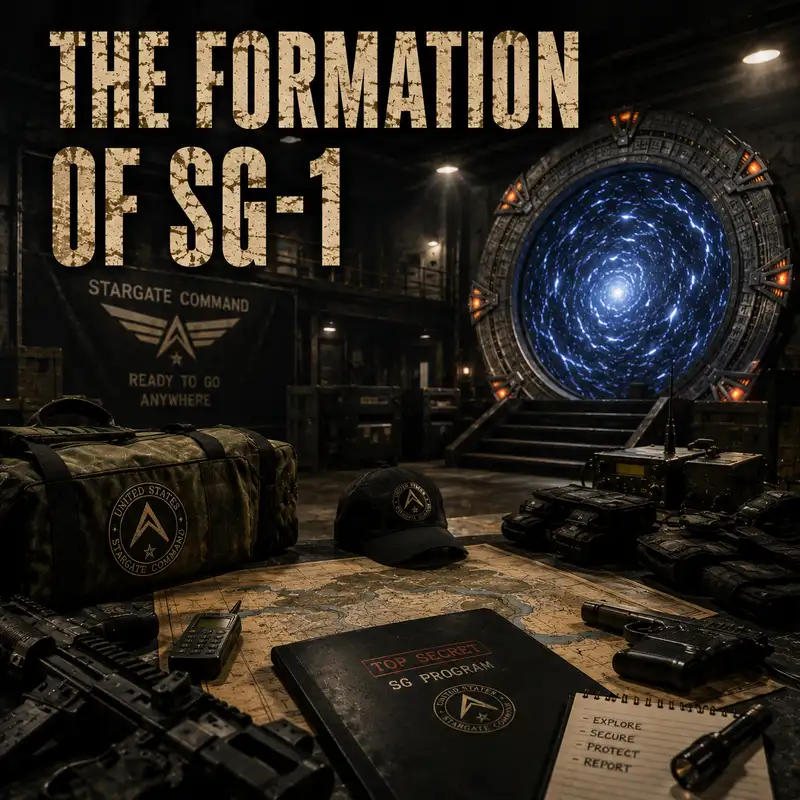
Their equipment reflected the limited nature of early Earth capability. They carried conventional firearms, sidearms, explosives, radios, field gear, medical supplies, and remote transmitters required to open the iris on return. A mobile analytic laboratory probe normally checked the destination before personnel crossed. Headquarters tracked the mission clock and could lock out transmitter codes if a team missed its return window. These procedures reduced risk, but none provided rescue if the local gate was captured, buried, or disabled.
The team therefore depended on access more than firepower. S G One could defeat a small patrol, conduct a raid, or support local resistance. It could not hold a planet against a Goa’uld army or protect a population from ships in orbit. Its survival required discretion, local alliances, reliable gate coordinates, and a route back to the dial-home device. The program gained interstellar reach before it gained interstellar logistics. Four people could travel almost instantly across the Milky Way and still be stranded because one armed guard stood beside the control pedestal.
The four members also carried motives that did not perfectly match official policy. O’Neill wanted to protect Earth and recover Skaara, while retaining a willingness to shield off-world civilians from his own government. Daniel’s search for Sha’re could pull the team toward risks a neutral analyst might reject. Teal’c intended not only to serve Earth, but to oppose the Goa’uld and eventually free the Jaffa. Carter believed in exploration and scientific gain while remaining responsible for military safety. Their objectives overlapped. They were never identical.
That misalignment created friction, but it also protected the team from a single institutional blind spot. O’Neill could challenge a technical plan that ignored field conditions. Carter could challenge an operational decision based on faulty science. Daniel could challenge a mission that treated people as obstacles rather than partners. Teal’c could challenge Earth’s assumptions about an enemy culture he had lived inside. S G One’s internal disagreements were not a defect to be eliminated. Properly managed, they were an analytic system.
The team was not a conventional special-operations detachment, although O’Neill’s command experience and its frequent missions invited that description. It lacked the manpower, dedicated communications support, heavy weapons, and rehearsed extraction assets associated with many terrestrial special operations. It was closer to a joint reconnaissance and liaison element with combat capability. The unusual part was that science, diplomacy, intelligence, and direct action were not supporting agencies outside the unit. They walked through the gate together.
Its first departure as the completed four-person team was deliberately ordinary. A probe reported favorable conditions on a designated planet, Hammond authorized a standard reconnaissance mission, and the team moved up the ramp. No fleet waited. No alliance had requested rescue. No Ancient weapon needed activation. The importance of the moment came from the institution treating off-world deployment as a repeatable activity rather than an exceptional expedition. Earth had moved from proving the Stargate worked to establishing a standing patrol system.
The designation S G One soon carried influence beyond its number. As the lead team, it received missions involving the greatest uncertainty, the most important contacts, and threats that demanded several forms of expertise at once. That reputation can make the original selection appear inevitable. It was not. Carter had been imposed on a skeptical commander. Daniel had argued his way out of a headquarters role. Teal’c had nearly been removed for study. The team later remembered as the natural center of Stargate Command was assembled through dispute at almost every position.
Its success also depended on people who were not members. Hammond provided command authority and repeatedly defended the team against pressures from above. Gate technicians, medical personnel, engineers, intelligence staff, and security forces made each mission possible. Other S G teams held extraction sites, reinforced battles, surveyed worlds, and absorbed losses. S G One could become the program’s most visible field unit because an entire underground organization kept the gate powered, the iris controlled, the wounded treated, and the return route open.
Politically, the formation represented a quiet expansion of who could act in Earth’s name. A United States colonel led the unit, but one member was a civilian and another was an off-world Jaffa defector. Carter’s scientific role carried equal operational necessity to conventional combat skill. Teal’c’s presence meant Earth’s primary team included a former officer of the enemy whose long-term objective was revolution inside the Goa’uld military order. All of this occurred inside a program known only to a narrow group of officials. The arrangement was flexible, effective, and almost completely removed from public accountability.
The model carried serious vulnerabilities. The capture of one team member could expose gate procedures, Earth’s capabilities, and personal relationships. Daniel and Teal’c had family ties on enemy-controlled worlds. O’Neill had already shown that loyalty to individuals could lead him to falsify a report. Carter possessed knowledge central to the dialing system and later technological programs. Concentrating so much expertise in one small unit improved field performance while making every mission a potential intelligence loss.
Stargate Command accepted that danger because the alternative was sending technically simpler teams into politically and scientifically complex environments. Earth could not separate combat from interpretation when a symbol on a wall might be the return address and a local religious title might identify the enemy commander. S G One’s design acknowledged that survival beyond the gate required more than superior marksmanship. It required the ability to understand the machine, the society, the enemy, and the consequences of using force before the wormhole closed.
The formation of S G One was therefore less a triumph of perfect planning than an accurate response to a new kind of war. O’Neill supplied command and operational judgment. Carter connected military action to science and technology. Daniel turned language and culture into intelligence and diplomacy. Teal’c brought enemy knowledge, combat experience, and proof that the Goa’uld system could be resisted from within. None was sufficient alone. Together, they gave Earth a team capable of recognizing problems the institution did not yet know how to name.
The final image is not the team returning from a celebrated victory. It is four people standing at the foot of the ramp before a routine reconnaissance mission. One is a colonel recalled from retirement. One is a captain who had to insist that science did not make her less of an officer. One is a civilian searching the galaxy for his wife. One is a former First Prime who has only just been allowed to serve the world he once knew as legend. The Stargate opens, and Earth sends all four because no single profession can survive what waits on the other side.