The Genii: A Hidden Industrial Power Beneath the Farms
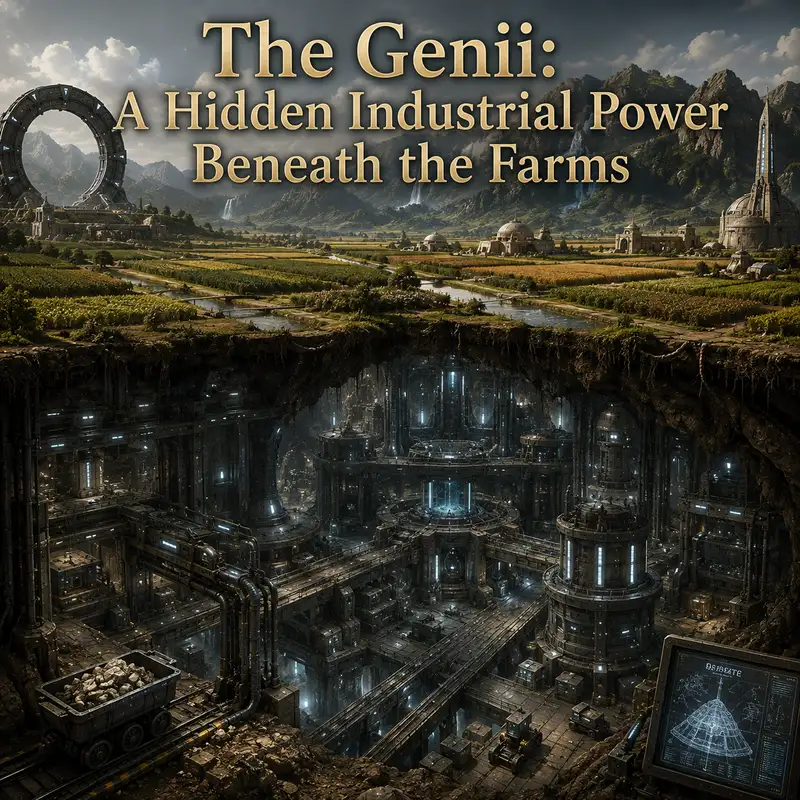
Rodney McKay’s detector should have found nothing unusual on a world of wooden barns, hand tools, and harvest ceremonies. Instead, it registered neutron radiation. He and John Sheppard followed the reading away from the path their hosts had marked, found a recently oiled hatch, and descended into a radio-shielded bunker. Armed soldiers met them below. Cowen, the genial farmer who had negotiated over crops only hours earlier, entered wearing a military uniform. The Genii had not lied about being farmers. They had concealed what else they were.
Beneath those fields stood the most organized indigenous human war state the Atlantis expedition had yet encountered. The Genii maintained laboratories, training areas, communications equipment, weapons production, and a nuclear program under the surface while presenting outsiders with a society that appeared centuries less advanced. Their deception was not a theatrical trick invented to embarrass visitors. It was a national survival system built over generations to answer one problem: how could a human civilization develop enough power to resist the Wraith without becoming visible enough to be destroyed before it was ready?
Cowen described the Genii as descendants of a once-great confederation of planets. The surviving record does not establish its borders, population, or political structure. It does establish its destruction. Wraith attacks drove the old Genii order close to annihilation, and a small number of survivors took refuge in bunkers built for wars already ancient to them. The shelters concealed enough people, equipment, and institutional memory to preserve more than a village. They preserved the foundation of a state.
Generation after generation remained below. Scientists continued research. Soldiers trained. Miners and technicians supported industrial work. Administrators protected the secret. The Genii did not recover by rebuilding visible cities and hoping the Wraith would overlook them. They separated their civilization into two connected layers. The surface displayed what the enemy expected to find: scattered agricultural communities with limited technology. The underground contained the capabilities the enemy was never meant to see.
The farms were therefore both camouflage and infrastructure. They concealed the scale of the population, but they also fed the many people living below. Genii traders exchanged crops with neighboring societies and gained information without revealing factories, reactors, or military installations. Surface clothing, tools, and buildings helped maintain the deception. When unfamiliar visitors approached, underground operations could be placed into silent mode. The result was an early form of whole-of-society signature management, developed by people who had learned that industrial progress could attract a culling fleet.
This strategy made sense because Wraith reconnaissance did not require a complete census. A large city, unusual radiation, sustained electronic emissions, or evidence of advanced weapons could be enough to mark a world as dangerous. The Wraith did not need to understand every Genii laboratory. They only needed to recognize that the population had become capable of resistance. By keeping industry underground and ordinary life dispersed above it, the Genii tried to deny the enemy a clear target until the day they could strike first.
Their technology was roughly comparable to Earth’s middle twentieth century in several important areas. They possessed radio communications, automatic weapons, explosives, industrial machinery, nuclear research, and enough electronics expertise to interface with a recovered Wraith storage device. Their equipment often looked crude beside Atlantis systems, but crude is not the same as ineffective. A tube-based display connected to captured alien memory still produced useful intelligence. That achievement required patient engineering, experimentation, and a willingness to work without instructions from the original manufacturer, a problem Earth personnel found increasingly familiar.
The Genii industrial base also had serious weaknesses. They lacked starships, shields, advanced sensors, and a reliable means of attacking targets throughout space. Their nuclear facilities exposed workers to dangerous radiation because shielding and safety practices lagged behind their weapons ambitions. Many people spent their entire lives inside contaminated underground areas. The state was producing a strategic weapon while quietly consuming the health of the scientists and laborers needed to finish it. National secrecy protected them from the Wraith, but it also concealed the human cost of their program from potential allies and perhaps from parts of their own population.
Cowen’s government placed military development at the center of national purpose. He held the title of Chief and exercised broad authority, although the continuity never provides a complete Genii constitution. Commanders such as Acastus Kolya led trained forces. Officers such as Ladon Radim handled technical and operational duties. Scientists worked directly on weapons and intelligence exploitation. The society clearly distinguished political leadership, military command, and scientific labor, but all three served the same generational objective: survive the next culling, then make sure there would never be another.
The atomic program was the centerpiece of that ambition. The Genii had uranium and understood the basic design of a fission weapon, but they were struggling to enrich the material and create a reliable implosion system. Cowen expected the first test in approximately five years. That schedule had been built around the assumption that the next major Wraith culling was still decades away. The premature awakening caused by the Atlantis expedition destroyed the timetable in one conversation.
The Genii plan was more sophisticated than simply building one bomb and waiting for a hive ship to appear. During an earlier culling, they had shot down a Wraith Dart and recovered its data-storage device. Tyrus and Sora had constructed an interface capable of extracting information from it. The device identified a hibernating hive and offered a route to additional navigational data. The Genii intended to locate sleeping Wraith forces, infiltrate them while their crews were dormant, and eventually destroy enough hives with nuclear weapons to break the enemy’s power before it could mobilize.
The concept had a sound strategic insight. The Wraith were most vulnerable during hibernation, and their decentralized hive structure made simultaneous attack more valuable than a sequence of isolated victories. The problem was scale. Atlantis later determined that more than sixty hive ships existed, with the possibility of others not represented in the captured data. The Genii would need sufficient weapons, accurate locations, trained infiltration teams, secure transportation, and near-simultaneous execution. Destroying a handful of hives would leave the survivors awake, informed, and extremely interested in the source of the explosions.
Delivery was the central weakness. The Genii could manufacture bombs before they could manufacture spacecraft. A Stargate could move teams between worlds, but not necessarily place a device inside a hive resting in space. Each target would require access, intelligence, and a route for insertion and extraction. A single compromised team could expose the entire plan. The strategy aimed at a civilization-level decapitation strike while relying on the mobility of small covert teams. It was bold, patient, and far from operational readiness.
Atlantis offered the missing capabilities. Puddle Jumpers could pass through space gates, cloak, maneuver near hives, and carry teams or weapons. McKay could accelerate the nuclear program. Teyla knew local societies and Wraith behavior. Sheppard had already survived combat inside a Wraith facility. From the Genii perspective, the expedition was less a friendly delegation than an unexpected package of propulsion, scientific expertise, and intelligence access. It was also a security threat occupying the most valuable Ancient installation in Pegasus.
The first contact began because Atlantis needed food. Teyla knew the Genii as fair agricultural traders, and Weir’s expedition was approaching rationing before its own crops could mature. Sheppard offered medicine and explosives in exchange for a share of the harvest. Cowen negotiated hard because the requested crops represented real labor and real risk. Even the false surface society had an actual economy. A large transfer to Atlantis meant clearing land, planting replacement fields, and ensuring that the hidden population did not go hungry.
Once Sheppard and McKay discovered the bunker, both sides moved from trade to coercive negotiation. Cowen considered killing them to preserve secrecy. Sheppard offered alliance. McKay recognized the nuclear project and offered technical help. The arrangement was not founded on trust. Each side possessed something the other needed, and each believed it could manage the danger long enough to gain an advantage. That is a workable basis for one operation. It is a poor foundation for a durable alliance.
Teyla forced the essential disclosure. Atlantis had awakened the Wraith early, and the Genii no longer had decades to prepare. Cowen’s reaction was anger, but not irrational anger. The newcomers had changed the strategic environment of every human world in Pegasus without first knowing those worlds existed. Genii reactors and radioactive work might now be detected before the bombs were ready. Their generational plan had been overtaken by an expedition whose first week had produced more strategic disruption than the Genii intended to cause in five years.
The joint mission to the sleeping hive exposed the moral difference between the partners. The stated objective was intelligence collection. When Teyla found humans cocooned for future feeding, she tried to rescue them. Tyrus believed any delay might awaken the ship and endanger the Genii program. He shot one captive to stop the attempted rescue, alerting Wraith guards and being shot and left behind during the escape. From his perspective, one life could not be allowed to compromise a campaign meant to save entire worlds. From Teyla’s perspective, a strategy that required murdering the people it claimed to protect had already lost part of its purpose.
Cowen responded to Tyrus’s death by attempting to seize the Wraith data and the Puddle Jumper. Sheppard had anticipated betrayal and positioned two cloaked Jumpers overhead. The Atlantis team left with the intelligence, while the Genii lost both a senior operative and access to the information their people had spent generations pursuing. Cowen’s decision was understandable as a bid to regain control of a national asset. It was also strategically costly. He confirmed every Atlantis suspicion and turned the only outside force capable of completing the Genii plan into an adversary.
The failed alliance hardened both sides. Atlantis now saw the Genii as aggressive, deceptive, and willing to use hostages. The Genii saw Atlantis as an unpredictable foreign power that possessed Ancient mobility, had awakened the Wraith, and had taken intelligence recovered through Genii sacrifice. Neither assessment was entirely wrong. The problem was that each side treated the other’s legitimate security concerns as evidence of bad faith while treating its own deception as necessary caution.
The Genii response was to improve their intelligence position and wait for opportunity. They maintained contacts on other human worlds, used relay communications, and cultivated people willing to trade information. When a massive storm forced Atlantis to evacuate most of its population to Manaria, the local leader Smeadon informed Cowen. Genii forces obtained an Athosian authentication device, coerced its owner into lowering the city’s gate shield, and entered Atlantis disguised as returning evacuees. Their surface camouflage had expanded into an off-world intelligence network.
Cowen ordered the assault despite Kolya’s warning that the new strike force was not ready. Kolya had been commissioned to turn guards and reconnaissance personnel into a specialized assault unit. He understood that training against familiar targets was not preparation for taking an Ancient city. Cowen saw a narrow window in which fewer than ten people remained inside Atlantis and decided that delay was more dangerous than inexperience. The disagreement revealed a functioning military hierarchy and a serious flaw in civil-military judgment. Cowen asked for professional advice, then chose the answer the opportunity required.
The Genii plan combined surprise, gate infiltration, hostage taking, and technical exploitation. They intended to seize explosives, medicine, Wraith intelligence, a Puddle Jumper, and ultimately Atlantis itself. Kolya captured Weir and McKay and forced them to continue the effort to protect the city from the storm. Ladon operated Ancient control systems well enough to track Sheppard and manage incoming reinforcements. The assault was not a raid by angry farmers. It was a carefully timed attempt to acquire the industrial and technological leap the Genii could not produce underground.
It failed because the force was too small, the city was unfamiliar, and Sheppard retained freedom of movement. Atlantis transporters, life-signs detectors, distributed generators, and the gate shield gave one defender options the Genii had not anticipated. Sheppard locked the Stargate after reinforcements began entering, and most of the incoming company struck the shield before the transmission could be stopped. The Genii had correctly identified Atlantis at its weakest moment. They had underestimated how much combat power remained in its architecture.
The assault also deepened internal tensions. Kolya was ruthless, but he had recognized the readiness problem. Sora fought partly from loyalty to the Genii and partly from anger over her father’s death. Ladon saw the cost of Cowen’s decisions from the control room. Genii officers were not interchangeable extensions of one national personality. They differed over risk, leadership, and the relationship with Atlantis. Those divisions would later matter more than any weapon taken from the city.
Cowen continued searching for a technological shortcut. His government targeted Atlantis personnel who possessed the Ancient gene, kidnapped Major Evan Lorne’s team, staged false deaths, and distributed wanted notices across other worlds. The objective was to obtain genetic samples, reproduce the trait artificially, and operate captured Puddle Jumpers. A false zero-point module and an apparent coup plot drew Sheppard, McKay, and other compatible personnel into a gas-filled trap. Cowen then demanded every Jumper in Atlantis.
The operation demonstrated impressive intelligence reach. The Genii identified the biological requirement behind Ancient systems, selected targets, manipulated local witnesses, and constructed several layers of deception. It also showed how far the state had moved from its original defensive purpose. Cowen was willing to execute hostages and steal the expedition’s transport fleet, not because Atlantis was attacking the Genii, but because its technology offered a faster path to power. Survival strategy had become acquisition strategy.
Ladon Radim built a real coup inside Cowen’s false one. His followers included people suffering from radiation exposure, among them his sister. Their condition was evidence of the price the weapons program had imposed on Genii citizens. Ladon waited to see whether Atlantis would treat them, then released the captured expedition members and detonated a nuclear device beneath Cowen and his elite guard at an off-world facility. The act removed the chief without turning the Genii homeworld into a battlefield.
Ladon’s rise did not transform the Genii into an open liberal society, and the screen record does not support such a claim. It produced a more pragmatic leadership willing to preserve an alliance with Atlantis. When Kolya later operated as a renegade, Ladon came to the city, accepted security restrictions, and helped search for Sheppard. He understood that the relationship offered intelligence, medicine, and strategic access the Genii could not replace. Atlantis understood that Ladon controlled the most organized human military power in the region.
The new relationship remained guarded. Kolya had supporters and spies close enough to steal Genii access codes and monitor Ladon’s movements. His faction abducted Sheppard and used a captive Wraith to torture him in an attempt to force Atlantis to surrender Ladon. The crisis showed that a change of chief did not erase the networks, grievances, and armed factions created under Cowen. Genii politics could no longer be treated as a single line running from the chief’s office to every soldier.
Ladon nevertheless expanded the state’s regional role. He claimed continuing operations against the Wraith and later offered Teyla and Ronon positions when surviving Lanteans removed the Earth expedition from Atlantis. Teyla considered the offer because, at that moment, the Genii were the strongest and most organized human force actively fighting the Wraith. That judgment matters. The hidden society beneath the farms had become a recognized regional power without developing a star fleet or abandoning its original method of concealment.
The Genii achieved that position through strengths Atlantis could not easily duplicate. They possessed local human intelligence networks, agricultural production, access to uranium, laboratories, trained ground forces, and a command structure able to sustain plans across generations. They understood that the Wraith war required patience and concealment as much as courage. They could place operatives on other worlds, move teams through the gate network, and continue functioning without a supply line to another galaxy.
Their weaknesses were equally persistent. They lacked space control, advanced power generation, and secure delivery systems for their most important weapons. Radiation damaged their own people. Compartmentalization encouraged leaders to mistake secrecy for strategy. An authoritarian security culture made compromise look like vulnerability. Rival officers could take trained personnel and intelligence into private factions. Most damaging of all, the Genii repeatedly tried to seize from Atlantis what cooperation might have provided more safely over time.
Atlantis also carried responsibility for the hostility. The expedition entered Genii territory while desperate for food, discovered a state secret, offered assistance it was not politically prepared to deliver, removed intelligence from a joint operation, and had already accelerated the Wraith awakening. Its personnel often described Genii suspicion as paranoia while protecting their own gate address, database, weapons, and technology with lethal force. The two societies were not morally identical, but their security behavior was more similar than either preferred to admit.
The unrealized alliance remains one of the great strategic failures of the early Pegasus campaign. Atlantis had Ancient mobility, scientific expertise, medical capability, and eventual access to Earth ships. The Genii had an industrial population, regional intelligence, local logistics, and an organized military. Together they might have built a broader human defense network. Instead, each early encounter reinforced the expectation of betrayal. Cooperation occurred only when immediate interests aligned, and every exchange required enough precautions to make the precautions part of the operation.
The Genii were powerful because the farms and factories were not opposites. The fields fed the bunkers. The villages concealed the reactors. The traders gathered information for the soldiers below. Their entire society had been shaped into a weapon that could remain hidden until the enemy was vulnerable. That design preserved them when more visible civilizations were destroyed.
It also left them poorly prepared for peace, partnership, or political trust. A state that survives by concealing everything eventually treats knowledge itself as territory. Outsiders become intelligence risks. Allies become potential suppliers. Technology becomes something to capture before someone else does. The Genii built an industrial power beneath their farms because hiding was the only strategy that had kept their people alive. Their tragedy was that, even after Atlantis offered another path, too many of their leaders still believed survival depended on keeping one hand on the harvest and the other on a weapon no one above ground was allowed to see.