The Goa’uld War Economy: Naquadah, Slavery, and Tribute
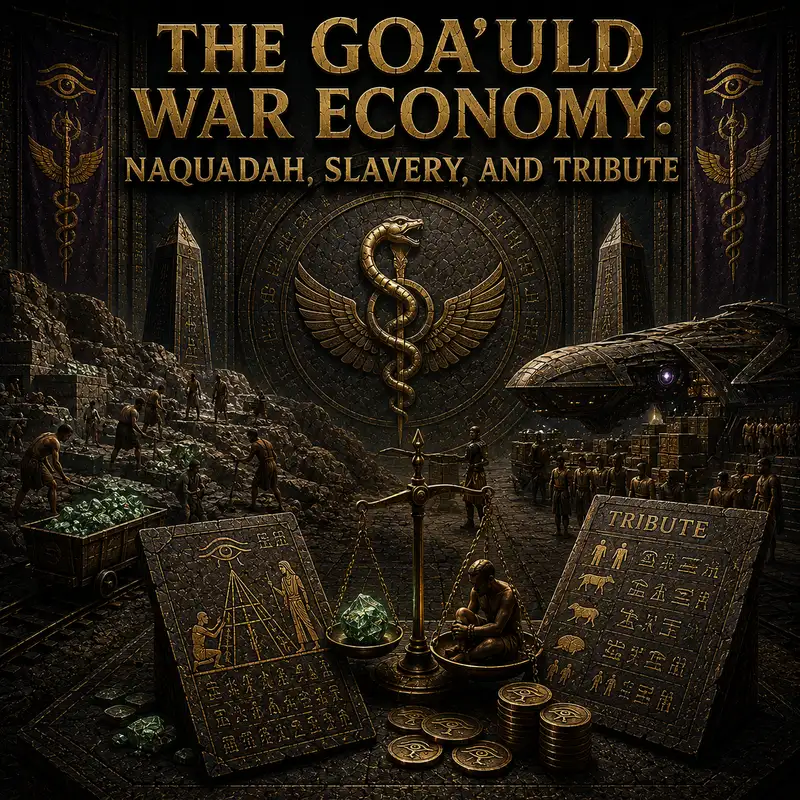
Lord Mot arrived on the mining world designated P four S two thirty-seven expecting tribute for Ba’al. The people had spent generations extracting naquadah from deposits that grew poorer every year. Ba’al had not visited in more than a century and apparently believed the mines were exhausted. Mot continued collecting in his name anyway. He was not forwarding the ore. He was stockpiling it, building the material base for a future attempt to overthrow his master. One shipment of stone had become wages for rebellion, evidence of fraud, and the reason an entire population remained enslaved.
That arrangement was not a minor example of corruption inside the Goa’uld empire. It was the empire’s economic system in miniature. A distant world produced a scarce strategic resource. Local leaders enforced quotas. An emissary collected the output. The ruling System Lord received wealth and military power without administering the mine directly. When oversight failed, the subordinate kept the tribute and prepared to become a ruler himself. The Goa’uld war economy converted conquered planets into privately controlled supply networks, then trusted fear to keep every level honest. Fear is excellent at producing silence. It is less reliable at producing accurate accounting.
The surviving record never shows a common Goa’uld currency, a unified treasury, or a central ministry assigning resources across the Milky Way. Their economy is better understood as a collection of personal domains. Each System Lord controlled worlds, Jaffa, mines, ships, labor, and subordinate Goa’uld. Tribute moved upward. Orders moved downward. Military force protected both directions. A ruler’s territory was therefore not merely land on a star chart. It was the productive base from which fleets could be built, armies supplied, rivals bribed, and rebellions punished.
Naquadah stood near the center of that system. Earth first encountered the mineral on Abydos, where Ra had forced a transported human population to work his mines. The original expedition did not yet possess the later scientific vocabulary, but Stargate Command eventually identified the ore as the same extraordinary element associated with the Stargate itself. Raw naquadah was highly valued among the Goa’uld because it could support compact power generation, advanced weapons, spacecraft, and technologies that conventional Earth industry could not reproduce.
Naquadah was not simply alien gold. Gold stores value because people agree that it does. Naquadah performed work. Refined material could power generators. Incorporated into weapons, it could produce destructive effects far beyond ordinary explosives. Earth’s first naquadah-enhanced nuclear warheads were expected to yield more than a thousand megatons each, although Goa’uld shields made that particular procurement milestone less reassuring than the briefing slides suggested. Later naquadah generators supplied clean, dense power for bases and equipment. The material linked mining directly to military capability.
That link explains why deposits determined the fate of worlds. A rich mine could finance ship construction and make an otherwise unremarkable planet strategically important. A depleted mine could cause a System Lord to withdraw, leaving the population behind like abandoned equipment. The concentration of ore mattered as much as its presence. Earth surveyors later found deposits so weak that mining enough for one battle cruiser might have taken generations, then discovered deeper concentrations capable of supporting actual production. Geology became force structure.
Extraction was only the first stage. Raw ore had to be located, mined, transported, purified, and integrated into systems built by people who understood Goa’uld engineering. The System Lords are often described as technological thieves, and much of their knowledge did come from older civilizations. Theft did not make industry unnecessary. A captured design still required refineries, shipyards, technicians, power systems, trained crews, and replacement components. The empire could appropriate scientific breakthroughs while maintaining a large and brutal manufacturing base around them.
Erebus showed that base without the palace curtains. The planet combined a naquadah refinery, blast furnaces fed by volcanic systems, and an anti-gravity construction facility holding an unfinished Ha’tak mothership. Ba’al’s forces used Jaffa prisoners of war as labor because their strength and symbiote-assisted physiology allowed them to endure heat and toxic gases longer than ordinary humans. Longer did not mean safely. The prisoners were worked until they failed, then executed or left to die. The ship rising above the camp was being purchased with bodies.
The arrangement was economically efficient only if the lives of prisoners were assigned no value. Food, shelter, safety, medical care, and long-term health could all be reduced below the level required for a free workforce. The laborers did not receive wages and could not leave. If one died, another captive could replace him. This did not make the work costless. It shifted the cost onto Jaffa families, conquered populations, and future rebellions. Slave labor does not remove expense. It hides the expense from the ruler’s ledger.
Erebus also joined production to counterinsurgency. Jaffa who refused to serve a new master after capture were sent to a place where their labor strengthened that master’s fleet. Prisoners who might have become rebel commanders instead purified naquadah and built Ha’taks. The same ship could later transport troops, bombard resistance worlds, and capture more laborers. Repression fed production, and production expanded the capacity for repression. That circular system was one reason a System Lord could recover quickly after conquest.
The Stargate network made tribute collection faster but did not make logistics disappear. Compact, high-value cargo such as refined naquadah could move from a distant mining world to a secure destination without a long voyage. Officials, guards, and collection teams could arrive on a predictable schedule. Yet ships remained necessary for bulk transport, orbital control, troop movement, shipyard support, and attacks on worlds whose gates were buried or defended. The Goa’uld war economy worked because gates and fleets complemented one another.
Gate-centered tribute also reduced the need for permanent occupation. A System Lord did not have to administer every village personally. Local priests, elders, collaborators, or subordinate Goa’uld could organize production and deliver the required amount at the gate. A small Jaffa force could supervise the collection and demonstrate what would happen if the quota was missed. The ruler received the useful product while leaving most of the daily burden to people already trapped on the planet.
The gate itself became a collection point, inspection station, and security choke point. Ore had to be packaged, guarded, and moved through during an active connection. Someone controlled the dial-home device, recorded the delivery, and decided whether a shortage reflected geology, theft, or rebellion. A ruler could supervise that process through a small number of trusted officials rather than maintaining a modern customs service. The arrangement was administratively light and militarily severe. If the numbers failed to satisfy the collector, an audit could arrive carrying staff weapons.
P four S two thirty-seven illustrates the method clearly. Its people mined increasingly scarce naquadah and continued offering tribute even though Ba’al had not appeared for generations. Lord Mot arrived as his emissary on a known schedule. The villagers understood that failure could bring punishment, while some local leaders reinforced obedience because resistance looked suicidal. The mine did not need a large standing garrison as long as memory, religion, and periodic violence made the population police itself.
Mot’s deception reveals the principal-agent problem inside Goa’uld rule. Ba’al had delegated collection to a subordinate and apparently stopped receiving reliable information once he judged the mine exhausted. Mot preserved the ritual, kept the output, and planned to use the stockpile against him. Naquadah was political power in a directly convertible form. With enough of it, a lesser Goa’uld could support weapons, ships, allies, and the claim that he deserved promotion into the ranks of the System Lords.
The same incentive operated on P three R six thirty-six, where a human named Pyrus had killed the Goa’uld who once ruled the planet. Pyrus did not close the mine or free its workers. He kept the sarcophagus, adopted the posture of a divine ruler, and continued sending naquadah through the Stargate because that was what the Goa’uld administration had done. The shipments were a masquerade intended to convince distant rulers that nothing had changed and discourage them from investigating.
Pyrus had defeated a Goa’uld without defeating the economic logic of Goa’uld rule. The workers still faced quotas, hunger, guards, and lifelong confinement underground. He believed the shipments protected the planet from reconquest, and that fear was not irrational. A world known to possess naquadah could attract another System Lord if production stopped without explanation. The defensive strategy preserved political independence for the palace by preserving slavery in the mine. Liberation at the top had become continuity at the bottom.
This is why tribute should not be understood as ceremonial gift-giving. It was payment backed by the threat of force. The goods demonstrated obedience and financed the military system enforcing that obedience. On some worlds the ruler might appear frequently. On others an emissary arrived after long intervals. The economic relationship continued as long as the subjects believed that missed deliveries would eventually bring Jaffa, a mothership, or both.
The most visible tribute was naquadah because the screen record repeatedly follows military operations near mines. The wider economy must have included more. Fleets required food, clothing, trained crews, maintenance, construction material, and local support. Palaces, temples, laboratories, and Jaffa communities also consumed resources. The surviving accounts rarely identify the exact agricultural quotas or administrative systems involved, so precise claims would be guesswork. What can be said is that naquadah alone could not feed a garrison or train a pilot. The empire relied on many forms of coerced production even when the camera remained near the reactor fuel.
Human beings themselves were strategic resources. Ra moved populations from Earth to labor colonies such as Abydos. Other Goa’uld raided worlds for hosts, servants, and captives. A suitable body could extend a symbiote’s life, provide memories and skills, or place a familiar face inside a targeted society. Jaffa carried immature symbiotes while also serving as soldiers. The empire did not merely own what people produced. It claimed ownership of their labor, movement, children, and sometimes their bodies.
Jaffa dependence supplied another form of compensation and control. A warrior received strength, healing, status, and access to replacement symbiotes instead of political freedom. The ruler gained a soldier who also protected a developing Goa’uld. Jaffa households then raised the next generation inside communities organized around service. The arrangement transferred recruiting, medical dependency, and reproductive support into the same population. It reduced the ruler’s need to purchase loyalty because survival itself had been placed inside the supply system.
That system allowed a small number of Goa’uld to control a vast human population. They did not need enough symbiotes to fill every administrative position. They used local rulers, priests, Jaffa officers, and collaborators to translate imperial demand into daily work. Advanced weapons handled the moments when consent failed. Religious authority handled many of the moments before that. The less frequently a Ha’tak had to fire, the more of its power could be preserved for a rival System Lord.
Technological suppression was part of the economic design. Many subject populations were kept agrarian or preindustrial while the Goa’uld monopolized advanced weapons and transportation. This reduced the immediate risk of rebellion, but it also limited productivity and innovation. A miner using hand tools produces less than a mechanized operation. The Goa’uld accepted that inefficiency because political control mattered more than broad prosperity. Their objective was not to maximize the wealth of society. It was to maximize the power available to the ruler without creating subjects capable of challenging him.
The system therefore produced impressive concentrations of military power alongside remarkable waste. One world could spend generations extracting a diminishing resource while receiving little investment in safer methods. Prisoners at Erebus could be worked to death even though experienced Jaffa represented decades of training. Rival System Lords duplicated shipyards, concealed reserves, and sabotaged one another’s campaigns. The empire was rich in assets and poor in trust.
Personal ownership made conquest economically attractive. When a System Lord fell, his worlds, Jaffa, ships, and mines did not disappear. Another ruler could seize them. After major defeats, surviving Goa’uld repeatedly divided or absorbed the territories and armies of the dead. Teal’c warned that killing one ruler often allowed another to usurp the same domain. A campaign could therefore pay for itself by transferring the defeated enemy’s productive base to the victor.
This made the Goa’uld economy inseparable from succession warfare. A subordinate who skimmed tribute could finance rebellion. A rival who killed him could claim the stockpile. A System Lord who conquered a world gained its mine and the people already trained to work it. The fastest route to growth was often not improved production but armed acquisition. That encouraged rulers to invest in fleets capable of taking assets rather than institutions capable of improving them.
Fragmentation created resilience as well as inefficiency. There was no single imperial treasury whose capture would bankrupt every System Lord. Ra’s death destabilized the old order, but other domains continued producing ships and tribute. Sokar’s death transferred much of his military establishment to Apophis. Anubis’s defeat led the surviving System Lords to divide his territories and armies, at least until Ba’al took more than his agreed share. The economy survived individual rulers because the mines and workers remained where conquest had placed them.
Its weakness was thin oversight. A world could continue paying tribute to a master who no longer knew the mine was active. An emissary could hoard the proceeds. Local leaders could falsify conditions. Commanders had incentives to report success and conceal depletion. The System Lord appeared omniscient to the village while relying on information moving through frightened subordinates. The distance between divine image and administrative reality could be several planets wide.
Resistance movements learned to attack that gap. They did not need to destroy every Goa’uld asset at once. They could stop a shipment, expose an emissary, free a labor camp, sabotage a refinery, or persuade Jaffa guards to change sides. On Erebus, S G One and allied forces disabled the anti-gravity systems supporting the unfinished Ha’tak. The falling ship drew guards away, and the prisoners revolted. The operation rescued captives and denied Ba’al a vessel without requiring Earth to occupy the planet indefinitely.
The economic target mattered as much as the tactical one. Destroying guards near a gate would have saved the immediate team but left the shipyard intact. Sabotaging the Ha’tak struck future force generation. Freeing Jaffa prisoners removed labor from Ba’al and returned experienced personnel to the rebellion. A single raid reduced production, strengthened the opposition, and demonstrated that the labor force was not passive. That is a considerably better return than counting bodies near the gate and declaring the planet secure.
Earth eventually confronted the same resource pressures. Stargate Command learned that naquadah could enhance weapons, power generators, and support the construction of fighters and battle cruisers. Small recovered samples were useful for research. An operational space force required far more. The Pentagon wanted F three-oh-twos and X three-oh-threes. Scientists and military survey teams were sent to find deposits. Earth had entered the war against an extractive empire and discovered that starships also require mines.
The confrontation on P three X four-oh-three showed how easily strategic necessity could reproduce imperial habits. Earth personnel found a promising naquadah deposit on land sacred to a large Unas population. The initial military approach treated the inhabitants as an obstacle to the mining mission. Deadly force was authorized if negotiations failed. The language was different from the Goa’uld, the chain of command was different, and the objective was planetary defense. From the Unas position, armed outsiders had still arrived to take the resource beneath their dead.
Daniel Jackson and Chaka created another outcome. The Unas agreed to work the mine themselves and provide naquadah to Earth as part of their struggle against the Goa’uld. The agreement did not erase the unequal technologies or interests involved, but it replaced seizure with negotiation and recognized the local population as an ally. The distinction was not sentimental. Consent created a more stable supply relationship than occupation would have, while avoiding a battle Earth’s mining detachment was unlikely to win.
The fall of the System Lords did not erase the infrastructure they had built. Mines, ships, trade routes, and former tribute worlds remained. New powers, including the Lucian Alliance, moved into parts of the vacuum and combined commerce, coercion, agriculture, captured Ha’taks, and regional warlordism. The flags changed faster than the economic geography. A population that had spent generations producing for one distant ruler remained vulnerable to the next organization that controlled transport and armed force.
The Goa’uld war economy succeeded because it linked strategic material, coerced labor, and political terror. Naquadah powered the machinery. Slavery reduced the ruler’s visible costs. Tribute distributed extraction across many worlds while allowing the System Lord to remain distant. Conquest added productive assets, and religion discouraged the workers from asking where the output went. The result could place fleets in orbit above civilizations that had never manufactured a rifle.
The same arrangement made the empire brittle. It rewarded hoarding, false reporting, and internal war. It kept workers poor, local economies narrow, and subject populations hostile. It assumed miners would always meet the quota, Jaffa would always guard the refinery, and emissaries would always forward the shipment. Once those people stopped cooperating, the gods discovered that their power had always depended on someone else carrying the crate to the gate. Naquadah built the ships, but stolen labor built the empire, and stolen labor was the part that eventually refused to remain property.