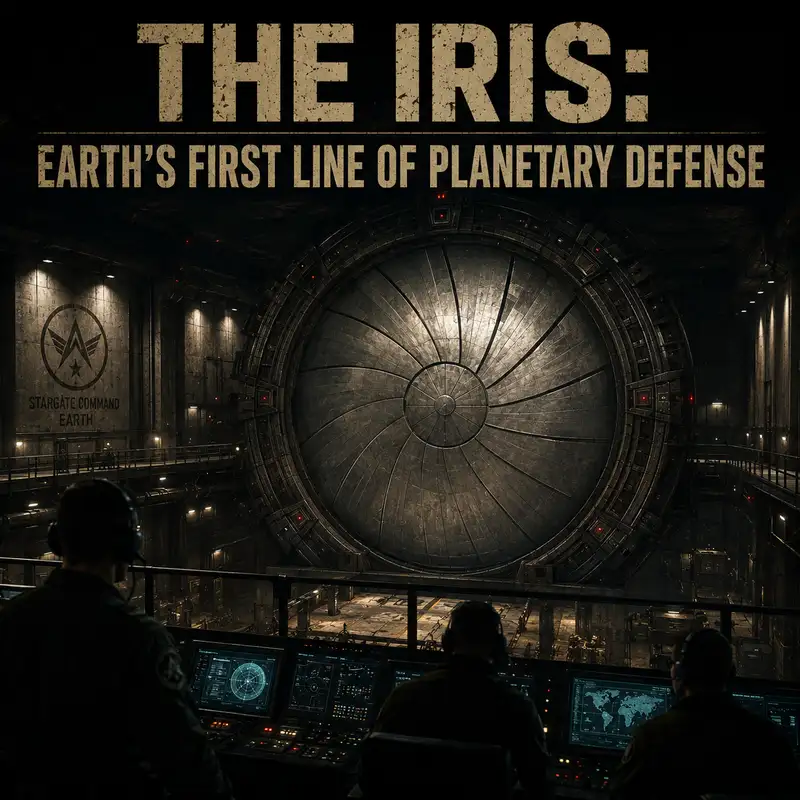
The Iris: Earth’s First Line of Planetary Defense
Colonel Jack O’Neill came through the Stargate last. Major Samantha Carter was only a few steps ahead of him, weapon raised toward the still-open wormhole. Behind them, Alar was running for the event horizon, offering knowledge, technology, and anything else that might purchase his escape from a collapsing regime. O’Neill reached the ramp, turned, and ordered the iris closed. General George Hammond confirmed the command. The metal barrier sealed the gate, and the control system recorded an impact. Earth had just used its first planetary defense not against an invading army, but against one desperate man.
That decision revealed what the iris had become. It was not simply a piece of armor bolted onto an alien machine. It was a border, an authentication system, a lethal denial device, and a command responsibility concentrated into a few seconds. Before the iris, an enemy who knew Earth’s address could enter Cheyenne Mountain without crossing an ocean, penetrating national airspace, or defeating a single surface checkpoint. After the iris, the wormhole could still form, but physical entry required permission. The central question is how that one engineering solution changed Earth’s defensive position, and why it never made the planet as secure as it appeared.
The need had been demonstrated by Apophis. His first raiding party entered the gate room while the Stargate was guarded as a dormant artifact rather than an active border. Jaffa killed American personnel, seized an airwoman, and withdrew before the base could organize a meaningful response. Cheyenne Mountain’s rock, blast-resistant construction, and armed security had been designed for threats approaching from outside. Apophis ignored all of them. He arrived on the lowest operational level, inside the protected perimeter, with the exit already open behind him.
Stargate Command responded with a terrestrial solution wrapped around Ancient technology. By the time O’Neill’s team returned from the first renewed mission to Abydos, a metal barrier had been installed directly over the event horizon. The original version was pure titanium. General Hammond described it as insurance against another surprise, which was accurate as far as insurance goes. The device could not prevent a hostile power from dialing Earth, but it could ensure that the next Jaffa patrol did not materialize in the room with weapons ready.
The iris worked because of where it sat. The closed barrier rested less than three micrometers from the event horizon. Matter transmitted through a Stargate normally reaches the destination as an encoded pattern and is reconstructed on the far side. With the iris occupying the space required for that reconstruction, incoming people and objects could not fully reintegrate. The resulting impacts were heard as heavy thuds against the barrier, but the travelers were not merely colliding with a conventional wall at running speed. The gate had been denied the physical volume needed to return them safely to matter.
This distinction gave the iris an extraordinary advantage. It did not have to absorb the full kinetic energy of an invading formation that had already emerged. It prevented ordinary matter from emerging in the first place. The wormhole still established, the chevrons still locked, and the event horizon still existed behind the barrier. Radio signals and other forms of energy could pass through. Physical travelers normally could not. Earth had separated connection from entry, turning the Stargate into a communications link even when the door remained closed.
The original titanium iris did not survive every hazard. When a connection to a planet near a newly formed black hole transmitted intense gravitational effects into Stargate Command, the barrier eventually broke apart under the strain. The gate itself was saved only through an improvised attempt to redirect the wormhole. Afterward, a new trinium-strengthened iris was installed. The replacement improved material strength without changing the underlying method. Earth did not redesign the Stargate. It refined the barrier controlling the few micrometers immediately in front of it.
The iris was only the first layer. Armed security teams still deployed in the embarkation room during an unauthorized activation. Blast doors separated the gate room from the rest of level twenty-eight. Control personnel monitored signals and impact events. Medical teams prepared for casualties and contamination. The base retained a nuclear self-destruct for conditions in which neither the iris nor internal defenses could contain the threat. The physical barrier bought time and limited the attacker’s options. Everything behind it existed because some threats would still find another path.
Routine operation depended on identification codes. An S G team preparing to return dialed Earth and transmitted its assigned code through the wormhole using a compact remote device. The control room received the signal, checked it against authorized records, and opened the iris before the team entered. The device became known as a G D O, an informal name for equipment performing a deadly serious task. Lose the transmitter, and the team might be standing one step from Earth with no safe way to cross.
Codes could be changed, disabled, or locked out. A team overdue beyond its authorized window might discover that its old signal no longer guaranteed entry. An ally could receive a special code, but that code could be withdrawn if trust collapsed or the device was captured. Stargate Command was therefore managing cryptographic credentials for people operating beyond immediate communications. The technology was portable. The authority behind it remained at Cheyenne Mountain.
No code opened the iris automatically in every circumstance. The signal created a claim of identity. A commander still had to decide whether the claim was credible. Was the team expected? Had it reported enemy contact? Could the transmitter have been taken? Was the person carrying it still in control of his own body? The safest rule was to keep the iris closed. The operational mission required exceptions, and every exception transferred risk from the people off-world to everyone on Earth.
The crisis involving S G Ten showed how difficult that judgment could become. A black hole distorted time near the team’s planet, slowing its identification signal until the control room initially failed to recognize it. Once the computers accelerated the pulses, the code matched S G Ten. Hammond opened the iris because the next impact might have been Major Boyd and his people. No one emerged. The wormhole collapsed, and gravity began affecting the base. Authentication had worked, yet the physical situation behind the signal was far beyond anything the procedure had been designed to evaluate.
Friendly arrivals could be almost as uncertain. Bra’tac and Tok’ra representatives received codes because their access mattered to Earth’s alliances. A wounded ally might arrive without advance notice and require the iris opened before a full explanation was possible. Diplomatic relations were therefore embedded in the access list. Granting a code meant trusting another organization to protect the device, control who used it, and warn Earth if it was compromised. The most important visa in the galaxy was a short radio transmission backed by a great deal of faith.
Strategically, the iris created an asymmetry in gate warfare. Earth could send small teams through unsecured gates, conduct reconnaissance or raids, and then withdraw to a hardened endpoint. A pursuing Jaffa force could dial Earth and still die against the closed barrier. The Goa’uld had ships, armies, and larger industrial resources. Stargate Command possessed one exceptionally well-defended doorway. That doorway allowed a technologically weaker power to operate aggressively without accepting equal vulnerability to immediate counterattack through the same route.
This advantage helped make the entire S G team system possible. Without the iris, every outgoing mission increased the chance that a captured address, a tracked withdrawal, or a coerced prisoner would deliver an enemy directly into Cheyenne Mountain. The alternatives were to bury the gate after each expedition, relocate it away from the command center, or maintain a permanently exposed defensive position around an open portal. The iris allowed the base to remain operational while treating every incoming connection as hostile until proven otherwise.
It did not prove the traveler’s identity. The first major warning came from Major Charles Kawalsky. He returned from Chulak with an authorized team and passed through the opened iris. A Goa’uld had entered his body during the withdrawal. His uniform, memories, voice, rank, and access codes remained valid while his intentions were controlled by an enemy symbiote. The barrier had stopped unauthorized matter. It had admitted an authorized officer carrying the threat inside him.
That problem repeated in different forms. A crystalline life-form copied O’Neill and returned with S G One. Alien infiltrators later duplicated members of an S G team and established a foothold inside the base. Their success did not require defeating titanium or trinium. They entered as people Stargate Command expected to receive. The iris authenticated the route and the credential. Medical screening, behavioral awareness, quarantine, and counterintelligence had to determine whether the person stepping down the ramp was still the person listed in the file.
Even ordinary emergency returns could defeat perfect closure timing. During one retreat, S G One rushed home pursued by large airborne insects. The iris began closing as the team cleared the event horizon, but one creature entered before the barrier sealed. Gate-room doors had to close, weapons came up, and the base contained the threat inside the chamber. The incident was small compared with a Jaffa assault, but operationally revealing. A barrier that closes in seconds still leaves seconds in which the entire room is exposed.
The Reetou demonstrated a more sophisticated weakness. An invisible Reetou had entered Stargate Command earlier, observed how personnel operated the iris, and later overrode the computer to open it for a human child. The metal plates remained fully functional. The control system obeyed hostile input. Stargate Command responded by adding palm scanners to iris controls, increasing the connection between physical authorization and the command to open. The episode was a reminder familiar to every security engineer. The strongest door in the facility is not useful if an intruder can operate the switch.
Advanced technology could also defeat the physical principle itself. The Tollan possessed phase-shifting devices that allowed them to pass through solid matter. Narim and other Tollan visitors could emerge through the closed iris without being destroyed. Their ability did not mean the barrier was poorly designed. It meant the design assumed incoming matter would behave according to the normal rules the Stargate used for reintegration. A civilization capable of changing those conditions could make three micrometers irrelevant.
Sokar attacked the iris without sending ordinary matter at all. He used an intense stream of subatomic particles moving at extreme velocity. The particles were small enough to reintegrate in the narrow space between the event horizon and the barrier, then released energy as they decayed. The iris heated, the gate room became dangerous, and liquid nitrogen provided only temporary relief. Sokar had converted a protected doorway into the focus of a remote siege.
The defense against that attack was operational rather than material. Stargate Command tried to occupy the gate with an outgoing wormhole so Sokar could not dial in. His system established the next incoming connection faster. Earth eventually sent the dying Apophis back through the gate, removing the immediate reason for the assault. The iris had stopped soldiers and cargo. It could not stop an enemy from using the wormhole as a channel for energy, pressure, and coercion. The political decision surrounding Apophis mattered more than another layer of metal.
A digital life-form exposed the same boundary from another direction. During a probe mission, a structured electromagnetic signal traveled back through an outgoing wormhole and entered Stargate Command’s computer network. It damaged systems, disabled the iris circuitry, and eventually took control of Samantha Carter’s body. The barrier could not block information carried as energy, because allowing radio communication was essential to gate operations. Earth’s first line of defense had an intentional opening, and an intelligence advanced enough to inhabit that opening could bypass the gate room entirely.
Gravity also ignored the distinction between friendly and hostile traffic. The black-hole connection transmitted a force through an outgoing wormhole even though ordinary matter could not travel in that direction. Closing the iris reduced some immediate physical hazards in the room, but it did not end the gravitational effect. The barrier strained and ultimately failed. The crisis proved that the iris was a defense against expected gate transit, not against every phenomenon a wormhole could couple between two locations.
Anubis later attacked the gate itself. An Ancient-derived weapon fed energy into Earth’s Stargate and prevented the connection from closing, causing the naquadah in the ring to build toward a catastrophic overload. The iris could reduce or delay some of the energy reaching the room, but it could not stop the gate from becoming the weapon. Stargate Command eventually removed the active ring from the mountain and carried it away from Earth aboard an experimental aircraft before it exploded in space. The first line of defense had become attached to the munition.
A second Stargate on Earth complicated the defensive picture further. The Antarctic gate, and later the gate controlled through the Russian program, showed that an iris protected one endpoint, not the planet as an abstract whole. Network priority, dial-home devices, and physical control determined which gate received an incoming connection. If hostile traffic could be redirected to an unprotected ring, the shield over Cheyenne Mountain offered no help. Planetary defense required control of every usable endpoint, not confidence in the best-defended one.
The iris also carried moral authority that no engineering diagram could describe. When O’Neill ordered it closed behind him during the Eurondan withdrawal, he knew Alar was attempting to follow. Alar had led a regime fighting to preserve itself through genocide and had concealed that truth while seeking Earth’s aid. O’Neill denied him entry, and the impact confirmed the consequence. The barrier allowed a field commander to convert a political and moral judgment into immediate lethal force without a firefight or trial.
That was not the only kind of decision made at the controls. Opening the iris could grant asylum, receive refugees, admit an ally, or accept a prisoner whose presence might invite retaliation. Closing it could protect billions while abandoning an S G team that had lost its transmitter. The same mechanism performed rescue and execution depending on timing and authority. Its operation was technically simple because the difficult part had been moved into human judgment.
The command burden became especially severe during hot extractions. A team under fire needed the barrier open before the first person entered, yet the defenders wanted it closed before the pursuing force followed. Radio reports might be broken, the transmitter might be in the hands of the last survivor, and wounded personnel might move more slowly than the mission clock allowed. Gate-room security could not see the approach on the far side. It had to trust the code, the voice, and the commander’s estimate of when the last friendly traveler had crossed.
This procedure changed field doctrine. Teams guarded their remotes as survival equipment. Mission plans included check-in windows and alternate destinations. Lost codes were reported and deactivated. Allies received controlled access rather than permanent open entry. Base defenders treated any unexplained activation as a possible attack. The iris turned gate security into a continuous system of communications, authentication, intelligence, and command rather than a single mechanical action.
It also encouraged risk. Stargate Command could raid a Goa’uld facility, irritate a System Lord, and expect that immediate pursuit through the gate would fail. That confidence was often justified. It was never complete. An enemy could come by ship, attack the Stargate with energy, infiltrate an authorized traveler, steal a code, exploit another Earth gate, or strike an allied world instead. The iris reduced one avenue of retaliation and sometimes made the remaining avenues easier to underestimate.
The material itself required maintenance, replacement, power, and reliable controls. The original barrier was destroyed. The strengthened version could be heated, strained, phased through, electronically overridden, or rendered irrelevant by attacks on the Stargate and computer network. Earth could manufacture and repair the iris because it was primarily a human engineering project, which made it more sustainable than many recovered alien devices. Its strength came from combining known materials and doctrine with a precise understanding of one Ancient system limitation.
No Goa’uld shield gifted the capability. No Asgard vessel remained on station to enforce it. The iris was Earth’s own adaptation, developed before the planet possessed interstellar ships or reliable orbital defenses. That origin mattered. Stargate Command’s earliest strategic advantage was not superior firepower. It was the ability to study an enemy’s access route and change the conditions at the destination. The Goa’uld inherited the gate network. Earth learned how to fortify its address.
The iris became Earth’s first line of planetary defense because it made invasion through the Stargate controllable. It transformed an active wormhole from an automatic breach into a request for entry. It protected the planet from armies, bombs, and pursuit forces that depended on ordinary matter transmission. It also exposed the limits of every fixed defense. Signals could lie. Codes could be captured. Energy could pass. Computers could be compromised. Advanced civilizations could change the rules.
The defining image is the closed iris with an incoming wormhole behind it and an identification signal appearing on the control-room screen. Somewhere beyond the barrier, a team may be wounded, an ally may be fleeing, or an enemy may be holding the transmitter. The metal cannot decide. It can only remain closed until a human being accepts the risk of opening it. Earth’s first planetary defense was powerful not because it removed uncertainty, but because it gave Stargate Command a few seconds in which uncertainty could become a decision.