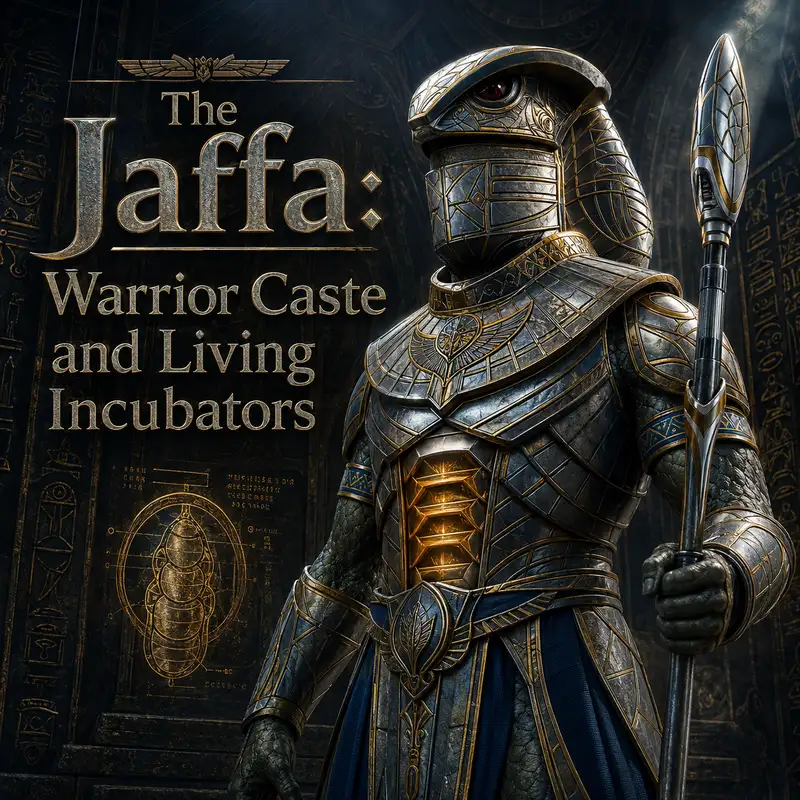
The Jaffa: Warrior Caste and Living Incubators
Teal'c reached into his own abdominal pouch and removed the organism keeping him alive. His son, Rya'c, had stopped breathing on a forest path outside Chulak. Earth medicine was too far away, and the Stargate was still under hostile control. Teal'c had opposed the prim'ta because he understood it as the ceremony that enslaved every Jaffa child. He now placed his own larval Goa'uld inside Rya'c to save the boy's life, knowing that he would have only a short time to find another. The act was not a change of faith. It was a battlefield medical decision forced upon a father by an empire that had redesigned his family’s biology.
That contradiction defines the Jaffa. They were the soldiers who enforced Goa'uld rule and the living incubators who sustained the Goa'uld species. The larva inside each warrior provided health, healing, strength, and longevity. It also replaced the Jaffa’s natural immune function, making removal potentially fatal. Military service, religious identity, family status, and biological survival were therefore linked to the same organism. The Goa'uld did not merely recruit an army. They created a population whose bodies reproduced the ruling class and whose continued lives depended on the rulers they served.
The Jaffa were descended from humans taken and altered by the Goa'uld. Their most visible modification was the abdominal pouch used to carry a developing symbiote, but the deeper change involved immune dependence. Before the Goa'uld created the Jaffa, blending a mature symbiote with a human host succeeded only about half the time. Incubation inside a Jaffa prepared the larva for a far more reliable transition into a host. That made the Jaffa a biological solution to an imperial problem. The same population could protect the young Goa'uld, improve their chances of survival, and provide the armed force required to obtain future hosts.
The transformation did not begin when a warrior joined a unit. It began in childhood. As a Jaffa approached the age of the prim'ta, the natural immune system could no longer sustain the body. Priests then implanted a larval symbiote and declared the child a true Jaffa. The ceremony was described as an honor and entry into the religious life of the community. It was also an irreversible transfer of medical dependency. A child too young to understand imperial strategy became physically tied to a succession of Goa'uld larvae for the remainder of life.
The symbiote offered benefits powerful enough to make the system appear sacred. A Jaffa could resist diseases that killed ordinary humans, recover from serious wounds, endure harsh conditions, and remain physically capable for more than a century. Through kel'no'reem, a disciplined meditative state, the warrior synchronized with the symbiote and supported its healing work. Jaffa did not become invulnerable. They could be killed by catastrophic trauma, blood loss, energy weapons, or damage to the larva. Their advantage was durability. A veteran could accumulate decades of combat experience while retaining the strength to apply it.
The price appeared whenever the symbiote was removed, injured, or ready to leave. Major organs could begin failing within hours. Fever followed, then death unless another larva or an effective substitute restored the missing immune function. When a symbiote reached maturity, it had to depart and seek a human host. The Jaffa then required a replacement. This cycle continued for decades, until age or injury made another implantation impossible. Bra'tac understood that his final symbiote would mark the end of his life. The gods had built mortality into the resupply schedule.
A larva inside a Jaffa was therefore not merely a passenger. It was a future member of the Goa'uld political class. Once mature, it could take a host and emerge with inherited knowledge from its queen. The Jaffa infantryman might be carrying a future administrator, scientist, commander, spy, or minor ruler while fighting to protect the empire that symbiote would later serve. Every Jaffa formation was simultaneously an army, a guarded nursery, and a moving biological supply network.
This arrangement reduced the need for separate institutions. Human societies normally divide military recruitment, medical care, religious initiation, and reproductive support among different organizations. Goa'uld rule concentrated those functions around the prim'ta. Priests controlled the ceremony. Rulers controlled the supply of larvae. Families prepared children for service. Military leaders rewarded obedience with rank and status. The same system that filled the army also produced adult Goa'uld and ensured that rebellion carried an immediate medical penalty.
Jaffa society was broader than a single rank of armored infantry. It included children, parents, priests, priestesses, craftsmen, servants, farmers, political elders, and people whose daily work sustained the warriors. Yet the Goa'uld placed the warrior ideal at the center of public identity. A Jaffa was expected to value strength, endurance, discipline, loyalty, and willingness to die in service. Even those who did not stand in the front rank lived inside communities organized around military obligations and the needs of the symbiote cycle.
Training was personal as well as institutional. Experienced warriors took apprentices and transmitted weapons skills, fieldcraft, customs, and the political instincts required to survive near a Goa'uld court. Bra'tac trained Teal'c before Teal'c became First Prime of Apophis. That relationship mattered because Jaffa professional knowledge could persist across generations even when rulers were careless with their troops. A strong mentor taught more than how to fire a staff weapon. He taught when to obey, when to conceal doubt, and how to recognize an order that would destroy a unit for no military purpose.
The First Prime stood at the summit of this military hierarchy. He served as chief warrior, field commander, personal enforcer, and visible extension of the Goa'uld ruler. The position brought prestige, access, and influence, but not security. Teal'c’s father, Ro'nak, had served as First Prime to Cronus and was executed after refusing to accept blame for an unwinnable battle. His family was exiled. The message was clear. Rank existed at the pleasure of the god, and professional judgment mattered only until it contradicted divine vanity.
Forehead markings made allegiance visible. Ordinary warriors bore the symbol of the Goa'uld they served. A First Prime or senior religious figure could receive a gold emblem through a deliberately painful process. The mark functioned as unit identification, declaration of faith, badge of rank, and brand of ownership. It also complicated rebellion. A warrior who deserted could not easily conceal decades of service. Liberation did not remove the symbol. Teal'c carried the mark of Apophis long after he had dedicated his life to destroying everything it represented.
In campaign terms, Jaffa forces gave the Goa'uld a flexible pool of ground troops for gate seizures, palace security, shipboard duty, raids, occupation, host collection, and suppression of revolt. Elite guards protected System Lords and important installations. Other units held villages, guarded mines, escorted prisoners, or reinforced allied rulers. Command quality varied enormously. Some formations were experienced and dangerous. Others were poorly led levies whose courage could not compensate for ceremonial doctrine and a ruler’s refusal to admit that the enemy had changed.
These were not the armed forces of a unified Jaffa state. Each Goa'uld maintained personal armies marked by his or her symbol, and those armies inherited the rivalries of their masters. Jaffa serving Apophis could spend decades fighting Jaffa serving Cronus, Heru'ur, or another System Lord, then be ordered into a temporary alliance when politics shifted. Shared language and warrior customs did not create a common chain of command. The arrangement protected Goa'uld authority by preventing the soldiers from seeing themselves as one people with one interest. It also meant that imperial coalitions were fragile. A battlefield plan could collapse because two rulers distrusted each other more than they feared the enemy in front of them.
The Jaffa’s physical advantages were most valuable in close combat, prolonged operations, and environments with limited medical support. A wounded warrior could sometimes continue fighting or recover without the evacuation chain an Earth unit required. Long lives created deep familiarity with Goa'uld weapons, ships, gate routes, and rival factions. Religious motivation could sustain discipline under extreme pressure. Those were real strengths. Stargate Command learned quickly that dismissing Jaffa as primitive because they carried staffs and wore ornate armor was an excellent way to underestimate a veteran who had been fighting since before the observer’s grandparents were born.
Their weaknesses came from the political system rather than from a lack of courage. Goa'uld command emphasized obedience, spectacle, and fear. Staff weapons were lethal, but they also served as symbols of authority and instruments of terror. Against unarmed populations, that combination was efficient. Against troops using compact automatic weapons, grenades, radios, cover, and decentralized initiative, the slower weapon and rigid formation could become liabilities. The problem was not that every Jaffa was tactically incompetent. It was that the empire often rewarded intimidation more reliably than adaptation.
Experience also remained concentrated in individuals. A capable First Prime could train disciplined subordinates, coordinate ships and ground forces, and preserve lessons from earlier campaigns. A vain or frightened ruler could execute that commander and erase decades of professional knowledge in an afternoon. The Goa'uld possessed long-lived soldiers but rarely built institutions that protected military expertise from court politics. That was acceptable while opponents were isolated villages and rival gods using similar methods. It became costly when Earth forces learned quickly, shared intelligence across teams, and treated failure as a reason to revise doctrine rather than punish the messenger.
Jaffa logistics also reflected their double role. A unit needed food, ammunition, transport, and replacement weapons, but it also carried living symbiotes that could be injured, stolen, or mature during a campaign. A dead warrior might represent the loss of an experienced soldier and a future Goa'uld. A canister of larvae could be medical cargo, reproductive stock, and a strategic target at the same time. Gate travel shortened distance, but it did not eliminate these requirements. A force cut off from replacement larvae faced a biological crisis even if it still possessed weapons.
The Goa'uld used that dependence to control entire communities. A loyal household could receive access to priests, safe implantation, and replacement symbiotes. A disgraced family could lose its home, status, and medical security. Teal'c’s defection did not punish him alone. Drey'auc and Rya'c were driven into poverty because the First Prime had become a shol'va, a traitor. Drey'auc had to persuade the priesthood that she remained loyal so her son could receive the treatment that would keep him alive. Imperial discipline reached the battlefield through the family.
This helps explain why Jaffa service cannot be reduced to either fanaticism or simple coercion. Many genuinely believed the Goa'uld were gods. Others understood the deception but saw no practical path to resistance. Some valued the honor, status, and fellowship of the warrior caste. Some feared for their children. Most lived with several of these motives at once. A Jaffa could despise a ruler’s cruelty and still believe that obedience protected the community. The empire survived by making moral compromise look like parental responsibility.
The symbiote itself was usually isolated from the Jaffa’s conscious mind, exchanging biological signals without open conversation. Shan'auc discovered that deep kel'no'reem could create a limited exchange of images and feelings. She believed she had taught the larva she carried to reject Goa'uld cruelty. The symbiote later took a host, became Tanith, and murdered her. The episode revealed two important facts. The developing Goa'uld was not an inert organ, and the empire had concealed the possibility of communication because it did not want Jaffa influencing its young.
That relationship created an intelligence problem inside every warrior. The Jaffa protected an organism with inherited knowledge and an identity that might remain concealed until maturity. A larva could potentially observe aspects of Jaffa life while the carrier knew little about the mind inside the pouch. Goa'uld rulers trusted religious indoctrination to keep the incubator loyal and biological isolation to keep the offspring uncontaminated. Shan'auc’s experience showed that neither barrier was perfect, though it also showed that communication did not guarantee reform. The child could listen, learn, and still deceive the person keeping it alive.
Teal'c’s decision to turn against Apophis was therefore more than a battlefield defection. He rejected the religious order, the command hierarchy, and the biological contract of Jaffa society at once. He still needed the symbiote inside him. He still bore the gold mark of the ruler he betrayed. His family remained under Goa'uld authority. Every mission with S G One placed him in the unusual position of fighting the empire while physically sustaining one of its future members.
Early rebellion could not simply order every Jaffa to remove a larva. That would have converted liberation into mass death. Rebel forces needed captured symbiotes, access to friendly queens, or continued raids against the same system they wanted to destroy. Drey'auc died when her symbiote matured and she refused or could not obtain another. Her death demonstrated that belief could change faster than biology. A Jaffa might declare freedom in a moment, but the body still demanded imperial resupply.
The rebellion also inherited the habits of the warrior caste. At Cal Mah, Kytano assembled Jaffa from rival services and promised unity, sanctuary, food, weapons, and honorable sacrifice. His followers wanted a commander who looked and sounded like the leader their culture had taught them to follow. Kytano was actually the Goa'uld Imhotep using a Jaffa host and revolutionary language to build a new army. The deception succeeded because rejecting one god did not automatically teach the rebels how to distrust authoritarian command.
That incident was not an argument against Jaffa military culture. It was a warning about institutional transition. The qualities that made Jaffa effective soldiers, including loyalty, endurance, reverence for proven warriors, and willingness to sacrifice, could support liberation or another dictatorship. Teal'c and Bra'tac had to persuade their people that freedom required more than changing the name on the forehead symbol. It required commanders to justify orders, warriors to question impossible missions, and factions that once fought for rival gods to cooperate without submitting to a replacement deity.
The Hak'tyl resistance exposed another weakness in Goa'uld claims about the warrior caste. Moloc ordered female infants killed because he believed only males should strengthen his armies. Ishta and her followers rescued the girls, trained them, and created a formidable force in hiding. Their existence showed that the exclusion was political, not biological. It also revealed the cruelty of the dependency system. To keep the girls alive when they reached the age of implantation, the Hak'tyl ambushed other Jaffa and took their larvae.
Those raids were tactically successful and morally corrosive. A captured larva could save one child, but removing it might kill the Jaffa who carried it. The Hak'tyl had escaped Moloc’s authority without escaping the biology he controlled. Their hidden base required food, weapons, security, training, and a continuing supply of symbiotes. Each rescued infant increased both the future strength of the resistance and its immediate logistical burden. Freedom had become a recurring procurement operation conducted against other enslaved people.
Tretonin changed the strategic equation. Derived from Goa'uld biology and later adapted for Jaffa use, the drug could replace the immune function of a larval symbiote. After an ambush killed more than a hundred rebel Jaffa and left Teal'c and Bra'tac sharing one failing symbiote, tretonin kept both men alive. It later offered the Hak'tyl and other Jaffa a path away from implantation. The treatment was not effortless. It required regular production, distribution, medical knowledge, and acceptance of new physical limitations.
For Teal'c, life without a symbiote initially felt like weakness. Injuries healed more slowly. Kel'no'reem no longer worked in the same way. He needed sleep and had to rely on rehabilitation rather than the internal repair system that had supported him for a century. This was more than a medical adjustment. Jaffa culture had equated physical strength with worth and weakness with death. Tretonin could free the body from the Goa'uld while forcing the warrior to reconsider what being Jaffa actually meant.
Once tretonin spread, the Goa'uld lost one of their strongest instruments of control. A ruler could still threaten families, destroy settlements, and command fleets, but withholding larvae no longer guaranteed obedience. Jaffa units could defect without planning to raid a hatchery every few years. Children could approach adulthood without receiving a future Goa'uld. The change did not by itself win the war. It removed the biological veto that had made sustained rebellion almost impossible.
The collapse of the System Lords transformed the warrior caste into the military core of a new political order, but liberation did not erase old divisions. Jaffa had served different gods, carried different symbols, followed different commanders, and inherited rival interpretations of honor. They knew how to fight in hierarchies built around personal authority. Building representative institutions, distributing tretonin, controlling captured ships, and deciding who spoke for the Free Jaffa demanded skills the Goa'uld had never wanted them to develop.
The Jaffa were among the Goa'uld empire’s greatest achievements because one engineered institution solved several problems at once. It produced resilient soldiers, protected developing symbiotes, improved future blending, extended military careers, and made the army dependent on its rulers. It was also the empire’s most dangerous vulnerability. The Goa'uld placed their young inside armed people who could observe their fear, survive their punishments, and eventually recognize that divine power depended on Jaffa obedience.
Rya'c survived because Teal'c used the very system he wanted to destroy. That did not make the prim'ta benevolent, and it did not make Teal'c a hypocrite. It showed how thoroughly Goa'uld rule had occupied Jaffa life. The larva was medicine, chain, child, enemy, and military resource at the same time. The Jaffa became free only when they could separate survival from service and warrior identity from ownership. Their rebellion began with the claim that the Goa'uld were false gods. It became irreversible when a Jaffa could remove the god from his body and remain alive.