The Kidnapping of Teyla and the Hunt for Michael
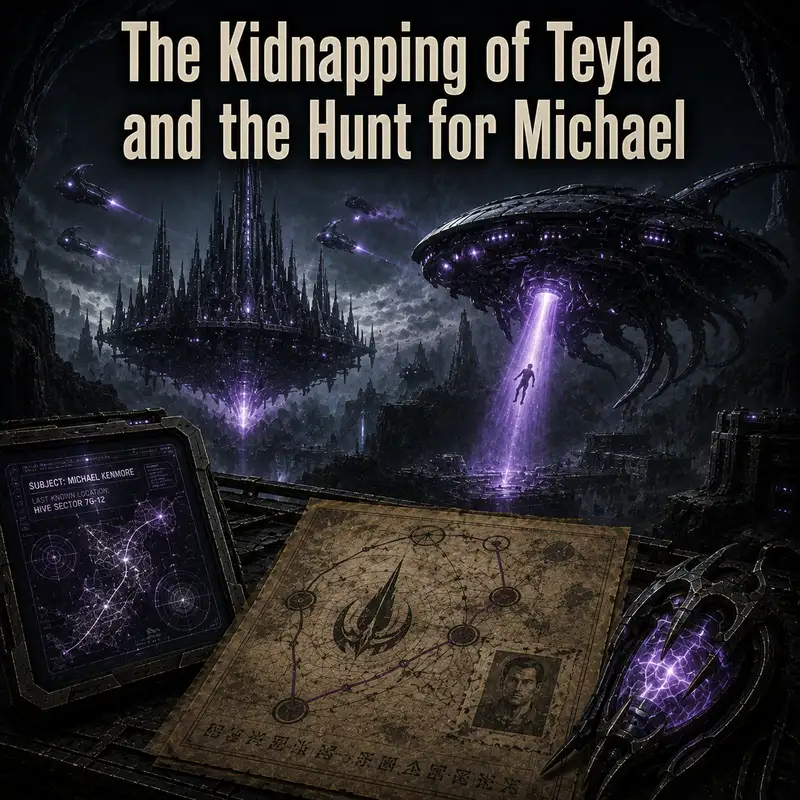
The Wraith Dart did not fire on Teyla Emmagan. It swept low over the trees, opened its culling beam, and removed her from the battlefield before Major Lorne’s team could react. The trader they had been questioning had dragged the heavily pregnant Teyla into the beam deliberately. By the time Earth weapons came up, the Dart was already climbing away with both of them stored inside. Michael had not defeated an Atlantis team in combat. He had used a human source, a familiar piece of jewelry, and one carefully positioned aircraft to collect the only prisoner he truly wanted.
Teyla’s kidnapping was the final step in a counterintelligence operation that had begun months earlier with the disappearance of the Athosians. The hunt that followed was not a simple pursuit of one ship. Michael had no public capital, recognized territory, or stable alliance whose communications Atlantis could monitor. He moved through hidden laboratories, worshipper networks, hired intermediaries, Wraith ships, and human trading routes. Finding him required Atlantis to reconstruct a dispersed organization from artifacts, rumors, prisoners, an unwilling clone, and eventually intelligence from a future that no longer existed.
The Athosians had already been displaced several times by the Pegasus wars. After losing their original world and later leaving Atlantis, they established a settlement on New Athos. The location offered distance from the city and the possibility of rebuilding an independent community. It did not provide orbital defenses, continuous surveillance, or a permanent Earth garrison. Atlantis could visit through the Stargate and provide medical or military assistance, but New Athos remained a separate settlement whose security depended heavily on concealment and local warning. Against Michael’s mobile forces, neither proved sufficient.
Teyla and Doctor Jennifer Keller arrived for what should have been a routine visit and found the village deserted. Food, possessions, and structures remained, but the people were gone. There was no normal distress signal and no body count explaining what had happened. The absence itself became the first intelligence problem. A Wraith culling, a forced evacuation, an internal departure, and a covert abduction could leave very different evidence. Teyla had to search while protecting Keller and while armed Bola Kai warriors moved through the same area, creating noise around an already uncertain scene.
Nabel Golan presented himself as a Genii observer and claimed the Athosians had been taken by the Wraith. He later tried to kill Teyla and Keller. The Bola Kai supplied another plausible suspect because they were violent outsiders who had entered the abandoned settlement. Neither explanation was complete. Months later, Nabel would be exposed as Michael’s operative inside the village. His original account had done exactly what useful deception should do. It offered a familiar enemy, explained the missing population, and encouraged Atlantis to search for a culling force rather than a clandestine human-Wraith research network.
Keller discovered after the escape from New Athos that Teyla was pregnant. The child’s father was Kanaan, an Athosian Teyla had known since childhood and with whom she had recently formed a closer relationship. The discovery transformed the missing-person search without reducing Teyla’s responsibilities to grief and motherhood. She remained an experienced expedition leader, Pegasus diplomat, and Wraith intelligence asset. She was also searching for the father of her child and nearly her entire surviving community. Every failed lead now carried both strategic and personal weight.
Atlantis searched for months and found almost nothing. Michael changed facilities, blindfolded prisoners during movement, employed human agents, and used ships that could leave a planet without passing through its Stargate. He had access to P nineties taken from an Athosian weapons cache, Wraith stunners, Darts, and followers able to move through trading communities without looking like Wraith troops. A conventional enemy creates signatures through bases, supply columns, and command posts. Michael created smaller traces across many worlds and relied on the fact that no single witness understood the whole organization.
Teyla’s pregnancy also created a command dilemma. Removing her from every mission would have protected the unborn child while separating the search from the person with the best cultural knowledge and strongest motivation. Allowing her to pursue leads exposed both of them to Michael. The expedition chose a middle path, using teams and escorts while continuing to take her information seriously. That policy was reasonable. It could not remove the deeper vulnerability. Michael understood Teyla’s connection to the Wraith and knew that hope for Kanaan could reach places ordinary tradecraft could not.
About six months after the Athosians vanished, Teyla began seeing Kanaan in dreams and meditative visions. He appeared frightened, alive, and in need of rescue. He directed her back toward a village she had already searched. Rodney McKay doubted that one human could contact another across interstellar distance, but Teyla had experienced remote contact through her inherited Wraith traits before. The message therefore occupied the most dangerous category in intelligence work: unlikely enough to invite skepticism, yet consistent enough with previous experience that ignoring it could cost lives.
At the village market, Teyla recognized a pendant that had belonged to Kanaan. The merchant produced more Athosian possessions and identified the trader who had supplied them. The trail was physical, specific, and emotionally compelling. Lorne’s team detained the dealer and forced him to identify the source world. Teyla had finally moved from visions to evidence. That apparent improvement concealed the trap. Michael had not merely sent a false dream. He had placed genuine property from the missing population into a commercial route where Teyla’s knowledge would recognize it and validate the entire chain.
Lorne wanted his personnel to scout the destination before Teyla advanced. The warning came moments too late. A Dart approached, the dealer seized Teyla, and the culling beam collected them together. The method avoided a prolonged firefight and denied Atlantis a body, a prisoner, or a damaged aircraft to examine. It also exploited the operational habits of gate teams. Once a source produces a location, attention shifts toward the destination. Michael attacked during that transition, when the team was preparing to move rather than defending the source already standing beside them.
Aboard Michael’s ship, Teyla learned that the Athosians had not been culled. They had been taken for experimentation and conversion. Kanaan was already one of Michael’s hybrids, physically altered and mentally bound to his cause. Michael also revealed that the visions had come from him. He had used Kanaan’s appearance as a disguise and reached across roughly ten thousand light-years to touch Teyla’s mind. The kidnapping was therefore not an improvised opportunity at the market. It was the planned result of a remote influence operation built around her strongest personal attachment.
Michael’s interest centered on the unborn child. Teyla carried the inherited Wraith genetic traits the Athosians called the gift, and Kanaan possessed the same ability. Michael believed their son would contain a combination useful for perfecting his hybrid soldiers. The screen record does not define the exact sequence or capability he expected to isolate. His strategic purpose was clear. He wanted a force that retained Wraith strength and mental ability without the need to feed. The child was not a hostage for negotiation. He was research material Michael considered too valuable to risk losing.
Teyla’s gift had often helped Atlantis detect Wraith, interrogate threats, and communicate where ordinary sensors failed. Michael turned that advantage around. He understood the same biological channel, studied Teyla’s emotional priorities, and delivered a message she could verify through real artifacts. The operation combined technical access with human intelligence. The false Kanaan supplied motivation. The stolen pendant supplied authentication. The dealer supplied a route. The Dart supplied extraction. No single step required Teyla to behave irrationally. The trap worked because every decision looked defensible when examined by itself.
Atlantis responded through the few networks capable of reaching Michael. Sheppard asked Todd for information, despite assuming the Wraith would withhold anything that did not serve his own faction. Rumors among Wraith worshippers eventually identified one of Atlantis’s people as a captive. The Daedalus collected Sheppard’s team and Major Lorne’s unit near the suspected world. Michael had already removed or blocked Teyla’s subcutaneous transmitter, so Asgard transporters could not simply recover her. The teams beamed into the facility and found a prisoner, but it was not Teyla.
The man walking out of Michael’s laboratory looked like Carson Beckett, who had died in Atlantis months earlier. He carried Beckett’s memories and believed he was the original physician. Michael had cloned him from genetic material taken during an earlier imprisonment and forced him to assist with biological research. The recovery was an intelligence breakthrough wrapped inside a medical and personal crisis. Atlantis had found someone who knew Michael’s methods and facilities. It had also found a manufactured person whose body was deteriorating and whose thoughts might still be accessible to Michael’s influence.
Samantha Carter could not assume that Beckett was a reliable source simply because his friends recognized him. Michael might have planted him, altered his memory, or designed his assistance as another lure. Tests established that he was a clone with shortened telomeres and dependence on regular injections. His information remained useful. He knew the layouts of at least four facilities and had once glimpsed a Stargate address while being transferred. He could not supply a complete map of Michael’s network because his captors had deliberately compartmentalized his movement. Even a nearly perfect copy of the chief scientist had been given only the access required for his work.
The glimpsed address led Sheppard’s team into an ambush, but it also produced the prisoner they needed. The wounded operative was Nabel, the supposed Genii source from New Athos. He had used a P ninety from the cache Atlantis left with the Athosians and feared Michael more than Earth custody. Sheppard offered protection beyond the Pegasus galaxy if Nabel identified the facility holding Teyla. The proposal changed the source’s survival calculation. Michael claimed to have spies everywhere in Pegasus. Earth could offer the one sanctuary his network could not easily reach.
Nabel’s description matched one of the complexes Beckett knew. Beckett volunteered to guide the assault even as his body began failing without Michael’s injections. The structure was a maze of laboratories, cells, machinery, and concealed routes. Sheppard, Ronon, McKay, and Beckett entered through the Stargate while Michael prepared to evacuate. They found Halling and surviving Athosians imprisoned in a warehouse section. Halling explained that fifty men with stunners had infiltrated New Athos under cover of night and taken the settlement by surprise. Many captives had already been removed for conversion.
The raid recovered part of the missing population, but Michael controlled the timetable. He shut down life-support systems sustaining experimental subjects, ordered Teyla taken to his ship, and abandoned the facility. Beckett reached her before departure and placed a pistol on Michael. He could not fire. Michael had made the clone receptive to the same mental influence used on the hybrids. Teyla refused to leave without Kanaan, and the delay allowed Michael to stun Beckett and drag her away. Sheppard’s team reached the surface in time to watch the ship depart.
This was the central frustration of the hunt. Atlantis had followed a rumor through a Wraith contact, recovered a unique source, captured the original spy, identified the correct facility, rescued surviving Athosians, and reached Teyla physically. The mission still failed at its primary objective. Michael’s distributed organization had enough warning and mobility to sacrifice one base while preserving its commander and most valuable prisoner. Tactical success increased the intelligence picture without ending the pursuit. Beckett entered stasis because his body was collapsing, and Sheppard resumed the search with prisoners but no current location.
A thin Genii lead took Sheppard to the Stargate on M four S five eight seven. He stepped through and arrived in Atlantis roughly forty-eight thousand years in the future after the wormhole interacted with a solar flare. A holographic version of McKay, prepared decades after Sheppard’s disappearance, explained the alternate history that had followed. The event was not prophecy and did not remain the prime timeline. It was a record of what would happen if Sheppard failed to return in time, preserved specifically so he could carry actionable intelligence back.
In that erased future, Atlantis needed two months to locate Teyla at a warehouse complex on M two S four four five. The rescue arrived after she had given birth and after Michael had killed her. He used the child to complete the hybrid program, expanded the Hoffan campaign, broke weakened Wraith factions, and began selecting human survivors for conversion. McKay identified Teyla’s rescue as the turning point from which the wider collapse followed. The value of the account was not certainty that every later event must occur. It was the address and the warning that delay favored Michael.
McKay’s plan returned Sheppard to Atlantis twelve days after his disappearance. He arrived with memories of a ruined future and one location the present expedition had not yet found. Carter did not have to accept the entire alternate history as inevitable to act on the intelligence. The address was specific, the source had been built by McKay, and Teyla had not yet delivered the child Michael wanted. Sheppard’s team, Lorne’s team, and another Marine element moved through the Stargate. The hunt had finally gained what it had lacked for months: a target tied to a deadline.
The warehouse on M two S four four five appeared abandoned. It was also a booby trap. As the teams searched, the building collapsed around them. Sheppard and Ronon were pinned in one section, while McKay and Lorne were trapped elsewhere. The self-destruct system automatically transmitted a subspace burst, alerting Michael that someone had entered the site. The intelligence from the alternate future had led Atlantis to the correct node in his network, but Michael had converted that node into an alarm and casualty-producing obstacle. Teyla was no longer inside. His cruiser was close enough to answer the signal.
Carter led combat engineers and medical personnel back through the gate because the Daedalus remained about two hours away. The rescue force had to excavate unstable ruins while watching for Michael’s return. McKay and Lorne were reached first. Sheppard was bleeding beneath a beam, and Ronon refused to leave him. Hybrid troops began digging from above because Michael wanted the trapped expedition members alive. The same wreckage held friendly rescuers, enemy recovery teams, injured personnel, and a transmitter network that could reveal positions. Search and rescue had become close combat conducted through layers of concrete and steel.
The Daedalus arrived and found Michael’s cruiser in orbit. Carter warned Colonel Steven Caldwell that Teyla was probably aboard, preventing him from simply destroying the ship. The Daedalus disabled the cruiser’s hyperdrive, but Michael returned fire. To recover Sheppard, Ronon, and the remaining Jumpers, Caldwell had to lower his shields. Direct hits damaged sublight propulsion, hyperdrive, Asgard weapons, life support, and other systems. Earth had finally cornered Michael’s ship and temporarily lost the capabilities normally used to board, beam through jamming, or finish it.
The rescue plan used the systems still available. F three-oh-two fighters would attack the cruiser and force Michael to launch Darts. Opening the bay doors would create a brief entry point for a cloaked Puddle Jumper waiting outside. Sheppard, Ronon, and McKay would infiltrate, locate Teyla, and sabotage the cruiser before its hyperdrive repairs were complete. Sheppard had internal injuries and was not medically fit for the mission. He made clear that he was going anyway and offered to accept disciplinary action afterward. Carter allowed the operation because no healthier officer possessed the same combination of Ancient-gene access, shipboard experience, and personal knowledge of the target.
The fighters drew the Darts as planned. Sheppard slipped the cloaked Jumper through the closing bay doors, and the F three-oh-twos damaged the cruiser’s main weapons. Inside, McKay accessed a terminal and estimated that the hyperdrive would return in about fifteen minutes. The team found Teyla in Michael’s laboratory, already in labor after months of captivity. There was no time for a normal medical evacuation. When the drive began powering again, Sheppard and Ronon moved to destroy it with C four while McKay remained with Teyla.
The split mission succeeded in the least orderly way possible. Sheppard and Ronon fought through hybrid guards and demolished the hyperdrive. McKay, whose medical qualification for the assignment consisted largely of being present, delivered Teyla’s son and wrapped him in his jacket. The birth removed Michael’s reason to keep Teyla alive and made immediate escape even more important. When the team returned to the bay, the cloaked Jumper was gone. Michael had found and stolen it, preserving his own escape route while leaving the rescuers aboard a damaged cruiser surrounded by hostile hybrids.
Kanaan provided the final route out. Teyla had continued appealing to the person beneath Michael’s mental control, reminding him that their child would never be safe while Michael lived. He resisted long enough to meet the team and lead them to a Dart. Sheppard placed most of the group in the culling-beam storage system and carried the infant in the cockpit. After transmitting a valid authentication code to the Daedalus, he cleared the cruiser. With Teyla, the child, and the team confirmed safe, Caldwell used the restored Asgard beam weapon to destroy Michael’s ship.
The rescue ended the kidnapping without ending the hunt. Michael escaped in the stolen Jumper and later used it against Atlantis. Kanaan and other surviving hybrids required retrovirus treatment and controlled recovery before they could safely rejoin their people. The Athosians recovered from the warehouse represented only part of the original settlement. Some had been converted, some had died in experiments, and others remained unaccounted for. Atlantis saved Teyla and her son, but it could not restore the months taken from the prisoners or the community New Athos had been meant to protect.
Teyla was kidnapped because Michael understood that intelligence is most effective when the target authenticates the deception personally. He used her gift as a communications channel, Kanaan as the message, Athosian property as proof, and a Dart as the extraction team. Atlantis found her only when several incomplete sources converged: Wraith rumors, Beckett’s memories, Nabel’s fear, an alternate future, orbital reconnaissance, and Teyla’s continued influence on Kanaan. Michael built the trap around her loyalties. The rescue succeeded because those same loyalties survived captivity and ultimately broke his control from inside the ship.