The Kull Warriors: Anubis Builds an Unstoppable Army
The Claymore mines detonated directly beneath the black-armored soldier. It walked out of the smoke. A larger C four charge followed, throwing fire and debris across the clearing. The soldier kept moving. Machine-gun fire, staff blasts, and fine-tipped trinium darts had already failed. The force field intended to trap it had failed as well. For the Earth personnel and rebel Jaffa watching it advance, the problem was no longer how to capture one enemy combatant. It was how to fight an army built from soldiers that conventional weapons could not stop.
The Kull warriors were Anubis’s answer to a strategic crisis inside the Goa’uld system. Jaffa rebellion was spreading, System Lords were losing commanders, and armies raised through religion and hereditary service were becoming less reliable. Anubis did not attempt to restore loyalty through better leadership. He redesigned the soldier. The resulting force combined laboratory-grown bodies, specially prepared Goa’uld symbiotes, energy-absorbing armor, integrated weapons, and programming that removed the uncertainty of belief. The Kull appeared unstoppable because Anubis attacked every weakness of the Jaffa system at once.
A Jaffa army was powerful, experienced, and capable of operating across planets, but it was also a society in uniform. Jaffa had families, teachers, rival clans, memories of old masters, and increasingly persuasive reasons to doubt the Goa’uld. They required larval symbiotes to survive, yet that same biological dependence no longer guaranteed obedience. Teal’c, Bra’tac, and other rebels had shown that a warrior could reject the god he served while keeping the training that made him dangerous. Every Jaffa formation now contained a possible future defector.
Anubis needed troops who could not question his divinity, compare him with another master, protect their families, or decide that a suicidal order was politically inconvenient. He also needed soldiers able to defeat the large Jaffa forces still loyal to rival System Lords. The Kull program answered both requirements. It did not recruit a better warrior from an existing population. It created a body for combat, placed a controlled symbiote inside it, and wrapped the result in armor that made ordinary battlefield fire nearly irrelevant.
The first recovered Kull warrior revealed the scale of the change. Teal’c and Bra’tac arrived at the site of a meeting between the rival Goa’uld Ramius and Tilgath. Tilgath and the remaining Jaffa from both delegations had been slaughtered. Ramius escaped, but only narrowly. The evidence indicated that one armored attacker had broken the gathering by itself. Teal’c and Bra’tac fought the warrior and returned its body to Stargate Command, believing their combined fire had finally killed it. The autopsy delivered a less satisfying explanation.
The host was organic, but its entire cellular structure was less than three weeks old. Its organs were radically disproportionate. An enlarged heart and lungs supplied muscles designed for extraordinary strength, while longevity had received little consideration. The body was not a perfected human. It was an expendable combat platform shaped around immediate performance. Even the Goa’uld symbiote could not sustain it indefinitely. The first warrior had not died from staff fire. It had suffered pulmonary failure because the body was already approaching the limit built into it.
The synthetic host had also been grown as nonliving tissue and animated only after reaching physical maturity. Residual energy in its cells resembled the effects of a sarcophagus, but a normal sarcophagus could heal or revive damaged life, not animate a body that had never lived. The source was technology derived from an Ancient healing device once discovered by the Goa’uld Telchak. Anubis had failed to capture the original device in ancient times, but partial ascension later gave him enough knowledge to recreate its essential function.
This was the first foundation of the Kull system. Anubis could manufacture an adult body without childhood, culture, training, or prior loyalty. The host had no family to threaten, no community to protect, and no personal history to recover. Its life began at the point when it became useful. That solved the personnel problem brutally, but not completely. A Goa’uld symbiote normally carried genetic memory, ambition, and the expectation of ruling. Those qualities were valuable in a System Lord and disastrous in a mass-produced infantryman.
Anubis solved the second problem through a queen kept on Tartarus. A Goa’uld queen could choose whether to pass genetic memory to her offspring. The Tok’ra queen Egeria had once withheld that inheritance for a very different purpose, creating offspring without the accumulated domination of the Goa’uld line. Anubis learned of that process after probing Jonas Quinn’s mind. He applied the same biological principle to industrial obedience. His queen produced symbiotes with minimal inherited identity, leaving them available for whatever conditioning his technicians imposed.
The result was not a normal Goa’uld inside an artificial host. Brain activity from both body and symbiote was abnormally low. A captured warrior could speak and identify Anubis as its master, but displayed little independent personality. It possessed Goa’uld strength and healing without the political ambition that made ordinary symbiotes unreliable subordinates. Anubis had created life specifically to deny it a meaningful choice. The Kull were not citizens, converts, or even conventional slaves. They were biological weapons issued a command structure.
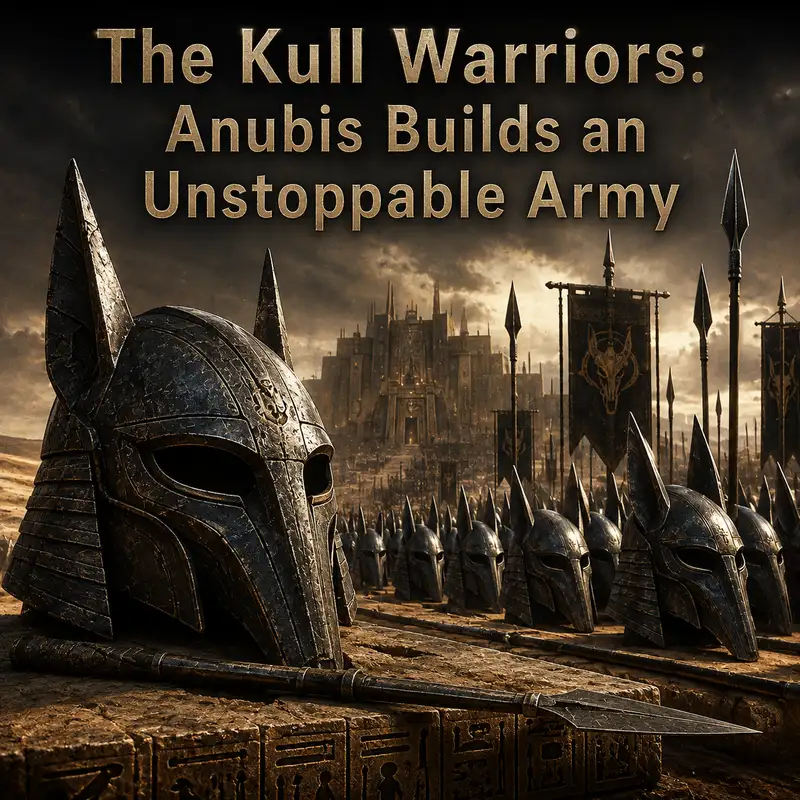
Their armor completed the design. Its outer plates and tightly woven material resisted Earth’s strongest armor-piercing rounds while absorbing staff and zat energy. The helmet incorporated breathing filtration and fitted so closely that parts appeared fused to the body beneath it. Wrist-mounted weapons delivered rapid energy fire without requiring the warrior to carry a separate staff. The suit protected, armed, and sustained the wearer as one integrated system. A Kull could advance under fire while engaging multiple targets, exactly the role needed to break Jaffa defensive lines.
The armor was not literally impenetrable. Carter found that a fine trinium point could pass through the fabric between rigid sections. The discovery suggested an ambush using tranquilizer darts and a one-way Tok’ra force field. Ramius had survived the first attack, making his planet a likely destination for another assassination attempt. Earth teams and rebel Jaffa established positions around the expected route from the Stargate. The plan was technically sound by the standards of the available evidence. The evidence turned out to be incomplete.
The arriving warrior walked through the force field, pulled out two trinium darts, and ignored the tranquilizer. Massed automatic fire did not slow it. Claymores and C four produced dramatic explosions and no useful result. Its return fire wounded Colonel Reynolds and killed rebel Jaffa while enemy ships and reinforcements moved toward the gate. The ambush force lost control of its extraction route and surrendered to Ramius rather than be surrounded. One Kull warrior had disrupted several S G teams, a rebel contingent, and an operation built specifically to capture it.
The capture succeeded only after the Kull completed its mission and killed Ramius. Carter used the ring transporter of a captured cargo ship to move the warrior directly into the sealed hold. The crew then removed life support from the compartment. It took approximately ten minutes for the Kull to lose consciousness, and it fought the ship around it during much of that time. The method proved two important facts. The warrior still required oxygen, and a defense that stopped bullets did not make it independent of the environment.
Interrogation produced almost nothing through ordinary questioning. A Tok’ra memory-recall device succeeded where language failed. When Teal’c asked for the warrior’s planet of origin, the device displayed the sky remembered by the prisoner. Tok’ra star-mapping technology converted those visible patterns into a location. The Kull had given up Tartarus without intending to. Anubis had removed personality and initiative from his soldiers, but he had not removed memory needed for navigation and mission performance. Intelligence collection found the seam that firepower had missed.
Tartarus was built to prevent precisely this kind of penetration. A powerful sensor array watched approaches to the planet. The Stargate stood inside Anubis’s base behind a force field stronger than the one used in the failed ambush. Conventional entry by gate or ship would be detected and contained. The solution was to turn captured Kull armor into an access credential. Jacob Carter, protected by Selmak, wore the suit and walked through the gate barrier because the security system was designed to admit Anubis’s own troops.
Once inside, Jacob disabled the external sensor array. Carter, Teal’c, and Bra’tac then approached in a Tel’tak, using temporary radioactive isotopes to reduce detection by internal sensors. The operation showed the danger of integrating protection and authentication too closely. The Kull armor was excellent battlefield equipment, but its ability to pass the base barrier meant that one captured suit could open the installation to an enemy. Anubis had built a strong gate defense and attached its key to every soldier expected to use it.
The infiltration exposed a manufacturing complex rather than a barracks. Holding tanks supported symbiote production. Laboratories serviced synthetic hosts and armor. The Goa’uld scientist Thoth monitored defects and investigated failures in the process used to govern the symbiote mind. The queen was preparing another spawn cycle without passing on genetic memory. This was not an army growing through recruitment and training. It was a production line, with quality-control problems, biological inputs, technical staff, and a ruler impatient with anything below specification.
Carter, Teal’c, and Jacob destroyed the queen’s chamber with C four. That action prevented another production cycle and removed a critical biological component. It did not destroy the army already completed. From an observation area, they saw hundreds of Kull assembling in disciplined formations, with enough additional facilities to support an estimate in the thousands. The raid had closed part of the factory after the warehouse was full. The team escaped under pursuit, but Anubis retained more than enough finished soldiers to begin his campaign.
The Kull soon demonstrated why the System Lords feared them. They were used to eliminate commanders, break Jaffa formations, and dismantle the forces of rulers who could no longer rely on ordinary troops to hold against them. During Anubis’s campaign against Olokun, Kull units slaughtered Jaffa who resisted and captured senior commanders. Rival Goa’uld could replace a fallen Jaffa unit only by drawing from the same increasingly doubtful warrior culture. Anubis could deploy troops whose obedience had been installed before they were placed in armor.
The battlefield effect extended beyond casualties. Jaffa who saw Kull warriors absorb staff fire and continue advancing faced a weapon designed to invalidate their training and their religious confidence at the same time. Traditional Goa’uld warfare depended heavily on terror, formation, and visible demonstrations of divine protection. The Kull gave Anubis a more convincing demonstration than ceremony. His soldiers appeared immune to the weapons carried by every competing army. Submission began to look less like faith and more like a reasonable estimate of survival.
Earth and the Tok’ra answered with the original Telchak device recovered in Honduras. Carter and Jacob studied its life-giving energy and attempted to reverse the effect. Their prototype did not attack the armor as a conventional projectile. It was designed to counteract the reanimation energy sustaining the synthetic host. Early testing produced a weapon only about seventy percent effective, with limited shots and an inadequately calibrated power unit. The concept existed. A reliable field system did not, which is an important distinction when the enemy has already begun mass deployment.
Anubis attacked the new Alpha Site before development was complete. The base contained Earth personnel, Tok’ra, rebel Jaffa, and the research team working on the counterweapon. Ships entered the atmosphere, the evacuation began, and the base commander activated the self-destruct rather than allow the site and its technology to be captured. Dozens were killed or left missing. The Stargate survived in a crater, but the installation around it disappeared. The attack denied the alliance a base even though it failed to recover the research.
One Kull warrior survived the blast and pursued Carter into the surrounding hills. She was wounded, exhausted, and separated from the prototype’s main firing assembly, but still carried the improved power unit. A downed unmanned aerial vehicle provided a missile, which she rewired into an improvised ambush. The explosion buried the Kull beneath earth and rock. It climbed back out. Large kinetic force could disrupt the warrior, yet even a direct missile strike did not guarantee a kill under field conditions.
O’Neill and Teal’c reached Carter with the partially effective prototype supplied by Jacob. Carter handed over the better-calibrated power unit, and O’Neill fired twice. The Kull collapsed and did not recover. The armor had not been penetrated by a bullet or overpowered by a larger energy blast. The weapon had neutralized the artificial life process beneath it. Earth and the Tok’ra had found the correct target inside Anubis’s system, not by producing more destructive fire, but by understanding what made the soldier alive.
The resulting Kull disruptor changed the tactical problem, but it did not make the warriors harmless. The weapon required a specialized energy module, calibration, trained handling, and enough time for a clear shot. Early units carried only limited charges. Ordinary P nineties, staff weapons, and explosives remained unreliable against intact armor. The best countermeasure therefore had to reach the units likely to encounter Kull, including rebel Jaffa, while surviving the loss of bases and the breakdown of the alliance that had created it.
That alliance paid heavily for the breakthrough. No one established with certainty whether captured Tok’ra intelligence or missing Jaffa recruiters had exposed the Alpha Site. The investigation instead revealed how little each partner shared with the others. The Tok’ra withdrew rather than surrender control of covert operations. The rebel Jaffa left to establish independent bases and leadership. Anubis had failed to seize the counterweapon, but his attack fractured the coalition responsible for developing it. A Kull warrior could be killed. The political damage caused by the Kull program was harder to repair.
Anubis continued using Kull troops as guards, assault forces, and symbols of his authority. They accompanied his campaign against Earth and were deployed against the Ancient outpost beneath Antarctica. By then, Earth possessed disruptors capable of killing them, but only because archaeological recovery, Tok’ra science, and battlefield improvisation had converged in time. Without that narrow technical answer, Anubis’s ground troops could have operated beneath the protection of a fleet that conventional Earth forces were already unable to defeat.
The Kull army also outlived Anubis’s first defeat, which exposed another feature of its design. Ba’al located Tartarus and reprogrammed the warriors to serve him. Their loyalty was not devotion to Anubis as a person. It was an installed command relationship that another Goa’uld with access to the system could alter. With Kull forces under his control, Ba’al gained enough advantage that other System Lords considered capitulation and asked Earth for help. The army was transferable strategic property, much like a fleet, except the ships did not need their beliefs rewritten.
Later fighting revealed the program’s limits. Many Kull were destroyed in combat with the Replicators, an enemy that could consume technology and attack in numbers the armor was never designed to absorb indefinitely. Intelligence later placed many of the remaining warriors on Tartarus, and Anubis deployed Kull forces to Dakara. When Anubis was removed from the conflict, the Kull became disorganized and confused. Rebel Jaffa then defeated them. The soldiers built without independent purpose could continue a mission, but they could not create one after the command authority disappeared.
The production model was therefore powerful and brittle. Synthetic hosts eliminated recruitment time but had short lives. Blank symbiotes eliminated ambition but required controlled spawning, conditioning, and implantation. Armor defeated common weapons but demanded advanced materials, maintenance, and specialized access systems. Centralized programming guaranteed obedience but made the force vulnerable to capture, reprogramming, and command loss. Anubis had built the ideal army for rapid conquest, not for forming a durable society or governing territory without constant direction.
The comparison with the Jaffa is revealing. Jaffa could doubt, defect, argue, and disobey, which made them unreliable servants of false gods. Those same qualities allowed them to organize resistance, build alliances, preserve communities, and continue fighting after a commander fell. Kull warriors were superior in a firefight and inferior in every political function an army eventually performs. They could clear a gate, break a defensive line, and terrorize a rival domain. They could not decide what victory should mean once the last order had been completed.
Anubis came closer than any earlier System Lord to replacing inherited military tradition with deliberate force design. He joined Ancient-derived biotechnology, Goa’uld symbiotes, engineered armor, and industrial production into a soldier that made conventional Jaffa tactics obsolete. The Kull were not truly unstoppable. They could suffocate, fail biologically, be shattered by sufficient force, or be killed by a disruptor aimed at the energy sustaining them. What made them terrifying was that every normal response failed first, often long enough for the mission they were sent to complete.
The Kull program solved Anubis’s immediate problem and exposed the weakness of his larger empire. He created troops who would never betray him, then discovered that they could serve another master when reprogrammed. He created bodies without fear, then left them unable to act coherently when command disappeared. He created armor that defeated the weapons of existing armies, then concentrated production around technology his enemies could study and reverse. The final Kull formations did not fall because they learned freedom. They fell because an army built without choice had no answer when no one remained to tell it what to do.