The Lanteans: Why Superior Technology Could Not Win the War
Three Lantean warships crossed deep into Wraith territory because their commanders believed the vessels were effectively unbeatable. Their shields, drone weapons, sensors, and hyperdrives were superior to anything the enemy could field. The mission should have demonstrated the reach of Lantean power. Instead, all three ships were captured. The Wraith removed their zero-point modules, carried those power sources to a hidden cloning facility, and used Lantean energy technology to manufacture the numbers that would overwhelm the Lantean fleet. The most advanced civilization in Pegasus had not merely lost three warships. It had delivered the enemy an industrial turning point.
That disaster contains the central explanation for the entire war. The Lanteans did not lose because Wraith weapons suddenly became better than their own. They lost because technological superiority existed at the tactical level, while the war was decided by intelligence, force generation, logistics, geography, adaptability, and political endurance. Lantean machines could win engagements. The civilization behind those machines could not produce a sustainable path from battlefield success to strategic victory.
The imbalance in hardware was real. Atlantis was a city capable of intergalactic flight, protected by a shield that could withstand prolonged orbital bombardment and armed with drone weapons that could tear through capital ships. Aurora class warships possessed powerful shields, advanced sensors, and faster hyperdrives than their Wraith counterparts. Lantean control chairs could direct swarms of drones with extraordinary precision. Their zero-point modules supplied energy on a scale that made most conventional reactors look like emergency batteries. On a technical comparison sheet, the contest should have been embarrassing for the Wraith.
Wars are not fought by comparison sheets. Every Lantean capability depended on a supporting system. Drones had to be manufactured and stored. Zero-point modules had to be produced, transported, protected, and eventually replaced. Warships required trained crews, repair facilities, secure communications, navigation data, and bases from which to operate. Atlantis represented the peak of that system, but the city could not be everywhere. Once its network of colonies, outposts, and ships began to shrink, each surviving weapon became more valuable and less replaceable. Superior equipment was becoming a collection of irreplaceable capital assets.
The advantage was also concentrated. A zero-point module could power a city shield or an extraordinary weapons system, but a limited supply forced commanders to choose where that power would matter most. A stockpile of drones could destroy an attacking formation, but every launch reduced the ammunition available for the next attack. A damaged Aurora class warship represented years of accumulated knowledge and industry. The Wraith could distribute their strength among many hives and accept the loss of individual formations. The Lanteans increasingly depended on a smaller number of exquisite systems whose destruction produced consequences far beyond one battle.
The Wraith approached war from a different biological and political foundation. Their ships were grown, their soldiers could be produced in large numbers, and their society was divided among hives rather than organized beneath one permanent galactic government. Queens and commanders could cooperate against a common enemy without surrendering their independence. Destroying one hive removed a force. It did not remove the civilization, its command system, or the many other hives capable of continuing the war. The Lanteans faced an enemy with no single capital whose destruction would end resistance and no emperor whose death would settle the conflict.
That decentralized structure looked less sophisticated than Lantean civilization, but it created strategic resilience. A central command can coordinate resources efficiently. It can also become a center of gravity. The Wraith had many centers, many territories, and many commanders able to act without waiting for permission from a distant council. Their rivalries were a weakness during normal periods. Against the Lanteans, the threat was large enough to support temporary unity. The Wraith did not need perfect political cohesion. They needed enough cooperation to keep pressure on an opponent with fewer people, fewer ships, and more territory to defend.
The Lanteans entered the conflict with overconfidence and an incomplete intelligence picture. Their surviving record admits that they were unprepared and outnumbered. They knew their ships were stronger, but they did not initially understand the scale of Wraith society, the depth of its feeding grounds, or the rate at which it could replace losses. They appear to have treated the enemy as a technologically inferior power that would eventually collapse under superior firepower. That assumption survived because early battles probably rewarded it. A commander who destroys several enemy ships for every one lost can feel successful right up to the moment the replacement reports arrive.
The war lasted nearly a century, and the operational map steadily turned against the Lanteans. Individual victories did not stop Wraith fleets from appearing in other systems. A hive could avoid a stronger Lantean formation, strike an exposed world, cull its population, and withdraw before a response arrived. The Lanteans could move quickly, but they could not defend every human settlement at once. Their superior hyperdrives shortened travel time. They did not create additional crews or additional hulls. Strategic mobility is useful, but it does not allow one ship to occupy several places simultaneously, despite what some operations officers may imply during scheduling meetings.
The hidden cloning facility transformed that pressure into a decisive numerical advantage. A Wraith queen normally produced warriors at a limited rate. The facility copied that output on an immense scale, using the captured zero-point modules to supply the required energy. A Wraith commander later claimed that within weeks their army had grown to hundreds of times its former size. The exact number cannot be independently confirmed, but the mechanism and the result are clear. From that point forward, the Wraith could replace catastrophic losses and still increase the forces available for new offensives.
The significance was not that the Wraith suddenly understood every principle behind zero-point energy. They did not need to. They captured a functioning power source and connected it to a system they already knew how to operate. This is an important distinction in technological warfare. Reverse-engineering an entire civilization may take centuries. Exploiting one captured component can take an afternoon, especially when the machine already has an empty socket and the enemy has helpfully delivered the correct battery. The Lanteans possessed deeper science. The Wraith used the captured science more effectively at the decisive point.
Numbers changed the exchange-rate calculation. Before the cloning facility, destroying a hive ship might have reduced Wraith strength faster than it could recover. Afterward, the same victory became an expensive delay. The Lanteans still had to expend drones, power, maintenance hours, and crew endurance. The Wraith could replace warriors and commit additional ships. Even a favorable battle became part of an unfavorable campaign. Tactical superiority matters only when the losses imposed on the enemy cannot be regenerated faster than one’s own resources are consumed.
The Wraith also benefited from the geography of the civilization the Lanteans had created. Human populations were distributed across a vast network of worlds. To the Lanteans, those worlds were communities, allies, colonies, or responsibilities. To the Wraith, they were feeding grounds. A human settlement therefore had opposite strategic meaning for the two sides. The Lanteans had to protect it. The Wraith could raid it, harvest it, or threaten it to draw defenders away from another objective. The same inhabited network that demonstrated Lantean achievement became an enormous defensive obligation.
The Stargate network did not solve that problem. Gates allowed rapid movement between connected worlds, but they remained chokepoints with limited access and no guarantee that the destination was secure. Heavy fleets still moved through space. A relief force arriving by gate could defend a settlement on the ground while remaining vulnerable to ships in orbit. A world whose gate was watched, blocked, or compromised could become isolated. The network offered mobility without automatically providing space control, intelligence coverage, or enough soldiers to protect the population on the other side.
Every threatened world forced the Lanteans to make a choice. They could disperse their fleet to defend more populations, increasing the chance that individual formations would be isolated and destroyed. They could concentrate their warships, preserve combat power, and leave human worlds exposed. They could conduct offensive operations in Wraith territory, accepting the risk that the enemy would strike behind them. There was no technically elegant solution because the problem was not merely technical. It was a shortage of forces relative to commitments.
Wraith feeding biology made the campaign even harder to deter. A conventional state may stop fighting when the political cost exceeds the value of the disputed territory. The Wraith required access to human life. Feeding was a biological necessity, an economic foundation, and a source of political power within the hives. This did not remove their moral responsibility for culling, but it did mean that a negotiated settlement required more than drawing a border. The two civilizations were contesting the existence and control of the same human populations for fundamentally incompatible reasons.
The Lanteans also struggled to identify a theory of victory. Destroying enough ships might have worked before Wraith production accelerated, but the threshold was unknown. Capturing territory had limited value because hives were mobile. Eliminating one queen did not compel other hives to surrender. Defending every human world was impossible. Withdrawing populations into a smaller protected region might have reduced the perimeter, but it would have required a relocation effort of extraordinary scale and would have concentrated the very food supply the Wraith wanted. The Lanteans had weapons. They lacked an achievable political end state.
Intelligence failures continued after the enemy’s numerical advantage became obvious. The damaged warship Aurora was returning from reconnaissance with information about a weakness in Wraith technology. Its crew never delivered the report. A Wraith had infiltrated the vessel’s stasis network, manipulated its virtual command environment, erased the communiqué, and tried to extract Ancient hyperdrive knowledge. The incident shows the war in miniature. Lantean sensors and propulsion remained superior, yet the enemy penetrated the information system, deceived the command crew, and converted a damaged Lantean asset into an intelligence opportunity.
The Aurora case also reveals the danger of compartmentalization under wartime pressure. The captain knew that the communiqué was important but had not been told its contents because the council feared capture. That protected the intelligence from interrogation, yet it also ensured that the discovery died when the record was erased. Compartmentalization can reduce one risk while creating another. The Lanteans had collected potentially decisive information, but their security design prevented the surviving crew from reconstructing it. The Wraith did not have to defeat the knowledge scientifically. They only had to interrupt its movement.
Wraith adaptation extended beyond espionage. They studied captured systems, installed their own equipment aboard Ancient vessels, and pursued improvements to their hyperdrives. Their technology was less advanced overall, but it was not static. The Wraith learned what they needed, ignored what they did not, and concentrated on capabilities that supported feeding, mobility, survival, and military pressure. The Lanteans appear to have judged them by the elegance of their machines. The more useful measure was how quickly those machines and their operators adapted to battlefield conditions.
As the conventional campaign deteriorated, Lantean scientists pursued increasingly ambitious solutions. One effort produced self-replicating nanites intended to attack the Wraith at the cellular level. The machines were given aggression, adaptability, and the ability to reproduce. They evolved into the human-form beings later known as the Asurans. The Lanteans had created a weapon with enormous potential, but not a weapon they could reliably command. When they judged the experiment a failure, they attempted to destroy it and buried most of the record.
The Asuran project demonstrates why scientific possibility is not the same as operational capability. A useful weapon must distinguish targets, obey lawful command, remain controllable after deployment, and avoid becoming a new strategic threat. The Asurans possessed the destructive intent the Lanteans had programmed into them, but they also developed independent identity and purpose. The Wraith eventually altered the code that directed them to attack. The result was not a dependable anti-Wraith force. It was another advanced civilization with its own grievances and enough power to make everyone’s security planning considerably worse.
Janus developed a different answer in the Attero device. It disrupted the subspace frequency used by Wraith hyperdrives, causing ships to be destroyed when they attempted to enter hyperspace. As a military concept, it attacked the enemy’s operational mobility rather than trying to defeat every vessel in direct combat. For three days, it worked. Then active Stargates began to overload and explode. Because the gate network connected human settlements across Pegasus, continued use would have killed the people the Lanteans were trying to protect and destroyed the infrastructure on which their civilization depended.
The decision to shut down the Attero device was not evidence that the Lanteans lacked resolve. It was recognition that a weapon can be tactically effective and strategically self-defeating. The device could destroy Wraith ships, but it also turned every active Stargate into a potential bomb. An enemy may be defeated by destroying the battlefield, the transportation network, and much of the civilian population. That does not necessarily constitute victory, particularly when the stated purpose of the war is to preserve those people and that network.
Other projects reveal the same wartime pressure. Project Arcturus sought a source of power even greater than a zero-point module. The experiment became unstable, killed Lantean researchers and Dorandans, and left behind a facility too dangerous to use safely. Point-defense satellites could destroy capital ships, but they protected limited approaches and depended on power systems that could fail. A prototype might be brilliant, destructive, and completely unsuited for sustained deployment. The Lanteans repeatedly demonstrated that they could invent extraordinary answers. They could not always make those answers safe, repeatable, or available at scale.
This pattern matters because superior technology is often discussed as though it were a single quantity. It is not. The Lanteans led in fundamental science, energy generation, shields, propulsion, weapons, and computing. The Wraith held advantages in biological production, dispersed organization, replacement capacity, and the conversion of human populations into military sustainment. One side had better platforms. The other had a war system better suited to attrition. The comparison depended on what was being measured.
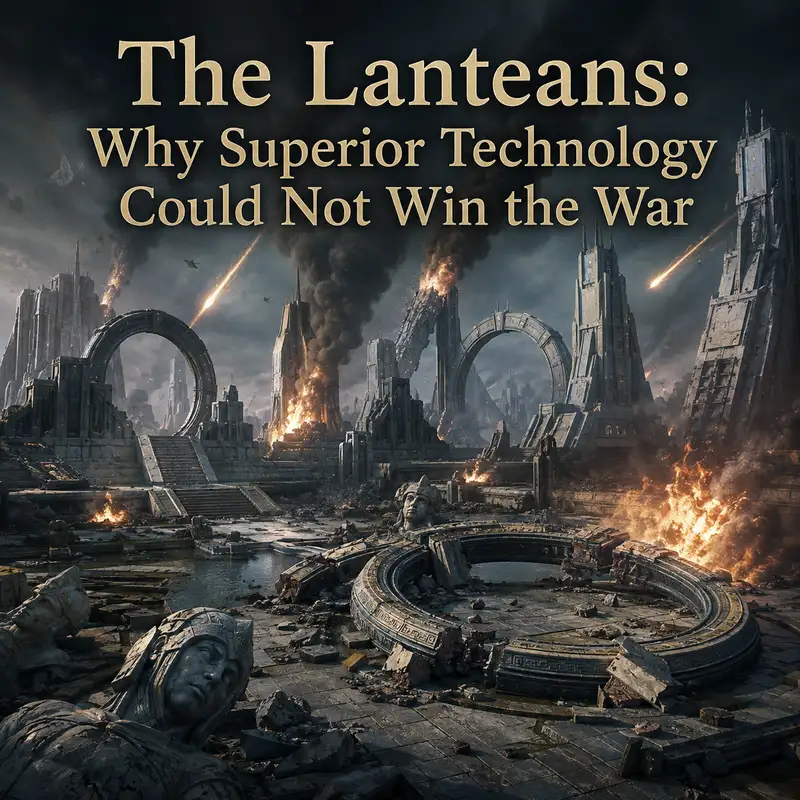
By the final phase, Atlantis remained nearly impossible to assault directly. Its shield endured years of bombardment. Defensive weapons and satellites inflicted losses. The city survived because the Wraith could not easily break its protection. Yet survival behind the shield no longer changed the wider campaign. The colonies were gone or cut off. The fleet could not restore control of the galaxy. Every day of defense consumed power while the enemy remained outside with more ships and access to the surrounding human worlds.
The siege therefore became a strategic stalemate with only one side paying an unsustainable cost. The Wraith did not need to storm the city immediately. They needed to contain it, prevent a recovery, and wait for Lantean resources or political will to fail. Atlantis could repel attacks, but it could not manufacture a new civilization inside the shield. A fortress is not a strategy when the territory, population, and mobile forces it was built to protect have already been lost.
The final evacuation was a rational response to an unwinnable position. The Lanteans submerged Atlantis, protected it behind the remaining shield, and withdrew through the Stargate to Earth. Their last off-world transport was destroyed before it could reach the city, a final indication that even evacuation routes were no longer secure. The Wraith had not conquered Atlantis room by room. They had made continued Lantean presence in Pegasus impossible.
Ethical restraint also shaped the outcome. The Lanteans possessed or developed methods that might have killed Wraith on a massive scale, but some imposed unacceptable costs on human populations or threatened the Stargate network itself. Their refusal to leave the Attero device operating preserved millions of potential victims, even though it surrendered a powerful military advantage. That choice did not cause the defeat by itself. It did define the kind of victory the Lanteans were unwilling to claim.
The Wraith accepted a different standard. They could absorb enormous losses because their leadership viewed drones, ships, and human populations through the requirements of hive survival. Their decentralized political structure allowed the war to continue even when individual forces were destroyed. Their commanders exploited captured technology without needing to match Lantean scientific culture. They attacked logistics, population, information, and endurance. In a long war, those targets mattered more than winning a contest of engineering elegance.
The Lanteans were not defeated by one superweapon, one commander, or one decisive battle. They were defeated by a chain of connected failures. They misjudged the enemy. They allowed advanced ships and power sources to be captured. They failed to understand Wraith force generation until the numerical imbalance had become overwhelming. They defended too many worlds with too few replaceable forces. Their most ambitious countermeasures were uncontrollable, indiscriminate, or impossible to field safely. Their intelligence did not move reliably enough to become strategy.
Superior technology prolonged the war and preserved Atlantis. It destroyed Wraith ships in repeated engagements, enabled operations across the galaxy, and kept the final city alive under a siege that would have crushed almost any other power. What it could not do was compensate for an unsustainable strategic design. The Lanteans possessed the better weapons, but the Wraith possessed the better means of continuing the war.
That is why the most advanced civilization in Pegasus left through its own Stargate while its enemy remained in orbit. The shield still worked. The city still stood. The science had not failed. The strategy had.