The Long Sleep: Stasis and Destiny’s Unfinished Escape
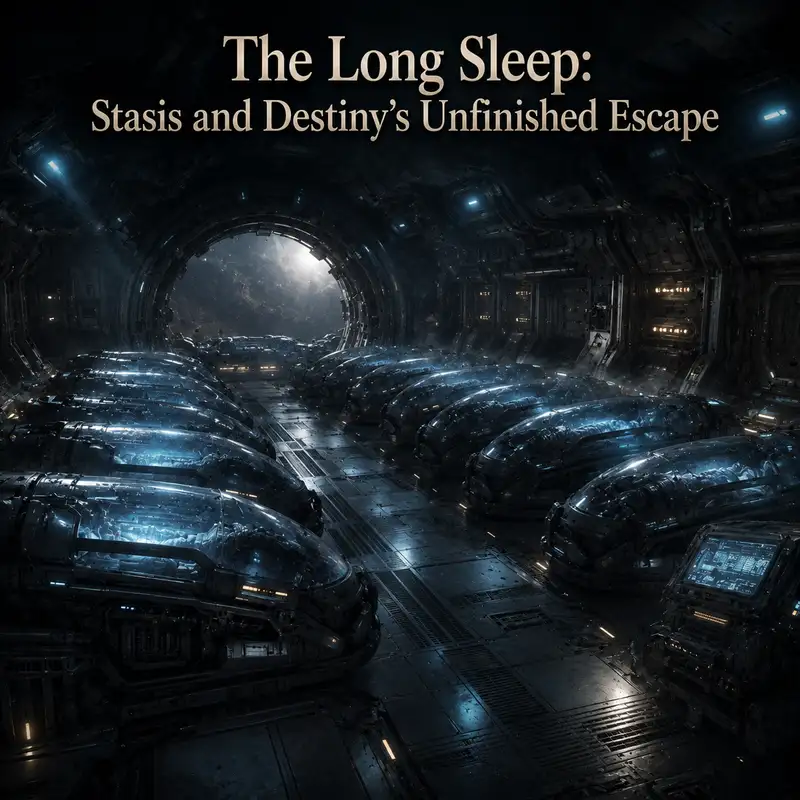
Power shut down across Destiny one compartment at a time. Lights faded in the corridors, consoles went dark, and the occupied sections of the Ancient ship became silent. Eli Wallace walked past rows of stasis chambers containing everyone who had shared the voyage from Icarus Base. Colonel Everett Young and Nicholas Rush were the last to enter. Once their pods sealed, Eli was the only conscious person aboard. He had roughly two weeks of minimal life support, a malfunctioning chamber, and more than seventeen hundred pages of Ancient technical documentation between himself and death.
The long sleep was not a planned phase of Destiny’s mission. It was a strategic withdrawal forced upon a crew that could no longer use the route ahead. The expedition had survived failing life support, alien attack, a Lucian Alliance occupation, time displacement, and the destruction of a human civilization descended from an alternate version of itself. None of those events had removed its most basic limitation. Destiny required stars for energy and Stargates for supplies. The automated drones learned both patterns and positioned command ships where the Ancient vessel had to go.
Rush and Eli improved Destiny’s sensors enough to detect the subspace signals linking drone command ships to their attack formations. The breakthrough was supposed to reveal safe gaps. Instead, it produced a map of the blockade. Command ships were waiting near every accessible Stargate from Destiny’s position to the edge of the galaxy. The crew had about a month of food and water. Homeworld Command could offer advice through the communication stones but no supply line. The only known planet capable of providing enough power to dial Destiny still refused to permit the attempt.
Leaving the Ancient route did not provide a practical alternative. The seed ships had spent immense spans of time identifying viable systems and placing Stargates on selected worlds. Beyond that prepared corridor lay hundreds of billions of stars, only a fraction with planets and a smaller fraction with environments that might support human life. Searching ungated systems by shuttle could require months or years between usable worlds. Destiny could leave the road, but the crew would lose the reconnaissance, access, and logistics that made the voyage survivable.
The expedition tested whether force could reopen that road. Rush proposed tuning Destiny’s shields to match the limited energy range of the drone weapons. The adjustment made ordinary fire far less effective, allowing the ship to surprise a command vessel and attack at close range. The drones adapted before the battle was finished. When their weapons stopped penetrating the shield, they rammed Destiny directly. Each machine became a guided projectile, exchanging a replaceable drone for damage to a ship whose manufacturer had ceased supporting the model more than a million years earlier.
Destiny destroyed the command ship and gained enough time for teams to collect a small amount of food from the nearby world. The tactical operation succeeded. Its strategic result was a warning. The ship had lost shield strength, weapon positions, power distribution, and structural margin during one resupply mission. The crew could repeat the method, but every victory would leave Destiny less capable of surviving the next one. They were not fighting toward freedom. They were consuming the ship in installments.
Eli’s solution was to stop fighting for access to the galaxy and bypass it. Destiny was only about a third of the way through the region. It would have to continue past the remaining systems, cross a larger intergalactic gap than the one before it, and reach the first seeded Stargates in the next galaxy. Battle damage had reduced faster-than-light performance, and there was no time to complete major repairs. The estimated journey was three years, with enough uncertainty around the estimate to make everyone aboard understandably attentive to the phrase “give or take.”
The ship possessed enough stored energy for one continuous faster-than-light crossing, but only under severe conditions. Almost every nonessential system had to be shut down. The crew could not remain awake because life support for dozens of people would consume the reserve before Destiny reached the next network. The ship could not stop to recharge because the drones controlled the stars and any interruption would destroy the power calculation. If the estimate fell short by even a small fraction, Destiny could leave faster-than-light travel in the intergalactic void and require a thousand years or more to drift the remaining distance.
Stasis converted that impossible energy budget into a possible one. Once sealed inside a chamber, a person’s metabolism dropped to the point that food and water were unnecessary for the duration. The pods maintained the occupants while Destiny shut down the atmosphere, lighting, temperature control, and support systems needed by an awake population. They were not simply beds with very effective doors. They were individual life-support environments able to suspend biological demand while the larger ship went dark.
The surviving record does not provide a complete medical description of the process. It does not establish that occupants were frozen, explain every physiological control, or show the long-term effects of remaining suspended for years. Eli and Adam Brody had tested the system enough to determine that the chambers worked. That was not the same as completing a controlled three-year medical trial. The crew had access to Ancient technology, partial diagnostics, and no qualified Ancient physician. Stasis was safer than thirst and more uncertain than an ordinary night’s sleep.
The chambers also required power and functioning components. Their advantage was that their combined demand was low enough to preserve the crossing reserve, not that they operated without energy. Every pod became a separate point of failure. A seal, control circuit, power conduit, medical interface, or wake sequence could malfunction while no technician remained conscious to respond. The plan replaced the expedition’s food, water, and air requirements with dependence on automation the humans had not designed and could not monitor during the voyage.
Rush objected for another reason. Destiny’s mission depended on collecting information across its entire route. The ship was not traveling toward one final location where the answer waited. It accumulated observations piece by piece as it crossed galaxies prepared by the seed ships. Skipping most of one galaxy could mean bypassing data essential to the pattern the Ancients had detected in the cosmic background radiation. From Rush’s perspective, the long sleep preserved the vessel by abandoning part of the reason the vessel existed.
Young gave him one day to produce a better answer. Rush could not. That failure did not mean Eli’s proposal was safe. It meant every alternative was worse. Remaining on the route required repeated battles and supplies the ship could not obtain. Going off route surrendered the gate network without offering a reliable planet. Waiting consumed power and food. The commander therefore authorized preparation for a maneuver that might preserve the crew, damage the Ancient mission, and leave everyone unable to correct an error for three years.
Initial inspection revealed that several corridors contained enough stasis chambers for the expedition. Powering them all exposed a new problem. The final section had suffered damage, perhaps before the humans ever boarded Destiny. Eight pods would not come online. The science team identified a failed material used in high-temperature superconductors within the pod system. They needed palladium hydride, obtainable from ores associated with heavy meteorite activity. Destiny did not carry a replacement stock.
The only likely source was a world the ship had locked out as dangerous. Repeated impacts had made the surface hazardous and possibly toxic. A drone command ship remained in the system. Entering another battle would consume the energy reserved for the three-year jump. Failing to enter meant eight people could not be placed in stasis. Keeping those eight awake was not a compromise. Their life-support demand would cause Destiny to fall short, and the crew did not have enough supplies to sustain them for the full crossing.
The arithmetic converted a repair shortage into a command decision about eight deaths. Young would have to choose people to remain outside, allow them only the short period before their consumption threatened the ship, and expect them to shut down their own life support. Rush treated the choice as unavoidable if the material could not be obtained. Greer rejected the idea of volunteering while leaving seven others to face the same end. His assessment was that the expedition had arrived together and, if necessary, would fail together. That was morally coherent and strategically fatal.
Lisa Park found the operational alternative. Destiny would release an unmanned shuttle near the target system and make it transmit a subspace burst resembling a Stargate activation. The command ship would investigate and take its drones away from the planet. While the machines pursued the decoy, Destiny could remain at a safer distance, dial the planetary gate, and send a team to collect meteorite material near the impact craters.
The shuttle was already an irreplaceable asset. Destiny carried only two, and both had been used for reconnaissance, rescue, and operations beyond gate range. Park’s plan deliberately exchanged half of that capability for enough material to place eight people in stasis. The sacrifice made strategic sense because a shuttle was useful only if a crew remained alive to fly it. Earth had acquired many advanced platforms during the Stargate Program. Destiny specialized in reminding its passengers that possession and replacement were unrelated concepts.
Rush remotely piloted the decoy while Scott, Greer, and Morrison crossed the Stargate in Ancient spacesuits with a kino-supported cargo sled. The team could identify promising rock but could not test the exact concentration on the surface. Its task was therefore to gather as much material as possible before the drones recognized the deception. The operation combined electronic deception, remote flight, gate logistics, hazardous-material collection, and a departure clock that offered little room for a second attempt.
The command ship took the bait. When its drones closed on the shuttle, Rush flew an evasive pattern while Eli overloaded the engines. The shuttle struck the command vessel and destroyed it. At the same time, the away team filled two sleds with material from the impact sites and returned through the gate. The operation removed one command ship, cost one shuttle, and recovered the component needed for the stasis repairs. It was a tactical exchange designed around the only strategic resource that mattered: enough chambers for everyone.
The science team repaired the eight pods, and the expedition began preparing for departure from ordinary life. Camile Wray arranged short communication-stone visits so personnel could contact Earth before entering stasis. The stones could not transfer anyone home or deliver another power source. They allowed the crew to explain that, even under ideal conditions, they would disappear for at least three years. The command channel became a farewell system because there was no military assistance left to coordinate.
Those visits carried different forms of unfinished business. Scott saw the son who did not know he was his father and could not decide whether intervention from Homeworld Command would improve the boy’s life. Wray reached Earth while Sharon was away and ended their relationship by telephone rather than extend an indefinite separation. Park, blind after the blue-supergiant recharge, used another person’s eyes to watch rain falling on a lake. Eli apologized to his mother for leaving her alone. She asked whether, despite everything, he was happy. He realized that he was.
Young did not visit his former wife. He spoke with Telford and accepted that his marriage had been broken long before the stasis plan. Telford promised that Earth would still be working on the problem when the crew awakened, although neither man could know whether three years would be the true interval. The exchange showed the limit of command across the universe. Homeworld Command could remain loyal, but loyalty could not shorten the distance, restore Destiny’s drive, or create a second Icarus planet.
The last awake group shared a final meal using fresh food that would spoil once the environmental systems shut down. Young described the expedition as a family formed by loss, conflict, and repeated survival. The statement was not simply morale language. Military personnel, civilians, scientists, and former enemies had become one interdependent crew. Stasis required each person to place physical survival in the hands of the same ship and the same technicians. Whatever political divisions remained, the long sleep would treat everyone with impressive administrative equality.
Personnel entered the chambers in groups while Brody and the science team monitored the pods. Blind and injured crew members required assistance. Military leaders surrendered consciousness before the ship was fully secured for the crossing. Medical care ended when Johansen entered her chamber. Security ended when Scott and Greer entered theirs. Civilian oversight ended when Wray was sealed inside. Each pod reduced the active crew until only Young, Rush, and Eli remained to complete the final programming and verify the system.
The last diagnostic revealed that one repaired chamber had failed only after the section became fully engaged. Earlier checks had shown no problem because the damaged subsystem had not been carrying its complete load. The expedition had solved the shortage of eight pods and arrived at a shortage of one. Most of the crew was already suspended, unable to help, advise, or consent to another change in the plan.
One conscious person could remain alive on minimal life support for approximately two weeks before the power demand began consuming the reserve required for the jump. That created a narrow repair window and a hard decision at its end. If the pod could not be restored, the remaining person had to shut down life support and die. Continuing for even a few extra days could cause Destiny to leave faster-than-light travel early. The sleeping crew might awaken after a thousand years of drift, or never awaken at all.
Rush volunteered to remain outside because he considered himself the most qualified to repair the chamber. Young refused to trust him with the final shutdown decision. Their history made the concern reasonable. Rush had concealed control of Destiny, manipulated its course, and repeatedly placed the mission above the preferences of the crew. If he failed after two weeks, he might preserve his own life for a little longer and gamble every person in stasis. Young decided that he would remain awake instead, not because he could fix the pod, but because his death would guarantee the power reserve.
That choice was command responsibility reduced to its hardest form. Young was prepared to exchange any chance of personal survival for certainty that the ship would continue. It was also wasteful. Leaving a person without the ability to repair the system guaranteed a death that solved nothing beyond power discipline. The expedition needed someone technically capable enough to succeed and trustworthy enough to stop if success proved impossible.
Eli supplied that combination. He argued that Young’s survival outside the pod was automatically impossible, while his own offered a genuine chance. He had spent the voyage treated as Rush’s gifted protégé, yet he had solved the ninth-chevron assumption, found the hidden bridge, developed the bypass plan, and repeatedly corrected calculations others had missed. Remaining awake was not a boyish gesture of sacrifice. It was a technical assessment delivered by the person who had designed the crossing.
Rush tried to discourage him and finally acknowledged the ability he had often used without fully respecting. Eli did not need another compliment or formal title. He needed control of the problem. Young accepted because refusal would replace Eli’s uncertain survival with his own certain death. The decision placed the expedition’s commander and senior scientist into stasis while leaving the youngest principal member of the science team responsible for the ship.
Once Young’s chamber sealed, Destiny’s remaining systems powered down. No watch stood on the bridge. No medic monitored the sleeping crew. No security team guarded the Stargate. The ship entered a state closer to its ancient unmanned voyage than anything it had experienced since the Icarus evacuation. Its navigation, faster-than-light drive, power management, stasis system, and wake sequence would operate without human supervision while Eli worked against the last active deadline.
The core live-action record does not establish whether he repaired the chamber, found another way to preserve himself, or died after protecting the crossing. It does not confirm that Destiny completed the three-year journey or that the crew awakened in the next galaxy. Later possibilities discussed outside the screen continuity do not resolve that historical gap. The last confirmed condition is one awake person, one failed pod, two weeks of support, and a ship accelerating into the dark.
The long sleep was therefore an escape only in the conditional sense. It broke the drones’ blockade by refusing to use the stars and Stargates they controlled. It preserved food, water, and power by suspending the people those resources normally sustained. It also surrendered three years, skipped part of Destiny’s scientific route, eliminated human control during the crossing, and placed every life aboard inside machinery that could not be repaired from within.
That is what made the stasis plan strategically sound and profoundly unfinished. The crew had not defeated the drones, reached Earth, or secured another galaxy. It had purchased distance by becoming cargo aboard its own ship. As Destiny moved between the stars, the expedition’s future rested on an automated course, a damaged Ancient chamber, and Eli Wallace standing alone at the observation window, smiling because the impossible problem was finally his to solve.