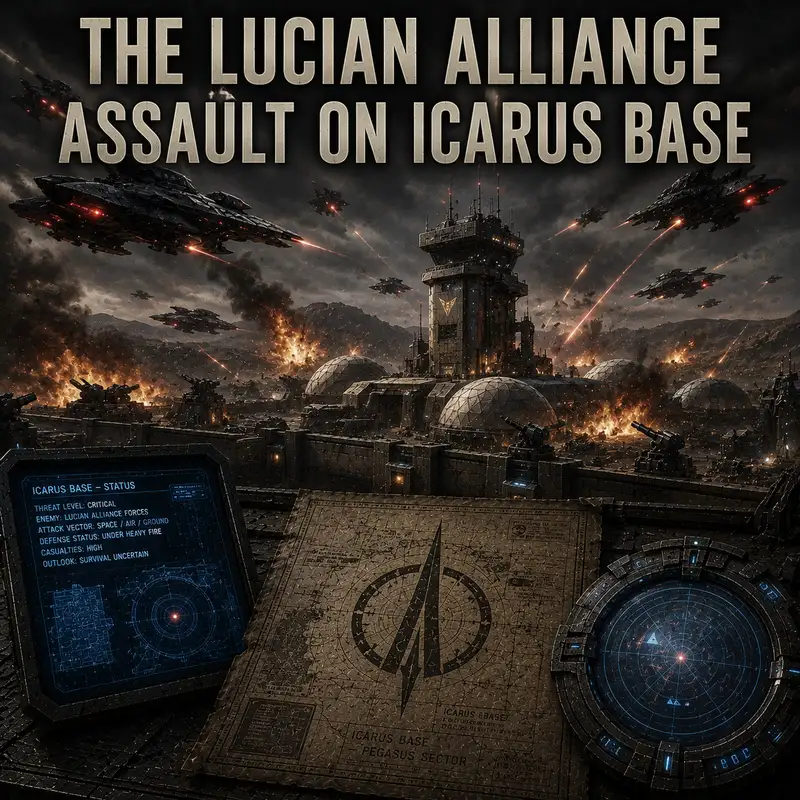
The Lucian Alliance Assault on Icarus Base
Three Ha'tak motherships emerged from hyperspace over the Icarus planet and opened fire without warning. They did not transmit an identity, demand surrender, or attempt negotiation. Colonel Samantha Carter reported that the George Hammond's shields were holding, but the Earth battlecruiser was not the attackers' real target. A full squadron of death gliders and a troop transport were already descending toward the surface. The Hammond and its F three-oh-two fighters had destroyed some of them. The remainder would reach Icarus Base in less than three minutes. Colonel Everett Young did not have time to identify the enemy with certainty. He had time to defend a mountain, move a frightened base population through one gate room, and decide what could still be saved.
The force package revealed more than the attackers' silence did. Capital ships provided orbital fire. Gliders forced the defenders to divide their attention between the sky and the ground. A troop transport carried the means to seize rooms, capture specialists, and occupy the installation after the bombardment had broken its defenses. This was not merely an attempt to destroy a laboratory from orbit. The record does not preserve the Lucian Alliance commander's exact orders, so capture, intelligence collection, and denial remain possible objectives. The landing force strongly suggests that someone expected there to be something worth taking. Later investigation would confirm that the target was not simply Icarus Base. It was the ninth-chevron project and the Ancient destination hidden behind it.
Icarus Base existed because the planet beneath it possessed a core rich in naquadria, an energy source powerful enough to support an unprecedented Stargate connection and unstable enough to make every experiment a planetary safety problem. The base was built inside a mountain, protected by armed personnel, surface railguns, fighters, and the presence of an Earth battlecruiser. Its Stargate had been integrated into the planetary power system and modified for outbound use because an incoming wormhole was considered too dangerous. These measures discouraged casual approach. They did not make it a fortress capable of absorbing a sustained combined-arms attack. Icarus depended first on secrecy, then on distance, and only after those failed on weapons. Once the location was compromised, the base's greatest advantage became a fixed point the enemy could plan against.
The Lucian Alliance had grown in the political wreckage left by the Goa'uld System Lords. It was not a single centralized empire with a uniform chain of command. It was a coalition of warlords, smugglers, mercenaries, commercial networks, and regional powers that had acquired Goa'uld worlds, ships, weapons, and transportation systems. Internal rivalry limited coordination, but decentralization did not mean military weakness. A faction able to assemble three Ha'taks, a glider force, a troop transport, intelligence assets, and trained personnel could conduct a major expedition without controlling the entire Alliance. Icarus demonstrated the danger of treating the organization as ordinary organized crime. The Alliance could turn captured imperial hardware and commercial reach into a military operation against one of Earth's most sensitive installations.
The attack was made possible by an intelligence compromise that remained hidden during the battle. Colonel David Telford had previously operated undercover inside the Lucian Alliance. At some point, the Alliance discovered him and subjected him to Goa'uld-derived conditioning. He returned to Earth appearing to remain a loyal officer, retained access to highly classified programs, and was selected to command the expedition that would pass through the ninth-chevron address. Under hostile control, he provided the Alliance with information about Icarus and the work being conducted there. This was not a case of a disgruntled officer openly defecting. It was more dangerous. A trusted insider continued to pass security checks, attend briefings, and perform his duties while his judgment and loyalties had been manipulated by a method Earth knew existed but failed to detect.
The timing of the assault made the compromise look especially deep. Senator Alan Armstrong was present to review the project his political support had helped fund. Eli Wallace had just arrived after solving the mathematical problem embedded in an online game. Rush was preparing another attempt to lock the ninth chevron. Telford, the designated expedition commander, was on site. The screen record does not establish whether the Alliance deliberately selected that exact test window, but the coincidence is difficult to dismiss. At minimum, the attackers knew where to strike. The evidence suggests they may also have known when the base held its most valuable personnel and the project was closest to success. A classified location had become transparent to an enemy that understood its operational rhythm.
Young's first response was not elegant because surprise attacks rarely permit elegance. He moved to the surface defenses, demanded an assessment from Carter, and prepared the base for contact. Carter could only identify the Lucian Alliance as her best estimate because the ships had arrived firing. Colonel Telford launched with the F three-oh-two force to intercept the transport and the remaining gliders. Base personnel manned railguns and defensive positions. Young released Master Sergeant Ronald Greer from confinement, returned his weapon, and sent him into the fight. That decision was a calculated emergency measure. Greer had disciplinary problems, but he was also a trained combat soldier, and Icarus suddenly needed every person who could hold a defensive line more than it needed a perfectly maintained detention roster.
In orbit, the George Hammond faced a mission more difficult than a simple ship-to-ship duel. The three Ha'taks did not need to destroy Carter's vessel to accomplish their immediate purpose. They needed to keep it occupied while weapons fire and assault craft reached the planet. A defender may possess the stronger individual platform and still fail to protect a fixed site when the attacker can divide the engagement across several axes. Carter had to preserve her ship, block or absorb fire aimed at the surface, coordinate fighter operations, track the transport, and remain available for rescue. The record does not explain why the Hammond did not rapidly eliminate the motherships with its most advanced weapons. It would be speculation to invent a malfunction or technical immunity. What the record does establish is that the Alliance achieved penetration despite the Hammond's presence.
The troop transport was the operational center of the assault. Carter's fighters reduced the incoming formation, but enough craft survived to continue toward Icarus. Telford understood that the defenders' best chance was to destroy the transport before it could land its troops. Once a large ground force reached the mountain, the problem would change from air defense to close protection of entrances, power systems, command spaces, and the gate room. An underground installation can shelter personnel from some bombardment, but it also channels defenders into predictable corridors. The Alliance's combination of gliders and transport was designed to exploit that transition. Gliders suppressed surface positions and forced the railguns to engage fast targets. The transport threatened to place soldiers close enough to turn a strategic base into a room-by-room battle.
Icarus had visible weapons, trained guards, and defensible approaches, but it was fundamentally a scientific and engineering installation. Its surface railguns could destroy aircraft that entered their arcs. They could not create air superiority against capital ships, gliders, and a transport arriving together. Its military contingent could secure laboratories and delay an assault. It could not occupy a wide defensive perimeter while also protecting technicians, civilians, wounded personnel, and the only evacuation point. Every soldier sent to the surface reduced the manpower available inside. Every corridor blocked by debris narrowed the route to the gate. The defenders were not holding terrain for reinforcement. No relief column was approaching through the mountains. Their task was to buy minutes, and the enemy had arrived with enough firepower to make minutes expensive.
Young recognized when defense had become evacuation. He ordered essential personnel to the gate room and directed Sergeant Riley to dial Earth. Preserving the base was no longer possible. Preserving the people and whatever equipment they could carry remained possible, but only through a single doorway. The Stargate offered extraordinary strategic mobility and almost no tolerance for disorder. Everyone had to reach the same chamber. Wounded personnel had to be moved through shaking corridors. Scientific cases, weapons, medical supplies, and communications equipment competed for hands and time. A collapse cut off part of the evacuation route, forcing Young, Greer, and others to recover trapped personnel while the structure continued to fail. The gate was an escape route, a chokepoint, and a deadline made visible.
The deeper crisis was forming below them. Sensors detected a dangerous energy spike in the planetary core. Icarus Base had spent years learning how to draw controlled power from naquadria. The assault introduced repeated shock and damage into that system. Continued bombardment was driving the core toward a chain reaction that could not be stopped from the control room. The base had been placed on the planet because no portable source could provide the same energy. That meant the power plant could not be isolated from the battlefield, shut down, or abandoned while the installation remained intact. The planet itself was now the largest munition in the engagement. The Alliance had successfully attacked the project and, whether through ignorance or indifference, had also started destroying the ground beneath its own assault force.
The order to evacuate to Earth should have ended the argument. Instead, Dr. Nicholas Rush stopped the dialing sequence. He believed that the energy released by the failing core might translate through an open wormhole and threaten the receiving gate on Earth. He redirected the system toward the nine-chevron address after Eli identified the correct point of origin. Young had not authorized that destination. No advance team had crossed, no receiving site had been surveyed, and no return route existed. The assault turned a dispute that should have required scientific review and command approval into a decision made while the ceiling was falling. Young could defend the base or supervise the gate room, but he could not restore a normal decision process after Rush had replaced the evacuation address with the objective of the entire Icarus Project.
The people who crossed were therefore not the expedition that Earth had planned. They were whoever survived long enough to reach the gate. Military personnel carried weapons and cases. Scientists grabbed what work they could. Medics tried to move casualties. Civilians who had arrived for a demonstration became evacuees. Some personnel were separated by structural collapse. Others were wounded during the bombardment or the rush to escape. Young was badly injured as the last groups went through. Senator Armstrong reached the destination with injuries that would soon prove fatal. The assault did more than destroy Icarus. It selected the crew of Destiny by proximity, luck, and physical access to one room. Training plans, command assignments, medical staffing, and supply manifests were replaced by the contents of a panicked evacuation line.
Telford's role during the battle remains one of its most important contradictions. Later evidence proved that he had compromised Icarus while under Lucian Alliance conditioning. Yet during the assault he launched in an F three-oh-two and fought the incoming force. He warned the base when the attackers could no longer be held back and remained with the air battle until he was recovered by the Hammond. Nothing in the established record proves that he deliberately sabotaged the defense or allowed the transport to pass. The Alliance may have expected him to preserve his cover. He may not have known the exact timing or tactical plan. His conditioned mind may also have permitted him to perform apparently loyal actions while serving a larger hostile purpose. Intelligence history is full of agents whose usefulness depended on looking most trustworthy when the crisis began.
The planet exploded shortly after the evacuation. The blast consumed Icarus Base, destroyed the unique power source, and caught the Lucian Alliance ships before they could escape. The attackers had achieved a devastating result. Earth lost the installation, its research infrastructure, and any immediate ability to repeat the dialing experiment. Yet the Alliance also lost the assault force and failed to occupy the target. If the objective was capture, the operation ended in disaster. If the objective was to deny Earth the base, it succeeded at an extraordinary cost. If the objective was to gain access to Destiny, it produced the most perverse outcome of all. Earth personnel reached the Ancient ship, but neither Earth nor the Alliance controlled the connection that sent them there.
As a military plan, the assault displayed real competence. The Alliance obtained sensitive intelligence, concentrated force without warning, ignored the defending battlecruiser as a distraction, attacked the fixed objective, and combined orbital fire with fighter and transport operations. The defenders had less than three minutes before the first assault craft reached the base. That is an effective surprise attack. The plan's weakness was scientific and logistical. The Alliance treated Icarus as a conventional fortified outpost rather than a laboratory attached to an unstable planetary core. Sustained bombardment threatened the very facility they appeared to want. The force had no demonstrated method for stabilizing the planet, extracting the research after a chain reaction began, or withdrawing its capital ships before the core detonated. Tactical precision carried them to the target. Incomplete technical intelligence destroyed them there.
Earth's greater failure occurred before the first Ha'tak arrived. Icarus was secret, remote, and inaccessible through normal incoming gate travel. Those protections were intended to make discovery and infiltration difficult. They could not compensate for an officer who already knew the location, mission, staffing, procedures, and strategic value of the project. Telford's undercover service had placed him close to the Alliance and then returned him to positions of extraordinary trust. Known Goa'uld conditioning should have made psychological compromise a standing counterintelligence concern. Instead, the system treated his return as a security problem that had been resolved. The project did not fail because information was available to too many people. It failed because one carefully placed person possessed almost every piece the enemy needed.
The Alliance's motives also deserve more than the label of criminal greed. Its leaders emerged from worlds transformed by the collapse of Goa'uld rule. Earth and its allies had helped destroy an imperial order, then lacked the resources and authority to stabilize every region left behind. Ambitious local powers filled the vacuum. Some Alliance figures could plausibly argue that Earth was monopolizing Ancient discoveries while claiming to act for the wider galaxy. That grievance did not make the assault legitimate. The Alliance used a conditioned officer, attacked without warning, endangered civilians, and attempted to seize a project through force. Its later claim that Destiny should be shared was difficult to separate from its intention to control the ship. Understanding the political resentment behind the attack does not require mistaking conquest for liberation.
Icarus Base failed as a defensive system because too much depended on one irreplaceable location. The naquadria planet could not be moved. The dialing infrastructure could not be reproduced quickly. The modified Stargate restricted access. The base relied on one nearby battlecruiser and a limited fighter and ground-defense force. There was no second Icarus site ready to continue the mission, no equivalent power source available for an immediate retry, and no safe method to preserve the installation once the core became unstable. This was understandable. Unique scientific opportunities often create unique military vulnerabilities. The base was designed to exclude intruders and protect a dangerous experiment. It had not been designed to survive a fleet action while an insider supplied the enemy with the address.
The defense still accomplished something important. Carter and the Hammond prevented the attackers from operating without opposition. The F three-oh-twos reduced the incoming wave and bought time. Ground crews manned exposed weapons while the base shook beneath them. Young shifted from defense to evacuation before the perimeter fully collapsed. Greer, Scott, Tamara Johansen, Riley, and others kept people moving, treated casualties, restored blocked routes, and carried equipment through the gate. The result was not a clean rescue. Personnel died, the intended command structure was broken, and the survivors reached an unknown destination with inadequate supplies. Even so, dozens escaped a planet that was already beyond saving. Tactical discipline could not preserve Icarus, but it prevented the loss from becoming total.
For Homeworld Command, the immediate aftermath was an intelligence nightmare. The evacuees had been ordered to Earth, yet none arrived. The Icarus planet was gone. The Hammond survived with Telford, but the principal scientists, military personnel, and visiting civilians had vanished through an unknown connection. Only later did residual memories transferred through the Ancient communication stones expose Telford's meetings with Alliance contacts. The investigation revealed that the Icarus attack was part of a larger effort to reach Destiny. Commander Kiva's faction had obtained the dialing research, located another naquadria-rich planet, and intended to send its own force to seize the ship. That later operation transformed the first assault from an isolated raid into the opening move of a continuing campaign.
The battle also changed how the Lucian Alliance had to be understood. It was no longer merely a network trafficking in crops, weapons, and stolen ships at the edge of Earth policy. It had penetrated Homeworld security, attacked a strategic base, challenged an Earth battlecruiser, and pursued an Ancient asset beyond the known galaxies. The Alliance did not need superior science or a unified empire to create strategic effects. It needed access, surprise, and enough inherited Goa'uld hardware to overwhelm one critical point. Earth had spent years becoming stronger in open combat. Icarus showed that strength in ships and weapons did not automatically protect a classified program from subversion. The enemy reached the battlefield before the first vessel entered hyperspace because the decisive breach had already occurred inside Earth's security system.
The Lucian Alliance assaulted Icarus Base because it possessed the location, understood the value of the ninth-chevron project, and believed concentrated force could take what secrecy had kept from it. The attack succeeded because Icarus was a fixed and irreplaceable target whose defenses were built around remaining undiscovered. It failed because the Alliance did not fully understand the planetary system it was bombarding and could not control the destruction it began. Earth saved part of the garrison by losing control of its destination. The Alliance destroyed the base it appeared to want and died in the explosion. Icarus fell not because its defenders lacked courage or weapons, but because a secret known by the wrong officer had turned a unique power source into a target, and the target into a bomb.