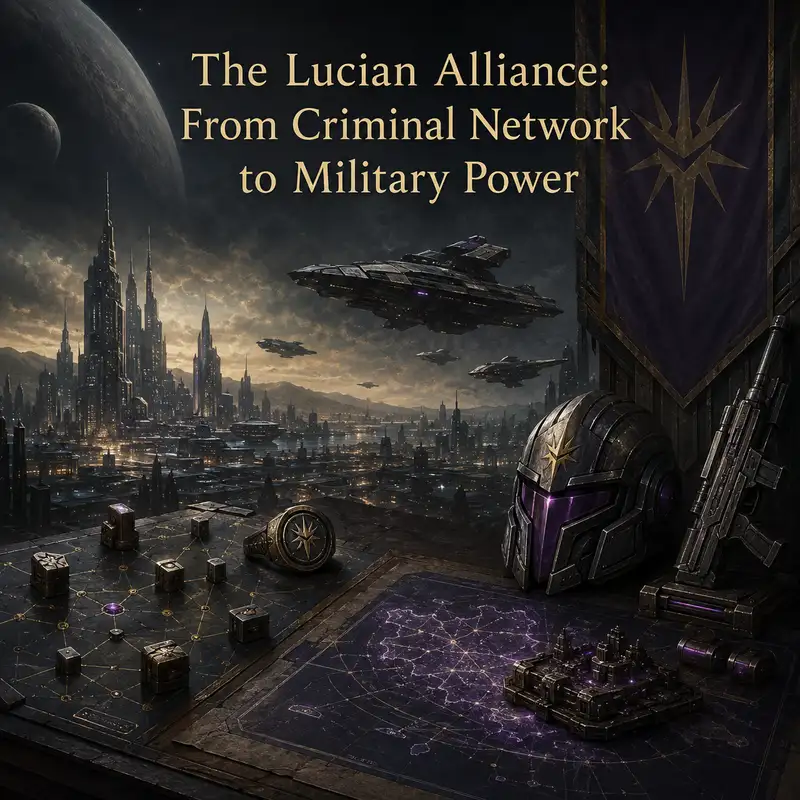
The Lucian Alliance: From Criminal Network to Military Power
Three Ha’tak motherships emerged over the Icarus planet and opened fire on one of Earth’s most secret installations. Death gliders and a troop transport descended while the George Hammond fought in orbit. The attackers knew the location, understood the value of the ninth-chevron project, and had enough force to challenge an Earth battlecruiser while landing troops against a fortified base. Only a few years earlier, Stargate Command had described the Lucian Alliance as a coalition of smugglers and mercenaries. At Icarus, that coalition arrived as an intelligence service, expeditionary fleet, and assault force.
The Alliance did not become a military power by replacing the Goa’uld with a new centralized empire. It became powerful by occupying the spaces the Goa’uld left behind. Former smugglers, mercenaries, local warlords, and commercial operators gained access to abandoned worlds, captured ships, frightened populations, and trade routes no legitimate government could secure. They connected those assets through coercion and profit, then used the resulting network to field armed force. The central question is how an organization built around criminal enterprise acquired enough political authority, economic depth, and military capability to threaten Earth.
The organization’s roots appear to predate the final collapse of the System Lords. Ginn later described its history as stretching back roughly twelve or thirteen years. Its rapid rise, however, followed the destruction of the old Goa’uld order. When the Replicators devastated the System Lords and the Jaffa rebellion broke their remaining authority, thousands of worlds gained freedom without receiving stable governments, protected trade, or replacement institutions. The fall of an empire removed rulers and armies. It did not automatically provide food distribution, courts, engineers, or anyone willing to repair the hyperdrive on an abandoned mothership.
That vacuum favored groups already accustomed to operating between jurisdictions. Smugglers knew the routes. Mercenaries knew the weapons. Former collaborators knew which warehouses, mines, and estates had belonged to which Goa’uld. Local strongmen knew which communities could be intimidated and which rivals could be bought. The Alliance offered cooperation among these actors without requiring them to surrender all local control. It was less a nation than a negotiated market for force, information, transport, and protection. That made it difficult to govern and equally difficult to destroy.
Under Netan, the Alliance developed a recognizable hierarchy. Its territory was divided among lieutenants called seconds. Stargate Command assessed that roughly twenty of these figures oversaw regional operations involving smuggling, extortion, racketeering, and the trafficking of kassa. A second might control several planets, production sites, ships, and armed personnel while still acknowledging Netan as the senior leader. Authority flowed downward through patronage and fear rather than a professional civil service. Netan could grant territory, punish failure, and coordinate fleets, but he depended on ambitious subordinates who were powerful enough to challenge him.
This structure solved an immediate expansion problem. The Alliance did not need to administer every captured world directly from one capital. Regional leaders collected revenue, maintained local forces, and protected their own commercial systems. The center received loyalty while the seconds retained substantial autonomy. The price was permanent instability. A lieutenant who gained ships, profitable territory, or a dramatic military victory could become a rival. Every failed campaign weakened not only the organization’s position against an enemy but also the leader’s position inside the Alliance.
Kassa became the clearest example of how criminal commerce could support political control. The crop resembled corn but contained a highly addictive psychostimulant. The Alliance controlled major growing areas, moved the harvest through protected shipping routes, and distributed it across human worlds. The product generated profit, created dependent customers, and gave local commanders leverage over agricultural communities. It was narcotics trafficking organized at interplanetary scale, with farmland, transport vessels, armed guards, and market enforcement serving the same system.
Ginn’s account showed the harsher side of that economy. On her world, Alliance forces burned local crops until the population depended on food supplied by its occupiers. The Alliance then shaped education and recruited young people into its armed organizations. Ginn herself was forced into the Alliance Guard under threat to her family. This was not merely a cartel selling an illegal product to willing buyers. It was a political authority using food insecurity, addiction, and violence to restructure a society. The difference between criminal enterprise and government becomes less comforting when the criminals control the harvest, the school, and the rifle.
Economic control financed military control, but the Alliance’s fleet came primarily from the civilization it replaced. Ha’tak motherships, Al’kesh bombers, Tel’tak cargo ships, death gliders, ring transporters, staff weapons, and Goa’uld communications systems all became available as System Lords died or lost territory. The Alliance captured, purchased, stole, or inherited these assets and found personnel able to operate them. The surviving record never shows a Lucian shipyard producing Ha’taks at scale. The Alliance inherited a fleet, not the industrial civilization that had originally supported it. That distinction created a military power with impressive hulls and uncertain replacement capacity.
Inherited technology still provided enormous operational reach. A Ha’tak could transport troops, carry smaller craft, bombard a planet, and cross interstellar distances through hyperspace. Cargo ships could move covertly, use rings, and land personnel where a Stargate was watched. Al’kesh could escort convoys or strike fixed targets. These capabilities allowed a decentralized organization to connect territory scattered across the galaxy. They also made local warlords less dependent on the Stargate network. Control of a gate no longer protected a world when an Alliance ship could arrive in orbit.
The Alliance’s early confrontations with Earth revealed that commerce and military force were already integrated. When Ba’al began stealing Stargates from worlds within Alliance influence, Netan did not submit a complaint to a regional authority. He brought three Ha’taks to recover the stolen property. His ships attacked Ba’al’s mothership, disabled its weapons and engines, and demanded both the cargo and the vessel. The objective was economic, but the response was a fleet operation. The Alliance had reached the point where interference with a trade network could trigger capital-ship combat.
Netan also claimed that Alliance spies operated throughout the galaxy. That statement may have included intimidation, but later events showed that the intelligence network was real. Commercial contacts, smugglers, local agents, and former Goa’uld infrastructure gave the Alliance access to information across political boundaries. A government intelligence service normally distinguishes collection, analysis, covert action, and military command. The Alliance often placed those functions in the same hands. It was administratively untidy and operationally useful.
The Free Jaffa Nation viewed this expansion as a direct strategic threat. Both powers emerged from the destruction of the Goa’uld order and inherited parts of its military system. The Jaffa sought political legitimacy and control of worlds their people had helped liberate. The Alliance seized ships and territory through force, trade, and intimidation. Their conflict was therefore not simply law enforcement against smugglers. It was competition over who would control the former imperial space, its transportation routes, and the populations suddenly beyond Goa’uld rule.
The Alliance’s ability to negotiate with other powers also marked its transition beyond ordinary criminality. Teal’c did not approach Netan as a police target when the Ori fleet threatened the galaxy. He approached him as the commander of ships needed for a coalition battle. Netan bargained from self-interest and expected recognition in return, but recognition mattered. Once neighboring governments must negotiate with an armed network over fleet participation, trade access, or control of planets, the difference between outlaw organization and regional power becomes operational rather than semantic.
The Ori invasion briefly pushed those rivals toward cooperation. Teal’c persuaded Netan to commit three motherships to the allied fleet assembled near the Supergate. The decision demonstrated that the Alliance could participate in coalition warfare and deploy capital ships beyond protection of its own commerce. It also produced catastrophic losses. Ori warships overwhelmed the combined Tau’ri, Jaffa, Asgard, and Lucian force. Netan’s surviving ship was badly damaged, and the Alliance blamed Teal’c for drawing it into a battle that had cost ships it could not easily replace.
Those losses exposed the weakness hidden beneath the fleet. An established state can lose ships while retaining shipyards, trained replacements, tax revenue, and institutions strong enough to survive a commander’s embarrassment. Netan led a coalition in which prestige was a form of command currency. When ships were destroyed, plantations suffered, and the Ori seized trading worlds, his seconds did not merely question strategy. They questioned why Netan should remain leader. The Alliance could absorb tactical losses more easily than it could absorb the appearance of weakness.
Anateo’s revolt showed how dangerous that internal competition could become. He used a neutron star and a minefield to trap the Earth ship Odyssey, attacked it with Ha’taks, killed Colonel Paul Emerson, and captured the vessel with Samantha Carter aboard. The operation required intelligence, timing, capital ships, boarding forces, and enough technical competence to hold an advanced Tau’ri warship. It was not the work of an amateur pirate. Anateo intended to present the Odyssey as proof that he deserved control of the entire Alliance.
The same operation demonstrated why the Alliance struggled to convert tactical competence into durable strategic power. Anateo’s first objective was not a common Alliance policy. It was the overthrow of Netan. Cameron Mitchell infiltrated the hierarchy by impersonating the reclusive second Kefflin, then exploited distrust among the commanders. Deception caused Alliance ships to fire on one another while S G One recovered the Odyssey. Earth escaped, Anateo died, and Netan retained power only temporarily. The Alliance had assembled the force to defeat a Tau’ri battlecruiser, then allowed a succession struggle to consume the victory.
Earth responded by attacking Alliance commerce. S G One struck kassa convoys, destroyed cargo containers, and eliminated escorts. After the third attack, Netan’s concern was not only the shrinking supply. He feared that failure to stop S G One made him appear weak before his seconds. He placed a bounty on the entire team and recruited hunters able to reach Earth covertly. The operation endangered civilians and demonstrated impressive access. It also ended with another challenge to Netan. The surviving record strongly implies that the hunter Odai Ventrell turned his weapon on him for a larger reward.
Netan’s likely fall did not destroy the Alliance. That fact is central to understanding the organization. Its power was distributed across regional leaders, planets, fleets, markets, and coercive networks. A conventional empire might fragment when the emperor died. The Alliance was already fragmented and therefore adapted through replacement. Leadership changed, factions competed, and operations continued. Decentralization made coordinated strategy difficult, but it gave the organization resilience against decapitation.
That resilience made military response unusually complicated. Destroying one convoy reduced revenue but strengthened the argument of rivals who claimed the local commander was weak. Killing one leader could trigger succession violence without removing the farms, ships, or agents controlled by the surviving seconds. Capturing a planet did not dismantle trade routes on other worlds. Earth could raid the Alliance, and the Free Jaffa could contest its territory, but neither possessed enough forces to police the entire former Goa’uld domain. The Alliance survived inside the gap between the ability to strike it and the ability to replace what it controlled.
Commander Kiva’s faction represented the next stage of that evolution. It pursued more than trade protection or piracy. It conducted long-term intelligence operations against Earth, developed scientific programs around Ancient technology, and prepared an expedition to seize Destiny. Colonel David Telford spent nearly a year infiltrating the Alliance. His cover was discovered, and he was subjected to Goa’uld-derived conditioning that turned a trusted officer into an intelligence asset. The Alliance did not merely recruit informants. It altered the loyalty of a cleared Stargate officer and returned him to positions where he could compromise the Icarus Project.
Telford’s access carried strategic consequences. During his undercover assignment, an Alliance attack killed thirty-seven people at an Earth outpost while he withheld warning to preserve his position. After conditioning, he provided detailed information about Icarus Base, its personnel, and the ninth-chevron research. Alliance agents met him on Earth, used jamming technology to interfere with surveillance and transport locks, and moved through the capital region with a Goa’uld cargo ship. An organization once described as smugglers had penetrated Homeworld security closely enough to use an American colonel as a courier.
The attack on Icarus Base was the military expression of that intelligence success. Three Ha’taks arrived without warning, engaged the George Hammond, launched death gliders, and sent a troop transport toward the surface. The exact assault order remains unknown, but the force package suggests more than simple destruction. The Alliance appears to have wanted access to the installation, its scientists, or the dialing program before the unstable planet was lost. Bombardment destabilized the naquadria-rich core, turning the objective into a planetary explosion and sending the surviving Earth personnel through the ninth-chevron address.
The loss of the first Icarus planet did not end the Alliance effort. Kiva’s organization had located another world with similar naquadria deposits. Its scientists conducted months of orbital survey work and mapped the deposits in detail. They acquired Earth computers, reproduced much of the Icarus installation, and adapted stolen equations to their own planet. Olan and the other specialists were not equal to Nicholas Rush, but their presence proved that the Alliance had developed technical institutions as well as armed formations. Stolen research had been converted into a working strategic program.
Kiva’s motive combined politics, ambition, and legend. Alliance accounts held that the ninth-chevron destination offered extraordinary understanding and perhaps power comparable to the Ancients. Destiny also represented a functioning Ancient ship with weapons, archives, propulsion, and knowledge gathered across galaxies. Possession could offset Earth’s growing technological advantage and elevate Kiva’s faction inside the Alliance. The expedition would be effectively one way, but authoritarian organizations have rarely struggled to find volunteers when the definition of volunteering is handled by armed guards.
Homeworld Command attempted to destroy the second Icarus site before the Alliance could dial. The George Hammond attacked from orbit, but Kiva ordered the connection established as the planet destabilized. Soldiers, scientists, technicians, weapons, and supplies crossed to Destiny. The force seized the gate room, took hostages, and divided the ship. This was the Alliance at the height of its military development: strategic intelligence, a unique power source, scientific replication, capital-ship defense, and an expeditionary boarding force operating billions of light-years from its political base.
The Destiny operation also exposed an important logistical limit. Kiva could send a capable force through the gate, but she could not establish a reliable supply line afterward. The naquadria planet was destroyed during the dial, and Destiny lacked the stored power for a routine connection back to the Milky Way. Her troops carried what they could, then became as stranded as the people they intended to conquer. The Alliance had mastered strategic access to the ship without solving sustainment. It could project power across the universe once. It could not support an occupation there indefinitely.
The occupation failed for the same reason earlier victories had failed. Kiva was wounded, Dannic challenged Varro, and the force divided over whether control of Destiny mattered more than survival. Ginn finally killed Dannic when he refused to surrender during a lethal pulsar crisis. The Alliance troops possessed enough force to seize much of the ship but not enough technical knowledge to operate it without the people they had captured. They controlled compartments, not the complete system. Inherited weapons had again outrun institutional cohesion.
The prisoners who remained aboard Destiny complicated Earth’s understanding of the enemy. Varro, Ginn, and others had served the Alliance, but their reasons differed. Some were committed operators. Some had been absorbed by conquered communities. Some had been threatened into service. Some could cooperate when removed from the command structure that controlled them. The Alliance military was therefore not one ideological force. It was a mixture of warlord retainers, coerced recruits, specialists seeking status, and people for whom service was the price of keeping a family alive.
The campaign against Earth continued even after the failed boarding. A cloaked Goa’uld cargo ship crashed into Homeworld Command carrying a naquadria bomb capable of devastating Washington. The attack combined covert access, a captured ship, suicide delivery, and a weapon built from unstable alien material. It was not an attempt to defeat Earth’s fleet in open battle. It was a strategic strike against command infrastructure and political leadership. The bomb was eventually defused, but the operation proved that the Alliance could threaten Earth directly without winning space superiority.
By this point, calling the Lucian Alliance a criminal network was accurate and insufficient. It remained involved in narcotics, smuggling, extortion, and piracy. It also governed planets, shaped education, controlled food, recruited armies, operated capital ships, maintained intelligence cells, conducted scientific research, and planned strategic attacks. Those are functions normally associated with states. The Alliance performed them without accepting the legal restraints, public obligations, or stable institutions that might have made its rule legitimate.
Its greatest strength was conversion. Goa’uld plantations became revenue. Captured motherships became fleets. Smuggling routes became military logistics. Criminal contacts became intelligence networks. Conquered populations became recruits. Stolen equations became an Icarus project. Its greatest weakness was the same process. The Alliance could use what it seized without reliably reproducing the industrial, political, and educational systems that made those assets sustainable. Every powerful second remained a potential usurper, every coerced soldier a possible defector, and every irreplaceable Ha’tak a loss that prestige could not conceal.
The Lucian Alliance became a military power because the collapse of the Goa’uld created territory without government, technology without owners, and populations desperate for survival. The Alliance connected those fragments faster than legitimate institutions could replace them. It never became a coherent empire, and that prevented it from matching Earth’s technological integration or sustaining unified strategy. It did become something more difficult to eliminate: a decentralized armed order that could lose leaders, ships, and worlds while continuing to regenerate from the same instability that had created it. The three Ha’taks over Icarus were the visible fleet. Behind them stood burned farms, coerced recruits, captured hulls, stolen research, and a galaxy whose liberation had arrived before its reconstruction.