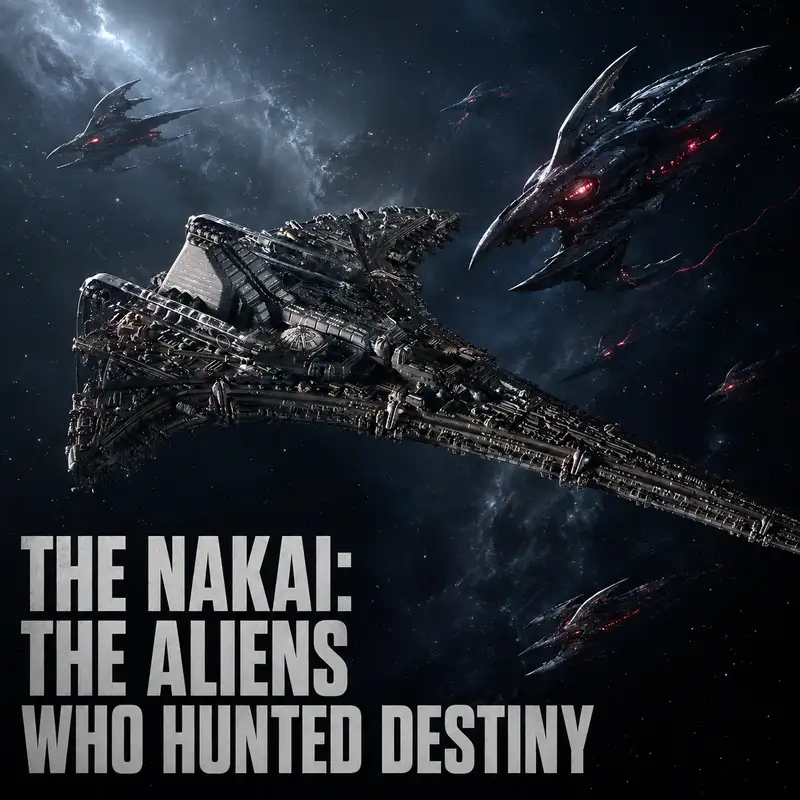
The Nakai: The Aliens Who Hunted Destiny
Chloe Armstrong slipped away from quarantine, reached an Ancient console, and transmitted Destiny’s position to the aliens who had altered her. Three hostile ships emerged from hyperspace into a system already crowded with automated drones. The drones immediately divided their attack. Some continued firing on Destiny. The rest turned toward the newcomers. Chloe had not surrendered the ship. She had summoned one enemy to absorb the fire of another, betting that the hunters would value Destiny too much to let it be destroyed. The maneuver worked, but it also proved something disturbing. The aliens had followed the Ancient vessel across the void between galaxies and were still waiting for any signal that would lead them back to it.
The people aboard Destiny never established a formal name for this civilization. The term Nakai was supplied later and is useful for distinguishing them from the other unidentified species encountered during the voyage. Almost everything known about them came from combat, captivity, invasive medical procedures, and a single coerced bargain. Their government, homeworld, population, and internal politics remained unknown. What the expedition could assess was their operational behavior. The Nakai possessed interstellar warships, hyperspace capability, advanced neural technology, biological engineering, and enough knowledge of Ancient systems to track Destiny without fully taking control of it.
That combination made them less a conventional enemy fleet than a persistent intelligence service with ships. They did not encounter Destiny once and move on. They tagged it, followed it, interrogated its operators, exploited its communication system, planted redundant tracking devices, altered a human captive, and adjusted their methods each time direct assault failed. The central question is why they invested so much effort in one damaged vessel, and why an enemy capable of pursuing it between galaxies never succeeded in taking it.
The answer begins before the Icarus survivors arrived. Destiny’s automatic defenses had apparently resisted Nakai attempts to board for a long time. A small alien craft had been attached to the underside of the ship before the human expedition discovered it. Nicholas Rush later identified the device as a subspace tracker. Its position and age suggested that the Nakai had found Destiny during its unmanned voyage, understood that it was important, and lacked the authorization or technical knowledge required to pass its defenses. The Ancient ship was already being hunted. Human arrival did not create the campaign. It created a new vulnerability inside it.
Destiny had been traveling for more than a million years on an automated mission to gather evidence connected to a pattern in the cosmic background radiation. To the Nakai, that mission may have mattered less than the platform carrying it. Destiny contained Ancient archives, power systems, weapons, navigation data, a Stargate, and records collected across galaxies no Nakai expedition may have surveyed independently. Even a damaged Ancient vessel represented a technological prize of extraordinary value. The surviving evidence does not show whether they wanted the scientific mission itself, the ship’s military capabilities, or the civilization-level knowledge stored aboard. Rush’s assessment was broader and probably safer. They wanted Destiny and its secrets.
Their opportunity came when Young abandoned Rush on a planet after discovering that the scientist had tried to frame him for murder. Rush found a crashed Nakai craft and activated its systems while trying to survive. In doing so, he triggered a distress signal. The aliens recovered the ship and captured him. Their interest was immediate and methodical. Rush was not treated as a prisoner of war whose rank or allegiance mattered. He was treated as an access point to Destiny.
The Nakai placed Rush inside a water-filled chamber, fitted him with a breathing mask, and connected a device to his forehead. The equipment functioned as a neural transmitter and receiver. It extracted memories while also exposing him to fragments of alien thought and technical information. The process was painful, disorienting, and invasive, but it gave the captors something conventional interrogation could not provide. Rush could lie in speech. His memories of Destiny, its crew, and its systems were more difficult to conceal when the machine reached them directly.
The first face-to-face contact aboard Destiny began through another Ancient system. A routine communication-stone exchange unexpectedly placed Colonel Everett Young inside a Nakai body while a Nakai consciousness occupied Young’s body aboard the ship. The alien reacted violently before the crew broke the connection. Young gained only a brief view of the hostile vessel, but the incident established that the Nakai possessed a compatible stone and could become linked to Destiny through equipment the human crew considered secure. Intergalactic distance was no defense when both sides were using Ancient technology they only partly understood.
Soon afterward, a large Nakai vessel approached Destiny. Young transmitted a peaceful message and asked for communication. The reply was a single demand for surrender, delivered in English. That wording mattered. It showed that the Nakai had already extracted enough human information to communicate clearly, and that they chose coercion rather than inquiry. They did not ask who the newcomers were or why they occupied Destiny. They treated possession of the ship as illegitimate and expected compliance. Whatever chance existed for cautious first contact ended before either side exchanged a useful explanation.
The force that followed was designed to disable and board rather than simply annihilate. The mothership launched smaller attack craft while engaging Destiny’s shields. Only a fraction of the Ancient ship’s weapons were available, and weapons fire drew from the same limited reserves supporting defense and life support. The Nakai pressed that weakness. Their larger vessel maintained pressure while small craft maneuvered close enough to exploit damaged areas. One attached itself to the hull, cut through several inches of Ancient structure, and abducted Chloe Armstrong from inside the ship.
The boarding operation revealed a disciplined objective. Chloe was not a military commander, but she was the daughter of a senator who had supported Project Icarus and had lived aboard Destiny from the moment of the evacuation. She knew the crew, the command relationships, the gate room, and the visible systems. More importantly, her capture demonstrated that the Nakai could penetrate the hull without winning complete space control. A battle that appeared centered on shields and weapons had been a diversion for a human-intelligence operation conducted through a hole in the deck.
Chloe was placed in a chamber similar to Rush’s and subjected to the same class of neural interface. Young used the communication stones again, this time deliberately, and reached the Nakai ship through an alien body. He found Rush and learned enough to locate Chloe. Rush, meanwhile, had absorbed fragments of the vessel’s controls and the layout of its fighter bay. The interrogation system worked in both directions. The Nakai extracted human knowledge, but every connection risked giving the captive information about them.
Destiny’s shields were failing, and Young faced a choice between preserving the captives and preserving the ship. He ordered the main weapon fired against the Nakai mothership even though Rush and Chloe remained aboard. The attack forced the enemy to withdraw. Rush and Chloe escaped in one of the smaller craft and landed it on Destiny. Tactically, the crew recovered its people and survived the engagement. Strategically, the Nakai had obtained extensive information about Destiny’s new occupants, and Rush returned carrying a second problem that no external sensor could detect.
A tracker had been implanted beside his heart. Rush discovered it only after the crew destroyed the craft attached beneath Destiny and the Nakai still found them. The layered design was an effective counterintelligence measure. If the external tracker was discovered, the implanted transmitter would continue broadcasting. If Rush died during removal, Destiny would lose the scientist most capable of operating the ship. The Nakai had converted a recovered prisoner into a beacon and placed the beacon where any attempt to remove it could become fatal.
Rush concealed the implant because he feared Young would decide that saving the ship required killing him. That secrecy intersected with a civilian attempt to seize control of Destiny, leaving the crew politically divided when three Nakai ships arrived. The enemy had not caused the conflict, but it benefited from it. Military personnel controlled weapons and life support. Civilian personnel controlled other sections and depended heavily on Rush. The tracker turned an internal dispute into an external targeting solution.
Removing it required a physician on Earth to use the communication stones and operate through Chloe’s body aboard Destiny. The medical team improvised visual support with a kino while the ship was under attack. The device sat dangerously close to Rush’s heart, and the operation had to proceed while shields, power, and command authority remained contested. Once the tracker was extracted, Scott destroyed it. Destiny escaped, but the engagement demonstrated the Nakai’s preferred campaign logic. They did not need to defeat the ship in one battle. They needed to keep contact long enough for age, internal division, and accumulated damage to create a boarding opportunity.
Their next major attempt moved from tracking into sabotage. Lieutenant Vanessa James had aborted a communication-stone session without fully clearing her imprint from the system. That residual connection allowed a Nakai consciousness to occupy her body. The intruder reached Destiny’s controls, disabled the faster-than-light drive, and appears to have transmitted the ship’s location. James experienced nightmares and fragments of confinement because her own consciousness had been displaced while the alien used her body. The attack bypassed shields, weapons, and locked doors by entering through a trusted human operator.
This was more than a clever infiltration. It was a warning that every Ancient system aboard Destiny could become an enemy avenue if the crew did not understand its security behavior. The communication stones had been treated as a protected channel to Earth. The Nakai treated them as access infrastructure. A body was an authentication token, and the token remained valid even when the person using it had changed. Destiny’s crew could guard the communications room, but the danger was already inside James before anyone recognized the intrusion.
The sabotage left Destiny unable to resume faster-than-light travel. A gate team considered evacuating to a nearby planet, but a kino sent through the Stargate detected Nakai ships waiting near the destination. The enemy had covered both escape systems. Destiny could not jump away, and the only available gate route placed personnel beneath hostile spacecraft. The Nakai then arrived in force, launched boarding craft, and attacked the damaged ship. Their plan linked space control, gate denial, electronic sabotage, and close assault. It was the most complete operation they conducted against Destiny.
The crew survived because Doctor Jeremy Franklin entered the Ancient neural-interface chair and somehow restored the drive. The procedure removed him from normal human contact and may have transferred part of his consciousness into the ship. Destiny escaped before the Nakai could complete the boarding action. The tactical result looked like another narrow victory. The cost was a scientist effectively lost to an Ancient system, extensive damage, and confirmation that the Nakai could reach into the ship without crossing the hull. Their intelligence campaign was improving faster than Destiny’s defenses.
Chloe’s medical condition revealed the longest part of that campaign. After her abduction, a gunshot wound healed with abnormal speed. Dark changes spread across her skin. She experienced blackouts, wrote in an unfamiliar language, and displayed mathematical abilities she had never possessed before. She could understand and manipulate parts of Destiny’s systems at a level approaching the senior science staff. The Nakai had not merely questioned her. They had altered her biology and cognition.
The exact intended end state remained uncertain. The evidence supports several possibilities that may overlap. Chloe could have been changed into an intelligence source capable of understanding Destiny for the Nakai. She could have become a transmitter able to summon them when the transformation advanced far enough. The modification may also have been intended to produce a biological operator compatible with systems the Nakai could not access directly. What the record does not support is a complete explanation of Nakai reproduction, society, or long-term medical doctrine. One altered captive is evidence of a program, not a full cultural anthropology.
For Young, Chloe became both a crew member and a security risk. He placed her in quarantine and prepared for the possibility that she would have to be left on a habitable planet. Rush argued for continued study because her altered cognition gave the expedition new access to Destiny. Chloe understood the danger more clearly than either man. She was becoming useful to the ship while becoming less recognizably herself. The Nakai had created a weapon that did not need to threaten her loyalty. It changed the meaning of what her own mind could do.
That change eventually became the basis of the opening maneuver. When automated drones trapped Destiny and attacked its shuttle, Chloe used the abilities gained from the Nakai to transmit a signal. The aliens had followed into the new galaxy and had been searching for the ship. Three vessels emerged through hyperspace and entered the drone engagement. The machines treated them as targets, dividing the pressure on Destiny. Chloe had converted the tracking relationship into a tactical decoy.
The plan immediately became a negotiation. One surviving Nakai ship blocked the human shuttle and transmitted a warning that there would be no escape. Young and Rush proposed an exchange. The Nakai would release the shuttle and reverse Chloe’s transformation. Destiny would help them survive the incoming drone wave. The bargain was coercive, but it was also the first evidence that both sides could recognize a limited shared interest. The Nakai opened their hangar, accepted Chloe, and used their medical technology to remove the visible transformation.
They honored the immediate medical portion of the agreement. Chloe returned with normal test results, no spreading lesions, and no further blackouts. She retained much of the mathematical knowledge acquired during the process. The Nakai ship then withdrew into hyperspace when the battle turned against it, leaving Destiny to face the drones again. That retreat did not necessarily violate the exact bargain, but it clarified the limits of cooperation. The Nakai would negotiate to preserve their vessel and recover access to Chloe. They would not sacrifice themselves for the people they had abducted and altered.
Their behavior across the campaign suggests a civilization with sophisticated operational planning and a narrow strategic obsession. Nakai ships could cross intergalactic distances through hyperspace, launch specialized assault craft, penetrate an Ancient hull, manipulate communication stones, conduct neural extraction, and engineer a human body. They were advanced by human standards but did not possess Ancient mastery. They could follow Destiny, damage it, and exploit its operators. They could not reliably command the ship, defeat its automatic protections, or reproduce the access held by a legitimate Ancient crew.
That gap explains much of their violence. If Destiny could not be opened through technical means, the Nakai needed living intermediaries. Rush offered systems knowledge. Chloe offered social knowledge and a body that could be modified. James offered a trusted physical presence aboard the ship. Communication stones offered temporary control of a human operator. Trackers offered persistence until another vulnerability appeared. Every method treated people as components in an access architecture. The Nakai did not need to hate humans to violate them. They needed humans to reach the machine.
Their acquisition objective also constrained their military options. Destroying Destiny would deny the prize they had spent years pursuing. Heavy fire could damage the archives, drive, power cells, or gate they wanted to capture. Boarding exposed smaller craft and personnel to defenders operating inside familiar corridors. Interrogation created information leakage. Trackers could be found. Biological alteration produced an intelligent subject capable of turning the connection against them. The desire to take the ship intact forced the Nakai into methods that gave a weaker crew repeated chances to resist.
Human unpredictability did the rest. The Icarus survivors were not the trained Ancient crew the Nakai may have expected, but they were also not passive passengers. They used communication stones for counter-infiltration, kinos for surgery and surveillance, an Ancient chair as an emergency repair mechanism, and Chloe’s transformation as a way to summon the enemy into another enemy’s fire. Their improvisation was often reckless and costly. It made them difficult to model. The Nakai understood Destiny’s patterns better than the humans did, but the humans repeatedly survived by refusing to behave like part of the original design.
Very little can be said confidently about the Nakai beyond the campaign. Their refusal to explain themselves left no diplomatic history, political map, or account of why Destiny mattered to them personally. The water-filled interrogation chambers do not establish that they were aquatic. Their blue skin and black suits do not reveal a social order. Their use of several ships does not prove a unified empire. Military intelligence can describe observed capabilities and recurring intentions without pretending that uniforms and machinery constitute a civilization’s complete history.
What can be assessed is why the hunt endured. Destiny was an irreplaceable Ancient asset moving through regions beyond ordinary reach. The Nakai had located it, tagged it, and failed repeatedly to enter. Human occupation weakened some defenses and supplied operators whose minds and bodies could be exploited. Each failed assault produced more knowledge and another reason to continue. The campaign became self-reinforcing. The more the Nakai learned, the more valuable Destiny appeared. The more aggressively they pursued it, the more completely the human crew denied them any possibility of voluntary access.
The Nakai never secured Destiny because they could not resolve the contradiction at the center of their strategy. They needed the ship intact, needed human beings to unlock it, and treated those same human beings as disposable instruments. Their technology allowed them to cross galaxies, enter minds, and rewrite biology. It did not create consent, trust, or a reliable crew of their own. The final irony was Chloe Armstrong. They altered her to make Destiny more accessible to them. She used what they gave her to drag their fleet into a drone battle, save the ship they wanted, and return aboard carrying knowledge the Nakai could no longer control.