The Nox: Pacifism in a Militarized Galaxy
The Goa’uld attack on Tollana should have destroyed every ion cannon before the first mothership entered firing range. Their Jaffa had used a legal hearing as cover, located the defensive sites, and sabotaged them one by one. One weapon survived because Lya of the Nox made it disappear. She did not aim it. She did not fire it. Teal’c did, destroying the attacking ship and saving the planet. Lya’s explanation afterward was precise: she had hidden a weapon, not used one. Even she acknowledged that the distinction was narrow.
That narrow distinction defines the Nox. They rejected killing in a galaxy organized around conquest, slavery, planetary bombardment, and the control of Stargates. Yet they were not helpless, politically irrelevant, or unaware of danger. They could conceal people, weapons, animals, cities, and even a Stargate. They could restore the recently dead. They could disarm soldiers without injuring them and move refugees beyond the reach of a government determined to seize them. Their pacifism was not passive acceptance. It was a strategy of denying violent actors the target, the weapon, or the opportunity they needed.
The surviving record reveals very little about the full Nox civilization. Earth encountered only a few individuals, saw one immense floating city, and learned almost nothing about their government, population, industry, or command structure. No Nox fleet was observed, and no formal military organization was identified. Their abilities are equally difficult to classify. Some appeared technological, some resembled mental discipline, and the Nox themselves did not separate those categories for human convenience. Any assessment must therefore begin with restraint. What they could do is clear. How they did it often is not.
Earth’s first contact began for reasons the Nox would have considered revealing. Stargate Command was under pressure to recover technology that could improve planetary defense. Teal’c described the Fenri, a large flying creature hunted by Apophis because it appeared able to vanish. S G One was sent to capture one alive and determine whether its apparent invisibility could be turned into a tactical advantage. The mission was framed as reconnaissance and acquisition. From the Nox perspective, armed strangers arrived through the gate, pursued a native animal, and immediately began discussing how its abilities might be weaponized.
The operational plan was already unstable. The team carried tranquilizer weapons suited to capturing the Fenri, not fighting a Goa’uld command party. Soon after arrival, the Stargate vanished from view, removing the team’s only known extraction route. Then S G One discovered Apophis on the planet. Capturing him promised intelligence on Goa’uld technology and the location of Daniel Jackson’s wife, Sha’re. The opportunity was extraordinary. The available force was not.
O’Neill approved an ambush despite the missing gate, limited ammunition, and inadequate preparation for Apophis’s personal shield. The attack failed almost immediately. O’Neill, Carter, and Daniel were killed. Teal’c prepared to die rather than return to service under his former master. Then he vanished from Apophis’s sight. S G One later awakened in a forest settlement, alive, disarmed, and in the care of people who had watched both sides approach the same problem through violence.
The Nox appeared at first to be a small woodland community. Anteaus, Lya, Ohper, and the child Nafrayu wore simple clothing, lived among trees, ate what the forest provided, and showed no visible machinery. Ohper described an age of more than four hundred years without presenting himself as remarkable. Their surroundings encouraged S G One to classify them as vulnerable people with unusual healing knowledge. That assessment said more about Earth’s assumptions than about Nox capability.
The Nox had removed the team’s weapons and attempted to heal a wounded Jaffa named Shak’l, even though he had fought beside Apophis. They did not accept S G One’s division of the encounter into allies who deserved protection and enemies who could be restrained, exploited, or killed. Teal’c understood that Shak’l would report their location. O’Neill wanted to take him to Earth. The Nox would permit departure only if Shak’l chose it. Consent applied even to a man likely to bring the Goa’uld back.
This was not ignorance of the Goa’uld. The Nox knew that Goa’uld hunting parties had visited their world for generations. They had concealed the Fenri each time, allowing the hunters to believe the animal itself possessed the ability to disappear. That deception protected both the creature and the people hiding it. The Nox had not defeated the hunting parties. They had maintained a false intelligence picture so successfully that the Goa’uld continued searching for the wrong source of power.
Their principal defense was concealment. They hid themselves, the Fenri, the Stargate, and eventually an entire city. The effect was more complete than visual camouflage. People and objects could vanish from immediate physical access, and weapons could be removed from armed personnel without a struggle. The screen record never provides a reliable technical description. Operationally, the result was clear. The Nox controlled who could perceive, reach, or engage them.
That capability changed the normal logic of defense. Earth protected a base by hardening entrances, posting guards, authenticating returning teams, and preparing to close the iris. The Goa’uld protected power through fleets, Jaffa garrisons, fear, and retaliation. The Nox prevented the engagement from occurring. A target that could not be located could not be bombarded accurately, occupied, or forced into battle. Their doctrine emphasized signature reduction on a civilizational scale.
Even the decision not to bury the Stargate before first contact reflected careful security thinking. Daniel asked why the Nox had allowed Goa’uld hunters to continue arriving. Ohper pointed out that a buried gate would reveal deliberate action. Leaving it accessible supported the deception that the world held animals but no advanced population. Only after Shak’l learned the truth and Apophis directly encountered Nox abilities did concealment through normal access become untenable. The gate was then buried because the intelligence situation had changed.
The Nox ability to restore life carried its own limitation. Their ritual required several participants and prevented them from maintaining concealment while it was performed. Teal’c immediately recognized this as a vulnerability. The Nox recognized it as a responsibility. When Shak’l killed Lya during his escape, the others restored her rather than pursue him. When Apophis killed Nafrayu and left the child as bait, they began the ritual even though they knew the act would expose them to attack.
That choice is central to understanding their pacifism. The Nox did not avoid violence by refusing every risk. They accepted danger to preserve life, including the life of a child whose rescue might reveal the entire community. Their doctrine required courage, but it was a different form of courage from the one S G One understood. O’Neill wanted to stand between the Nox and the enemy with a weapon. Anteaus was willing to become visible and vulnerable without one.
S G One could not accept that decision. The team recovered a missed weapon, constructed a bow, and prepared an ambush intended to exploit the low-speed weakness in Apophis’s personal shield. The plan was tactically intelligent and strategically unnecessary. As O’Neill prepared to strike, the Nox removed Apophis and his Jaffa from the engagement and returned them through the Stargate. No one was killed. The immediate threat ended because the Nox controlled access to the battlespace more completely than either armed force realized.
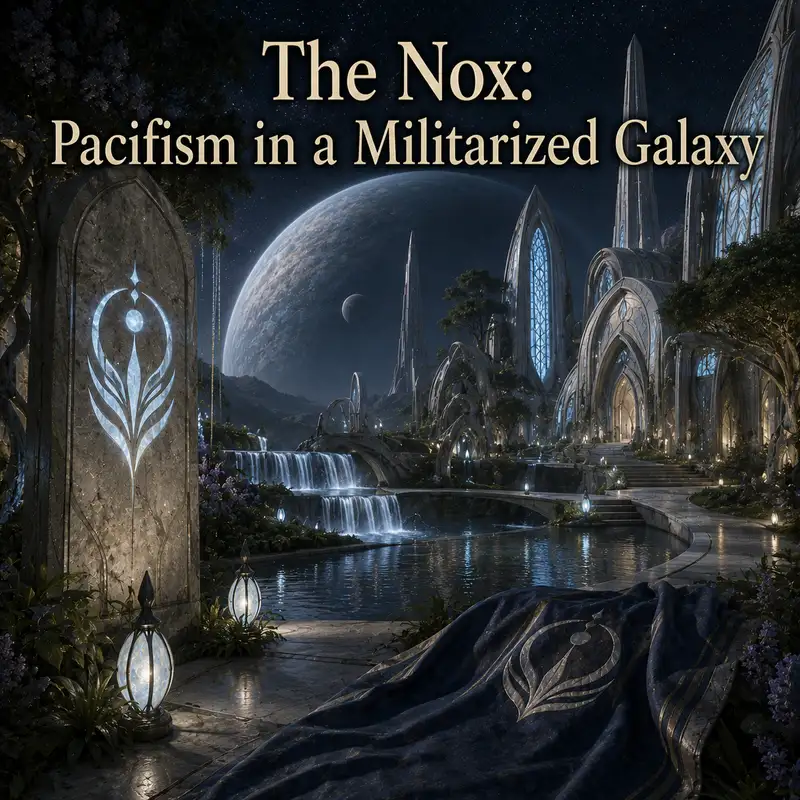
Only then did Anteaus reveal the floating city concealed above the forest. The modest settlement had not been evidence of technological weakness. It was a chosen way of life beneath a hidden center of advanced civilization. S G One had spent much of the mission trying to protect people who had already survived Goa’uld contact for centuries. The Nox had spent the same period preventing their rescuers from making the situation worse.
The lesson was not that military force never works. S G One had already seen worlds where refusing to resist meant slavery or death. The lesson was that the team had mistaken visible simplicity for helplessness and its own preferred method for a universal requirement. The Nox did not need to kill Apophis because they could deny him access, information, and control. Their pacifism was supported by an extraordinary defensive advantage.
That support creates the first major criticism of Nox philosophy. It is easier to reject weapons when one can make an attacking army disappear from the battlefield. Most human populations under Goa’uld rule could not hide a village, restore the dead, or remove a System Lord through an act of will. A Jaffa ordered to execute civilians did not possess a nonviolent option merely because the Nox had proven one could exist at a higher technological level.
The Nox also did not use their abilities to liberate the galaxy. They protected their world, preserved the Fenri, offered sanctuary in selected cases, and intervened when personally involved. They did not appear over occupied planets, remove Goa’uld garrisons, or train resistance movements in concealment. For people living under slavery, Nox neutrality could look less like moral wisdom than security purchased through capabilities no one else possessed.
There is, however, another side to that restraint. Advanced civilizations in the Milky Way repeatedly caused disasters by giving powerful technology to societies unprepared to control it. The Nox had observed enough of Earth to know that Stargate Command’s first interest in the Fenri was tactical exploitation. Refusing to transfer knowledge was not necessarily indifference. It may have been a judgment that armed intervention and technological proliferation would extend the habits they opposed.
Their place among the four great races reinforces the scale of that judgment. The Nox had once participated in the ancient association that included the Asgard, the Ancients, and the Furlings. The meeting place later found by Earth showed intellectual exchange among civilizations of immense age and capability. Nothing in the surviving record proves that this was a military alliance. The Nox may have contributed precisely because they represented a path to security not based on fleets or coercive power.
Their later actions show that isolation was not absolute. When S G One rescued Tollan survivors from a volcanic catastrophe, elements of the United States government saw an opportunity to seize advanced technology. Colonel Maybourne arrived with presidential authority to take custody of the refugees. The Tollan refused cooperation, and Stargate Command faced a conflict between lawful orders, humanitarian responsibility, and the risk that unwilling detainees would become subjects of forced technical exploitation.
Daniel contacted the Nox. Lya came through the Stargate and offered the Tollan sanctuary. When armed personnel were ordered to stop them, she concealed the refugees and removed the soldiers’ weapons. The intervention was decisive, nonlethal, and openly resistant to coercion. The Nox did not negotiate over ownership of Tollan knowledge because they rejected the premise that the refugees were property to be transferred between governments.
This episode of sanctuary reveals the political force inside Nox pacifism. Lya did not remain neutral between armed captors and people trying to leave. She sided with voluntary movement and bodily autonomy, then used superior capability to make violence ineffective. No soldier was injured, but the government order failed. Pacifism did not mean obedience to authority. It meant refusing to let authority turn weapons into the final argument.
The Nox later helped the Tollan reach a new homeworld, where they established Tollana and built their own Stargate. The available record does not explain the transportation, resources, or duration involved. It does establish that the Nox could support more than a brief evacuation. They were able to provide refuge, facilitate relocation, and maintain diplomatic contact with another advanced civilization without absorbing it or demanding political control.
Their relationship with the Tollan was selective for understandable reasons. The Tollan possessed advanced science, a strong prohibition against transferring dangerous technology, and institutions that preferred law to military expansion. They were not identical to the Nox, but they shared enough assumptions to cooperate. The Nox did not build a public alliance network. They cultivated a quiet relationship with a society capable of meeting them without immediately asking for weapons.
That relationship brought Lya to Tollana as the neutral member of a Triad convened over Skaara and the Goa’uld Klorel. Both minds occupied the same body, and the Tollan process had to decide whose claim took priority. O’Neill and Daniel represented Skaara. Zipacna represented Klorel. Lya’s role was not to command the outcome but to listen, assess personhood and consent, and cast the deciding judgment.
Her decision favored Skaara. The young Abydonian had not disappeared when Klorel entered his body. He could speak, reason, remember, and assert his own will. The Nox rejection of violence was therefore connected to a broader rejection of domination. A Goa’uld could describe symbiosis as biological necessity, but necessity did not create consent. Lya’s ruling protected a person without treating the destruction of the symbiote as the only possible remedy. The Tok’ra later removed Klorel alive.
The Goa’uld delegation had never intended to rely only on legal argument. Zipacna’s Jaffa used the proceedings to locate and disable Tollan ion cannons before an attack. This was a classic exploitation of procedural restraint. The defenders honored the hearing, limited surveillance, and assumed their security systems were sufficient. The attackers used the time created by due process to prepare the destruction of the court itself.
Teal’c recognized the pattern and asked Lya for help. She could not fire a weapon without violating Nox principles, but she could hide one cannon from sabotage. When the attack began, that concealed weapon remained operational. Teal’c used it against gliders and the Goa’uld mothership. Lya’s action preserved the Tollans’ ability to defend themselves while keeping her hands from the controls.
The distinction did not remove her responsibility. Without Lya, the cannon would probably have been disabled. Without the cannon, Tollana could have fallen. The deaths aboard the attacking ship were a foreseeable result of her choice. Samantha Carter observed that Lya had remained on a very fine moral boundary, and Lya agreed. The Nox were not pretending that indirect action was free of consequence.
Refusing to help would also have been a choice. It would have allowed a deceptive aggressor to destroy a civilian population, overturn a lawful judgment, and return Skaara to involuntary control. Lya’s decision suggests that Nox pacifism was not an absolute ban on every act connected to lethal force. It was a discipline requiring the Nox to avoid killing while preserving space for others to resist immediate conquest.
That position is morally uncomfortable because it separates enabling from execution. Military coalitions make similar distinctions through intelligence support, logistics, targeting, and defensive aid. A state may claim it did not fire the missile while providing the sensor data that made the strike possible. Lya’s action was far narrower and directed toward planetary defense, but the ethical structure is recognizable. Pacifism inside a war does not escape questions of complicity. It changes where those questions are asked.
The Nox approach offered several strategic advantages. Concealment reduced the need for large standing forces. Disarmament prevented escalation. Restoration limited the permanent cost of violence when intervention came in time. Sanctuary protected threatened populations without annexation. Legal mediation allowed disputes to be addressed without treating armed strength as proof of ownership. Most important, the Nox rarely gave an aggressor a target that could be converted into political leverage.
The same approach depended on conditions few civilizations possessed. Concealment had to defeat enemy sensors. Access to the Stargate had to remain controllable. The ritual of life required time and exposed those performing it. Refuge required a secure location and resources. Nonlethal intervention required such overwhelming control of the immediate environment that hostile weapons could simply be removed. Pacifism without those capabilities would have produced very different casualty reports.
There were also threats the screen record never forced the Nox to confront directly. O’Neill warned that the Goa’uld might return in ships and bombard the planet from orbit. The Nox expressed no fear, and their hidden city suggested confidence, but their defense against sustained orbital attack was never demonstrated. No Replicator infestation, Ori crusade, or Wraith culling reached their world on screen. Their philosophy was tested by armed intruders and covert aggression, not by every form of industrialized war present in the wider setting.
Their limited contact with Earth may itself have been a security policy. The Nox did not establish an embassy at Stargate Command, join Earth’s war against the System Lords, or become a routine supplier of technology. They appeared when sanctuary, mediation, or a specific relationship justified the risk. In a galaxy where allies often arrived with conditions, intelligence requirements, and urgent requests for weapons, the Nox preferred a very small diplomatic footprint.
This made them frustrating partners and effective survivors. Earth could not plan an operation around Nox support because the Nox had made no standing commitment to provide it. The Goa’uld could not easily target them because there was little visible infrastructure to map and no predictable military pattern to exploit. Their absence from most campaigns was not evidence that they lacked influence. It was evidence that their strategy denied outsiders the access required to measure it.
The Nox were pacifists, but they were not neutral about life, consent, or domination. They healed enemies, protected animals, rescued refugees, defended a host’s right to his own body, and helped preserve a planet’s last means of resistance. They refused to kill, yet they did not always refuse to interfere. Their methods replaced destruction with concealment, coercion with sanctuary, and retaliation with the removal of opportunity.
Their philosophy could not simply be copied by Stargate Command or by populations living under Goa’uld rule. Those societies lacked the Nox’s abilities, security, and historical experience. For them, armed resistance was often the only available way to prevent enslavement. The Nox did not prove that every just war was unnecessary. They proved that advanced power did not have to express itself through weapons, occupation, or the demand to be obeyed.
The hidden ion cannon on Tollana remains the clearest image of their position. Lya preserved a weapon she would not fire so that others could survive an attack they had not chosen. The resulting victory carried a moral cost she did not deny. Nox pacifism endured in a militarized galaxy because it was neither surrender nor innocence. It was the disciplined use of overwhelming capability to keep violence from becoming the only decision left.