The Odyssey’s Mission Into the Ori Galaxy
Cameron Mitchell ordered the Odyssey to surrender while four Ori warships fired into shields already reduced to eighteen percent. The hyperdrive was offline. Replicators controlled much of the ship. Armed crewmen were defending the Asgard core behind welded doors, and half of S G One remained somewhere on the planet below. The Ori ignored the surrender call and continued firing. Earth’s first mission into the enemy’s home galaxy had begun as a search for one artifact. It was ending as two separate battles, neither of which the original plan had anticipated.
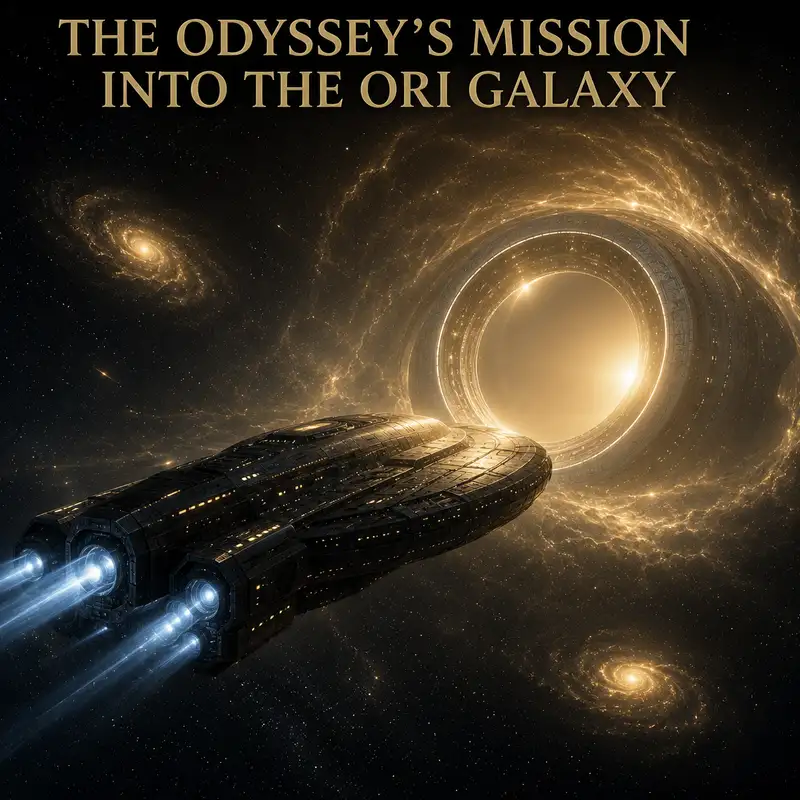
The Odyssey’s mission was not a conventional fleet operation. One Earth battlecruiser crossed the Supergate to find the Ark of Truth, carry a small team into the political center of the Ori system, recover the device, and return before another invasion wave reached the Milky Way. No friendly base existed on the far side. There was no reserve ship, established supply line, medical facility, or extraction force waiting in the Ori galaxy. The Odyssey was transportation, headquarters, reconnaissance platform, fire support, laboratory, and the only practical rapid route home.
The mission became necessary because the Sangraal had solved only half of the strategic problem. Merlin’s weapon appears to have destroyed the ascended Ori, but their followers did not know that. Priors continued issuing orders. Warships continued moving through the Milky Way. Adria had ascended and inherited the power generated by the remaining worshippers. The leaders above the crusade were gone, while the human institutions built in their name continued functioning. Earth needed a way to break belief, not simply another weapon capable of destroying ships.
Tomin provided the decisive intelligence. After rejecting the Priors and surrendering to S G One on Dakara, he described a passage in the Book of Origin concerning Ortus Mallum, the birthplace of evil. The story referred to a settlement buried when a mountain erupted. Daniel Jackson connected it to recurring visions that may have been left by Merlin’s consciousness. If the Alterans had created the Ark before abandoning their original galaxy, the Ori’s sacred story might preserve the location where it had been hidden.
That assessment rested on several uncertain links. Daniel’s visions were incomplete. Origin had rewritten Alteran history into religious doctrine. Ortus Mallum might have been symbolic rather than geographic, and repeated searches had already failed to recover an artifact. The intelligence was still better than any alternative. Earth could track Ori ships and estimate their readiness. It could not defeat the entire crusade before more vessels crossed the Supergate. A disputed passage in an enemy religious text became the basis for a strategic expedition.
The International Oversight Advisory approved the mission and added its own representative. Mitchell received temporary command of the Odyssey for the operation. James Marrick, a former intelligence officer working for the advisory, was assigned to oversee him. The arrangement created two authorities aboard one ship. Mitchell controlled operations. Marrick represented the body that had approved the mission and could challenge how Earth’s most valuable space asset was being used. That tension was manageable only while both men pursued the same objective.
The Odyssey was uniquely suited to the assignment. It carried a zero-point module, an advanced cloaking system, Asgard transporters, intergalactic hyperdrive technology, powerful shields, and the Asgard computer core installed during the final transfer of Asgard knowledge to Earth. The core was integrated throughout the vessel and could analyze, design, and synthesize technology from stored information. Those capabilities made the mission possible. Their integration also meant that anyone who compromised the core could reach nearly every important system aboard the ship.
The Supergate eliminated an intergalactic transit that otherwise would have consumed valuable time and exposed the ship across an enormous distance. Odyssey established an outgoing connection using intelligence Daniel had acquired while he was a Prior, then passed through into the Ori home galaxy. The crossing itself succeeded without enemy interference. That was the last part of the mission that proceeded almost exactly as planned.
Tomin introduced Daniel and Vala Mal Doran to Hertis, a member of the anti-Ori underground. Hertis had heard that the fires of Celestis had gone out, but the Priors had interpreted the event as evidence that the Ori demanded greater effort rather than evidence that the gods were dead. He also reported that additional warships had been built and were ready to depart. The resistance could challenge doctrine and preserve forbidden history. It could not stop the fleet.
Hertis identified ruins in mountains near the plains of Celestis as the location traditionally associated with Ortus Mallum. Priors and unbelievers had searched the site before without success. The absence of a previous discovery offered little reassurance, but Daniel interpreted it as evidence that the Ark might remain hidden. Odyssey moved toward the Celestis system under cloak, carrying the search team into the most politically sensitive region of the enemy’s civilization.
Marrick objected to the priority. He believed Odyssey had been sent primarily to stop the next wave of Ori ships and regarded the search for the Ark as an uncertain diversion. Mitchell insisted that finding the Ark was the mission. The dispute was not between caution and recklessness. Both men were responding to real threats. Marrick saw warships preparing to leave. Mitchell saw a device that might remove the reason those ships were fighting. The problem was that Marrick possessed another set of orders he had not disclosed.
S G One and Tomin transported to the mountain site and began searching the buried settlement. No obvious energy signature identified the Ark. Daniel relied on the terrain, fragments of local history, and another vision to locate a passage beneath the ruins. The work was archaeology under an operational deadline. The team needed tools, communications, stable transport locks, and time to excavate. The Ori fleet and the shipboard chain of command were reducing all four.
Marrick entered the restricted Asgard core room, replaced a control crystal, sealed the door, and activated a hidden program. Turning on the core made Odyssey detectable to Ori ships. That was deliberate. The International Oversight Advisory had prepared a contingency in case the Supergate could not be destroyed. Odyssey would attract the Ori fleet, manufacture a Replicator, and place it aboard one enemy vessel. The machine would spread through the fleet and consume the warships from within.
The concept had a certain strategic logic. Ori shields had defeated conventional weapons, while Replicators could adapt, reproduce, and turn an enemy’s own material into additional combat power. One machine might accomplish what an allied fleet could not. The plan also repeated nearly every mistake made during earlier attempts to control Replicators. It treated rapid adaptation as an advantage that would remain pointed at the intended target and assumed a shutdown procedure would still work after the machine began improving itself.
The advisory’s program removed the Replicator’s vulnerability to the anti-Replicator weapon. Marrick knew Mitchell and Carter would try to destroy it before it reached an Ori ship, so the contingency had been designed to defeat Earth’s own established safeguard. The screen record does not identify who wrote the program or how broadly the plan had been approved. Marrick refused to name the programmer. What is clear is that an oversight authority placed a modified strategic weapon aboard the Odyssey without informing the officer commanding the ship.
Mitchell and Samantha Carter returned from the surface and forced entry into the core room. They found the machine forming inside a containment field. The anti-Replicator weapon failed exactly as Marrick expected. Conventional P nineties could destroy individual blocks, but the Replicator escaped into the ship before the crew could finish it. Marrick had intended to infect an Ori vessel. He had instead released an enemy preloaded with detailed knowledge of Odyssey’s systems into the most advanced ship Earth possessed.
The machine quickly became a queen and began producing additional Replicators. It selected a location near a major power conduit, where other blocks could bring it raw material. Bulkheads and elevators locked. External communications failed. Power fluctuated across the vessel. Transporters stopped responding. The Replicators did not have to learn the ship by trial and error because its design had been placed into their memory. They entered the battle with a better systems map than many new crew members receive during orientation.
Mitchell deployed armed teams through the compartments while Carter tried to preserve navigation, life support, and hyperdrive control. Ammunition became a logistical constraint almost immediately. Individual Replicators could be shot apart, but each engagement consumed rounds while the queen converted more of the ship into replacements. The crew was fighting a boarding action against an enemy using the vessel itself as supply.
The Ori ships drawn by the Asgard core were closing. Mitchell ordered the surface party transported aboard before Odyssey entered hyperspace. The command failed because the Replicators had already seized the transport system. Daniel, Teal’c, Vala, and Tomin remained beneath Ortus Mallum while the ship prepared to withdraw. Mitchell faced a command decision with no satisfactory answer. Remaining in orbit might recover the team and lose the ship. Leaving preserved Odyssey but abandoned four people inside the enemy’s political heart.
He chose the ship. Odyssey entered hyperspace before the Ori formation could complete its encirclement. The decision did not mean the ground mission was cancelled. It meant that the two halves of the expedition could no longer support one another. The surface team had no functioning extraction, limited communications, and no guarantee that Odyssey would ever return. The ship had lost the people searching for the artifact that justified every risk taken to reach the galaxy.
Daniel’s team continued through the unstable passage and found the Ark in a sealed underground chamber. The artifact appeared intact, but its activation sequence remained unknown. They brought it toward the surface as the ruins shifted around them. Ori soldiers then ambushed the group. Teal’c was shot in the back and left for dead. Daniel, Vala, and Tomin were taken to Celestis with the Ark. The recovery objective had been achieved in the narrowest sense. The enemy now possessed the recovery team and the device.
Aboard Odyssey, the Replicator infection expanded. Carter identified the Asgard core as the decisive compartment. If the machines gained direct control of it, they would control a system integrated with the entire ship and gain access to the Asgard knowledge base. She concentrated the remaining defenders around the core and had the doors welded shut. That protected the system temporarily while trapping the defenders inside. Shipboard containment had become a series of shrinking secure areas rather than control of the vessel as a whole.
Mitchell located the queen in an access tube near a cargo hold and placed explosives around it. Destroying the queen immediately would have drawn every mobile Replicator toward him, and Carter still lacked a shutdown command. He therefore left the charges in place and used the queen as a potential diversion. The decision treated the infestation as a network with behavior that could be manipulated, not merely a collection of targets to shoot.
Marrick’s own plan turned against him in the brig. Replicators cut through the compartment and incorporated blocks into his body, creating a human-shaped assault platform. They appear to have used him because he knew there was supposed to be a shutdown safeguard, even though he did not know the command itself. The advisory representative who had intended to direct the machines became an interface through which the machines searched for the one order that could destroy them.
Carter searched the creation program stored in the Asgard core. It was enormous, and the core initially reported no shutdown directive. She began trying to write one while the defenders around her ran short of ammunition. Writing a reliable base command for an adaptive artificial life form would normally be a long research project. On Odyssey, the available development cycle was measured by how many Replicators remained outside the door.
The machines retook navigation and pulled Odyssey out of hyperspace. Four Ori warships appeared around it and opened fire. The vessel was now fighting at two scales. Outside, shields absorbed weapons from ships built to defeat entire fleets. Inside, Replicators disabled the systems needed to maneuver, communicate, and repair damage. The Ori did not need to board Odyssey. Marrick’s contingency had already supplied the boarding force.
At the same time, seven Ori warships entered Earth’s solar system and held position. The Apollo reported that the Antarctic defense system could not reliably stop that concentration. General Hank Landry had a captured Prior inside Stargate Command and no assurance that S G One would return. The expedition’s success or failure had ceased to be an off-world intelligence matter. Earth’s survival now depended on a ship trapped in another galaxy and a ground team being held in the enemy’s capital.
Mitchell confronted the Replicator-controlled Marrick near the queen. He briefly disrupted the blocks controlling the man and reached the person beneath them. Marrick revealed that the shutdown program was stored on the reverse side of the crystal he had inserted into the Asgard core. Mitchell then destroyed the queen and Marrick with the explosives. The attack drew Replicators toward his position and relieved pressure on Carter’s defenders long enough for her to examine the crystal.
The location of the command was a final example of the plan’s design philosophy. A safeguard existed, but it had been concealed from the commander, inaccessible to the crew, and physically embedded in the device used to create the threat. Precautions are most useful when the people facing the emergency know how to use them. Carter activated the command, and the Replicators throughout Odyssey disassembled before they breached the core.
Removing the internal enemy did not restore the ship immediately. Hyperdrive remained offline, shields had fallen to eighteen percent, and four Ori warships continued firing. Mitchell transmitted a surrender in the hope of buying time. The Ori ignored it. The battlecruiser had survived the Replicators only to return to the simpler problem of being outnumbered by ships that could destroy it.
The ground mission supplied the answer. Teal’c survived his wound, crossed the terrain toward Celestis, and received limited aid from Morgan Le Fay when his body could go no farther. Daniel learned from Morgan that the crystals carried by the Priors formed a communications network within the galaxy. The Ark did not have to reach every believer individually. If it exposed one central Prior, the conclusion could spread through the hierarchy.
Daniel, Vala, Tomin, and Teal’c brought the Ark before the Doci and found the activation sequence. The device forced him to recognize that the Ori were not gods. That understanding moved through the linked Priors of the Ori galaxy and weakened Adria by collapsing the worship sustaining her. Morgan could then confront Adria on the ascended plane.
The effect reached Odyssey through the behavior of the ships attacking it. Their weapons ceased fire before the remaining shields failed. The crew did not initially know why. From the bridge, the change looked like an unexplained enemy decision. In Celestis, it was the political collapse of the authority giving those ships purpose. The ground team had not destroyed the fleet. It had removed the belief that made continued attack obligatory.
Odyssey recovered the team and the Ark, then returned to the Milky Way through the Supergate. The device had to be used again on the Prior held at Stargate Command because the connection among Prior staffs did not extend cleanly between galaxies. Once the Milky Way network received the same truth, the seven Ori ships threatening Earth withdrew. The expedition ended the immediate crusade without defeating those ships in battle.
The mission produced several different kinds of success. The Ark was recovered and activated, making the mission a scientific and intelligence success. The Priors rejected the central deception of Origin, making it a political success. Earth and the Odyssey survived, making it a strategic success. The original shipboard plan failed almost immediately, the command structure was sabotaged, and much of the team had to finish the mission without support. Operational success arrived through adaptation rather than execution.
The cost included dead Odyssey personnel, severe ship damage, the loss of Marrick, the wounding of Teal’c and Mitchell, and the near destruction of Earth’s most valuable battlecruiser. It also revealed a dangerous civil-military problem. The greatest threat placed aboard Odyssey did not come from an Ori intelligence service. It came from an International Oversight Advisory contingency whose secrecy prevented the commander from controlling it. Oversight had become covert operational command without accepting responsibility for the consequences.
The mission also demonstrated the limitations of Earth’s technological inheritance. Odyssey possessed the accumulated knowledge of the Asgard and still nearly died because one program used that knowledge against it. Integration had increased capability and expanded the damage possible from unauthorized access. Earth could operate the core. It had not yet developed the institutional controls required for every use that different governments could imagine.
Odyssey did not conquer territory in the Ori galaxy, destroy a shipyard, or establish a permanent base. It carried a small force across an intergalactic boundary, enabled contact with a resistance network, placed specialists close enough to recover one artifact, survived internal sabotage, and remained alive long enough for the ground team’s success to change the enemy’s orders. That is the proper scale of the achievement.
The expedition succeeded because its two isolated battles finally converged. Carter and Mitchell preserved the ship. Daniel, Teal’c, Vala, and Tomin broke the religious command network. Neither group could see the full effect of the other’s work until the Ori guns stopped. The Odyssey crossed the Supergate to carry Earth into the enemy’s home galaxy. It returned because the people it had been forced to leave behind changed the minds of the ships trying to kill it.