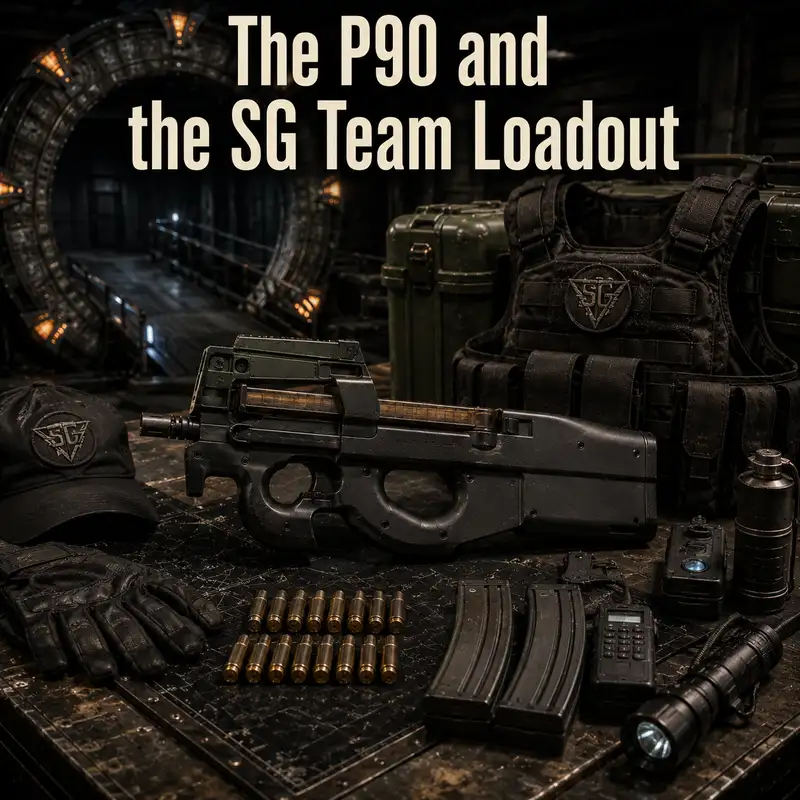
The P90 and the SG Team Loadout
Daniel Jackson had been dragged away by an Unas, one member of the recovery team was already dead, and the trail was growing colder. Jack O’Neill asked for two units armed with P nineties and immediate departure. A drone was sent ahead to search. Another team secured the Stargate. Radios tried to reach personnel who might already be out of range. The weapon request was memorable, but it was only one part of the response. Stargate Command was not sending four people with an impressive gun. It was assembling a compact reconnaissance and rescue system around a single vulnerable doorway.
The P ninety became the most recognizable firearm carried by S G teams because it matched a very unusual mission profile. Personnel had to move through the Stargate, clear confined rooms, cross open terrain, enter alien ships, protect scientists, and sometimes fight their way back to the same gate used for insertion. They needed enough firepower for sudden contact without carrying the weight of a conventional infantry squad. They also needed radios, authentication equipment, medical supplies, explosives, scanners, food, water, and whatever artifact Daniel Jackson had decided was historically essential. The complete loadout was a compromise between what the team might need and what four people could still carry at a run.
Stargate Command did not begin with the P ninety. Early teams commonly carried M P five submachine guns, along with service pistols and other weapons selected for the mission. The transition was not accompanied by a surviving procurement memo explaining every requirement. The first recorded fielding came during the urgent search for Daniel, when O’Neill requested the new weapons after learning that an Unas had survived earlier gunfire. The available evidence supports a practical interpretation rather than a dramatic one. The P ninety offered greater magazine capacity, compact dimensions, controllable automatic fire, and a higher-velocity cartridge designed for the personal-defense role.
The P ninety was designed by F N Herstal as a personal-defense weapon, a category between the service pistol and the full-size rifle. Its five point seven by twenty-eight millimeter ammunition fed from a fifty-round magazine mounted along the top of the receiver. The action sat behind the trigger in a bullpup arrangement, allowing a useful barrel length inside a short overall weapon. The design was fully ambidextrous, relatively light, and known for low recoil. Standard versions included a nonmagnifying optical sight, while weapons used by Stargate personnel were often fitted with lights or aiming devices for dark corridors, ruins, caves, and ships.
Those details mattered because S G teams were not ordinary infantry patrols. S G One included a special-operations officer, an astrophysicist, an archaeologist and linguist, and a Jaffa warrior. Every member eventually became highly capable with firearms, but only part of the team’s purpose was to fight. Carter might need both hands for a scanner or control panel. Daniel might need to examine inscriptions without pointing a muzzle at the people whose history he was trying to understand. Teal’c might shift between Earth weapons and captured Goa’uld equipment. A short weapon on a sling could remain available without becoming the only thing its carrier was able to do.
The fifty-round magazine gave a four-person team more immediate ammunition before a reload, which was valuable when contact began at close range or when several Jaffa emerged from a gate room at once. It did not create unlimited firepower. Fifty cartridges added weight, magazines occupied space on a vest, and every round had to be supplied from Earth. A team could not expect to find replacement five point seven ammunition in a Goa’uld fortress or an isolated village. High capacity reduced the frequency of reloads. It did not remove the need for controlled fire, ammunition accounting, or a plan to disengage before the magazines were empty.
Compactness was equally important. Many S G engagements occurred inside pyramid corridors, underground facilities, Ancient laboratories, Tel’taks, Ha’taks, and the concrete passages of Stargate Command itself. A longer rifle offered advantages at distance, but length became a liability when turning through doorways, climbing ladders, working around control crystals, or moving behind another team member. The P ninety could be kept close to the body and brought onto target quickly. Its layout also made it usable by left- or right-handed personnel without requiring a different weapon. That mattered in a command where the available shooter might be whichever scientist was still standing.
The cartridge and rate of fire also suited the enemies Stargate Command met during the middle years of the Goa’uld war. Jaffa armor functioned as protection, identification, and intimidation, but recorded engagements showed that it did not reliably stop modern Earth fire. Accurate bursts from a P ninety repeatedly defeated Jaffa in practical combat, while the weapon’s low recoil helped personnel keep rounds on target. The advantage was not mystical stopping power. It was the combination of sighting, controllability, magazine capacity, and training. A modern projectile weapon could place several shots where a staff blast might place one, especially in the hands of a soldier who had practiced the same movement hundreds of times.
Training was the feature no armory could issue in a case. O’Neill drilled Jonas Quinn on loading, unloading, assembly, and handling until the process became automatic. Carter trained rebel Jaffa to use Earth weapons, demonstrating that effectiveness came from deliberate aim rather than ceremonial display. New personnel had to learn trigger control, magazine changes, malfunction procedures, sectors of fire, and the discipline not to shoot past a teammate in a narrow tunnel. The P ninety was easy to handle compared with many rifles, but easy did not mean self-operating. An advanced sight and fifty rounds only made mistakes happen more efficiently if the user had not been trained.
The primary weapon was only the visible center of the loadout. Many personnel carried a conventional service pistol as a backup. The pistol remained useful if the P ninety was lost, damaged, empty, or too awkward during climbing and close work. It also gave a team member carrying scientific equipment a lighter immediate option. Sidearms were not expected to defeat every alien threat. They were insurance, and insurance is most valuable when the original plan has already failed.
Alien sidearms added another layer. Zat weapons were frequently carried because they could incapacitate a human or Jaffa without immediately killing the target, and because they could affect some electronic systems. They were useful for prisoner recovery, shipboard fighting, and situations in which Stargate Command needed intelligence rather than bodies. They were also inconsistent against certain machines and species, and their effects created serious questions when a target had already been struck. A zat did not replace the P ninety. It gave the team another level of force, something a conventional firearms loadout did not always provide.
The most important device on the vest might not have fired anything. Teams returning to Earth commonly carried a remote iris-code transmitter, usually called a G D O. After dialing home, the team sent an authentication code through the active wormhole. Stargate Command verified the signal and opened the iris. Without a valid code, the barrier remained closed. On some missions, commanders imposed a reporting deadline and warned that the codes would be locked out if the team failed to return on schedule. A P ninety could clear the route to the gate. It could not persuade the control room to open Earth’s last defensive barrier.
The G D O turned identity into part of the loadout. Protecting it was a security requirement because a captured transmitter could help an enemy imitate a friendly return. Authentication procedures therefore mattered as much as marksmanship. A wounded team might have to retrieve the device from an injured member before dialing. A separated team could reach the gate with weapons and still lack permission to come home. The iris made Earth difficult to invade, but it also meant that every outbound mission carried a small piece of the access-control system into enemy territory.
Radios were equally fundamental. Voice communication allowed the team to coordinate movement, report contact, request support, and speak with Stargate Command through an open wormhole. Off-world range was still limited by terrain, distance, structures, interference, and damaged equipment. A mountain, a buried facility, or an alien shield could isolate personnel even when the gate remained operational. Teams therefore used call signs, reporting schedules, and overdue procedures. Radio silence could mean a dead battery, a blocked signal, capture, or casualties. The command had to decide which possibility justified sending more people through the same exposed doorway.
Reconnaissance began before boots crossed the event horizon. A mobile analytic laboratory probe could provide imagery, atmospheric readings, radiation data, and an initial view of the destination gate. Unmanned aerial vehicles could extend the search beyond the immediate landing area, as they did during the hunt for Daniel. These systems were not accessories clipped to a vest, but they belonged to the complete mission package. The P ninety protected the team after arrival. The probe and drone reduced the chance that the team would arrive blind, although neither could reveal a concealed government, a cloaked enemy, or the political meaning of armed strangers appearing at a sacred site.
Navigation remained difficult because an off-world team had no Earth satellite network overhead. Personnel relied on reconnaissance imagery, local guides, handheld instruments, tracking devices when available, and their own ability to remember the route back. The gate was the extraction point, not a moving helicopter that could meet the team somewhere else. A patrol that traveled too far had to preserve enough time, strength, and ammunition to return. Search-and-rescue operations often left another unit guarding the gate because finding a missing person was pointless if the enemy captured the only route home.
The tactical vest and pack carried the less dramatic equipment that kept a mission functioning. Spare magazines, radio batteries, lights, knives, basic tools, first-aid items, water, food, protective clothing, and mission documents all competed for space. A scientist might add scanners, sample containers, cameras, cables, or a portable power source. A demolition mission added C four, detonators, timers, and more security. A medical mission added trauma equipment and personnel trained to use it. The result was never one universal Stargate loadout. It was a modular package shaped by the mission, the destination, and how much uncertainty the commander was willing to carry on everyone’s back.
Explosives deserve particular attention because C four became almost as characteristic of S G operations as the P ninety. Compact charges could destroy control crystals, disable a ship, collapse a tunnel, breach a door, or deny technology to an enemy. Their value came from placement, not simply explosive power. Carter’s technical knowledge often identified which component had to be destroyed. O’Neill and other trained personnel determined how to reach it and how long the delay should be. Explosives also created an extraction deadline. Once the timer started, the team still had to find the rings, the transport, or the gate before its own sabotage removed the route.
Medical equipment faced limits no field manual had anticipated. A pressure dressing could control bleeding. It could not remove a Goa’uld symbiote, reverse radiation exposure, cure an alien plague, or predict how an unknown atmosphere would affect human biology. S G teams carried enough first aid to keep casualties alive during movement, but serious treatment required the infirmary, a field medical team, or alien assistance. This made casualty evacuation part of every loadout decision. Extra ammunition was useful. So was leaving enough carrying capacity to move a wounded teammate.
Protective clothing varied with the threat. Field uniforms and load-bearing vests supported ordinary reconnaissance. Helmets, eye protection, heavier armor, cold-weather gear, hazardous-material protection, or environmental suits appeared when intelligence justified them. No practical armor made a person safe from every staff blast, energy beam, acid exposure, parasite, or explosive decompression. Too much protection reduced speed and endurance. Too little increased vulnerability. The team had to make that trade before transit, often from information collected by a probe parked only a short distance from the gate.
The P ninety was therefore not the best answer to every mission. A longer-range rifle was better when distance and open terrain dominated. Shotguns and heavy automatic weapons proved useful against mechanical Replicators, whose moving blocks reacted differently from living targets. Sniper rifles, machine guns, rocket launchers, and grenade launchers appeared when specialized teams expected a conventional fight. Marines assigned to combat missions carried heavier support weapons than a reconnaissance team could manage. Stargate Command’s strength was not blind standardization. It was the ability to issue a familiar primary weapon while changing the rest of the package when intelligence supported a different choice.
Enemy adaptation forced further changes. Ordinary P ninety fire was nearly useless against Anubis’s Kull warriors. Stargate Command and the Tok’ra developed a specialized nullifier that could be mounted with the familiar weapon. The attachment, not the ordinary cartridge, defeated the life-sustaining energy that animated the Kull body. The P ninety became a stable delivery platform for a rare alien-derived countermeasure. This was a good example of technological integration done honestly. Earth had not invented a bullet powerful enough to solve the problem. It combined a maintainable human weapon with a specialized device built from knowledge it had only recently acquired.
The same distinction applied to Replicators. Projectile weapons could break apart early mechanical forms, while zat and staff fire were often much less useful. Shotguns and concentrated automatic fire became logical additions. The machines then adapted, reformed, or appeared in human form that ordinary bullets could not stop. A loadout that succeeded during one encounter could become dangerously obsolete during the next. Stargate Command had to treat mission reports as living intelligence rather than proof that the last successful weapon would remain effective.
Against Priors of the Ori, the limitation became even clearer. A Prior could stop incoming bullets through advanced abilities granted by Ori technology and biological alteration. More ammunition did not solve a defense that prevented the rounds from reaching the target. Teams needed anti-Prior technology, deception, distance, or a different operational objective. The P ninety remained useful against ordinary soldiers and for security, but it could no longer define the engagement. Every weapon has an enemy or condition that turns its strengths into irrelevant details.
The Atlantis expedition carried P nineties into the Pegasus galaxy because the same advantages still applied. The weapon was compact, familiar, maintainable by human armorers, and effective against many human opponents and Wraith personnel when rounds reached vulnerable areas. Yet Pegasus missions added Wraith stunners, Puddle Jumpers, Ancient devices, and different medical and diplomatic risks. The weapon crossed galaxies more easily than its supply chain. Magazines, parts, cleaning equipment, and ammunition still had to come from Earth or from stores carried with the expedition. A dependable gun remains dependent on dependable logistics.
That logistical reality began at the Stargate Command armory. Weapons were checked out before departure, returned afterward, and inventoried with unspent ordnance. Armorers maintained the guns, inspected magazines, controlled ammunition, and ensured that mission-specific attachments were available. This was not glamorous, but it separated a sustained program from a group living on whatever happened to be left in the team room. The P ninety became a standard because it could be repeatedly issued, serviced, trained, and resupplied. Captured alien weapons might be more powerful. They rarely came with a reliable stock of replacement parts and an instructor certified to explain the warranty.
Standardization also allowed teams to share magazines and knowledge. A wounded member’s ammunition could be redistributed. Another operator could recognize a malfunction. An armorer could prepare several teams for the same rescue without creating a separate maintenance problem for every person. The advantage was institutional rather than cinematic. The weapon did not need to be the strongest firearm in existence. It needed to work for scientists, soldiers, and allied personnel across hundreds of missions while remaining familiar enough to use under stress.
The loadout changed with the mission’s political purpose as well. A diplomatic visit conducted with weapons raised could turn a cautious population hostile before Daniel finished the first sentence. A rescue mission required speed and medical capacity. A reconnaissance patrol needed sensors and endurance. A direct-action raid needed explosives, extra ammunition, and a clear withdrawal plan. A humanitarian delivery might use the gate’s cargo capacity for food and medicine rather than combat stores. The team commander had to balance protection against the message the equipment sent. Arriving peacefully while dressed for a small invasion was sometimes a difficult position to explain.
This was the hidden burden of S G team equipment. Every item represented an assumption. More ammunition assumed contact was likely. More scientific gear assumed the site could be studied safely. More medical supplies assumed casualties could be reached. A drone assumed the terrain allowed observation. A G D O assumed Earth’s control room still recognized the code. C four assumed there would be time to place it and escape. The P ninety assumed the enemy could be harmed by fast-moving metal. Stargate missions became dangerous when an assumption failed and no one had carried the alternative.
The P ninety endured because it solved a large number of common problems without pretending to solve all of them. It was short enough for ships and ruins, controllable enough for mixed teams, powerful enough for many Jaffa engagements, and capacious enough to give four people meaningful immediate fire. Unlike a staff weapon, it relied on technology Earth could maintain. Unlike an Ancient device, it did not require a rare gene or a depleted power source. Unlike a captured prototype, it could be placed in the armory, issued again, and expected to function after routine service.
The complete S G loadout was therefore a system of mobility, security, intelligence, sustainment, and extraction. The firearm protected the people carrying the radio. The radio connected them to the command that controlled the iris. The G D O authenticated their return. The probe reduced uncertainty. The medical pouch bought time. The explosives changed the target. The spare magazines kept the team in the fight long enough to reach the gate. The P ninety was the visible edge of that system, but the loadout behind it was what allowed four people to cross a hostile doorway, complete the mission, and still possess a way home.