The Pentagon, the SGC, and the Chain of Command
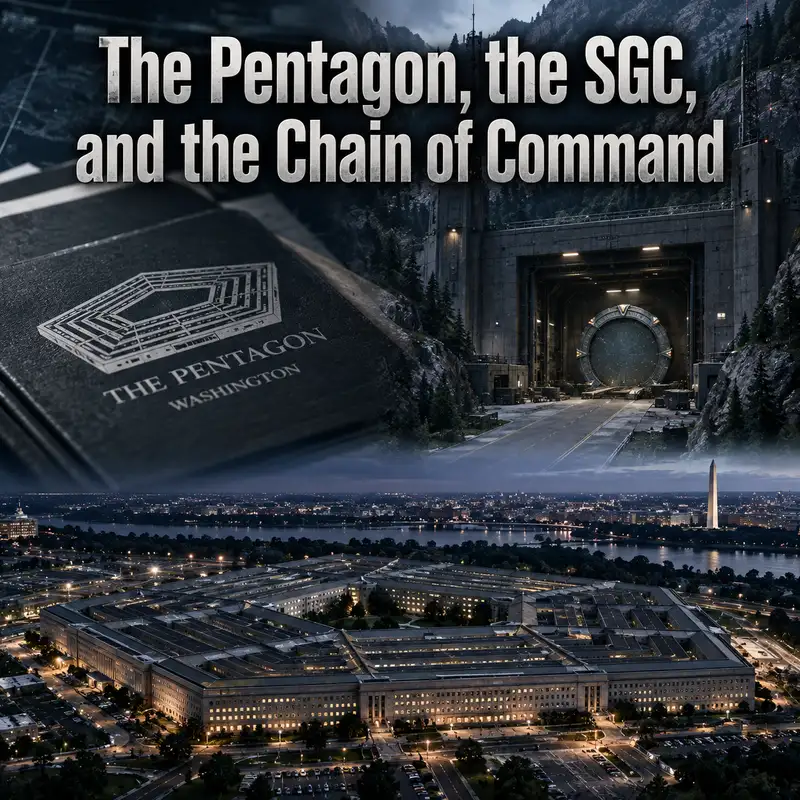
Major Paul Davis arrived at Cheyenne Mountain with a Special Forces team and an order from the Office of the Joint Chiefs. The Stargate was locked to a world collapsing into a black hole, time dilation was spreading through the facility, and General George Hammond was trying to save personnel whose radio transmissions had slowed almost beyond recognition. Washington initially believed the base might be suffering an alien incursion. When Hammond refused to leave during the emergency, Davis informed him that the President wanted a personal briefing. The officer who controlled Earth’s only functioning interstellar portal was still subordinate to a chain far above the mountain.
That moment exposed the central problem of command within the Stargate Program. Who had the authority to order a mission, close the iris, abandon a team, employ an alien weapon, or risk the planet to rescue people trapped off-world? The formal answer was military and constitutional. Authority flowed from the President through the national defense establishment to the commander of Stargate Command, then to SG team leaders and the personnel under them. The operational answer was less tidy. Communications failed, scientific facts changed faster than orders could be issued, and several organizations possessed influence without possessing clear command authority.
The modern program began with direct presidential authorization. After Apophis reopened the gate and demonstrated that Earth remained exposed, the President approved nine SG teams for reconnaissance, threat assessment, and peaceful contact. Only the President and the Joint Chiefs were initially identified as knowing the full truth. General West had commanded the original Abydos operation. Hammond inherited the reactivated program, its underground installation, and a mission that no existing service doctrine had anticipated. The Stargate came with no table of organization, no established combatant command, and no manufacturer’s representative willing to answer technical questions.
The surviving record never provides a complete conventional organization chart for Stargate Command. It does show a United States Air Force command operating under Pentagon and presidential authority, with unusually direct access to the Joint Chiefs. That matters because it would be misleading to insert a familiar real-world headquarters into a chain the screen continuity does not name. The command was classified so tightly that normal administrative boundaries became difficult to see even for officials inside government. What is clear is that Hammond did not own the Stargate. He exercised delegated command over the installation and its operations.
Within Cheyenne Mountain, that delegated authority was extensive. The commanding general approved team assignments, authorized departures, set mission priorities, controlled the gate schedule, decided when to recall personnel, and directed the defense of the base. He could suspend operations, order quarantine, deny the return of a compromised team, and recommend whether a recovered device should be moved into research. The gate room gave those decisions unusual finality. Closing an airfield inconveniences aircraft. Closing an iris while an incoming traveler is in transit can kill the traveler before anyone on Earth sees a face.
The security system therefore separated identity from access. Returning teams transmitted a remote authentication code before the iris opened. Control-room personnel verified the signal and reported to the commander. A colonel leading a team on another planet could request entry, but could not grant it to himself. The final decision remained on Earth because the destination carried the greater strategic risk. That division protected the planet from captured radios, impersonation, Goa’uld infiltration, biological contamination, and enemies who understood that the shortest route to Earth ended in one heavily guarded room.
Off-world, the balance shifted. Once the wormhole closed, Hammond could not supervise a team by continuous radio. An SG leader received a mission, understood the commander’s intent, and then operated with broad tactical discretion. Colonel Jack O’Neill could change a route, negotiate an extraction, destroy a target, or abort a mission when conditions no longer matched the briefing. That was not freedom from command. It was mission command under severe communications limits. The team remained accountable afterward, assuming it returned and the after-action report survived contact with O’Neill’s editing instincts.
Rank alone did not settle every decision inside S G One. O’Neill held tactical command. Samantha Carter was a commissioned Air Force officer whose scientific expertise often determined which options were physically possible. Daniel Jackson was a civilian consultant whose linguistic and cultural judgment could determine whether an apparent military threat was actually a diplomatic misunderstanding. Teal’c began as an alien defector with knowledge of Goa’uld forces, customs, and command practices unavailable anywhere in the Pentagon. Hammond’s task was not to make every decision personally. It was to decide whose expertise should carry weight without surrendering responsibility for the result.
This created a command culture in which disagreement could be useful rather than automatically insubordinate. Carter could warn that a device might destroy the base. Daniel could argue that an order would violate an agreement or endanger a population. O’Neill could explain that a plan designed in a briefing room would not survive movement through the destination gate. Hammond listened, questioned, and then decided. His authority worked because subordinates were allowed to present unwelcome information. A commander who hears only confirmation eventually receives it from the enemy.
The Pentagon’s role was broader and more distant. It provided national policy, personnel authority, classified funding, strategic direction, and coordination with the rest of the defense establishment. It also connected Stargate Command to the White House and the Joint Chiefs. Major Paul Davis became the clearest human face of that relationship. Assigned to the Office of the Joint Chiefs, he appeared during crises, high-level briefings, security incidents, and operations involving technologies or facilities beyond Cheyenne Mountain. He was a liaison and staff officer, not the routine commander of the SGC.
The distinction mattered during the black-hole emergency. Davis arrived with orders and personnel because higher headquarters had an incomplete picture of what was happening below. Hammond had the local knowledge but lacked the authority to ignore a direct presidential summons. He insisted on speaking to the President before leaving because the emergency could not be explained adequately through a standard chain of messages. Washington could demand an immediate briefing. The black hole was not especially interested in the briefing schedule. Effective command required a way to escalate facts upward before distant officials made an irreversible decision.
Presidential authority was decisive because the Stargate Program combined military action, foreign relations, intelligence collection, and the possible use of civilization-level technology. The President could authorize the program, approve its continuation, replace its commander, suspend operations, and decide which governments would be informed. Yet the President could not manage each incoming wormhole from the Oval Office. The system depended on delegation. The farther a decision moved from immediate danger, the more strategic authority increased and local awareness decreased. The chain worked only when each level understood that tradeoff.
Congressional power operated differently. Senator Robert Kinsey did not command SG teams, but his position in the appropriations process gave him leverage over the money that kept the gate operating. He could demand hearings, challenge classified expenditures, and press the executive branch to close the program. His effort to terminate Stargate Command briefly succeeded even as evidence of an approaching Goa’uld attack accumulated. S G One then violated the shutdown order, used the gate, and prevented the assault from succeeding. The action was tactically necessary and constitutionally awkward, which is often where secret wars place their most capable officers.
Kinsey’s mistake was not that he asked whether the program was accountable. A multibillion-dollar command conducting covert operations on inhabited worlds required scrutiny. His failure was that he treated incomplete knowledge as proof that the threat was exaggerated and political control as a substitute for operational competence. Stargate Command’s defenders sometimes made the opposite error, treating a record of saving Earth as permission to avoid hard questions. Neither position produced a healthy chain of command. Oversight without understanding became sabotage. Expertise without accountability became a private foreign policy.
The National Intelligence Department complicated matters further because it occupied a parallel line of authority. The department had legitimate intelligence and oversight functions, but it was not the operational chain commanding Hammond’s teams. Colonel Harry Maybourne and other officials nevertheless tried to direct outcomes through investigations, covert collection, and political pressure. Rogue elements stole alien technology and ran unauthorized off-world operations. The N I D could recommend, investigate, and collect intelligence. It could also misuse classification. Those authorities were not interchangeable, although several officials worked diligently to blur the distinction.
The removal of Hammond demonstrated how a parallel organization could capture a formal chain without openly overthrowing it. N I D-linked conspirators threatened Hammond’s family, forcing him to retire. Major General Henry Bauer then received legitimate command authority through official channels. His orders carried the force of rank and appointment even though hidden pressure had shaped the appointment. Bauer divided S G One, emphasized aggressive technology acquisition, and ordered development of a naquadah-enhanced weapon that nearly sent a destructive reaction back through the Stargate.
This was not merely a contest between a good general and a bad one. Bauer had identified a real strategic requirement. Earth needed weapons capable of deterring enemies with shields and starships. His failure was command judgment. He reduced an organization built for reconnaissance, diplomacy, science, and defense into a rapid acquisition program, suppressed the expertise warning him about risk, and treated an off-world population as an acceptable test environment. The chain of command had functioned administratively. It had failed strategically because lawful authority had been obtained through coercion and then exercised without institutional balance.
Hammond’s restoration did not prove that commanders should ignore civilian direction. It proved that civilian direction must be based on honest information and lawful process. Hammond generally obeyed presidential orders even when he disliked them. He also challenged incomplete directives, requested direct clarification, and accepted responsibility when emergency action departed from procedure. His style rested on disciplined trust. Team leaders were expected to exercise judgment. Scientists were expected to state danger plainly. The commander was expected to absorb the political consequence rather than place it entirely on the people who had warned him.
There were occasions when the formal chain itself became compromised. Alien infiltration of Stargate Command showed that a uniform, a familiar face, and a valid position did not guarantee a lawful order. When much of the base was replaced or controlled, S G One had to use independent judgment and outside contacts. Counterintelligence became part of command legitimacy. Personnel needed to know not only who outranked them, but whether that person remained who the badge and memory said they were. Few military regulations include a useful paragraph for hostile shape-shifters.
Russia’s acquisition and operation of a second Stargate created a different jurisdictional problem. The United States could no longer claim exclusive physical control of Earth’s access to the network. Negotiations brought Russian participation, information sharing, and personnel into the program, while the main operational command remained at Cheyenne Mountain. This produced overlapping national interests. A Russian officer could serve inside the system while still answering to a government with its own priorities. Allied participation made planetary defense stronger, but it also meant that an American commander could not assume every strategic decision belonged solely to Washington.
The classified briefing at the Pentagon for representatives of Britain, China, France, and Russia marked the point when the command problem became openly international within the secret. General Hammond and Major Davis explained the program, its costs, its dangers, and the capabilities Earth had developed. The other governments had sound reasons to object. The United States had been making decisions in the name of the planet while withholding the existence of the war from governments expected to share its consequences.
Kinsey attempted to use that anger to transfer control of the program to the National Intelligence Department. Hammond argued for continued Air Force command. The deciding intervention came from Thor, who conveyed the Asgard High Council’s preference that Hammond and his organization remain in charge. Alien endorsement did not settle every constitutional issue, but it carried considerable diplomatic weight. The resulting arrangement preserved American military operation of the SGC while expanding consultation, participation, and later international oversight. The committee agreed that Earth needed one operational command. Agreement became more conditional when the discussion reached whose command it should be.
The International Oversight Advisory eventually added a formal multinational layer. Its representatives could influence budgets, policy, technology sharing, and leadership decisions, especially in programs whose personnel and risks crossed national boundaries. The advisory did not replace the SGC commander in the gate room. It constrained the political space in which that commander operated. This distinction was essential. Oversight could establish priorities and demand accountability. It could not conduct immediate tactical command from a conference table when an unidentified signal arrived seconds before the wormhole closed.
A presidential transition revealed another weakness created by extreme secrecy. Henry Hayes became President before being briefed on the Stargate Program. General Francis Maynard, Chairman of the Joint Chiefs, delivered the disclosure after the inauguration. The new commander in chief instantly acquired ultimate authority over a war, a fleet program, alien treaties, and an existential threat he had not known existed. Vice President Kinsey and investigator Richard Woolsey then competed to shape his first judgment of Hammond and S G One. Classification had protected the secret, but it had also compressed strategic education into a briefing delivered after authority had already changed hands.
Hayes chose not to remove Hammond immediately. He reviewed the competing cases, recognized Kinsey’s hidden associations, and allowed the existing command to continue its search for an Ancient defense against Anubis. Soon afterward, however, he did use presidential authority to restructure the program. Hammond was relieved, gate operations were placed under review, and Doctor Elizabeth Weir was installed as a civilian leader. Her appointment demonstrated that command of the SGC was not inherently owned by an Air Force general. It was an executive assignment shaped by the political and diplomatic needs of the moment.
Weir’s authority was legitimate even though her background was diplomatic rather than military. She relied on uniformed officers for tactical and security expertise while retaining the power to approve or deny action. Her brief tenure also showed why civilian control is not the same as civilian micromanagement. During the crisis surrounding Anubis and the Ancient outpost, she had to judge whether extraordinary claims from S G One justified extraordinary risk. The President had changed the commander, not suspended the need for professional military advice.
The Battle of Antarctica forced the organization to separate several levels of command. Weir directed the SGC. Hammond took command of the Prometheus force sent to defend S G One’s approach. The President and Pentagon coordinated the national response. O’Neill, carrying Ancient knowledge, led the critical action at the objective. No single officer controlled every element. The defense succeeded because political authority, base command, space operations, and field initiative aligned for a limited period around one purpose.
After the battle, Earth formalized what the emergency had revealed. Hammond was promoted to oversee the SGC, the X three-oh-three program, and the Antarctic site on behalf of the Pentagon and Washington under the emerging Homeworld Security structure. Jack O’Neill was promoted to brigadier general and placed in command of Stargate Command. Samantha Carter, now a lieutenant colonel, assumed leadership of S G One. The old team’s chain of command became an institutional ladder. Experience gained at the gate moved upward into the headquarters responsible for deciding how that experience would be used.
O’Neill’s transition from field commander to base commander carried its own operational cost. He could no longer solve every problem by accompanying the team. His responsibility expanded from the survival of several people to every team, every incoming traveler, and every risk to Earth. He could authorize missions he would not personally lead and deny rescue attempts he would once have demanded. Command provided a larger office, a better parking space, and a much less forgiving casualty ledger.
Major General Hank Landry later assumed command of the SGC while O’Neill moved to Washington and broader Homeworld responsibilities. By then, the institution coordinated SG teams, off-world bases, Earth-built starships, the Atlantis connection, international partners, and responses to threats arriving through both hyperspace and the gate network. Homeworld Security, and later Homeworld Command, provided a higher headquarters for capabilities that no longer fit beneath one mountain commander. The chain had expanded because the battlefield had expanded.
Even then, the command system remained a federation of specialties rather than a perfect vertical line. Military authority directed operations. Scientists defined technical possibilities and hazards. Intelligence organizations collected and analyzed information. Diplomats managed alliances. International bodies controlled political support. Contractors and research facilities converted discoveries into equipment. Confusing these roles produced disaster. Integrating them produced capabilities Earth could not have created through any one institution alone.
The formal chain can therefore be stated simply. The President held ultimate civilian authority. The Pentagon and Joint Chiefs translated national policy into military direction and provided oversight, resources, and coordination. Homeworld-level headquarters eventually synchronized planetary defense programs. The commander of Stargate Command controlled the base and its missions. SG team leaders exercised tactical command beyond the gate. Yet the simple diagram hides the real work. Every level depended on information moving upward honestly and authority moving downward clearly.
The greatest strength of the system was delegated judgment. A team leader could act when Earth was unreachable. A scientist could stop a technically impossible order before it became a casualty report. A base commander could challenge Washington with facts from the scene. A President could replace commanders when political legitimacy required it. The greatest weakness was secrecy. It allowed parallel agencies to imitate command, limited informed oversight, and made personal trust carry weight that should have belonged to transparent institutions.
At the end of every mission, the chain narrowed to a final decision in the control room. A code arrived. A technician reported it. A commander judged whether to open the iris, risk the base, and bring the team home. The Pentagon could define policy, the President could appoint the commander, and committees could review the result. None of them could make that decision after the traveler struck a closed shield. Earth survived because authority was delegated far enough to act, but not so far that anyone could forget who would answer for opening the door.