The Priors: Missionaries, Governors, and Biological Weapons
Lieutenant Fisher returned through the Stargate without a wound, a fever, or any sign that an enemy had crossed with him. His team had been observing a Prior preach to an isolated human population. During the service, the Prior touched Fisher as though offering a blessing. Standard medical screening found nothing unusual. Fisher left Stargate Command, stopped at a gas station and a restaurant, and attended a ceremony at Peterson Air Force Base. Only later did he become ill. By then, the Prior’s message had traveled farther than any sermon. Earth had not been invaded by soldiers. It had been entered by one carefully selected carrier.
The gate room had done its job. The iris had not failed. No hostile formation had forced the mountain, and no suspicious object had arrived in the wormhole. The breach occurred because the weapon looked like a healthy airman returning from an authorized mission. That was the essential danger of the Priors. They were not simply clergy attached to an Ori army. Each was a portable system for conversion, administration, intelligence collection, coercion, and biological attack. A single Prior could perform work that a conventional empire might assign to missionaries, governors, special operations teams, medical units, and strategic weapons.
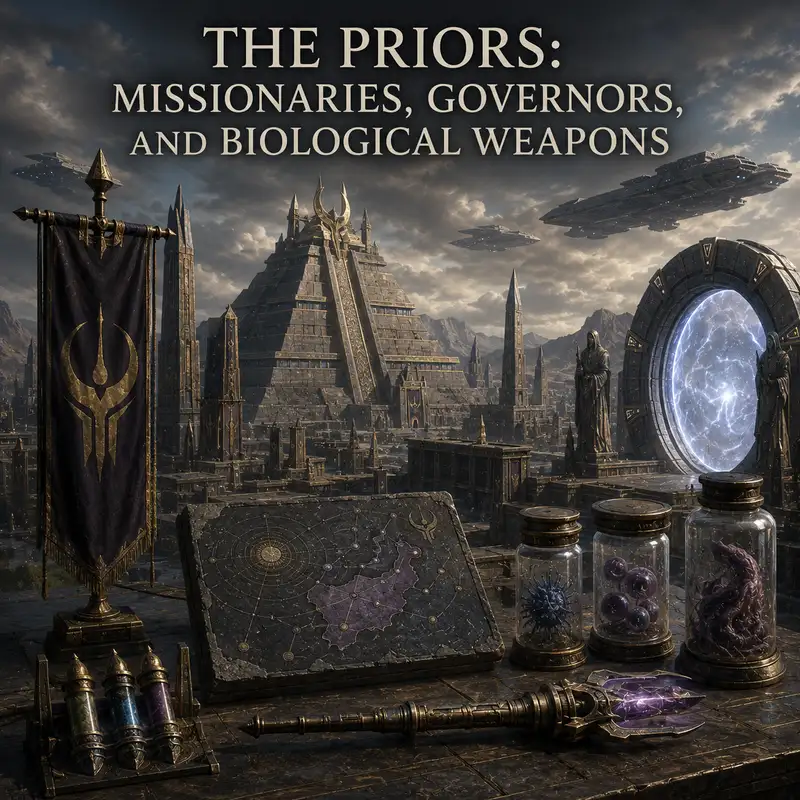
The Ori created Priors from ordinary human beings through deliberate biological transformation. The process advanced the subject toward the physical and mental condition that natural human evolution might reach only after an immense period of time. Skin became pale. Eyes changed. Distinctive markings identified office and devotion. More importantly, the brain gained access to abilities beyond normal human limits. Priors could move objects without touching them, sense thoughts, inflict pain, heal disease, influence living tissue, and manipulate energy. Their staffs helped focus and display those abilities, but the power was not merely a weapon hidden inside the wood. The Prior himself was the weapons platform.
Selection mattered as much as biology. The Ori did not need independent philosophers with unusual powers. They needed committed agents who would present Ori policy as sacred truth. In the village of Ver Eger, an administrator who enforced religious authority and condemned suspected heretics was rewarded by being transformed into a Prior. Gerak, already a major political figure among the Free Jaffa, received the same transformation after embracing Origin. The pattern suggests that loyalty, influence, and demonstrated willingness to enforce doctrine were central qualifications. The Ori improved the body after the institution had already tested the mind.
Priors appear to have believed sincerely in Origin. That does not remove responsibility for what they did, but it explains why they were so effective. A mercenary may reconsider when the mission becomes dangerous or the payment becomes uncertain. A Prior interpreted danger as proof of sacrifice and resistance as evidence that the mission was necessary. He did not need a political officer standing behind him. He carried the political system within his own convictions. When he offered a village the choice between worship and destruction, he could describe the ultimatum as mercy because submission remained technically available.
Their position connected the ascended Ori to the human societies below. The Doci served as the highest visible interpreter in the Ori home galaxy, while Priors carried doctrine outward through the Stargate network. Beneath them stood local administrators, converted leaders, soldiers, and civilian believers. Later, Adria directed the crusade as the Orici, but the Priors remained the connective tissue of the occupation. They translated distant authority into local orders. They could explain the Book of Origin, validate a collaborator, condemn a dissenter, direct troops, or recommend the destruction of an entire settlement. Few empires have fielded a more compact chain of command.
The first stage of a Prior mission usually looked peaceful. He arrived alone or with minimal support, announced the teachings of Origin, left a copy of the Book, and demonstrated an ability the local population could not explain. Crops might grow. An illness might disappear. An injured person might walk. Someone apparently killed could be restored. These acts were genuine interventions, not stage tricks. That made the propaganda difficult to challenge. A community was not being asked to believe in a powerless abstraction. It was being shown a messenger who could alter the physical world and then told that his power proved the moral authority of the Ori.
The demonstration also collected intelligence. A Prior could identify who approached for healing, who refused to kneel, which leader controlled the gate, and which families influenced the village. Public worship revealed loyalties more efficiently than a covert survey. The Prior learned whether the population was politically unified, whether it possessed advanced weapons, and whether local elites could be recruited. Even rejection produced useful information. A world that attacked the messenger revealed its defensive posture. A world that argued exposed its intellectual leadership. A world that accepted the Book identified the people most likely to become the first layer of local administration.
The second stage was pressure. Priors frequently allowed time for consideration, but the deadline did not create a free choice. It established a period in which fear, internal argument, and collaboration could work on the target population. Leaders who favored submission could claim they were protecting civilians. Opponents could be blamed for inviting punishment. Families had to decide whether private disbelief justified public danger. By the time the Prior returned, the community might already be divided. The Ori did not have to create every fault line. They only had to make survival appear dependent on one side winning the argument.
When conversion succeeded, the Prior’s role changed from missionary to governor. The title was not always formal, and local rulers often remained in place, but practical authority rested with the person who could interpret doctrine and call down punishment. Existing institutions were useful. They knew the population, collected food, organized labor, and maintained order. Replacing them all would have required occupation forces the Ori did not need to provide. A converted council could continue meeting. A village elder could continue settling disputes. The limit was simple. No local decision could contradict Origin or the Prior who spoke for it.
This arrangement reduced the logistical cost of conquest. Stargates could move Priors and small parties quickly, but they could not by themselves supply a garrison for every inhabited world. Ori warships eventually brought armies into the Milky Way, yet even those forces were finite. Priors turned belief into administrative infrastructure. Local converts provided guides, interpreters, labor, recruits, and intelligence. Soldiers enforced the outer boundary of obedience, while community leaders handled daily life. The result resembled indirect rule with a theological command channel. It was economical, scalable, and deeply intrusive, because political loyalty could be tested through public worship.
A Prior also carried the authority to decide when persuasion had ended. On worlds resisting the crusade, Priors ordered troops to execute prisoners, directed attacks on villages, and used Ori warships as instruments of collective punishment. Tomin, a sincere believer and capable commander, began to doubt when he saw a Prior twist the teachings he claimed to defend in order to justify killing people who no longer posed a military threat. That moment exposed the governor’s power. The Prior did not merely advise the army. He defined what the army’s violence meant. If he called an execution purification, the command structure expected the soldier to accept the definition.
The campaign on Kallana showed that Priors were also strategic engineers. After local Jaffa rejected Origin, a Prior established an expanding force field around the Stargate. Attempts to penetrate or destroy the field only contributed energy to the process. Components for a supergate arrived and assembled inside the protected area. The planet itself was transformed into the gravitational source needed to power the enormous intergalactic connection. The Prior had entered as one man through an ordinary gate. He turned that foothold into infrastructure capable of receiving a fleet. Kallana’s population and physical mass were treated as expendable construction material.
This was the military elegance of the Prior system. The first person through the gate could negotiate, intimidate, reconnoiter, protect a beachhead, and begin building the route for heavier forces. A conventional expedition might require diplomats, engineers, security personnel, communications specialists, and a headquarters element. The Ori compressed those functions into one altered human supported by knowledge from above. The arrangement was efficient until the Prior encountered a problem outside his doctrine or a countermeasure that neutralized his abilities. Highly centralized capability can simplify deployment. It can also create a very important single point of failure.
Biological warfare was the Priors’ most difficult capability to defend against because it used normal human contact and normal movement. Fisher was not infected merely to kill one airman. He was used as a distribution system. The Prior appears to have manipulated his own genetic material to create the initial virus, then transferred it during the apparent blessing. The agent mutated after transmission, complicating diagnosis and treatment. Fisher’s delayed symptoms allowed him to pass through medical screening and enter public spaces. The operation exploited trust in returning personnel, the speed of modern transportation, and the secrecy surrounding Stargate Command.
The target was larger than the people who became sick. A fast-moving epidemic threatened hospitals, military readiness, public confidence, transportation, and the classified status of the Stargate Program. Earth’s governments could not explain that an alien missionary had engineered the disease without revealing the program that had brought his carrier home. Public-health authorities had to respond with incomplete information while Stargate Command pursued a cure through channels that could not be openly acknowledged. The Prior had created a medical emergency, an intelligence crisis, and a political exposure problem with one touch.
The outbreak also demonstrated how carefully coercion and mercy were paired. The same class of being that could create a plague could remove it. To an affected population, the sequence encouraged a simple conclusion. Resistance produced disease. Acceptance produced healing. Whether the Prior had caused the original suffering could be hidden, denied, or reframed as judgment. The cure then became evidence of benevolence. This was not merely biological warfare in support of religion. It was biological warfare designed to manufacture religious proof.
Stargate Command’s response depended on Orlin, an Ancient who descended into human form and retained enough knowledge to understand the attack. He concluded that the virus had originated from the Prior’s manipulated biology. That meant the most useful intelligence source was not a contaminated surface or a late-stage victim. It was the Prior who had created the root material. Cameron Mitchell, Daniel Jackson, and supporting personnel therefore had to capture the specific individual responsible and obtain a blood sample. The medical solution began as a special operations problem.
Capturing a Prior under normal conditions was close to impossible. Small-arms fire could be deflected. Weapons could be pulled from hands. Personnel could be thrown, immobilized, or killed before closing the distance. Samantha Carter and Doctor Bill Lee developed a device based on Orlin’s knowledge that emitted a frequency disrupting the advanced neural activity behind a Prior’s abilities. Concealed near the planned encounter, it temporarily reduced the target from an apparently supernatural opponent to a physically vulnerable man. The ambush succeeded, and the blood sample was taken. Science provided the opening. Armed personnel still had to enter the ring and use it.
The device did not solve the Prior problem permanently. Its effect was local, required the target to remain within range, and could be overcome as an advanced mind adapted. Daniel Jackson demonstrated that danger after Adria transformed him into a Prior for a covert plan of his own. Held under the device’s influence, he eventually learned to push through the interference. The lesson was operationally important. The anti-Prior device was a suppression system, not a prison with an unlimited service life. It bought time for interrogation, extraction, or conventional action. It did not justify leaving an adaptive prisoner unattended.
Nor did the blood sample immediately produce a cure. The virus had changed, and Orlin’s human brain was deteriorating under the burden of knowledge retained from ascension. The final missing information came from Gerak after he rejected the Ori’s command. As a Prior, Gerak cured the infected personnel at Stargate Command, including General Hank Landry. That act revealed the antibody response needed to complete the medical countermeasure. Gerak died almost immediately afterward, apparently destroyed by a safeguard built into his transformation or by direct Ori action. His body had been upgraded for service, not granted independence.
Gerak’s fate is critical to understanding the Priors as people. Transformation did not necessarily erase memory, loyalty, or the capacity for moral choice. He remained capable of recognizing the consequences of his decisions and acting against the institution that empowered him. Yet the Ori had designed a system in which disobedience could be punished through the servant’s own altered body. A Prior therefore occupied two positions at once. He was a perpetrator with extraordinary authority over ordinary people, and he was a controlled asset whose life depended on powers above him. Victimhood and responsibility existed together. Neither canceled the other.
Other Priors used biology on a smaller scale with equally deliberate effect. One healed Tomin’s lifelong disability, allowing him to enter military service and binding personal gratitude to the crusade. Another manipulated a Sodan warrior, Volnek, turning him into a violent instrument against his own people. Priors could restore health, accelerate growth, or inflict disease according to strategic need. Medicine and weaponry were not separate portfolios. Both involved control of living systems. The moral distinction came from intent, and the Priors allowed Origin to supply that intent for them.
Their powers also shaped battlefield behavior. A Prior accompanying Ori troops could protect a command group, break resistance without prolonged fire, and reinforce the belief that the army possessed divine support. Soldiers who saw projectiles stopped or enemies thrown aside did not need a technical explanation. They needed only the doctrine already provided. For opposing forces, the psychological effect could be severe. Conventional training assumes that cover, range, and weapon discipline matter. A Prior could make those assumptions appear obsolete until the countermeasure activated. The first successful suppression of a Prior was therefore an intelligence victory and a morale weapon as much as a technical achievement.
The same was true when a disabled Prior was killed by ordinary gunfire in front of Ori soldiers. Without access to his abilities, he could no longer compel Tomin to execute prisoners or prove his authority through force. Tomin refused the order. The Prior reached for a weapon and was shot. The surrounding soldiers surrendered rather than avenge him. One death did not defeat the crusade, but it exposed a truth the institution had worked hard to conceal. A Prior was powerful, enhanced, and dangerous. He was not divine, and when his biological advantage was neutralized, obedience became a choice again.
That did not make killing Priors a complete strategy. Their numbers were not precisely known, and the Ori could create replacements from loyal followers. Each dead missionary could be presented as a martyr. Converted worlds still had administrators, armies, and populations shaped by years of doctrine. Effective resistance required medical defenses, anti-Prior technology, secure gate procedures, local political allies, and information capable of separating the Ori’s existence from their claim to moral authority. A rifle could remove one governor. It could not by itself dismantle the system that had taught a village to request another.
The Priors’ greatest institutional strength was standardization. They shared a recognizable appearance, doctrine, staff, chain of authority, and range of enhanced capabilities. A population that had seen one could understand the role of the next. An Ori commander could deploy them across different worlds without creating a new administrative system each time. Yet standardization created common vulnerabilities. A frequency that disrupted one Prior could affect others. Biological knowledge taken from one could help defeat a plague. Their staffs and hierarchy connected them to a central religious network. The same architecture that allowed rapid expansion also allowed a successful countermeasure to spread in the opposite direction.
The Ark of Truth exploited that final weakness. When the Doci was forced to recognize that the Ori were not gods, the realization passed through the linked Prior hierarchy in the Ori home galaxy. The Priors in the Milky Way required separate exposure, but the principle remained the same. Their authority depended on a centralized belief system supported by shared connections. Once that certainty failed, Ori warships did not lose their engines and soldiers did not forget how to fight. What disappeared was the sacred command that made continued conquest seem obligatory.
The Priors were missionaries because belief was the resource the Ori needed. They were governors because converted worlds required supervision without costly occupation. They were biological weapons because control over living tissue could punish resistance, reward obedience, and turn human movement into a delivery system. These were not three unrelated duties. They were one integrated method of conquest. The sermon identified the target. The miracle established legitimacy. The governor organized compliance. The disease made refusal expensive.
Lieutenant Fisher never saw an Ori warship over Earth. He did not carry an obvious device, and he did not know he had been recruited into the enemy’s plan. He simply passed through a secure gate, cleared a medical examination, and continued with his day. That was the Prior’s most dangerous achievement. He could make invasion resemble routine contact, occupation resemble spiritual guidance, and biological attack resemble a blessing. By the time the difference became visible, the gate had already closed behind the weapon.