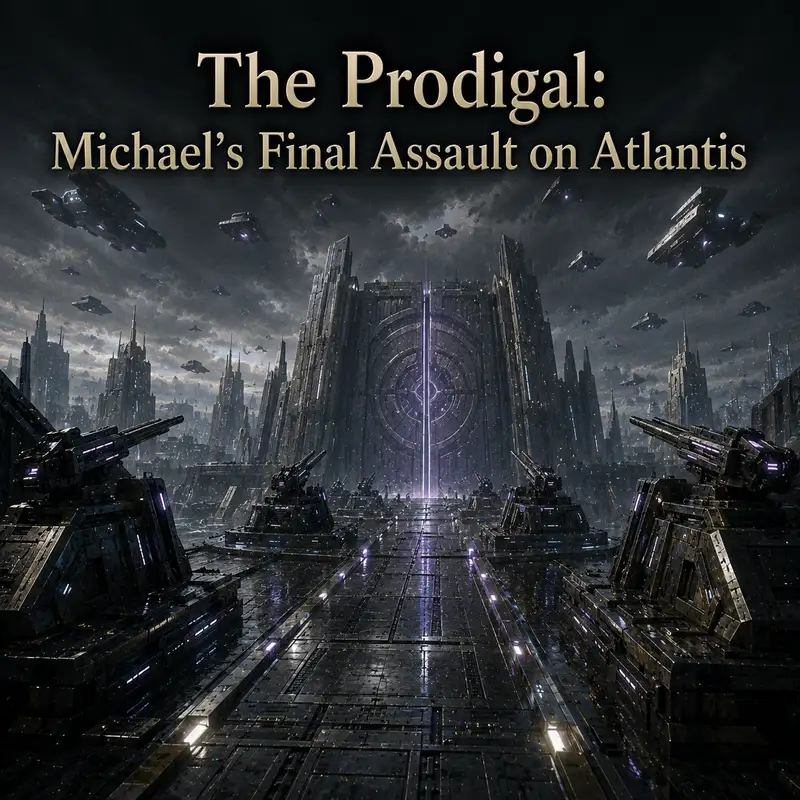
The Prodigal: Michael’s Final Assault on Atlantis
The identification code was valid. Major Nelson’s team was not expected until the following day, but early returns were not unusual enough to justify keeping Atlantis’s gate shield closed. Richard Woolsey authorized entry. A Puddle Jumper crossed the event horizon, settled on the Gate Room floor, and refused to rise toward the Jumper bay. Before the control room could challenge the pilot, a blue field expanded from the craft and dropped everyone within reach. The doors opened. Michael and a small detachment of hybrids stepped into the command center of Atlantis without firing a shot at the shield.
Michael’s final assault was a remarkably compact operation. One stolen aircraft provided transportation, authentication, power, electronic access, an area-defense system, and the planned extraction route. His force seized the Gate Room, isolated the central tower, captured Teyla Emmagan and her infant son, and began arming Atlantis’s self-destruct system. For much of the crisis, a handful of attackers held the most important levels of an Ancient city against a much larger garrison. The assault nearly succeeded because Michael understood the city’s security architecture. It failed because he allowed revenge to become more important than completing the raid.
He entered the operation from a position of strategic decline. Atlantis had destroyed major laboratories, recovered Athosian prisoners, disrupted the hybrid program, rescued Teyla, and destroyed Michael’s cruiser. Michael escaped that destruction by stealing the Puddle Jumper used during the rescue. He retained a few hybrids, technical knowledge, and enough genetic research to continue, but his network had lost much of its infrastructure. He could no longer behave like an emerging regional power. The attack on Atlantis was the work of a damaged clandestine organization attempting one decisive recovery mission before its remaining advantages disappeared.
The mission had three connected objectives. Michael wanted Torren because the child inherited unusual Wraith-related genetic traits from both Teyla and Kanaan. He believed those traits could strengthen his mental control over the hybrids who formed the basis of his future army. He wanted Teyla alive if she would come voluntarily and care for the child. He also wanted Atlantis destroyed as punishment for the experiment that had first transformed him. Seizing Torren supported the surviving hybrid program. Destroying the city served vengeance. Combining both objectives made the operation more ambitious and less disciplined.
The stolen Jumper was the key. Michael said it had provided information, technology, and the means to penetrate Atlantis. The record does not show exactly how he obtained Major Nelson’s current identification code, but the craft transmitted it successfully. Atlantis personnel confirmed the code, saw an expected type of friendly vehicle, and lowered the gate shield. Authentication proved that the sender possessed a trusted credential. It did not prove that Major Nelson was flying the ship. Michael exploited the difference between identifying a code and identifying the person using it.
The deception worked because it fit normal operations closely enough to avoid immediate alarm. Off-world teams sometimes returned early. Puddle Jumpers entered directly through the gate. The shield had to be lowered before the craft could pass. Once the vehicle was inside, there was almost no physical separation between the arrival point and the city’s control center. Atlantis’s gate procedures were designed primarily to stop hostile matter outside the shield. They were less effective against a captured friendly platform carrying valid access data and an enemy familiar with the base.
Michael’s hybrids connected the Jumper to an external power interface and shut down most of Atlantis. The city’s zero-point module and naquadah generator remained offline, while the upper central tower drew power directly from the captured aircraft. Doors sealed. Internal communications and most transporters failed. The gate shield remained under hostile control. Michael then combined modified Wraith stun-pulse technology with the Jumper’s cloaking system to create a protected zone around the Gate Room and control room. Anyone crossing the boundary was rendered unconscious rather than physically stopped.
The field turned a small foothold into a temporary fortress. Michael did not control every pier, laboratory, armory, residential section, or submerged bay. He controlled the vertical and electronic chokepoint through which the city normally coordinated them. The control tower stood more than seventy levels above some personnel on the outer piers. Without transporters, elevators, standard radios, or powered doors, defenders had to move on foot through a darkened city. The gate gave Michael an exit, the control room gave him system access, and the stun field made a direct counterattack costly.
John Sheppard responded by rebuilding command from whatever still worked. He distributed flashlights and short-range radios, ordered Marines to assemble while moving toward the tower, and sent Radek Zelenka to restore limited power. Zelenka used auxiliary batteries to bring McKay’s laboratory and several transporters online. Rodney McKay accessed noncritical surveillance feeds and identified the captured Jumper, the hybrids, Michael, Teyla, and Torren. The improvised command post did not restore Atlantis. It gave the defenders enough information to stop treating a city-wide blackout as a maintenance failure.
Sheppard prepared simultaneous assaults through separate stairwells. His instructions reflected the history behind the attack. Michael had escaped too many earlier encounters and remained capable of taking prisoners, altering bodies, and rebuilding from partial losses. Sheppard ordered the teams to fire if they gained a clear shot. C four opened the sealed access doors, but the advance stopped almost immediately. Major Lorne crossed the invisible boundary before McKay’s warning reached him and collapsed unconscious. The defenders could reach the tower. They could not cross the final few meters while the Jumper powered the field.
McKay and Zelenka identified the architecture of the defense. The cloaking system supplied the geometry, while the Wraith stun technology supplied the effect. Michael’s innovation was clever because neither component had originally been designed as a fixed internal perimeter. It was also brittle. The field, the hostile control-room systems, and the external power connection all depended on the same Jumper parked beside the Stargate. Destroying that craft would collapse most of the occupation at once. Reaching it was the problem, which is the usual difficulty with an enemy single point of failure.
Inside the protected zone, Michael’s force remained small. Ronon Dex estimated that only a handful of hybrids could have arrived because they all had to fit inside one Jumper. There was no follow-on company, orbiting cruiser, or relief force. Michael relied on shock, technical control, and the belief that the self-destruct could be armed before Atlantis personnel penetrated his defenses. This was never a plan to occupy the city. It was a raid designed to take one child, perhaps take Teyla, destroy the base, and disappear through the gate before superior numbers could matter.
Teyla understood that the military objective did not explain the entire assault. Michael held her in Woolsey’s office with Torren and tried to present himself as both captor and protector. He argued that Atlantis had created the person he had become and that his later violence was necessary for survival. He offered to spare Teyla if she joined him and promised that he would care for her and the child. The offer was not reconciliation. Michael had already decided to take Torren and kill everyone else in the city. Teyla’s consent would only have made the abduction easier to describe as mercy.
Torren was valuable because Michael’s hybrid army had a command problem. His mature hybrids could think, speak, operate ships, and perform complex missions, but some retained enough of their previous identities to resist his control. Michael believed Torren’s combined inheritance would let him strengthen the mental bond governing that army. During the hostage period, he collected a genetic sample from the child as insurance. Physical possession would accelerate the research and give him control over Torren’s upbringing. The sample meant Michael could still continue the project if the extraction failed, provided he escaped with his data and organization intact.
The self-destruct system became the operational delay. Michael’s technicians underestimated the encryption protecting it. They ran repeated factorization routines while Atlantis personnel organized below. The lead hybrid warned that the defenders would eventually breach the perimeter and argued that the child was already secured. Michael refused to leave until the device had been armed. Once the code was broken, his plan was to shift the self-destruct from Jumper power to Atlantis power at the last possible moment, depart through the Stargate, and deny the defenders time to cancel the sequence.
That decision transformed a successful infiltration into a prolonged hostage crisis. A commander focused on force preservation would have extracted Torren as soon as the route remained open. Michael remained because leaving Atlantis intact would not satisfy the purpose he had assigned to the mission. The city represented the place where he had been converted, deceived, imprisoned, and denied a stable identity. He wanted more than a future advantage. He wanted the people responsible to die inside the symbol of what they had done. Vengeance supplied determination. It also kept his only aircraft parked in the exact place the defenders were trying to destroy.
Resistance developed inside the occupied zone as well as below it. The initial stun wave affected personnel differently, and Ronon recovered before most of the control-room staff. Technician Amelia Banks awakened soon afterward and bypassed the lock on the room where the captives had been placed. When a hybrid entered, Ronon engaged him and Banks used five years of kickboxing training to help bring him down. The episode was a useful reminder that technical personnel assigned to a forward expedition sometimes arrive with qualifications not listed prominently on the duty roster.
Ronon conducted reconnaissance, counted the visible hybrids, and initially planned to reach the armory. He changed course after overhearing that the self-destruct encryption had been broken. With two Atlantis personnel, he attacked the control room before Michael could complete departure preparations. The supporting men were stunned, but Ronon reached Michael and forced him into close combat. Teyla used the fight to escape with Torren. Michael eventually threw Ronon from the control-room balcony to the Gate Room floor, leaving him unconscious and exposed to whatever Michael chose to do next.
Woolsey joined Teyla during the escape, but the stun field cut across the stairwell they selected. He fell through it and injured his arm. Teyla used the same hazard against a pursuing hybrid, then hid with Torren inside a maintenance access space. Her familiarity with Atlantis mattered more than the occupiers’ control of the main systems. Michael could search rooms and corridors within the perimeter. He could not easily search every service shaft, access panel, and concealed maintenance route in a city built for a population far larger than either force present.
Sheppard’s solution lay in an underwater Jumper bay containing two damaged craft left from an earlier flooding disaster. Both had remained unrepaired for approximately two years despite McKay’s assurance that the work was on his list. One vehicle retained some power but lacked functioning drive pods and weapons. The other had drones and useful components but no power. Sheppard and McKay cannibalized both to create one aircraft capable of flight. Deferred maintenance had become operational planning, which is an efficient way to make an engineering backlog suddenly receive command attention.
The repaired Jumper could rise from the submerged bay, but its weapons and inertial dampeners remained offline. Sheppard first proposed crashing it into the tower hard enough to destroy Michael’s craft. Without inertial protection, the impact would also kill the pilot. McKay treated the plan as the suicide mission it was. Zelenka then reported partial success against Michael’s lockouts. He could open access doors and, more importantly, lower the Stargate shield. He still could not disable the stun field or the self-destruct directly. That limited access created a better weapon than the drones McKay could not activate.
McKay proposed flying the repaired Jumper close enough to use its dialing controls, establishing an outgoing wormhole to any safe address. Zelenka would lower the gate shield at the correct moment. When a Stargate first activates, an unstable vortex expands outward before collapsing into the normal event horizon. Nothing in its path survives intact. Michael had parked his Jumper directly in front of the gate because that position supported entry, power, and escape. The same position placed most of the craft inside the space the opening vortex would occupy.
Teyla supplied the final delay. From hiding, she contacted Michael and demanded that he turn off the self-destruct before she surrendered. She did not trust his promise. She used his need to be believed and his fixation on her judgment. Michael kept speaking while his lead hybrid warned that less than two minutes remained. He eventually rejected the bargain, said he already had Torren’s genetic material, and prepared to leave the city burning. The exchange did not disarm the weapon. It held his attention during the final approach of McKay’s improvised aircraft.
McKay brought the repaired Jumper alongside the tower. Sheppard positioned strike teams outside the now-open access doors. Zelenka dropped the gate shield, and McKay initiated the dialing sequence. The unstable opening vortex destroyed most of Michael’s Jumper and the hybrids already aboard it. External power vanished. The stun perimeter collapsed. The self-destruct shut down before Michael could transfer it to the city’s power system. One activation of the Stargate neutralized the command post, extraction vehicle, defensive field, and demolition sequence. It was an elegant solution made possible by the enemy placing every critical function in one machine.
Sheppard’s teams entered the Gate Room as the surviving hybrids tried to recover. Michael paused beside the unconscious Ronon with a knife, intending to take one last life before departure. The gate activation interrupted him. Atlantis personnel overwhelmed the remaining detachment, and Sheppard wounded Michael in the shoulder. With the Jumper destroyed and the gate area lost, Michael ran toward the upper Jumper bay. Zelenka closed its exterior doors before he could find another aircraft. The raid had changed from planned extraction to escape on foot inside a city whose power and defenders were returning.
Michael fled to the top of the central tower and ambushed Sheppard on an exterior walkway. The fight favored Michael’s altered strength. He disarmed Sheppard, knocked him onto a lower structure, and came close to killing him. Teyla handed Torren to Banks, followed the pursuit, and entered the fight before Michael could finish it. Together, she and Sheppard forced him over the edge. Michael caught the ledge with both hands. Teyla looked down at the man who had abducted her people, converted Kanaan, imprisoned her through childbirth, and returned for her son.
She did not pull him up. Teyla kicked one hand free, waited, and then removed the other. Michael fell into the depths of Atlantis while Sheppard watched. This was not a formal trial, a negotiated surrender, or the clean conclusion of an arrest operation. It was a battlefield decision made after Michael had invaded the city, armed its self-destruct, attempted to abduct a child, and nearly killed two members of Teyla’s team. In prime live-action continuity, he did not return after the fall. The person Atlantis had once tried to manufacture ended where that experiment had begun.
The assault left Lorne unconscious, Woolsey with an injured arm, Ronon with a concussion, and Sheppard bruised from the tower fight. Atlantis regained power, communications, and control of the gate. Torren survived the entire crisis without apparent injury. The city had not been held by a large army, and its recovery did not require one. Michael’s initial advantage came from centralized technical control. Once that control failed, his small force had no depth, reserve, or alternate extraction. The difference between an occupation and a raid became decisive the moment the defenders reopened the doors.
The security failure was not simply that Atlantis accepted an identification code. Gate operations require fast decisions, and a shield left raised against a friendly Jumper would destroy the returning team. The deeper problem was credential reuse without sufficient secondary confirmation. Michael combined a trusted code, a friendly vehicle type, knowledge of return procedures, and the expectation that an early arrival would be accepted. Future defense would require treating captured platforms as intelligence compromises, separating authentication from identity, and challenging schedule changes before lowering the only barrier between an arriving ship and the control room.
The counterattack showed the value of distributed initiative. Woolsey had formal command but began the crisis unconscious and isolated. Sheppard organized the military response from the darkened piers. McKay and Zelenka restored fragments of the technical system. Banks opened a detention room and fought a hybrid. Ronon created an internal diversion. Teyla protected Torren, used the city’s hidden spaces, and manipulated Michael’s timetable. None possessed a complete picture. Their actions converged because each understood the immediate problem at his or her level and continued operating when Atlantis’s normal command network disappeared.
Michael’s final assault nearly succeeded because it reflected everything he had learned from humans and Wraith. He used stolen credentials, Ancient mobility, Wraith stun technology, cyber intrusion, hostages, genetic leverage, and a self-destruct system built by the people he hated. It failed because he repeated the weakness that had shaped his entire campaign. He could design bodies and manipulate systems, but he could not separate strategy from the need to make others acknowledge his grievance. He had Torren, an open Stargate, and a functioning escape craft. He stayed to punish Atlantis.
Michael returned to the city as the prodigal creation, not seeking restoration but intending to make his birthplace a tomb. Atlantis survived because its defenders recognized that his apparent fortress was a Puddle Jumper, his force field was a powered device, and his control of the city was narrower than it looked. They turned a neglected aircraft, partial system access, and the Stargate’s opening vortex into a counterattack. Michael wanted the final image of his war to be Atlantis disappearing behind him. Instead, the city remained, Torren remained with Teyla, and Michael was the one who fell from its highest tower.