The Rebellion That Buried the Gate
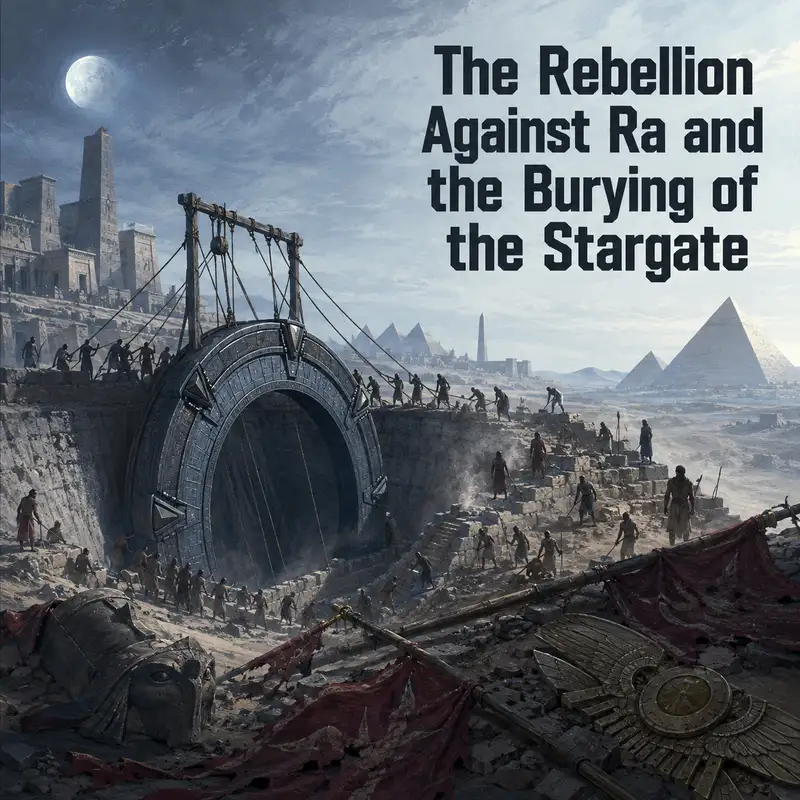
The rebellion’s most important military action occurred after the fighting had already begun. While Ra’s authority was collapsing around Giza, the insurgents had to seize a metal ring weighing many tons, move it away from the ruler’s ship, conceal it, and bury it deeply enough that no loyal garrison could reactivate it. They did not possess artillery, aircraft, armored vehicles, or an interstellar fleet. Their decisive weapon was denial. By removing the Stargate from the battlefield, they turned Earth from an easily accessible imperial possession into a world Ra could reach only by committing ships across interstellar space.
How did an ancient population defeat a ruler whose soldiers carried energy weapons, whose vessels controlled the sky, and whose technology had supported the appearance of divinity for thousands of years? The answer was not a single heroic charge. Ra was defeated by political delegitimization, underground organization, captured weapons, local numerical superiority, and a carefully chosen operational objective. The rebels did not need to destroy the Goa’uld order. They needed to make Earth ungovernable, force Ra to withdraw, and deny him the gate required for rapid return.
The surviving account comes from two layers of continuity. The original Stargate expedition learned on Abydos that people on Earth had risen against Ra, killed or overthrown his guards, and buried the Stargate. Later events placed the revolt roughly around three thousand B C and introduced time travelers into the final sequence. Those later events do not erase the indigenous rebellion. They complicate its command history. The broad movement, the hidden supporters, the mass of fighters, and the political will to remove Ra all belonged to the people living under his occupation.
Ra’s control was formidable, but it was not a modern territorial occupation with a permanent garrison in every settlement. His power was concentrated around the Nile region, the Stargate, religious centers, transport routes, tribute systems, and communities required to support them. Jaffa patrols enforced obedience. Local collaborators and believers extended surveillance where Ra’s troops were absent. His ship provided mobility and overwhelming force at selected points. A small alien ruling apparatus could dominate a much larger population while fear and religious authority performed most of the daily work.
The first requirement for rebellion was therefore not military. It was intellectual. Ra’s subjects had to accept that the being who appeared in light, returned from mortal injury, and commanded armored servants was not a god. That conclusion sounds simple only after the machinery has been explained. To the occupied population, the evidence of divine power was visible and repeated. Ra’s rule joined political authority, religious doctrine, and advanced technology into one system. Challenging the ruler meant challenging the explanation through which people understood the world, their obligations, and the consequences of disobedience.
Every successful act of resistance weakened that explanation. A Jaffa could be ambushed. A staff weapon could be taken. A patrol could be misled. A village could conceal fugitives. Each event supplied intelligence and changed expectations. Insurgencies grow when isolated people discover that their private doubts are shared. Ra’s authority depended on making each community believe resistance elsewhere was impossible or had failed. The rebels had to build the opposite perception, quietly at first, then publicly enough that neutrality became harder to maintain.
The movement relied on ordinary social networks. Families, workers, pilgrims, traders, and village leaders carried information without formal communications. Ra’s forces had better technology, but not perfect awareness. A patrol could search a settlement and still miss a chamber beneath a tent. The occupiers had to distinguish useful intelligence from rumor, rivalry, and fear. The resistance survived inside that gap. Its communications were slow, but embedded in relationships the Jaffa could monitor only by exposing themselves throughout the population.
Secrecy created its own danger. Organizers had to recruit enough fighters to matter without revealing the movement to loyalists. The later record shows that an early attempt failed because the conspirators expanded too quickly and trusted people who remained loyal to Ra. The resulting arrests and executions nearly destroyed the effort. That failure is a familiar insurgent problem. A resistance that never recruits remains harmless. A resistance that recruits indiscriminately becomes an intelligence service for the occupier.
In the time-altered account, Jack O’Neill, Samantha Carter, Daniel Jackson, and Teal’c arrived in Egypt around three thousand B C while attempting to recover an Ancient power source. Their vehicle was discovered, leaving them stranded. O’Neill and Teal’c refused to spend the rest of their lives under Ra without acting, and the group tried to accelerate the rebellion history said would eventually occur. They moved too fast. Ra’s security apparatus penetrated the organizing effort, and O’Neill, Carter, and Teal’c were captured and executed. Daniel survived.
The failed attempt revealed the difference between possessing advanced knowledge and understanding the political terrain. The travelers knew what Ra was, how Jaffa fought, and the broad historical outcome. None of that gave them a reliable list of supporters. Underground warfare depends on relationships, patience, and source validation. A team accustomed to short off-world missions tried to compress a popular uprising into an operation. The occupation punished the mistake.
Daniel and an Egyptian organizer named Katep then spent approximately five years rebuilding the movement. They created cells, concealed stores of weapons, prepared positions across the region, and gathered a force described only in the low thousands. The exact organization is not shown. There is no established table of units, command roster, or casualty count. What the record does show is disciplined preparation. Weapons were dispersed rather than held in one depot. Plans were hidden among ordinary communities. Patrol patterns were observed. The rebels waited until their numbers and secrecy could support coordinated action.
That period changed the character of the movement. It was no longer an impulsive response to one atrocity. It became an underground political and military organization. Katep represented the local legitimacy the outsiders lacked. Daniel contributed language, knowledge of Ra’s true nature, and a memory of future history, but he could not substitute for Egyptian leadership. Recruiting thousands of people required grievances that already existed, trusted messengers, and communities willing to risk collective punishment. The rebellion endured because Ra had created the conditions for it long before any time traveler arrived.
Weapons remained a serious limitation. Staff weapons and zat guns gave the rebels the ability to threaten Jaffa directly, but captured technology does not create an unlimited supply system. Every weapon had to be seized, hidden, distributed, and placed with someone willing to use it. Modern firearms brought by the stranded teams added another advantage, though ammunition could not be replaced locally. The rebels therefore had a mixed arsenal and almost no maintenance base. Their best opportunity was a short, concentrated confrontation in which numbers and surprise mattered more than sustained fire.
The Jaffa were better trained, better equipped, and accustomed to populations that treated resistance as sacrilege. A small patrol could dominate a village when everyone expected punishment and no one knew who else might resist. The same patrol became vulnerable when hundreds of armed civilians occupied surrounding terrain. Technology still mattered, but geometry and morale mattered with it. A staff weapon does not become less lethal because the operator is surrounded. It becomes less useful when firing guarantees return fire from every ridge.
The revolt had two related objectives. The political objective was to end Ra’s authority on Earth. The operational objective was to preserve control of the Stargate long enough to hide it. These were not identical. In one altered sequence, the rebellion succeeded and Ra withdrew, but he took the Stargate with him. Earth was free, yet the ring was absent from Giza, changing the entire modern history of the Stargate Program. The result demonstrates how a victorious uprising can still fail to secure the infrastructure that determines the next era.
Ra understood the gate’s value. It provided rapid movement to other worlds, access to labor and resources, and a route for reinforcements that did not require a ship to cross interstellar distance. If he could remove the ring while abandoning Earth, he would deny the rebels any immediate use of the network and preserve the option of installing the device elsewhere. The gate was not merely a symbol of occupation. It was strategic equipment, and a retreating force had every reason to evacuate it before less portable assets.
The rebels could not defend the gate in place. It stood near Ra’s ship, exposed and within reach of Jaffa forces. Even a large civilian formation with captured weapons could not hold open ground against a Goa’uld vessel. They needed the uprising to draw Ra’s attention away while a separate element moved the ring. It was a diversion supporting a raid on critical infrastructure, except the item being stolen was the road through which the empire had arrived.
The final corrected sequence depended on an Ancient Puddle Jumper carried into the past by alternate versions of O’Neill, Carter, and Teal’c. The small craft could cloak and could theoretically lift or tow the Stargate using cables. That advantage was extraordinary and unreliable. The crew did not fully understand the vehicle, the cloak had been damaged, and no Ancient maintenance detachment was available in the desert. The device worked exactly when required, which is admirable in a historical account and not something a prudent quartermaster would accept as a supply plan.
Carter repaired the cloak while a Jaffa patrol approached. The system activated, concealed the craft briefly, and then failed, exposing the vehicle at close range. The Jaffa surrounded it and opened fire. At that moment, the technological advantage had reversed twice. The time travelers possessed the most advanced platform on the field, but it was damaged and immobilized. The Jaffa had weapons capable of penetrating it. Neither side initially understood the full condition of the other. The encounter became a contest of time, protection, and whether the resistance could arrive before the hull failed.
Daniel and Teal’c approached the patrol openly. Teal’c appealed to the Jaffa to reject Ra’s divinity and surrender. The patrol leader refused, which was predictable. A short declaration could not erase generations of belief, military discipline, and fear of punishment. The appeal still served a purpose. It framed surrender as a political choice rather than simple cowardice and focused the patrol’s attention away from the surrounding terrain. Psychological operations rarely work because one sentence changes every mind. They work when the sentence arrives at the moment the tactical situation makes an old belief difficult to defend.
Katep then revealed the force already in position. Armed Egyptians rose along the ridges around the patrol, carrying staff weapons, zat guns, and at least one modern rifle. The Jaffa had been allowed to concentrate around the Puddle Jumper, placing themselves inside a prepared encirclement. Their leader could fire, but he could not control all approaches or guarantee escape. He dropped his weapon, and the others followed. The immediate victory came without a prolonged exchange because the rebels had created an unmistakable local superiority.
That surrender is the clearest surviving battlefield image of the revolt, but it should not be mistaken for the entire campaign. One patrol’s capitulation did not by itself expel Ra from Earth. The broader uprising involved thousands of participants, multiple hidden weapon sites, and a plan extending across the region. The screen record does not show every attack, casualty, or command decision. It establishes the decisive pattern: local forces isolated Jaffa elements, used surprise and mass to overcome technological inferiority, and created enough disorder that Ra chose withdrawal over a wider occupation battle.
The rebels’ greatest advantage was that Ra’s political system was brittle. He could kill large numbers of people, but indiscriminate destruction would damage the population and infrastructure he intended to exploit. He could bring more Jaffa into the fight, but only if communications and transport remained secure. He could use his ship, but the revolt was distributed among communities rather than assembled as one field army. The stronger his response became, the more clearly he demonstrated that obedience depended on weapons rather than divine authority. Repression could restore fear in one place while spreading proof of resistance to another.
Goa’uld rule was intensely personal. Ra’s body, ship, ceremonial authority, and access to advanced technology were the center of the regime. If he was captured or killed, subordinates could not easily preserve the same political order. Withdrawal protected the ruler and his power elsewhere. The rebels did not need to defeat every Jaffa in the empire. They needed to make Ra conclude that remaining on Earth threatened more than the planet was worth.
Once the gate had been moved, concealment became the next mission. The continuity does not provide a detailed engineering account of how the ring was lowered, covered, and sealed. The archaeological evidence found in nineteen twenty-eight shows deliberate burial beneath heavy cover stones near Giza. Whether every inscription and layer was prepared by the rebels themselves is not fully established. What is clear is that the gate was not merely abandoned under drifting sand. It was intentionally removed from use and hidden for the long term.
Burying a Stargate is effective because the device requires open space for a wormhole to form and matter to pass through. An obstructed gate cannot receive travelers safely in the normal manner. The rebels did not have to break Ancient engineering or dismantle naquadah components. They had to deny the ring a usable opening and conceal its location. Stone, earth, labor, and secrecy accomplished what their weapons could not. The solution was technologically simple because it attacked the operating environment rather than the machine.
The burial also changed the defensive geometry of Earth. While the gate remained open and known, the planet had a fixed portal through which Ra could send personnel with almost no warning. Once the ring disappeared underground, the fast route was gone. Ra could still return by ship, but a ship required travel time, fuel, crew, and a decision visible to rivals. The rebels had raised the cost of reconquest from a gate operation to an interstellar expedition. That difference bought Earth nearly five thousand years of isolation.
Why Ra never mounted such an expedition remains uncertain. Earth may have become less economically important after human populations had already been established across other worlds. Rival System Lords may have demanded his attention elsewhere. Returning in overwhelming force could also advertise that the Supreme System Lord had been expelled by his own subjects. The surviving record does not settle the question. It does show that Ra judged Earth dormant for so long that the planet later surprised the Goa’uld order simply by reappearing.
The rebellion’s immediate success did not free the humans already taken from Earth. Abydos remained under Ra’s rule. Other transplanted populations continued serving Goa’uld masters as laborers, worshippers, soldiers, and potential hosts. Earth’s liberation was therefore local, not universal. The rebels severed their own connection to the imperial system, but the diaspora created through that system endured. Their victory protected descendants who remained on Earth while leaving many other descendants beyond reach.
Ra responded to the danger of resistance by controlling memory. On Abydos, reading and writing were forbidden because preserved knowledge could expose his origins and connect present suffering to earlier rebellion. That policy reveals how seriously he regarded the Earth uprising. The rebels had shown that information could become a military resource. A population that remembered the Goa’uld as conquerors rather than gods could imagine a future without them. Ra’s answer was not better doctrine. It was enforced forgetting.
The time-travel element adds a final complication. In the final screen continuity, the successful rebellion was assisted by alternate versions of O’Neill, Carter, and Teal’c, along with a Daniel Jackson stranded from an earlier attempt. Their intervention ensured that Ra left without taking the gate and that a power source and recording survived for modern Earth. The contemporary members of S G One then had no reason to make the trip that had started the sequence. History retained the effects of people whose present-day counterparts never performed the mission.
That paradox can easily overshadow the rebellion, but it should not. The outsiders supplied specialized knowledge, an Ancient craft, and some captured-modern firepower. The Egyptians supplied the movement, the intelligence network, the hidden stores, the thousands of fighters, and the political objective. Katep and his allies had continued organizing for years after the first outsiders were killed. Without that local base, the Puddle Jumper would have been an isolated vehicle surrounded by Jaffa. Technology enabled the extraction of the gate. Popular resistance made the extraction strategically meaningful.
The rebellion succeeded because it matched its objective to its resources. The Egyptians could not destroy Ra’s interstellar power. They could deny him reliable governance in one region, isolate his patrols, seize weapons, overwhelm selected positions, and remove the Stargate from use. Each task was limited enough to be achievable and important enough to change the strategic situation. The movement converted private disbelief into organized force, then converted organized force into control of infrastructure.
For Ra, the loss was humiliating but survivable. He retained his ship, his off-world domains, and his position among the System Lords. For Earth, the result was civilizational. Human societies developed without routine Goa’uld intervention, unaware that their ancestors had once belonged to a galactic imperial system. The cost was isolation from the people taken through the gate and the loss of knowledge that might have explained where they had gone. Freedom was secured by closing the road, and closing the road also meant abandoning everyone still on its far side.
When archaeologists uncovered the Stargate at Giza in nineteen twenty-eight, they did not simply recover an Ancient machine. They reversed the most successful security measure in Earth’s early history. The rebels had buried the gate because they understood exactly what it represented: access for an occupier who could not be defeated on his own strategic terms. Their descendants opened it because they had forgotten the war that made burial necessary. The uprising’s final victory was therefore not the moment Ra’s soldiers surrendered. It was the long silence beneath the cover stones, during which Earth remained beyond his reach.