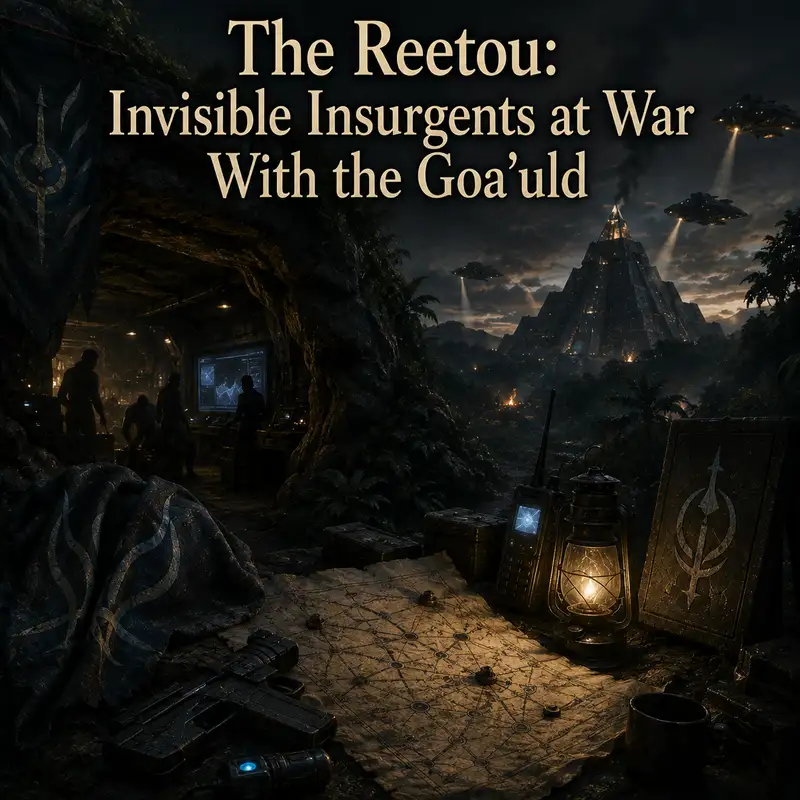
The Reetou: Invisible Insurgents at War With the Goa’uld
The iris opened without an authentication code.
No one in the control room had authorized it. The computer behaved as though another operator had taken command, and every attempt to close the barrier was overridden. When the incoming wormhole stabilized, the threat that emerged was not an armored assault team or a Goa’uld device. It was a weak human boy. He appeared to arrive alone, asked for Colonel Jack O’Neill, and said he had come to warn Earth about an invisible army already preparing to attack.
The warning introduced Stargate Command to the Reetou, a species whose war with the Goa’uld had produced one of the most dangerous forms of insurgency Earth had yet encountered. Most Reetou were not enemies of humanity. Their central authority opposed the attack. A radical faction, however, had concluded that the Goa’uld could not be defeated directly. Their solution was to exterminate the populations the Goa’uld used as hosts.
That strategy made Earth a target without requiring the Reetou rebels to conquer it. They did not need orbital superiority, occupation forces, or a government capable of ruling billions. They needed a gate address, a small number of infiltrators, and enough destructive power to turn invisibility into mass casualties. The central question is how a species nearly destroyed by the Goa’uld came to wage war against the Goa’uld’s victims instead.
The surviving record of the Reetou is unusually narrow. Earth encountered one representative of their central authority, one engineered human intermediary, one rebel staging world, and one five-member attack cell. No complete account of Reetou government, population, industry, or military organization survives. Even the relationship between the central authority and the rebels is known mainly through warnings supplied during a crisis. What can be reconstructed is a civilization divided over how to survive genocide.
The Reetou came from Reetalia. They were roughly human-sized, multi-limbed beings whose physical state placed them outside ordinary human perception. Samantha Carter described them as exactly one hundred eighty degrees out of phase with normal matter at the subatomic level. Within the scientific language of Stargate Command, that explained why their light and sound could not be detected by human senses.
Their condition did not make them ghosts. Reetou could stand on floors, move through corridors, operate equipment, fire weapons, and manipulate objects in the phase occupied by humans. Solid matter affected them to some degree, and a closed iris would prevent them from reintegrating after Stargate transit just as it would stop an ordinary traveler. They were invisible, not immaterial. That distinction created both their greatest tactical advantage and one of the few limits Earth could exploit.
The Goa’uld had already solved part of the detection problem. Symbiotes reacted to the presence of a Reetou with severe agitation and pain. Teal’c discovered this when his larval symbiote became violently disturbed near the boy’s unseen companion. A Goa’uld host or Jaffa could therefore sense that a Reetou was nearby, although not necessarily determine its exact location, number, or activity.
The Goa’uld converted that biological warning into a weapon. By isolating the emissions to which symbiotes were sensitive, they developed the transphase eradication rod. The device could illuminate a Reetou within the visible spectrum and kill it. The Tok’ra had copied several versions, giving them a specialized countermeasure against an enemy most humans could not even confirm was present.
The existence of that weapon helps explain the original war. The Reetou possessed an infiltration advantage capable of bypassing conventional observation and security. The Goa’uld regarded that potential as sufficient reason to attack. According to Jacob Carter and Selmak, most of the Reetou were destroyed even though the species had been peaceful. The campaign was preemptive in the most brutal sense. The Goa’uld tried to eliminate a population because its biology might someday threaten imperial control.
The result was not submission. It was radicalization.
The Reetou central authority continued to oppose indiscriminate violence. The rebel faction concluded that direct attacks against Goa’uld power were futile. System Lords possessed fleets, Jaffa armies, fortified worlds, and the weapons needed to detect Reetou operatives. The rebels therefore adopted a strategy of attrition directed at the biological foundation of Goa’uld rule. If every possible host were killed, they reasoned, the symbiotes would eventually have nowhere to go.
The logic was strategically unsound and morally catastrophic. Humans lived on countless worlds, and the Goa’uld could use species other than humans as hosts. A campaign large enough to deny them replacement bodies would require extermination on a galactic scale. Even complete success against one planet would barely affect the available host population. The rebels were not attacking the enemy’s center of gravity. They were attacking civilians because civilians were more reachable.
Their operational method was better designed than their grand strategy. Rebel teams usually consisted of five suicide infiltrators. They entered a target covertly, separated, planted cross-phasal explosives, and attempted to maximize destruction before detection. Each device was described as comparable to a small nuclear weapon. A single cell could threaten several cities without maintaining a supply line, defending territory, or surviving the mission.
This was insurgency reduced to access and detonation. The rebels did not need to persuade a local population, build a political wing, or preserve forces for a later campaign. Their invisibility allowed reconnaissance and movement. Their explosives supplied strategic effect. Their willingness to die removed the extraction requirement. That combination made a five-member team more dangerous to an undefended civilian target than a much larger visible force.
Earth offered several attractions. It held billions of possible hosts, possessed an active Stargate, and had begun fighting the Goa’uld in ways likely to draw attention across the galaxy. The rebels did not need to understand Earth’s national borders or military structure. If they could pass through the gate, escape the mountain, and reach population centers, their weapons could produce casualties far beyond anything Stargate Command could contain publicly.
The central authority understood the threat and sent an operative to warn Earth. The Reetou operative whom the human boy called Mother had already penetrated Stargate Command weeks before the warning was delivered. She followed S G One home from another world and observed base procedures without detection. After watching the team refuse to exploit the Salish people and their mineral resources, she decided O’Neill could be trusted.
Her surveillance demonstrated what an invisible intelligence service could accomplish. Mother learned personnel relationships, watched the gate room, studied the iris controls, and identified the officer most likely to believe an extraordinary warning. She did not recruit an insider or defeat a computer-security system remotely. She stood near the operators until she understood what they did, then used their own console to open the iris.
That incident exposed a weakness more serious than one unauthorized entry. Stargate Command’s security model assumed that anyone close enough to touch a control panel could be seen, challenged, and identified. Mother violated that assumption without compromising a badge, code, or human operator. The system had authenticated the action rather than the person performing it. In military terms, the perimeter ended at the concrete wall while the adversary had already been standing inside the command post.
Mother could not communicate directly with humans because her speech and physical presence remained outside their perception. She solved the problem by creating Charlie, a human child engineered to see the Reetou and relay their messages. He was not a disguised Reetou. He was human, apparently constructed from acquired human genetic material and altered so that his enlarged reticular formation could perceive what ordinary humans could not.
The work was advanced but dangerously incomplete. Accelerated development left Charlie with defective heart valves, failing kidney function, serious lung problems, and little chance of reaching adulthood without intervention. The central authority had created a diplomatic bridge whose body was collapsing before the message could be delivered. That was partly a technical failure and partly evidence of urgency. Mother brought him to Earth sooner than intended because there was no longer time to wait.
Stargate Command initially interpreted Charlie through familiar threat models. Medical personnel checked for a Goa’uld symbiote, concealed explosives, biological hazards, and other dangers previously hidden inside children. O’Neill and Hammond considered the possibility that Mother was a psychological defense created by a traumatized survivor. Those precautions were reasonable. They were also aimed at threats the command already knew how to name.
Teal’c’s reaction changed the intelligence picture. His symbiote sensed something in the infirmary that no human instrument had detected. Charlie then explained that Mother was physically present, and the unseen Reetou demonstrated her ability to interact with normal matter by destroying a computer monitor. The warning had moved from an unsupported story to a confirmed base penetration.
Jacob and Selmak arrived after Stargate Command contacted the Tok’ra using a Tollan subspace transmitter. Selmak immediately sensed Mother. A transphase eradication rod made her visible for the first time, revealing a being whose appearance was entirely unlike the human child she had created. The moment also proved that visibility and hostility were separate questions. Mother had possessed access to the base for weeks and had not attacked anyone.
The Tok’ra provided the operational intelligence Earth lacked. Reetou rebels favored five-member teams, relied on suicide tactics, and carried weapons capable of producing mass casualties. Earth firearms might slow a Reetou because the species still interacted with normal matter, but shooting at an unseen moving target was an optimistic plan even by Stargate Command standards. The eradication rods were the only reliable combination of detector and weapon available.
Mother supplied an address for a rebel staging world. The proposed operation carried an obvious counterintelligence risk. Any team sent through the gate might reveal Earth’s interest, trigger an engagement, or unknowingly bring invisible Reetou back during extraction. General Hammond still authorized reconnaissance because Earth needed to know whether the threat was a rumor, a small cell, or a force already preparing for deployment.
The mission package reflected the uncertainty. A mobile analytic laboratory probe was fitted with a transphase eradication rod and sent through first. Its scan showed the immediate gate area clear. O’Neill led the operation, Jacob accompanied the teams because Selmak could sense Reetou presence, and additional personnel provided security around the gate. The order was reconnaissance only. Engagement was permitted only if unavoidable.
The initial estimate expected perhaps five or ten rebels. The patrol found far more. The available account describes a large concentration, possibly thousands, gathered beyond the gate area. That discovery transformed the problem from a single planned attack into evidence of an organized insurgent movement with enough personnel to threaten numerous worlds.
The teams withdrew rather than fight an invisible force on its own staging ground. A scan of the gate room and the end of Selmak’s immediate reaction suggested that the return route was clear. It was not. One complete rebel cell had followed the expedition back to Earth. Exactly how the five avoided the sweep is not established, which is precisely the kind of gap an after-action report tends to underline several times.
The first sign came when a Reetou attacked the control room. Selmak then sensed a stronger presence elsewhere in the facility. A count established one rebel near the gate controls and four more inside the base. The cell had reached its intended pattern of operations. It had infiltrated undetected, divided its force, and was preparing to move beyond the point of entry before beginning wider destruction.
If even one rebel escaped Cheyenne Mountain with a cross-phasal explosive, the incident could become a city-level disaster. If several escaped in different directions, national authorities would have to hunt invisible suicide attackers while preserving the secrecy of the Stargate Program. The tactical fight inside the base therefore carried strategic and political consequences far beyond the corridors in which it occurred.
Hammond ordered a lockdown. Access points were sealed, emergency lighting reduced visibility for better contrast through the eradication rods, and search teams advanced through separate corridors while closing blast doors behind them. The objective was to corral the rebels inside controlled sections rather than allow them to disperse toward the surface.
The equipment solved only part of the problem. An eradication rod had to be aimed and swept across a space before it could reveal a target. Selmak and Teal’c could sense proximity but could not provide precise bearings. Conventional troops still had to enter corridors where the first visible indication of contact might be enemy fire. The weapon that made the Reetou killable did not make close-quarters combat safe.
The engagement wounded Jacob and O’Neill. Mother joined the defense and killed one of the rebels, demonstrating that the peaceful Reetou faction was not committed to passivity when civilians and its mission were threatened. The search teams killed the remaining infiltrators. The five-member cell was eliminated before any of its explosives reached the surface.
The tactical victory carried a personal cost. Mother was killed during the fighting. Charlie, already suffering from organ failure, collapsed soon afterward. Jacob proposed taking him to the Tok’ra, where blending with a symbiote might heal his body and allow him to grow up with access to the symbiote’s knowledge. O’Neill agreed because Earth medicine offered no realistic alternative.
Charlie left with Jacob after asking to remain with O’Neill. His later fate is not established in core screen continuity. The central authority’s messenger had survived long enough to save Earth, but the mission cost him the only parent he had known and carried him into another form of shared identity he had not been created to anticipate.
Stargate Command implemented two immediate countermeasures. Palm scanners were added to the iris-control system so an invisible Reetou could not operate it simply by reaching the console. The Tok’ra left several eradication rods and promised more when available. Both measures were useful. Neither removed the larger threat.
The palm scanner protected one control function. It did not detect an invisible observer in a briefing room, prevent sabotage elsewhere in the base, or identify a Reetou already present before a lockdown. The eradication rods provided a scarce technical solution but required trained personnel to search every relevant space. Earth had acquired a countermeasure, not a comprehensive sensor network.
The gate itself remained both vulnerability and defense. Reetou could not pass through a closed iris because their matter still had to reintegrate after transit. That gave Earth a reliable barrier against an unauthorized incoming team. The greater danger came from compromised control, trusted expeditions returning from contaminated worlds, or invisible operatives entering while the iris was already open for legitimate traffic.
The Reetou crisis therefore changed gate security in a fundamental way. Authentication could no longer be limited to identifying the team expected through the wormhole. Stargate Command also had to consider what might accompany that team without being seen. A successful extraction was not complete when the last visible person crossed the event horizon. The destination gate room itself had become a potential contamination zone.
The rebels’ campaign also exposed the difference between tactical ingenuity and strategic wisdom. Their invisibility, cell structure, and cross-phasal explosives were well matched to sabotage and mass-casualty attacks. Their theory of victory was not. Killing host populations would not reliably destroy the Goa’uld, and it transformed victims of the empire into targets of the resistance.
In that respect, the rebels reproduced the central moral logic of their enemy. The Goa’uld treated human bodies as resources for possession. The Reetou radicals treated the same bodies as resources to be denied. Both strategies erased the person inside the calculation. One sought to occupy the host. The other sought to kill the host before occupation became possible.
The central authority offered a different response to near-annihilation. It warned a threatened population, shared intelligence, and placed an operative at extreme risk to stop its own radicals. Yet the central authority had not prevented the rebels from gathering in large numbers or launching cells against other worlds. Whether it lacked the military capacity, political unity, or intelligence reach to suppress them remains unknown. Genocide had weakened the society that might otherwise have controlled the insurgency it produced.
The Goa’uld campaign against the Reetou also created a form of strategic blowback. By attacking a peaceful species because it might become dangerous, the Goa’uld helped create a faction committed to indiscriminate war. Their eradication rods and symbiote senses protected them better than ordinary humans, so the easiest targets became populations with little responsibility for the original attack.
No later confirmed Reetou offensive appears in the core screen record. That absence does not establish that the insurgency ended. Jacob and Selmak warned that the rebels were persistent and would attempt further infiltration. Earth retained the eradication rods and modified base security accordingly. The threat passed out of the surviving operational history without a peace agreement, a destroyed rebel movement, or a confirmed resolution.
The Reetou were dangerous because they combined invisibility with a doctrine that required neither conquest nor survival. Five infiltrators could enter through a single trusted route, disperse across an installation, and threaten cities before defenders knew a battle had started. Their technology made them difficult to detect. Their trauma made the radicals willing to target almost anyone.
Their story is also a warning about how extermination reshapes war. The Goa’uld tried to remove a possible future threat and produced insurgents who no longer distinguished between enemy rulers and potential hosts. The central authority tried to prevent that violence by creating a human child who could speak across the boundary between phases. Earth survived because that child reached the gate before the rebels could reach the surface.
The final defense was not a fleet or an orbital weapon. It was a palm scanner beside the iris controls, several scarce eradication rods, and a new understanding that an enemy could observe the command center for weeks before declaring war. The Reetou rebels fought the Goa’uld by attacking the lives the Goa’uld intended to use. In doing so, they became invisible not only to human eyes, but to the humanity of the people they had chosen to kill.