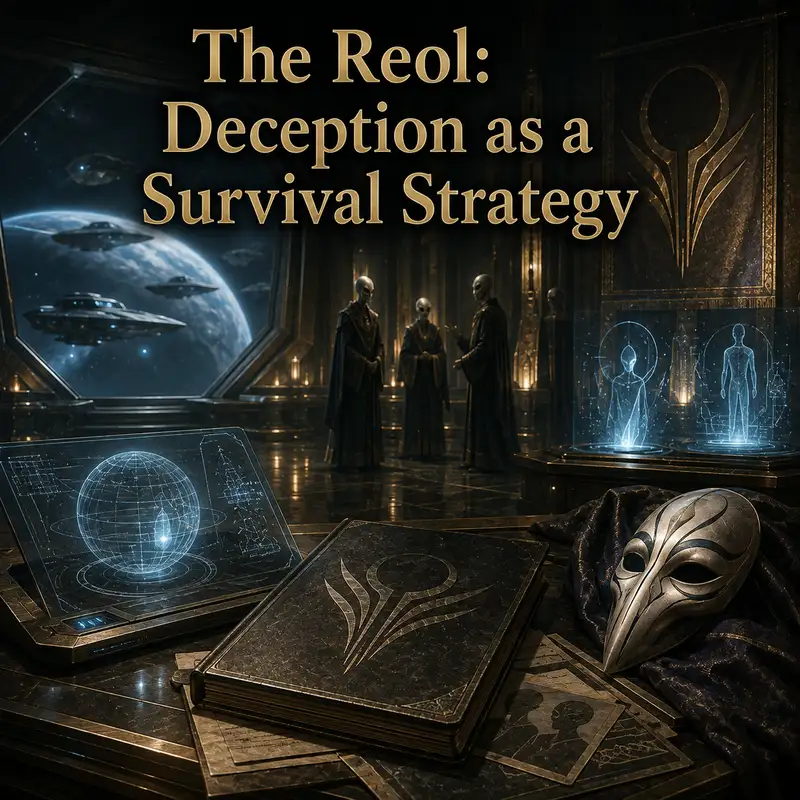
The Reol: Deception as a Survival Strategy
General Hammond had three members of S G One standing in front of him, all insisting that a fifth man had been left behind under Jaffa fire. Major Carter identified him as Lieutenant Tyler. Daniel Jackson remembered weeks of training with him. Teal’c regarded him as a fellow member of the team. Hammond had never heard the name. Personnel files contained no such officer, and the mission recording showed only the four people who had actually attended the briefing.
The contradiction created an immediate command problem. Colonel Jack O’Neill was stranded on another world with someone his team remembered as a trusted comrade, while every independent record said that comrade did not exist. Sending rescuers could expose more personnel to an unknown influence. Refusing to send them could leave O’Neill to die. The Reol had entered Earth’s war without breaching a database, stealing a uniform, or forging an identity card. One frightened survivor had compromised the command by altering what trained officers believed they remembered.
That was the Reol’s only demonstrated strategic advantage. They were not known for warships, advanced weapons, or fortified colonies. Kaiael, the only Reol encountered directly by Earth, described his people as peaceful, uncomfortable with technology, and poor fighters. The Goa’uld had hunted them nearly to extinction because their biology could do what armies and intelligence services spent enormous resources trying to achieve. A Reol could make strangers accept him as someone who already belonged.
The surviving record is limited. No Reol government, military organization, homeworld, population count, or industrial base was identified. Earth learned that some survivors had established a colony in an isolated region of the Milky Way and intended to bury its Stargate. Nothing confirms how many reached that refuge or what later happened to them. Any political portrait would therefore be invention. What the evidence does reveal is a species whose defensive doctrine grew directly from physical vulnerability.
A Reol body produced a chemical compound that interacted with memory processing. Doctor Janet Fraiser found that its structure resembled a neurotransmitter and that its strongest effect appeared in the part of the temporal lobe associated with recognizing faces. Exposure created a powerful sense of familiarity. The brain then supplied the details needed to explain that familiarity, building a history around a person the observer had only just encountered.
The effect was not ordinary camouflage. Kaiael did not merely appear human while leaving observers uncertain about who he was. S G One believed he was Lieutenant Tyler, a junior officer assigned to train with the team during the previous month. They remembered three earlier missions that had never happened. The chemical did not have to construct every detail itself. It encouraged the target’s own mind to make the false identity coherent.
That distinction made the defense unusually efficient. A fabricated personnel file requires names, dates, photographs, access permissions, and a story capable of surviving inspection. Kaiael needed close proximity and a suggestive cue. A label referring to Tyler, Texas, on a military ration package helped give the invented officer a name and origin. The surrounding environment supplied the rest. He was standing beside an off-world military team, so their minds made him an off-world military teammate.
The disguise existed inside the observers rather than in the physical world. Cameras did not record a fifth officer at the earlier briefing. Databases did not create a service history. General Hammond, who had not been exposed on the planet, remembered no assignment. The false past felt as reliable as any real memory to Carter, Daniel, and Teal’c, yet its credibility collapsed when the command compared human recollection with independent evidence.
This made the Reol ability a counterintelligence threat even when used defensively. Stargate Command relied on authentication codes, gate-room guards, personnel rosters, mission records, and the accumulated familiarity of people who worked together under pressure. Kaiael bypassed the last layer. He did not defeat the iris or alter the computer. He caused the team itself to vouch for him with complete sincerity.
Sincerity made the incident harder to resolve. Carter was not lying when she demanded a rescue mission. Daniel was not protecting a known infiltrator. Teal’c’s loyalty had not changed. Every one of them reported what appeared to be a shared operational history. Shared memory normally strengthens source reliability. In this case, the agreement among three experienced witnesses was evidence that all three had been affected by the same agent.
Hammond’s refusal to authorize an immediate return was painful and professionally sound. He knew O’Neill was in danger, but he did not know whether the team had encountered a chemical, parasite, device, or hostile intelligence operation. Anyone sent to the planet might return with the same certainty and a different fictional companion. Quarantine and independent review delayed the rescue, but the commander of an installation containing Earth’s Stargate could not treat collective confidence as proof of safety.
The investigation also attracted Colonel Frank Simmons, who used the incident to question S G One’s reliability and Hammond’s command. Simmons had political motives and searched for vulnerabilities he could exploit. The vulnerability itself was real. The Reol encounter demonstrated that a trusted team could be compromised without recognizing the compromise and without any member intending betrayal. The official inquiry became opportunistic, but the security question it raised could not be dismissed with it.
Fraiser found the answer in residue on Teal’c’s uniform. Brief exposure caused her to experience a reduced version of false recognition, which helped her identify the connection between the compound and memory. The chemical dissipated relatively quickly and required close proximity. Those limits allowed a rescue team to return with precautions. They also showed that the Reol defense was not permanent mind control. Its strength came from a short period in which false familiarity shaped real decisions.
Kaiael had used that period because his alternatives were poor. Goa’uld forces had captured him for study and were transporting him toward dissection. He escaped confinement, damaged the transport’s guidance system, and caused it to crash on the world where S G One later found him. He had no reason to know that the armed humans approaching the wreck opposed the Goa’uld, respected personal autonomy, or would risk themselves for an unfamiliar alien.
From his perspective, revealing his true appearance and asking for protection would have repeated the decision that had already led to capture. The Reol had experienced generations of fear and mistrust from other species. Their natural defense had evolved, or at least functioned, in a social environment where being recognized as Reol could be fatal. Deception was not an opening move toward conquest. It was the substitute for a weapon his people did not possess.
The choice still violated S G One’s autonomy. Kaiael entered their group, accepted equipment and protection, learned their procedures, and allowed them to risk their lives on the basis of invented memories. O’Neill went back for a wounded officer who had never served under him. Carter, Daniel, and Teal’c fought toward the Stargate believing they were responsible for a teammate. Survival explains the deception. It does not make the cost imaginary.
The cost increased when the team became separated. O’Neill and Kaiael were cut off from the gate while Carter, Daniel, and Teal’c returned for reinforcements. O’Neill treated the wounded Reol as one of his people because every relevant memory told him that he was. The protection was therefore stronger than visual disguise. It activated the obligations attached to the identity being perceived.
Kaiael’s behavior gradually gave those obligations a real foundation. He remained beside O’Neill under fire, warned him of approaching Jaffa, helped defend their position, and expressed gratitude that the colonel had returned for him. When he revealed the deception, O’Neill did not suddenly lose every reason to protect him. The fictional service record disappeared. The conduct displayed during the actual mission remained.
The revelation came when Kaiael’s wound healed too quickly for the human identity he had adopted. He allowed O’Neill to perceive his true appearance, a gaunt nonhuman form concealed beneath the chemically induced familiarity. The exact mechanism by which he briefly lifted the disguise was never explained. What mattered operationally was that O’Neill finally knew whom he was defending and continued the defense anyway.
The Jaffa were not conducting an ordinary search for escaped property. Their Goa’uld master wanted the biological mechanism. A species able to manufacture trusted identities inside an observer’s mind represented an extraordinary intelligence asset. Used by a System Lord, the compound could place apparent servants beside rivals, create false advisers inside courts, bypass personal recognition, and support assassination or theft without requiring a perfect physical double.
The Goa’uld response was therefore predictable and destructive. Rather than negotiate with the Reol, they captured individuals for study and hunted the species toward extinction. Peacefulness offered no protection because imperial powers often judge capability separately from intent. The Reol did not need to threaten a Goa’uld throne. The possibility that their biology could someday help someone else reach it was enough.
Reol survival doctrine minimized everything the Goa’uld normally targeted. They did not depend on a visible military, centralized infrastructure, or advanced devices that could be captured and reverse-engineered. Their defense traveled inside every individual body. It required no battery, command network, or supply convoy. A lone survivor could create social cover from whatever cues existed in the immediate environment.
The same design imposed severe limitations. The chemical worked at close range, faded with time, left detectable residue, and did not alter electronic records. It could create recognition, but it did not guarantee obedience. O’Neill continued making his own tactical decisions. Hammond resisted the team’s demands because he had not been exposed. Remote observation, physical barriers, independent authentication, and separation from the source could all weaken the effect.
Organized military systems were especially dangerous once they recognized the problem. A patrol relying only on visual recognition might accept a Reol immediately. A command with recordings, rosters, medical laboratories, and personnel isolated from exposure could discover the inconsistency. The defense was excellent for escaping the first encounter. It was less effective against a patient institution able to compare memory with evidence.
Kaiael also learned that deception could create the danger it was intended to avoid. His false identity delayed the rescue, triggered quarantine, and nearly caused Stargate Command to abandon the planet. Had Fraiser not identified the compound, O’Neill might have remained cut off until the Jaffa overran his position. The Reol technique protected Kaiael from immediate rejection while making later trust harder to establish.
S G One returned despite that breach. After the rescue force reached O’Neill, Kaiael offered to surrender so the Jaffa would release their pressure on the gate. When O’Neill refused, Kaiael tried to draw the enemy away on his own. The team prevented the sacrifice and fought through the remaining Jaffa. The decision denied the Goa’uld both a prisoner and access to the Reol biological secret.
The extraction also resolved the moral question in the most practical way available. S G One did not pretend that the manipulation had been acceptable. O’Neill directly challenged Kaiael for tricking them. The team nevertheless judged that surrendering a nearly exterminated survivor to dissection would be a greater wrong. Trust was rebuilt through shared action rather than restored by the false memories that had started the relationship.
Kaiael planned to return to a new Reol colony in an isolated region and bury its Stargate. That decision was more than fear-driven withdrawal. It removed the predictable access point through which Goa’uld forces, traders, explorers, and future allies might arrive. The Stargate provided mobility, but it also made any address a standing vulnerability. For the Reol, strategic depth meant becoming unreachable.
The colony’s disappearance was consistent with the species’ broader defense. At the individual level, a Reol survived by becoming someone the observer expected to see. At the civilizational level, the survivors intended to remove themselves from observation entirely. No treaty, fleet, or deterrent protected them. Their security depended on denying outsiders the location, identity, and access required to act against them.
Earth did not leave the encounter empty-handed. A sample of the Reol compound was retained for study, and later accounts place that research with the Tok’ra and Area Fifty-One. The surviving screen record does not establish the exact terms under which the sample was obtained or whether Kaiael approved its later operational use. That gap matters because a species hunted for its biology had just seen another military alliance preserve the same biology for research.
The Tok’ra converted the natural secretion into a modified, controlled intelligence tool. Their version could be carried in a ring with a sharp point. A covert operative needed to get close enough to prick the intended target and administer a small dose. The victim would then recognize the operative as a specific familiar person. The biological defense of a refugee species had become an injectable cover identity.
Daniel Jackson used the modified compound to infiltrate a summit of the Goa’uld System Lords. The operation required him to impersonate Jarren, the trusted human attendant of Lord Yu. Once Yu had been dosed, he accepted Daniel as the servant he expected to see. The chemical overcame the most difficult part of the physical disguise: the master’s personal recognition of someone who served near him.
The compound did not complete the mission by itself. Daniel still needed fluent Goa’uld, knowledge of court behavior, an understanding of the lo’taur’s status, and the discipline to remain convincing among rulers who considered humans property. He also needed access close enough to dose Yu before Yu identified him as an intruder. Reol chemistry opened the door. Training and cultural intelligence kept him alive after he crossed it.
That distinction is central to evaluating the technology. It was not a universal command serum. It did not make every observer see the same person automatically. Those not exposed could still recognize the operative’s real face, and behavior inconsistent with the assumed identity could create suspicion. The modified compound was strongest when paired with a carefully selected target, a believable role, and an environment that encouraged the target’s mind to complete the deception.
Daniel’s cover survived long enough for him to observe the System Lords, learn of Anubis’s proposed return, and reconsider the Tok’ra plan to eliminate the assembled rulers. He also used the chemical against Osiris when she recognized him. A survival adaptation created by a hunted species had enabled collection at the center of Goa’uld power and helped expose a strategic shift that would reshape the war.
Years later, Cameron Mitchell used the same method against the Lucian Alliance. He impersonated Kefflin, a powerful but reclusive lieutenant whom few Alliance commanders had met. After dosing Netan, Mitchell was received as a trusted subordinate rather than searched as an enemy officer. The cover worked because the chemical was matched with an identity whose absence from public view made inconsistencies difficult to test.
The operation also demonstrated the compound’s target-specific limit. Tenat, who had not been affected, recognized Mitchell. Mitchell later dosed him and caused him to perceive Mitchell as Netan. Acting on what he believed was an order from the Alliance leader, Tenat opened fire on Netan’s mothership. Netan returned fire and destroyed Tenat’s ship. A defense once used to avoid violence had been transformed into a means of producing enemy fratricide.
That evolution would have been familiar to the Goa’uld who originally captured Kaiael. They had hunted the Reol because they saw the compound’s offensive potential. Earth and the Tok’ra eventually proved that judgment technically correct, even while using the technology against predatory powers. The moral difference between those users remained significant. The strategic process was still uncomfortable. A refugee’s biology had become a weapon because other civilizations possessed the laboratories, tradecraft, and willingness to weaponize it.
The Reol encounter left a lasting counterintelligence lesson. Identity cannot rest entirely on recognition, no matter how sincere the witness or how long the remembered relationship appears to be. Personnel records, mission video, authentication procedures, medical controls, and observers separated from possible exposure are not bureaucratic redundancies in this environment. They are defenses against an adversary who can make the false feel personal.
It also showed why biological security cannot be separated from intelligence security. The compound was neither conventional toxin nor visible implant. It altered interpretation. A contaminated uniform carried enough residue to affect Fraiser through a barrier and briefly create recognition. The incident required quarantine, laboratory analysis, and evidence review at the same time. No single security office owned the full problem.
The most reliable test of Kaiael’s identity was ultimately not memory. It was conduct. Lieutenant Tyler had never existed, but Kaiael protected O’Neill, accepted danger for S G One, and tried to prevent his pursuers from reaching the Reol colony. Those actions did not make the original deception harmless. They provided a factual relationship strong enough to replace the invented one.
That is why the Reol were more than aliens with a useful chemical. Their biology exposed a weakness shared by empires and military commands alike. Institutions classify people rapidly because operations require decisions before perfect knowledge is available. The Goa’uld saw a specimen. S G One saw a teammate. The Tok’ra saw an infiltration capability. Each classification produced action before the Reol themselves had much control over how they were understood.
No later confirmed contact established whether the hidden colony survived. The absence may indicate that burying the gate worked exactly as intended. It may also conceal losses the record never captured. The screen continuity does not settle the question. For a species whose security depended on leaving no reliable trail, historical silence is both an intelligence gap and a possible success.
The Reol survived by making perception unreliable long enough to escape, not by defeating the forces hunting them. Their strategy was low-technology, biologically integrated, and brilliantly adapted to the first moments of contact. It was also temporary, ethically costly, and vulnerable to institutions that compared memory with evidence. Deception gave an individual time. Isolation was meant to give the species a future.