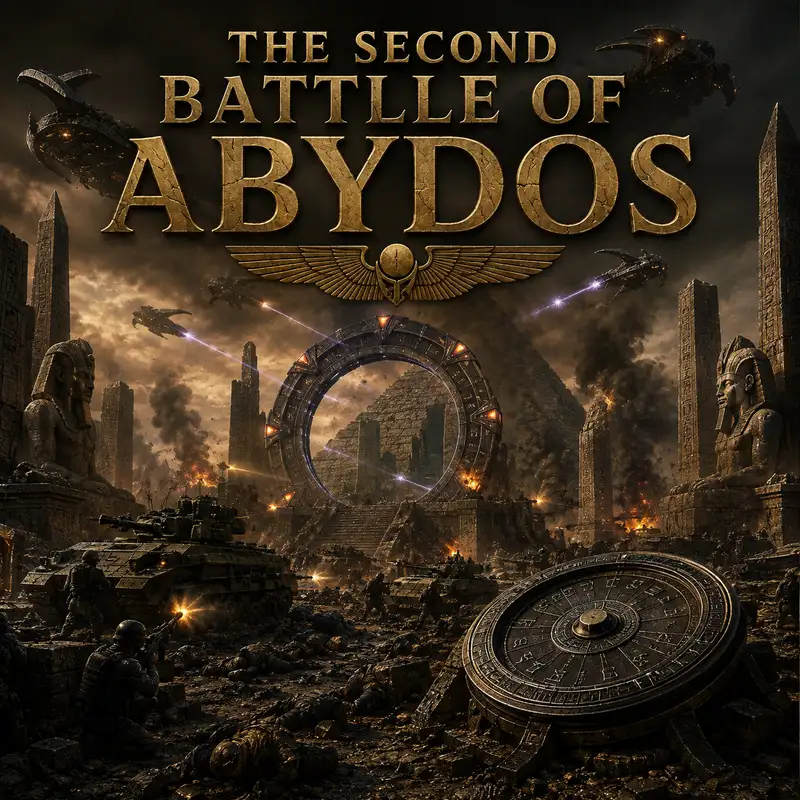
The Second Battle of Abydos
The iris began closing less than a second after Jack O’Neill emerged from the Stargate. Behind him, a massive energy pulse raced through the still-open wormhole from Abydos and shook the gate room beneath Cheyenne Mountain. Samantha Carter ordered a full diagnostic. O’Neill ordered the technicians to redial. The seventh chevron would not lock. A mission that began as an attempt to deny Anubis one ancient artifact had ended with the loss of Earth’s first off-world ally and a Goa’uld ruler now holding a weapon powerful enough to scatter the combined fleet of the System Lords.
The first battle on Abydos had been an uprising against Ra. Earth personnel and Abydonian rebels fought a ruler whose mothership was landed, whose guards could be reached, and whose destruction could be accomplished with a nuclear weapon already inside his vessel. The second battle was different in almost every military respect. Anubis arrived with orbital control, strike aircraft, transport capability, shielded landing forces, and knowledge that the object he wanted was somewhere beneath Ra’s pyramid. Earth could send a small team through the Stargate. It could not send a fleet capable of contesting the space above it.
That imbalance explains why the defense failed despite advance warning. Stargate Command did not authorize a planetary defense operation because it possessed no force capable of conducting one. The objective was narrower. S G One would reach Abydos first, locate the Eye of Ra, and deny it to Anubis by hiding, removing, or destroying it. Protecting the Abydonians depended on making the artifact unavailable before Anubis could seize it. Once his forces controlled the pyramid’s approaches, the team’s bargaining position rested on one piece of ancient technology and a block of C four.
The warning came from Daniel Jackson, who had ascended after his death from radiation exposure. Daniel appeared first to Skaara on Abydos and then to O’Neill inside Cheyenne Mountain. He reported that Anubis had acquired five of six objects known as the Eyes and was searching for the Eye of Ra. Combining all six would multiply their power dramatically. Abydos was the last major location associated with Ra that Anubis had not searched. Daniel believed the Eye was hidden somewhere inside the pyramid, but he did not know where.
Daniel could warn Earth, interpret inscriptions, and appear where ordinary reconnaissance could not reach. He also insisted that the ascended Others prohibited direct interference in mortal affairs. General George Hammond accepted the report because O’Neill’s account was supported by Teal’c, who had also encountered Daniel after his ascension. Anubis had already demonstrated Ancient-derived technology and methods beyond an ordinary Goa’uld. Treating the warning as false risked the completion of a strategic weapon. Treating it as true exposed S G One to an enemy it could not match. Hammond chose the mission because doing nothing was worse.
Abydos had warning of its own. Local leaders ordered Kasuf to move women and children toward the caves of Kalima while Skaara gathered everyone capable of fighting. The caves could conceal civilians from patrols and aircraft for a time. They could not protect a planet from orbital bombardment. The Abydonians were not preparing to defeat Anubis’s fleet. They were preparing to delay his search, defend the pyramid, and give Earth’s team time to find the Eye before the enemy reached it.
S G One arrived with O’Neill, Carter, Teal’c, and Jonas Quinn. Teal’c established a perimeter outside the pyramid with Abydonian fighters. O’Neill, Carter, Jonas, Skaara, and local guides descended into the catacombs. The force was divided because the mission required two tasks at once. Someone had to search for the Eye. Someone else had to hold the entrance long enough for the search to matter. The pyramid offered thick walls and confined approaches, but it also concentrated the defenders, the Stargate, and Anubis’s objective in one structure.
Anubis’s mothership emerged above Abydos while the search was still underway. Al’kesh bombers, death gliders, and a cargo ship attacked the perimeter. Teal’c’s rocket launcher could destroy a glider when the aircraft committed to a low approach. It could not penetrate the cargo ship’s shields or stop faster aircraft from maneuvering away. Ground forces landed behind the air attack and advanced toward the pyramid. Teal’c reported that the position could not hold, and O’Neill ordered the defenders inside. The withdrawal preserved the fighters but surrendered the surrounding ground.
Inside the catacombs, Jonas found repeated praise of Ra’s power but no inscription identifying his most valuable storage room. Daniel finally intervened by pointing to a passage concerning rays of the sun. Jonas focused a lamp through a magnifying lens, but the mechanism did not respond. Daniel noticed that the rays painted on the wall were red. Carter used the laser sight on her P ninety, and the concealed door opened. Ancient security had just been defeated by linguistic analysis, a rifle accessory, and the useful habit of bringing more than one kind of expert.
The chamber contained artifacts from Ra’s rule and something more important than the original mission objective. Daniel and Jonas found a stone tablet written in an early Ancient dialect. It described the Ancients as an earlier human civilization, connected ascension with their history, and referred to a lost city containing powerful technology. Daniel immediately recognized the strategic importance. The Eye could determine the battle above Abydos. The tablet might determine whether Earth could survive the war that followed. Jonas was told to protect it even if everything else had to be abandoned.
The Eye remained hidden inside the hidden room. Jonas located a hollow section of wall, and Carter breached it with automatic fire when no release could be found. The artifact was recovered intact as the perimeter collapsed. O’Neill, Teal’c, and Skaara withdrew down the stairs with Jaffa close behind. The defenders now possessed the object, but the enemy controlled nearly every route by which it might be removed.
Anubis had also dialed the Abydos Stargate, establishing an incoming wormhole and preventing S G One from opening an outbound connection to Earth. A gate already connected cannot be redialed until the wormhole closes. The hostile connection did not need to deliver the full assault force. It only had to deny extraction while Jaffa entered through surface approaches and ring transporters. Control of the gate did not require standing on the ramp. It required controlling when the gate was available.
The gate room became a close-range delaying position. Abydonians and S G One fired from cover as Jaffa entered from the surface and ringed directly into the chamber. Staff weapons struck stone, fighters fell, and the line contracted toward the secret room. Skaara was hit while defending the entrance. Teal’c and O’Neill carried him into the catacombs, but the wound could not be treated with the medical support available. The battle had no evacuation route, no surgical team, and no pause long enough to stabilize a casualty.
O’Neill converted the Eye from an objective into a hostage. He attached roughly a pound of C four to it and told Herak, Anubis’s First Prime, that he would destroy it unless the Jaffa cleared a path to the gate. The threat was credible because destroying the Eye still satisfied the denial mission. It was also credible because O’Neill made no attempt to separate his survival from the detonation. Herak could kill the team or preserve the artifact, but he could not confidently do both. For the first time since landing, the defenders possessed leverage that Anubis’s shields could not absorb.
Anubis answered that he would destroy Abydos if the Eye was not surrendered. O’Neill judged the threat a bluff. Jonas identified the underlying problem. Destroying the Eye might deny Anubis his complete weapon, but it would not stop the bombardment. Surrendering it might save the population, but only if Anubis honored an agreement. The team had reached the kind of decision commanders prefer to examine before deployment, usually in a room not surrounded by hostile Jaffa.
Skaara died during that debate. His final words described a bright light and the release of something he could no longer hold. His body vanished, leaving his clothing behind. Oma Desala had helped him ascend. The event saved Skaara from the final destruction, but it removed one of the principal Abydonian leaders while his people remained under attack. O’Neill had first met him as a young rebel against Ra. He now watched him leave ordinary existence after being mortally wounded defending the same pyramid from another false god.
Daniel confronted Anubis aboard the mothership and discovered why the Goa’uld possessed knowledge beyond the other System Lords. Anubis existed in a partially ascended state. The ascended beings had rejected him and attempted to return him to mortal existence, but the process left him as an energy form contained by his dark field and mask. He retained enough higher knowledge to understand technologies his rivals could not reproduce while remaining active in the political and military world below.
The revelation changed the battle’s scale. Daniel had believed his ascended state gave him the ability to destroy Anubis if he accepted punishment for interfering. Anubis knew the Others would enforce their rules and challenged him to act. Daniel instead alerted the System Lords. A large fleet under Lord Yu entered the system and surrounded Anubis’s mothership. Yu demanded the Eye and threatened destruction. The ground fight inside the pyramid had become the center of a three-sided confrontation involving Earth, Anubis, and the collective forces of his rivals.
Daniel offered to deliver the Eye if Anubis promised never to harm the Abydonians. He then told O’Neill that the System Lords and Anubis would fight over it, weakening one another, while S G One escaped with the tablet and began searching for the lost city. The plan depended on Anubis keeping his word, Daniel being able to enforce it, and Yu’s fleet containing the completed weapon if both assumptions failed. O’Neill understood that none of those conditions was reliable. The alternatives were still worse. Destroying the Eye guaranteed retaliation. Holding it guaranteed another assault. Surrender offered the only available chance for the civilians.
The explosives were removed and the Eye was handed to Herak. Anubis ordered his Jaffa to withdraw, allowing S G One to return to the gate room. The exchange achieved the immediate requirement of getting the team and the Ancient tablet to an available Stargate. It also transferred the final component of Anubis’s weapon intact. This was not a clean rescue. It was a negotiated withdrawal conducted under threat of planetary destruction, with the enemy receiving the object the mission had been authorized to deny.
Once installed with the other five Eyes, the artifact fully powered Anubis’s primary weapon. His mothership opened fire on the surrounding System Lord fleet. The responding Ha’taks could not penetrate his shields, while his weapon destroyed multiple ships and forced the survivors to retreat. Yu had brought enough force to threaten an ordinary Goa’uld ruler. He had not brought a defense against a system derived from Ancient knowledge and completed only moments before the battle. Anubis now held orbital supremacy and no opposing fleet remained to enforce Daniel’s agreement.
He ordered Abydos destroyed. The decision was not required to secure the Eye or escape the System Lords. It was punishment, denial, and demonstration. Abydos had rebelled against Ra, sheltered Daniel, supported Earth, and resisted Anubis’s landing force. Destroying it removed a symbolic enemy, erased a known Earth ally, and proved that promises made under pressure imposed no restraint once the pressure was gone. The attack also tested the completed weapon against a planetary target immediately after it had broken a fleet.
Daniel tried to stop him directly. He gathered energy and struck at Anubis, crossing the line he had warned O’Neill he could not cross. The attack was interrupted by the ascended powers enforcing noninterference. The precise mechanism remained beyond Stargate Command’s understanding, but the result was plain. Daniel was removed before he could destroy Anubis. The intervention protected the rules of the higher plane, not the people beneath the weapon. Anubis survived because those rules constrained Daniel more effectively than they constrained the partially ascended Goa’uld using Ancient knowledge.
Carter completed the outbound dial while the confrontation occurred above. Teal’c, Jonas, and Carter crossed first. O’Neill remained until the last moment, then felt the weapon strike as he stepped into the wormhole. The beam destroyed the pyramid and released an energy wave across the site. Part of that energy followed the active connection to Earth. The wormhole provided the team’s escape and transmitted the final effect toward Stargate Command at the same time. Strategic mobility had again revealed its other identity as a direct physical link between two battlefields.
The iris closed after O’Neill arrived, and the gate room shook as the energy pulse reached Earth. Repeated attempts to redial Abydos failed because the seventh chevron would not lock. The initial assessment was grim. Anubis had broken the agreement, destroyed Abydos, completed a weapon that gave him superiority over the System Lords, and removed Daniel from the fight. Earth had recovered S G One and the Ancient tablet, but it had failed to deny the Eye or protect its ally. Tactical survival could not be confused with mission success.
Carter refused to end the search without independent confirmation. Stargate Command continued dialing until a connection finally formed. A mobile analytic laboratory probe reported that Ra’s pyramid and the village appeared intact. S G One returned and found the Abydonians alive, including Skaara. The scene was not a restoration of the physical settlement. Skaara explained that Anubis’s blast had killed everyone and that Oma had helped the entire population ascend. The familiar village was a final manifestation provided long enough for the team to understand what had happened.
The farewell clarified both the mercy and the loss. The Abydonians had not survived as a population Earth could visit, trade with, reinforce, or defend. Their society no longer occupied the planet in ordinary physical form. Oma preserved them from oblivion, but she did not preserve their homes, farms, institutions, or future as a living civilization. Skaara told O’Neill that the Chappa’ai would remain until S G One departed. When the manifestation disappeared, the gate stood alone in the desert.
The battle produced no conventional casualty count. Every Abydonian was physically killed in the final strike and then ascended. Anubis lost aircraft, Jaffa, and ships, but the exact losses were never recorded. The System Lords lost multiple Ha’taks before retreating. S G One returned with all four members, yet without the people it had gone to protect. Military accounting can record personnel recovered and one tablet secured. It has more difficulty expressing the disappearance of an allied world.
At the tactical level, the defenders delayed Anubis, recovered the Eye first, inflicted local losses, and held the pyramid long enough to create a bargaining position. At the mission level, they preserved the Ancient tablet and escaped. At the operational level, Anubis captured the objective and cleared the site. At the strategic level, he completed his weapon, defeated the System Lord fleet, and destroyed Abydos. The defenders achieved several necessary tasks and still lost the battle.
The fighting exposed Earth’s dependence on small-team improvisation. A laser sight opened a chamber built by Ra. Automatic fire reached an artifact hidden behind masonry. C four created temporary leverage against a ruler protected by shields. None of those solutions could contest a mothership in orbit or protect civilians from planetary bombardment. Earth could reach Abydos in seconds and fight effectively inside the pyramid. It still lacked the space control required to make promises of planetary defense credible.
The Ancient tablet was the one result that changed the longer war in Earth’s favor. It provided a lead toward the lost city and the weapons Daniel believed could challenge Anubis. That intelligence later shaped Earth’s search for Ancient defensive technology. It did not compensate the Abydonians for their destruction, and it did not make the mission a hidden victory. It meant that the planet’s final material contribution to Earth was information capable of shaping the next phase of the conflict.
Anubis won because he integrated orbital superiority, gate denial, ground assault, coercive diplomacy, and advanced technology around one objective. The defenders could contest only one part of that system at a time. They could hold a corridor but not the sky. They could threaten the Eye but not the planet. Daniel could gather a rival fleet but could not guarantee its weapons would work. Oma could preserve the Abydonians through ascension, but only after the physical world they inhabited had been destroyed.
The second battle of Abydos ended the planet’s role as Earth’s first enduring off-world partner. It also revealed the war Earth was now fighting. The Goa’uld threat was no longer limited to rulers using inherited weapons they only partly understood. Anubis could combine Ancient knowledge with Goa’uld fleets, exploit the constraints placed on ascended opponents, and destroy a world after winning both a negotiation and a battle in orbit. Earth left Abydos with one stone tablet, four surviving team members, and no allied population waiting behind the next dial.
The final image was a temporary Stargate standing alone in the desert while S G One walked away from people who had already crossed beyond ordinary reach. Anubis captured the Eye and destroyed the battlefield. Oma preserved the Abydonians in another form. Earth preserved the intelligence that might someday answer the attack. None of those outcomes canceled the others. Abydos was saved from oblivion, lost as a world, and turned into the warning that technological access without space control was not yet planetary defense.