The Secret War: Why Earth Hid the Stargate
Alec Colson looked into a bank of television cameras and told the public that intelligent extraterrestrial life existed, several governments knew it, and they had concealed the truth. His evidence included satellite images of alien ships fighting above Earth and biological material his own company had helped analyze. Colson was correct. The official response was not confirmation. Samantha Carter appeared on television with a genuine Asgard hologram and used advanced alien technology to demonstrate how easily an alien image could be fabricated. The truth was defeated with a more convincing truth.
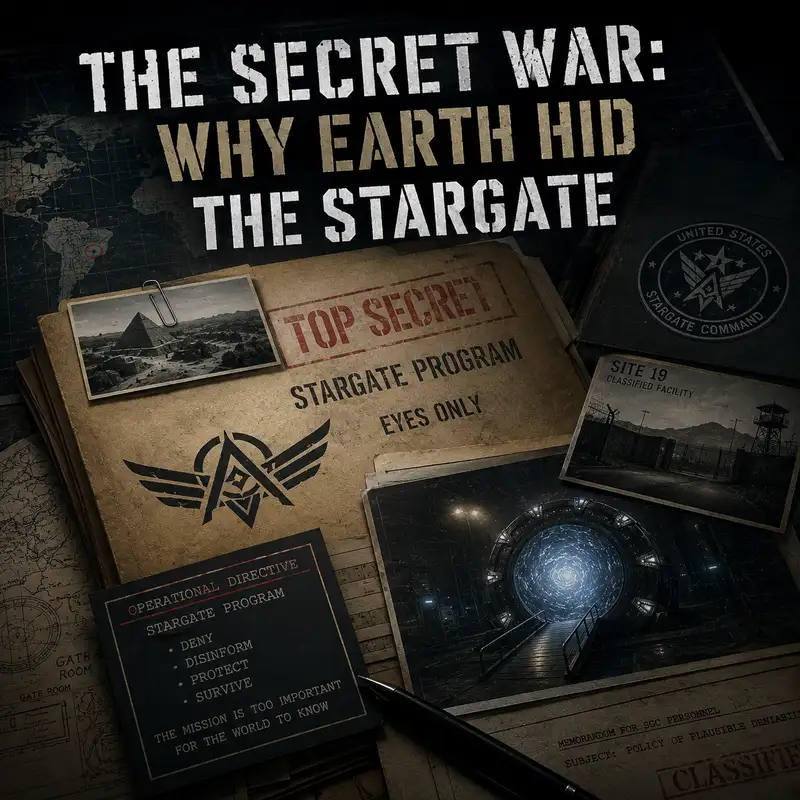
That incident captures the central contradiction of Earth’s secret war. The Stargate Program was hidden because disclosure could compromise military operations, expose vulnerable allies, destabilize governments, and reveal technologies Earth was barely able to control. Secrecy also concentrated power inside a narrow circle, concealed failures from the people who paid for them, and gave rogue officials room to build their own agendas. Earth hid the Stargate because secrecy was useful. It continued hiding it because no government had developed a safe way to stop.
The secret began before anyone knew the ring was a transportation device. The Stargate recovered near Giza entered American custody as an unknown strategic artifact during an era of global war. Researchers suspected it might have military value, which was enough to classify the work. In nineteen forty-five, the project opened a wormhole and lost Ernest Littlefield on the far side. The achievement was concealed, the records were fragmented, and even later officials responsible for the revived program did not know the gate had worked before.
This early secrecy protected an experimental program whose operators did not understand the machine, its destination, or the consequences of activation. It also prevented independent review of the Littlefield disaster. Catherine Langford was told that Ernest had died in an explosion. The successful transit was buried with the failure to retrieve him. Classification preserved the device from foreign intelligence while allowing the institution to redefine a breakthrough as an accident and then forget the most important evidence it possessed.
The modern Abydos mission inherited the same structure. General West controlled a classified project, Colonel Jack O’Neil led an armed expedition, and a nuclear weapon traveled through the gate under a compartmented demolition order. The public could not be told that a machine recovered in Egypt had opened onto another world because the government could not yet answer the first questions disclosure would produce. Who owned the device, where did it lead, what lived beyond it, and could Earth prevent something from coming back?
After Apophis raided Cheyenne Mountain, secrecy became a wartime measure rather than an archaeological precaution. Earth had discovered an interstellar enemy that used human hosts, commanded Jaffa armies, and already knew the planet’s gate address. Stargate Command began sending small teams to collect intelligence, recover technology, build alliances, and disrupt Goa’uld operations. Public discussion of addresses, procedures, off-world bases, or allied societies could expose missions whose survival depended on the enemy underestimating Earth’s reach.
Operational security covered much more than the location of the gate. It protected the iris and its authentication procedures, the identities of personnel, the addresses of friendly worlds, the existence of Alpha Sites, the capabilities of captured technology, and the weaknesses of Earth’s emerging defenses. A newspaper article could not be read by a System Lord in the ordinary way. A Goa’uld infiltrator inside a human government, a compromised contractor, or an agent working for the National Intelligence Department could read it quite efficiently.
Secrecy also preserved strategic surprise. Early Goa’uld rulers knew Earth had killed Ra, but they did not initially understand the scale, methods, or institutional durability of the new threat. S G teams moved as small patrols, attacked selected facilities, and disappeared through a network the Goa’uld considered their own. Earth could not win a conventional fleet war. It could exploit the fact that an advanced empire did not yet regard one human planet as a peer military power. Publicly advertising every acquisition would have been an unusual way to maintain that advantage.
Disclosure would not have created an immediate deterrent because Earth had very little with which to deter anyone. The iris protected one Stargate. Rifles could defeat Jaffa patrols but not Ha’tak motherships in orbit. The planet possessed no dependable shield and no fleet able to patrol the approaches to the solar system. Announcing the war might have informed humanity without changing the balance of power. It would also have revealed that the world’s governments could neither explain the full threat nor guarantee protection from it.
Officials also faced the expected political shock of disclosure. The Stargate proved that human populations lived on other planets, that several ancient religions had been manipulated by alien rulers, and that advanced civilizations had visited Earth long before modern states existed. It promised technologies capable of altering energy, transportation, medicine, manufacturing, and warfare. Even without panic, every government, corporation, religious institution, and scientific organization would demand access. The resulting struggle over control could become a security crisis before the first public committee finished choosing its name.
The American system tried to contain that problem through compartmentalization. The President and Joint Chiefs knew. Selected military leaders, scientists, intelligence personnel, and contractors received only the access required for their roles. The Pentagon concealed the cost under an unofficial budget designation known as Area Fifty-Two. By the end of the program’s first operational year, Stargate Command was said to cost seven point four billion dollars annually. A secret of that price eventually attracts someone from appropriations.
Senator Robert Kinsey became the first major political challenge. He received clearance because he controlled the money required to continue operations. Kinsey saw a program that had brought parasites, disease, dangerous nanotechnology, and hostile forces into a military base while producing few technologies the government could openly use. His judgment was narrow and often self-serving, but the questions were legitimate. What authority did Stargate Command possess, how were its risks measured, and why should an unofficial military project receive billions without normal public scrutiny?
Kinsey ordered the program closed just as Daniel Jackson warned that a Goa’uld attack was approaching. S G One violated the shutdown order, entered the gate, discovered Apophis’s invasion force, and helped destroy two motherships before they reached Earth. The result made Kinsey appear disastrously wrong and restored the program’s political support. It did not resolve the oversight problem. Stargate Command had saved the planet by disobeying lawful authority inside a system where almost no one outside the secret could examine whether either side had acted responsibly.
The victory strengthened the argument for secrecy because it showed the enemy was real and the defense fragile. It also made secrecy easier to abuse. Successful missions could not be public achievements. Failures could not be openly investigated. Families of personnel killed off-world received incomplete explanations. Decorations were presented privately. Scientists discovered evidence capable of rewriting human history and could share it only with other cleared personnel. The public financed a war it could neither debate nor recognize.
Armin Selig demonstrated that the information was already escaping. The journalist knew the approximate number of S G teams, the program’s cost, the location beneath Cheyenne Mountain, its technology-acquisition mission, and S G One’s role in destroying the attacking ships. He approached O’Neill expecting the largest story of his career. Minutes later, a car struck and killed him. The record never conclusively identified the driver or established who ordered the act. The uncertainty is part of the damage. In a secret system, even an accident can look like policy.
The program responded to leaks through denial, discrediting, and tighter control rather than public explanation. That approach worked because the claims sounded impossible and the government controlled most physical evidence. A reporter could describe a circular alien portal beneath Colorado. Officials could point to the absence of photographs, documents, witnesses willing to speak on record, and any reason a rational person should believe the story. Truth had to compete with ordinary standards of proof while the proof remained classified.
The problem grew as Earth’s capabilities expanded. Area Fifty-One studied recovered devices. Contractors supplied components without receiving the complete design. Engineers built the F three-oh-two fighter and the Prometheus from a mixture of human and alien technology. Launch facilities, pilots, medical teams, tracking stations, laboratories, and security personnel all entered the classified structure. The secret survived by dividing knowledge so that many participants understood their task without understanding the war their work supported.
Compartmentalization protected information and created vulnerabilities between compartments. Rogue elements inside the National Intelligence Department ran unauthorized off-world missions, stole technology from friendly societies, and damaged alliances Stargate Command had spent years building. Some officials believed the Air Force was too cautious and that any useful device should be taken before another power acquired it. Secrecy allowed them to describe theft as national defense because the victims could not appeal to an Earth court or public opinion.
The Russian discovery and operation of a second Stargate ended the illusion that one country could control every terrestrial endpoint. Moscow possessed the original Giza dial-home device and briefly ran its own gate program. Later agreements produced cooperation, compensation, and continuing suspicion. The United States could still operate the principal command, but the secret had become international. The question was no longer whether another government would learn. It was which governments would be invited before they discovered the truth through surveillance, espionage, or an alien ship falling into the ocean.
Anubis forced the next stage. His growing power and acquisition of advanced weapons convinced General George Hammond that Earth needed a broader defensive coalition. At a Pentagon briefing, representatives of the United States and Russia informed ambassadors from Britain, France, and China about the Stargate, the Goa’uld threat, Earth’s off-world missions, the F three-oh-two, and Prometheus. The revelation was controlled, classified, and limited to governments with major military and political power. It was disclosure without a public.
The ambassadors’ anger was predictable. The United States had conducted diplomacy in humanity’s name, acquired alien technologies, started conflicts, built spacecraft, and made agreements with Russia while keeping other major powers uninformed. They were being asked to share risk after years of being denied influence. From Washington’s perspective, secrecy had prevented leaks and preserved command unity. From their perspective, it had allowed one state to become the gatekeeper for the entire planet.
Kinsey used the dispute to propose transferring control to the National Intelligence Department, an organization he expected to influence through congressional oversight. The suggestion demonstrated why broader oversight did not automatically produce better governance. Some participants wanted accountability. Others wanted the asset. The Stargate was a defense system, intelligence source, diplomatic channel, transportation network, and path to technologies worth more than any ordinary weapons program. Anyone controlling it could shape Earth’s future.
Hammond’s position survived because Thor appeared before the ambassadors and endorsed Stargate Command. The Asgard commander credited Earth’s military team with assisting his own civilization and indicated a preference for Hammond’s continued leadership. That testimony resolved the immediate contest because it came from an ally whose technology exceeded anything in the room. It was also an odd foundation for constitutional legitimacy. An alien supreme commander had become the most persuasive witness in a classified argument over human oversight.
International disclosure continued after the Battle of Antarctica, when an entire Goa’uld fleet attacked Earth and the Ancient outpost destroyed it above the southern continent. More governments had to be informed because the military activity, debris, Antarctic operations, and multinational scientific requirements were too large for the original circle. The International Oversight Advisory emerged to represent participating nations and monitor programs whose cost and risk no longer belonged to the United States alone.
The International Oversight Advisory introduced civilian and multinational review, especially over Atlantis and later off-world projects. It could question commanders, influence appointments, allocate funding, and demand access to information. It also brought national rivalry and bureaucratic caution into decisions that sometimes had to be made before an incoming wormhole closed. The committee was neither useless obstruction nor perfect accountability. It was the political price of turning an American secret into a shared planetary enterprise.
Public secrecy nevertheless continued. Governments could inform one another under treaty and still withhold the truth from their citizens. This distinction allowed Earth to expand international participation without exposing operational details to every intelligence service, corporation, or private actor. It also created a widening democratic gap. More officials knew, more nations contributed, and more people were affected, while the public remained unable to ask what policies were being pursued in its name.
The strongest military argument for continued secrecy remained protection of vulnerable assets. Earth’s allies often lived on worlds with little defense against Goa’uld ships. Alpha Sites survived primarily because their addresses were unknown. Atlantis initially depended on limited power and uncertain support. Research facilities held devices capable of catastrophic failure. A public archive of gate addresses, ship capabilities, or alliance terms would not merely embarrass commanders. It could identify targets that Earth had promised to protect and lacked the forces to defend.
The strongest argument against secrecy was what happened inside the protected system. Rogue National Intelligence Department personnel evolved into the Trust, a network of former officials and wealthy industrial interests seeking control of alien technology. The Trust infiltrated contractors, blackmailed scientists, stole the Stargate, launched biological attacks against Goa’uld and Jaffa populations, and later became entangled with Goa’uld infiltration. These actors did not oppose secrecy. They depended on it.
Alec Colson became dangerous to the Trust because public disclosure would destroy the private value of classified access. His companies had contributed to technologies connected with Earth’s space-defense programs without receiving the full explanation. Communications satellites recorded the battle over Antarctica. Biological research uncovered evidence that did not belong to any terrestrial species. Colson concluded that the public had the right to know and gave governments a short deadline to tell the truth themselves.
Carter and Daniel Jackson tried to stop him without pretending his evidence was false. Once Colson was privately briefed, he understood the Stargate, the Goa’uld, Earth’s ships, and the scale of the war. He still believed disclosure would unite humanity and allow wider scientific participation. Carter argued that Earth’s defenses and political institutions were not ready for the consequences. Both positions contained truth. Colson correctly identified an enormous public right. Stargate Command correctly identified an enormous operational risk.
The official response crossed from secrecy into deception. Carter appeared on television with a projected image of an Asgard and explained how advanced holographic technology could create a convincing false alien. The demonstration discredited Colson’s presentation precisely because it used the kind of technology he was trying to prove existed. His evidence was made to look like a corporate fabrication. The government did not win the argument. It made the argument impossible for the public to evaluate.
The Trust applied harsher pressure. Colson’s business partner was coerced, the company’s finances collapsed, and attempts were made on Colson’s life. Stargate Command did not authorize those crimes, and Carter ultimately helped him escape to an off-world refuge. The distinction matters. The lawful program was not identical to the conspiracy operating around it. The shared secrecy still created the environment in which the Trust could act, hide its motives behind national security, and assume that any investigation would stop at the classified boundary.
By the later years of the war, secrecy had become an immense administrative undertaking. Homeworld Security coordinated Stargate Command, Earth’s ships, off-world sites, and planetary defense. The International Oversight Advisory represented foreign governments. Contractors built systems derived from alien science. Multinational personnel traveled to Atlantis. Civilian agencies responded to outbreaks and disasters without always knowing their source. Each expansion solved a capability problem and added another group whose silence had to be maintained.
The cover stories became increasingly ambitious. Alien vessels crashed in oceans. Space battles produced sensor data. Goa’uld operated inside corporations and local communities. The Prometheus and later battlecruisers required construction facilities, crews, and launches that could not remain invisible to every observer. Secrecy endured not because no evidence existed, but because the evidence appeared in fragments and official institutions supplied alternative explanations quickly enough to prevent those fragments from becoming one accepted account.
The strategic justification also changed over time. During the first years, secrecy protected a weak and isolated command fighting an enemy with overwhelming space power. Later, Earth possessed battlecruisers, international partners, advanced allies, and a growing ability to defend its orbit. Operational details still required classification. The case for concealing the existence of the entire program became less absolute. What began as protection from an enemy gradually became protection from political disruption, technological competition, institutional embarrassment, and loss of control.
The screen record never establishes that prime-continuity Earth completed a responsible public disclosure. That omission is revealing. The governments involved repeatedly managed immediate leaks but did not create a visible transition plan for civilian knowledge, scientific access, legal authority, or accountability for past deception. Secrecy was renewed one crisis at a time. A temporary wartime measure became an inherited policy because every year produced another reason that the present moment was inconvenient.
Earth hid the Stargate because the early program was vulnerable, the enemy was stronger, the technology was dangerous, and operational surprise saved lives. Those reasons were real. The secrecy also denied citizens a voice in interstellar war, protected monopolies over transformative technology, and allowed abuses to grow in the shadows beside legitimate defense. The secret war made Earth stronger before the public knew it was threatened. It never answered who had the right to decide when humanity was finally strong enough to be told.
The final image is not the Stargate beneath Cheyenne Mountain. It is an ordinary night sky above a world whose people believe the stars are distant and politically irrelevant. Beyond their sight, human crews patrol in ships built with alien technology, off-world teams negotiate in Earth’s name, and families receive carefully edited explanations for deaths that occurred on other planets. Secrecy protected the doorway by placing the burden of the truth on the few people allowed to know it. Everyone else lived inside the consequences.