The Seed Ships and the Stargate Network Beyond the Galaxies
Destiny did not slow as the smaller Ancient ship filled the observation windows. Colonel Everett Young ordered the main weapon prepared because every available reading suggested a collision. Nicholas Rush disagreed, although he offered little explanation beyond confidence that the two vessels were meant to meet. At the last moment, Destiny reversed thrust, matched the other ship’s course, and settled over it. A docking corridor extended between them. Data began moving automatically. The apparent obstacle was not an enemy or a derelict. It was one of the unmanned seed ships that had departed before Destiny, building the road the larger vessel had followed for more than a million years.
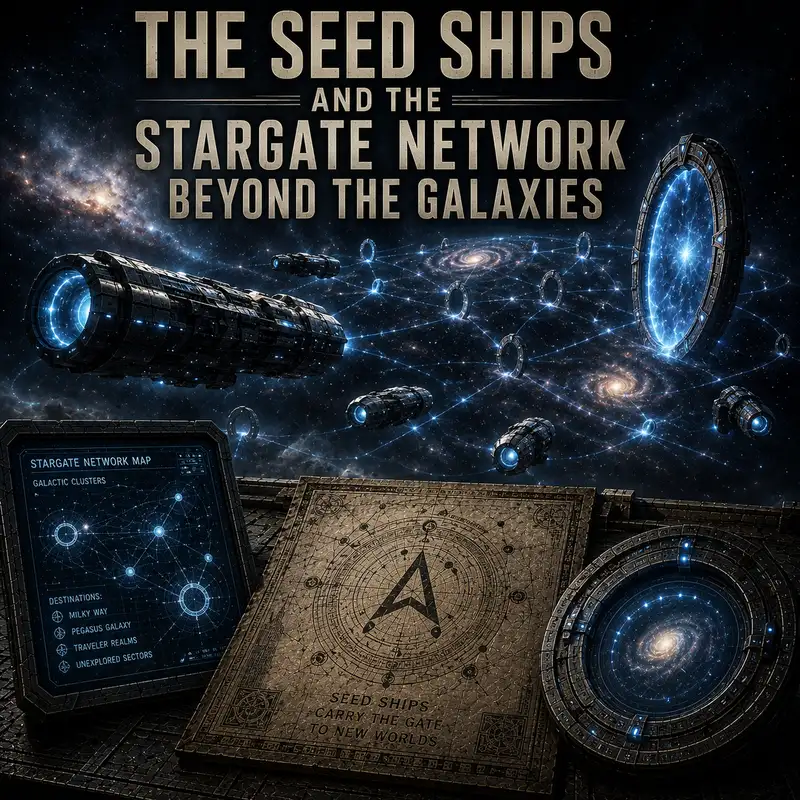
The seed ships explained how the Ancients extended Stargate travel far beyond the galaxies where their civilization had lived. Destiny alone could cross intergalactic space, but a research expedition still needed places to stop, resources to collect, worlds to examine, and a practical way to move people between a ship and a planet. The seed ships created that supporting infrastructure before the crew arrived. They were factory ships, survey platforms, navigational scouts, communications relays, and route planners combined into one automated system. Their work turned empty distance into a chain of reachable operating areas. The central question is not merely how they placed Stargates. It is how those machines converted a voyage across the universe into a mission that a living crew could actually conduct.
The Ancients could not rely on the Milky Way network for Destiny’s task. Ordinary addresses connected established points inside a known region. Destiny was moving through galaxies that had never been part of Ancient political territory, then crossing the void between them. A gate left behind in the Milky Way could not serve as a routine doorway to a vessel billions of light-years away. The ninth-chevron address solved the problem of reaching Destiny itself, but it did not provide local access to every world the ship would pass. The larger expedition therefore required two different systems: one extraordinary connection to place a crew aboard, and a separate local network that would support exploration along the route.
The Ancients launched multiple seed ships ahead of Destiny. These vessels traveled the same broad path but remained far enough in advance to prepare it. They identified planets worth adding to the route, manufactured Stargates, placed those gates on selected worlds, and gathered information for the ship following behind. Destiny then used that accumulated reconnaissance to decide when to leave faster-than-light travel and which gates to make available. The arrangement was distributed by design. No single scout had to prepare the entire universe, and Destiny did not have to carry every gate it would ever need. The expedition’s infrastructure moved outward before the expedition itself, rather like sending engineers, surveyors, and supply officers ahead of an army that would not arrive for geological ages.
The manufacturing function was not theoretical. When a team crossed into the seed ship encountered by Destiny, it found a large bay containing complete Stargates arranged along tracks. Rush identified the compartment as the place where gates were built before transport to their destination worlds. The sight clarified an important point. The seed ships were not simply freighters carrying a limited stock assembled elsewhere. At least this vessel possessed an onboard production line. That gave the Ancient program the ability to expand the network during the journey rather than commit every destination before launch. It also meant that a seed ship was an industrial asset whose loss removed more than one hull. It removed a mobile factory capable of creating future access points.
The surviving record does not explain every stage of that manufacturing process. It does not establish where the ships obtained all raw materials, how long one gate required to construct, or exactly how each finished ring was lowered onto a planet. Those omissions matter because a factory ship still depends on feedstock, energy, maintenance, and deployment equipment. The bay proves production capacity, not unlimited production. Even Ancient engineering had to obey an industrial sequence. Materials entered, components were fabricated, a gate was assembled, and some system delivered it to a usable site. The Ancients had automated that sequence so thoroughly that it could continue after the civilization responsible for it had stopped paying attention, which is either remarkable planning or the most ambitious unattended work order in history.
A useful gate required more than a solid surface beneath it. The seed ships had to gather enough information to judge whether a world deserved inclusion and to provide Destiny with some basis for later decisions. Brody described them as seeding planets and collecting information. The exact survey criteria remain incomplete, but the crew’s experience shows that the system distinguished among candidate destinations. Some addresses appeared available. Others were locked out or marked as unsuitable. Destiny could direct its people toward a world that might contain a needed resource while withholding access to alternatives it considered dangerous. The network therefore included an intelligence layer. The physical gate was only the visible end of a larger process involving reconnaissance, classification, data transfer, and route management.
That intelligence was valuable, but it was not infallible. A seed ship could pass through a system long before Destiny arrived. During that interval, climates changed, geological conditions shifted, civilizations rose, wars occurred, and local dangers emerged. A world that met Ancient criteria at the time of survey might be very different when a human team eventually stepped through. The crew also did not initially know what the ship’s categories meant. A locked address might indicate toxic atmosphere, an obstructed gate, hostile activity, unstable geology, or simply a condition the Ancients considered unhelpful to their mission. The automation could present a decision without presenting the reasoning behind it. That is useful for a trained operator and frustrating for an accidental crew trying to determine whether the computer is protecting them or merely enforcing an ancient preference.
The network available aboard Destiny was local rather than universal. As the ship moved, its control systems displayed the gates within practical reach of its current position. The accessible list changed when Destiny entered a new region. This created clusters of temporary options rather than a continuous route back across every galaxy already crossed. A team could dial from Destiny to a nearby world, and in some cases from that world to another gate in the same local group. What it could not do was connect the dots indefinitely and expect to reach Earth. Destiny’s movement, the limited set of known addresses, and the departure schedule made that idea far more dangerous than it first appeared.
The gates themselves were operated differently from the installations familiar to Stargate Command. The worlds along Destiny’s route generally lacked separate dial-home devices. Teams used a handheld Ancient remote linked to a kino to select and dial the available addresses. That made the equipment compact and suitable for an automated network whose destination worlds might never receive permanent personnel. It also concentrated several essential functions in one portable device. Lose the remote, damage it, exhaust its power, or carry it through the wrong wormhole, and an off-world team could find itself standing beside a perfectly functional Stargate with no convenient way to use it. Portability is excellent until the entire transportation system fits inside the pack belonging to the person who just missed extraction.
The first major supply mission demonstrated both the value and the danger of that arrangement. Destiny’s carbon dioxide scrubbers were failing, so the ship stopped near a desert world believed to contain material that could restore them. The team used the local gate, confirmed that it could dial back, and searched for a usable concentration of calcium-bearing material. Four other addresses appeared in the system, but Destiny had locked them out. Some personnel concluded that another planet might offer a safer place to live and attempted to bypass the ship’s judgment. Two crossed to another world. They did not return before Destiny resumed its voyage. The network offered alternatives, but every alternative carried its own intelligence gaps and extraction problem.
The desert mission also exposed the operational tempo imposed by Destiny. Once the ship stopped, a countdown indicated when it would return to faster-than-light travel. The crew did not control that schedule during the early expedition. Search teams had to estimate travel distance, resource weight, environmental exposure, and the time needed to carry everything back through the gate. Headquarters aboard Destiny had to decide how often to dial for radio checks, even though each connection consumed power the old ship could not casually waste. A gate reduced interplanetary movement to seconds. It did not reduce the time required to find limestone in a desert, dig it up, drag it across sand, treat casualties, and reach the ramp before the ship left.
This made the seeded network a logistics system rather than a guarantee of rescue. Destiny could stop near a world, send a small party, and recover whatever people could carry through the event horizon. Water, food, medicinal plants, minerals, and equipment could be brought aboard without landing the entire ship. That was an enormous advantage for a vessel operating without bases or tenders. The limitation was throughput. Every item had to be found, moved to the gate, and handled by a crew with finite time and labor. Heavy machinery, bulk agriculture, and major structural components remained difficult. The Stargate eliminated distance between two points while leaving weight, packaging, reconnaissance, security, and human exhaustion stubbornly intact.
Militarily, the seeded gates created predictable access points. A team arriving on a planet emerged at one fixed location, often without knowledge of who controlled the surrounding terrain. The gate could be watched, mined, obstructed, or used as an ambush site. Reinforcement depended on Destiny remaining close enough and willing to maintain contact. Orbital support was not guaranteed because the ship might be far from the gate’s world or unable to alter course. The crew could conduct reconnaissance, recovery, negotiation, and limited combat operations. It could not assume that a handful of personnel controlled a planet simply because they controlled the ramp. The network favored small expeditionary teams, rapid collection, and disciplined withdrawal. It punished anyone who mistook access for occupation.
The intelligence problem ran in both directions. Seed-ship data helped Destiny choose destinations, but every active gate also announced that an advanced transportation system had been placed on the world. Local societies might discover it, move it, bury it, damage it, or learn to operate it. Other spacefaring powers could identify the network and use its infrastructure for their own purposes. The Ancients appear to have accepted that risk, perhaps because the gates supported a scientific mission rather than territorial control. The screen record does not show that the seed ships negotiated with inhabited worlds before placing equipment. From the Ancient perspective, a gate was a research asset. From the perspective of anyone already living nearby, it could become a foreign installation delivered without explanation.
The damaged seed ship encountered by Destiny revealed how the system was supposed to maintain continuity. The smaller vessel had suffered a failure that allowed Destiny to catch up with it. Despite its condition, it recognized the larger ship, matched the docking interface, and began exchanging data. The transfer was substantial enough that Eli estimated it would require hours. No ordinary planetary countdown appeared because Destiny intended to remain attached until the exchange was complete. This was more than a convenient mechanical connection. It was a scheduled reconciliation between two parts of a distributed expedition. The scout returned its accumulated intelligence, and the mission ship absorbed whatever the scout had learned while traveling ahead.
The encounter also showed the age and durability of the design. Young was warned that the seed ship was older than Destiny and might be in worse condition. Yet life support still operated in portions of the vessel. Its control center could be activated. Its factory bay still held completed gates. Its power reserves remained significant. The ship had survived long enough for its follower to overtake it after more than a million years of independent operation. That is extraordinary endurance, but it should not be confused with perfect preservation. Dark corridors, failed relays, inactive systems, and an unexpected population aboard demonstrated what unattended service over that span actually looked like. Ancient equipment lasted a very long time. It did not become maintenance-free merely because everyone who understood the manual was gone.
The available power nearly transformed the seed ship from infrastructure into an escape route. Rush and Eli determined that the linked energy reserves and capacitors might provide enough output to dial Earth. For the stranded expedition, this was the first credible opportunity to turn the local seeded network into an intergalactic connection home. The plan required modifying conduits and transferring power through the docked vessels. It was not a routine feature of every seeded gate. It was an improvised use of a rare encounter with a large Ancient power source. The distinction matters. A successful connection would not have shown that the local network could normally reach Earth. It would have shown that two Ancient ships, temporarily joined and deliberately reconfigured, could attempt an exceptional long-range dial.
The attempt failed because the seed ship was no longer empty. The crew discovered a weakened alien aboard, then additional occupied pods and signs that others were moving through the vessel. These beings, later identified as the Ursini, had taken refuge on the ship and learned enough about it to resist the human effort. They stunned personnel in the control center and reversed the power transfer, drawing energy from Destiny instead. From their perspective, the humans had boarded their shelter, handled its systems, and begun draining the reserves that kept it useful. The first contact went badly because each side saw the same ship as essential property and neither possessed a common language or time for a careful diplomatic process.
Colonel David Telford remained aboard when Rush disconnected Destiny to stop the power loss. The seed ship and its unexpected occupants then became a separate expedition. Telford survived, established communication with the Ursini, and helped them operate the Ancient vessel. Later, they used it to find Destiny and rescue the larger ship from an attack. The event proved that seed ships were not locked permanently to one civilization’s use. A determined group with access, time, and technical assistance could adapt the platform. That made every surviving vessel a potential prize. It carried navigation, power, a gate factory, Ancient data, and the ability to dock with Destiny. An automated scout could become a sanctuary, a transport, an intelligence source, or an instrument in someone else’s war.
The Ursini also demonstrated the seed ship’s military limitations. They could maneuver it, dock with Destiny, and carry the larger vessel during a coupled faster-than-light jump. They could not turn it into a dominant warship. When automated drones attacked, the seed ship lacked the shields and firepower needed to break through alone. Its final contribution was a suicide run that drew drones away from Destiny and created a brief tactical opening. The vessel was destroyed along with the Ursini aboard. A platform designed to build access across galaxies ended its service as a diversion in a battle it had never been intended to fight. Strategic infrastructure often becomes a combat asset when no purpose-built alternative remains, although the conversion rate is usually paid in wreckage.
The loss illustrated both the resilience and fragility of the Ancient plan. The wider program used multiple seed ships, so one failure did not erase every gate already placed or halt Destiny immediately. Once manufactured and deployed, planetary gates could continue functioning without the factory vessel nearby. Destiny retained the addresses and could use the local network as long as it remained on the seeded route. Yet each lost seed ship reduced future reconnaissance, manufacturing, and data collection. A gate already on a world was durable infrastructure. A route not yet surveyed or seeded remained an empty gap. Distributed systems survive individual losses well, but only until those losses accumulate faster than the remaining network can compensate.
The seed ships did not create a galactic empire beyond the known galaxies. They created a narrow expeditionary corridor. The Ancients were not shown settling each region, governing the worlds they connected, or stationing forces around the gates. Their machines prepared access for a scientific vessel that might arrive much later. This explains why Destiny repeatedly encountered gates without encountering an Ancient support organization. The infrastructure outlived the institution. It was still technically capable, yet politically ownerless and logistically incomplete. The human crew inherited the benefits without the survey departments, maintenance depots, manufacturing authority, or trained personnel that had once made the system coherent.
That is also why the network could keep the expedition alive without taking it home. Local gates allowed the crew to obtain air-filter material, water, food, medicine, and information. They enabled contact with new societies and offered temporary refuge. They also created repeated risks of isolation, ambush, contamination, and missed departure. Earth remained beyond ordinary reach because the network was built to support Destiny’s forward movement, not reverse it. The route led from prepared worlds to the ship and onward into the next region. It was an exploration system with a direction, not a rescue ladder extending back through every galaxy already crossed.
The seed ships were therefore the hidden logistical foundation of Destiny’s mission. They turned an intergalactic vessel into the center of a moving Stargate network, provided reconnaissance before arrival, manufactured access points, and delivered accumulated data when contact became possible. Their achievement was not that they made distance irrelevant. They made distance manageable for brief periods and at selected locations. Every gate represented years of automated preparation, yet every mission still depended on a remote, a countdown, a carrying party, and a ship that might depart without them. Beyond the galaxies, the Ancients did not build one permanent road. They sent machines ahead to lay stepping-stones in the dark, and Destiny’s crew survived by reaching each one before the path moved on.