The Siege of Atlantis and the Ancient Withdrawal
The final off-world transport bound for Atlantis did not complete its journey. It carried Lanteans trying to reach the last secure refuge after a century of retreat, but Wraith forces destroyed it before it could arrive. Inside Atlantis, the evacuation was already being prepared. The loss did not bring down the city’s shield, disable its weapons, or open its towers to boarding parties. It did something more decisive. It proved that Atlantis was no longer the center of a functioning defense. It was an isolated refuge whose perimeter ended at the shield.
That distinction explains why the siege ended in withdrawal rather than conquest. The Wraith never demonstrated that they could simply blast their way into Atlantis. The city’s defenses remained superior, and Lantean weapons continued to destroy attacking ships. Yet the purpose of a fortress is not merely to remain intact. It must protect a population, support forces in the field, preserve communications, and create a path toward a favorable outcome. By the final years of the war, Atlantis could still survive an attack. It could no longer change the result of the war outside its walls.
The siege began only after almost a hundred years of conflict had stripped away the wider Lantean position in Pegasus. Before the war, systems inhabited or protected by the Lanteans extended across much of the galaxy. During the campaign, that network contracted under repeated Wraith offensives. Colonies disappeared from communication. Human worlds were culled. Outposts were overrun or abandoned. Warships continued to win engagements, but the strategic map moved steadily toward Lantea. When Atlantis became the last major Lantean stronghold, the war changed from a galactic campaign into the defense of one city.
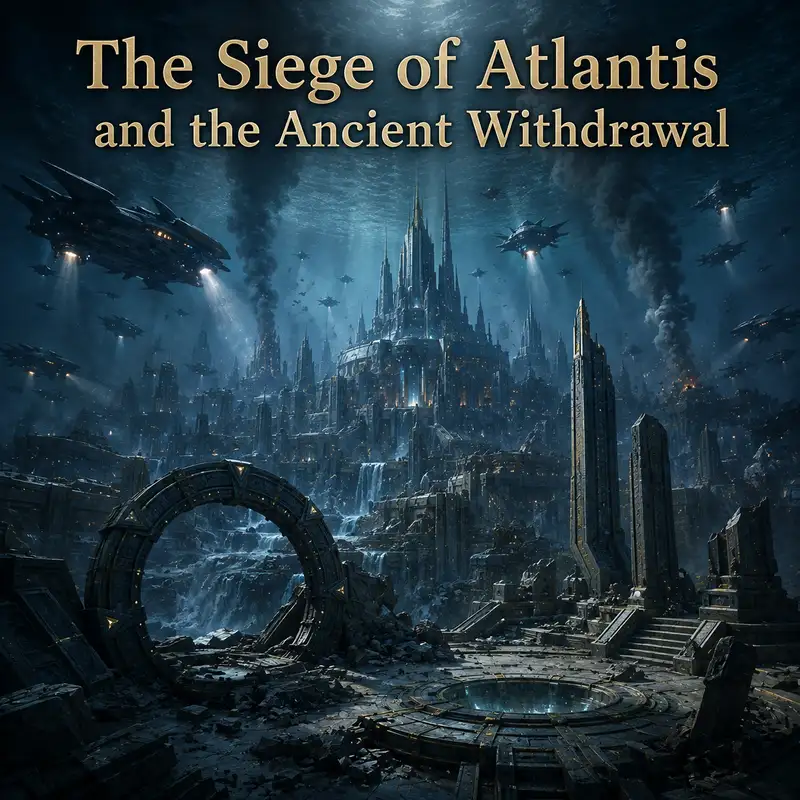
Lantea offered an impressive defensive position. Atlantis rested on an ocean and possessed the mobility of a city-ship, the power of multiple zero-point modules, advanced sensors, drone weapons, and a shield capable of resisting sustained bombardment. The surrounding system had also been protected by a network of weapons satellites. Later investigators found the remains of one such satellite and concluded that dozens may once have guarded the approaches. In its complete form, the defense was layered. Enemy ships had to cross monitored space, survive satellite fire, face Lantean vessels, and only then attack the city itself.
The Wraith dismantled those layers over time. Their hives and cruisers did not need to be individually superior to Lantean ships. They needed to arrive in numbers large enough to absorb losses, force the defenders to expend irreplaceable weapons, and return before the Lanteans could restore the system. One satellite could cut through a hive ship. A network of satellites could devastate an assault formation. Neither mattered forever if damaged platforms could not be repaired and destroyed platforms could not be replaced. The surviving satellite was not evidence that the defense had failed technically. It was evidence that the support system behind it had disappeared.
The same arithmetic applied to the fleet. Lantean warships had faster drives, stronger shields, and weapons that could destroy Wraith vessels efficiently. Those advantages had already prolonged the war for generations. They also encouraged the Lanteans to measure success through battles won and ships destroyed. The Wraith measured success through persistence. After captured zero-point modules powered a mass cloning facility, their ability to replenish warriors expanded on a scale the Lanteans had not anticipated. Every Wraith formation destroyed delayed the next attack. Every Lantean ship lost reduced the number of positions that could still be defended.
By the time Atlantis stood alone, the Wraith controlled the operational initiative. They could decide when to concentrate, when to withdraw, and where to intercept movement into the city. The Lanteans could respond, but response is not the same as initiative. A transport leaving an outpost had to cross space the Wraith increasingly watched. A damaged warship had to reach a shrinking number of repair facilities. A relief mission required a destination that still existed. The destruction of the final transport was therefore not an isolated tragedy. It was the predictable result of a blockade that had made movement outside the shield progressively more dangerous.
The Wraith did not need to occupy Lantea in the conventional sense. They did not require ground forces in every tower or an administrator seated in the council chamber. Their immediate objective was to neutralize the last organized Lantean power in Pegasus. Containment served that purpose. If Atlantis remained behind its shield while every allied world, shipyard, outpost, and population center was destroyed or cut off, then the city’s survival no longer threatened Wraith control of the galaxy. A fortress can be undefeated in every direct assault and still become strategically irrelevant. This is an unpleasant truth, which is why military histories usually discover it only after the maps have become mostly one color.
For the people inside Atlantis, the siege would have produced pressures that the surviving record only partly describes. The city required energy, maintenance, trained personnel, medical support, and functioning systems. Drone weapons were powerful but finite. Satellites and ships needed repair. Zero-point modules held extraordinary reserves, but extraordinary is not the same as unlimited. The Lanteans may still have possessed the knowledge to manufacture advanced equipment, yet a blockaded capital could not recreate the industrial network of an entire civilization while simultaneously defending itself. Every surviving component became both a weapon and a spare part for which no replacement was guaranteed.
The civilian problem was even larger. Atlantis had once stood at the center of a society spread across many worlds. During the siege, refugees and surviving personnel attempted to reach the city, while human populations elsewhere faced the Wraith without meaningful protection. The Lanteans could concentrate their remaining strength at Lantea or disperse it in rescue attempts that risked the final fleet. Neither choice produced victory. Concentration protected the last stronghold while abandoning the perimeter. Dispersal honored wider obligations while increasing the chance that Atlantis would lose the forces needed for its own defense. The final transport was one of the last visible consequences of that dilemma.
The Lantean High Council therefore faced a strategic decision rather than a simple military one. Moros, the final High Councilor, presided over a government preparing to save what remained of its people. Melia was among the council members involved in the evacuation. Janus, one of the civilization’s most inventive scientists, remained influential but increasingly willing to challenge restrictions he considered shortsighted. The surviving record does not identify a complete wartime chain of command or preserve the debates of every commander. What it does show is a leadership group that had stopped asking how to hold Atlantis indefinitely and begun asking what could still be preserved.
Continuing the siege offered the most emotionally satisfying option and the least convincing theory of victory. The shield might have endured for years longer. Additional Wraith ships might have been destroyed. A new scientific breakthrough might have appeared. None of those possibilities changed the strategic position already visible to the council. The Lanteans had no reliable way to restore their lost colonies, eliminate every hive, or prevent the Wraith from replacing losses. Remaining in Atlantis would have converted the last survivors of their civilization into the garrison of a monument, waiting for a power failure, a systems breakdown, or one successful enemy innovation.
A breakout by the remaining fleet was equally doubtful. Wraith forces controlled the approaches and had demonstrated the ability to intercept transports and damaged ships. Even if a Lantean task force punched through the blockade, there was no secure rear area waiting beyond it. The former network of protected systems had collapsed. Mobile forces without bases eventually become fugitives, and fugitives must still refuel, repair, and protect their noncombatants. The Lanteans could win the first engagement of a breakout and still discover that the second destination no longer existed.
Atlantis itself was a spacecraft, which raises the obvious question of why the Lanteans did not simply fly the city away. Core records do not provide a direct answer. The strongest military inference is that launching a vast city under blockade would have required enormous power, created a predictable target, and risked the only protected refuge before evacuation was complete. A city-ship also needed somewhere to go. Moving Atlantis to another Pegasus world would only relocate the siege. Attempting an intergalactic flight while Wraith fleets controlled local space would have placed the entire surviving population inside one very large, very valuable target.
The Lanteans had also pursued more radical solutions during the war. Their self-replicating anti-Wraith weapons became the Asurans and could not be safely controlled. Janus developed the Attero device, which could destroy Wraith ships entering hyperspace but also caused active Stargates to explode. Other power and weapons experiments carried catastrophic risks. These projects demonstrated extraordinary scientific capacity, but none provided a deployable answer that could preserve Atlantis, protect human populations, and end the war. A prototype that destroys the enemy and the transportation network is technically impressive. It is less appealing when the evacuation plan depends on that network.
The remaining viable route led through the Stargate. Atlantis possessed the only Pegasus gate installation configured to establish the intergalactic connection to Earth. Its control system included the component required to lock the eighth chevron, and its power systems could support the enormous energy demand. In strategic terms, the gate was no longer merely a transportation device. It was the final line of communication between the last Lantean stronghold and the civilization’s original home. Unlike a ship, it did not have to cross Wraith-controlled space. Once a wormhole formed, the journey took moments.
That advantage did not make the withdrawal simple. A Stargate is a doorway, not a mass evacuation fleet. Personnel had to assemble inside the city, move to the gate room, preserve order, and transit while the shield and other systems remained active. Equipment had to be prioritized. Records, portable technology, and personal possessions competed with time and carrying capacity. The gate could move a population with remarkable speed compared with conventional transport, but only the people who had already reached Atlantis could use it. Those trapped on distant worlds or aboard intercepted ships remained beyond the evacuation perimeter.
There is no evidence of a successful attempt to evacuate the human population of Pegasus to Earth. The scale alone would have been prohibitive, and Atlantis was the sole reliable intergalactic departure point. Many worlds were already inaccessible, occupied, or under observation. Others may not have trusted Lantean promises after years of retreat. The evacuation saved the remaining Lanteans, not the civilization they had fostered across Pegasus. That distinction is central to the withdrawal’s moral meaning. The gate solved the problem of distance. It did not make the decision equitable.
The most detailed surviving view of the final days comes from an unusual source. An alternate version of Elizabeth Weir was carried ten thousand years into the past by Janus’s experimental time ship after her expedition arrived in a version of Atlantis whose shield failed. She reached the city while the Lanteans were preparing to leave. Her presence created a temporal complication, but the evacuation she witnessed belonged to the same final crisis. The council was awaiting the last off-world transport. When that ship was destroyed, the remaining schedule became final. There would be no additional passengers and no further reason to delay.
Weir asked to return to her own time with enough power to save the future expedition. The council refused, fearing that further interference might damage the timeline. Moros ordered Janus’s time-travel research destroyed. The decision can appear rigid, especially with extinction outside the windows, but the council had reason to fear uncontrolled temporal technology. It had already watched scientific ambition produce weapons and experiments with consequences far beyond their intended purpose. In the final hours of the state, caution had become almost as strong as desperation.
Janus disobeyed in a carefully limited way. He arranged for Weir to remain in a stasis chamber, awakening periodically over thousands of years to transfer the city’s systems from one zero-point module to the next. He also installed a failsafe that would raise Atlantis if power fell beneath the level required to hold back the ocean. His intervention changed the future of the city and allowed the later expedition to survive its arrival. It also reveals that the official withdrawal plan was designed to preserve Atlantis, not merely deny it to the Wraith.
The council’s final protective maneuver was to submerge the city beneath Lantea’s ocean. Atlantis remained enclosed by its shield as it descended. The water above it attenuated incoming energy and extended the shield’s ability to endure bombardment. Submersion also reduced the city’s visibility and placed it in an environment difficult for Wraith forces to exploit. The surviving record does not establish precisely what the Wraith believed had happened. They may have assumed the city destroyed, inaccessible, abandoned, or no longer worth the cost of recovery. What is certain is that they did not seize it.
Submergence was not the same as surrendering the city. It was a preservation measure taken after the Lanteans had surrendered the campaign. Systems were reduced, the city was left to slumber, and the gate remained the controlled exit. Atlantis was too valuable to destroy and too dangerous to leave exposed. The council therefore chose a solution that combined concealment, passive defense, and evacuation. It was a form of strategic denial. The Wraith gained the galaxy, but they did not gain the Lanteans’ capital, database, or most concentrated collection of technology.
Preserving Atlantis also preserved hope. The Lanteans intended, or at least wished, to return. Their holographic record described the city as waiting for their kind to come back. That aspiration explains why the final plan did not resemble a scorched-earth demolition. A retreating force destroys what it believes it can never reclaim. The Lanteans instead stored their capital beneath the ocean as though the withdrawal were temporary. History would make that hope far more complicated. The city survived for ten thousand years. The civilization that had built it did not return in organized form.
The evacuation through the Stargate reversed a journey made millions of years earlier. The Lanteans had once left Earth for Pegasus with a mobile city, advanced industry, and the confidence to seed life across a galaxy. They returned as the survivors of a defeated expedition, carrying whatever knowledge and equipment could pass through the gate. Earth was still home in biological and historical terms, but it was no longer the center of their civilization. The human societies there could not provide replacement fleets, zero-point modules, or an industrial base capable of reopening the war.
The final holographic account compresses the survivors’ fate by saying they lived out the remainder of their lives on Earth. Later evidence adds important nuance. Some pursued ascension. Moros eventually became associated with the figure remembered as Merlin and later returned to human form for his own struggle against the Ori. Janus continued work that the council had prohibited. Others may have moved through the Milky Way gate network or lived among early human populations. The withdrawal preserved individuals and fragments of knowledge, but it did not preserve a unified Lantean state.
Pegasus experienced the other side of that decision. With Atlantis silent and the Lanteans gone, the Wraith no longer faced an organized galactic opponent. Human worlds remained connected by the gate network but lacked the fleets and institutions required for collective defense. Culling became the foundation of the postwar order. Societies learned to hide, disperse, or limit visible development. The Lanteans saved the last of their own kind while leaving the populations they had protected, influenced, or created to live under the enemy that had defeated them.
This does not mean the council possessed an easy humanitarian alternative. By the final siege, the capacity to conduct a galaxy-wide rescue had already been lost. Ships were being intercepted. Protected systems had fallen. Atlantis itself was under blockade. The moral failure began long before the evacuation, in strategic overconfidence, delayed recognition of Wraith force generation, and an inability to adapt the defense of human worlds to a long war of attrition. The final council inherited the consequences. Its choice was between an incomplete survival and a more complete destruction.
Measured tactically, the siege of Atlantis was a Lantean defensive success. The Wraith could not breach the shield, and their ships continued to suffer losses. Measured operationally, it was a defeat. Atlantis had been isolated from the forces and territories it was meant to support. Measured strategically, the withdrawal preserved the last survivors and denied the enemy the city. Measured politically, it marked the end of Lantean power in Pegasus. These judgments can all be true at the same time, which is why the word victory is often less useful than commanders would prefer.
The Wraith won the siege without capturing the fortress. They made every route into Atlantis unsafe, destroyed the final transport, reduced the city’s defenses to finite reserves, and removed any credible path back to galactic control. The Lanteans withdrew because the shield could preserve life but could not restore strategy. They submerged Atlantis because the city still represented a future they were unwilling to destroy. Then they stepped through the Stargate, leaving behind a capital that had survived the war and a galaxy that had not.
Atlantis remained beneath the ocean as a sealed record of that contradiction. Its towers were intact, its gate still connected to Earth, and its systems waited for descendants who no longer knew they were heirs. The siege ended not when the Wraith broke the shield, but when the Lanteans accepted that holding the city had become less important than saving the people inside it. Their withdrawal preserved the instrument of a possible return. It also confirmed that everyone beyond the shield would have to survive without them.