The Siege of Atlantis: Defense in Depth Across a City
The Ancient defense satellite fired exactly once. Peter Grodin had remained aboard the damaged platform while Rodney McKay and the pilot withdrew in a cloaked Puddle Jumper. The restored weapon struck the leading Wraith hive ship and destroyed it, proving that the Ancients’ old defenses could still kill the enemy that had defeated them. Then the improvised power route overloaded. The satellite could not fire again, Grodin could not be recovered, and two hive ships continued toward Atlantis. The strongest defensive system available to the expedition had worked, failed, and killed one of the people who made it work.
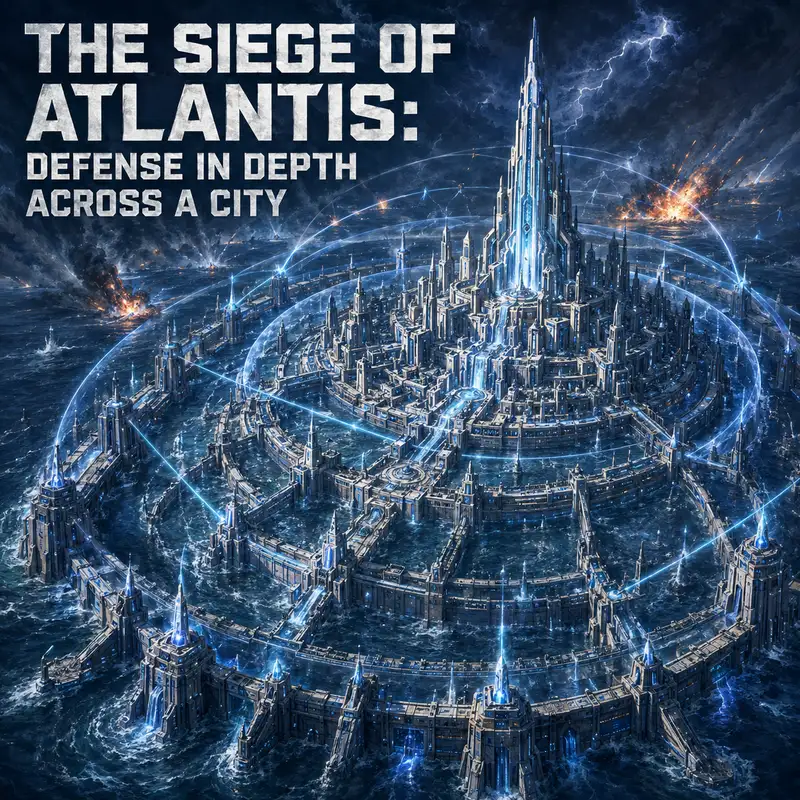
Atlantis survived because its defenders never depended on only one barrier. The city had no single weapon capable of defeating the Wraith armada and no reserve fleet waiting beyond the planet. Instead, the expedition built a sequence of imperfect defenses. Long-range warning led to reconnaissance. Reconnaissance led to an Earthbound message. An Ancient satellite led to mines, railguns, drones, interior security teams, a nuclear strike, a city shield, and finally a deception operation. Every layer was exhausted, penetrated, or countered. Each also forced the Wraith to spend time, reveal a method, or approach the next obstacle under less favorable conditions.
The warning came through Teyla Emmagan’s inherited connection to the Wraith and through a reconnaissance flight that confirmed the scale of the threat. Three hive ships were moving toward Atlantis, and each functioned as the center of a larger carrier group with cruisers and hundreds of darts. The Wraith did not merely want to bombard the city. They wanted Atlantis intact because its Stargate could reach Earth, a populated world beyond their normal range and therefore an almost unimaginable feeding ground. The expedition faced an enemy fleet, an urban boarding threat, and the possibility that losing one control room would expose another galaxy.
Atlantis began the campaign without a usable zero-point module, which meant the city shield could not be sustained and most Ancient weapons remained inaccessible. Earth was weeks away by ship under normal conditions, and the intergalactic Stargate connection required more power than the expedition possessed. McKay combined every available naquadah generator and briefly opened a wormhole long enough to transmit a compressed data burst to Stargate Command. The message included mission reports, information about Atlantis and the Wraith, and personal farewells. It was an intelligence operation disguised as a final transmission. If the city fell, Earth at least needed to know what was coming.
Elizabeth Weir simultaneously prepared an evacuation route and a denial plan. Teams searched for an Alpha Site where personnel could survive after abandoning Atlantis. Engineers armed the city’s self-destruct and developed a computer virus intended to erase the Ancient database. Destroying several occupied towers would not be enough. Atlantis was a city-ship containing redundant records and technology the Wraith might use to build an intergalactic drive. Weir’s problem was therefore larger than saving her expedition. She had to preserve people if possible, deny the city if necessary, and protect Earth even if both choices required sacrificing the place she had been sent to study.
The enemy had already crossed the defensive perimeter. A Wraith dart previously sent to scan Atlantis had reversed its culling system, deposited its pilot inside the city, and then destroyed itself. The infiltrator remained hidden for days, attacked Sergeant Bates, and appeared to be operating near power systems that supported the central tower. Atlantis possessed biometric sensors capable of identifying alien life, but limited power had confined their coverage mostly to the gate room because that was where the expedition expected intruders to arrive. The assumption was reasonable. The Wraith entered somewhere else. Counterintelligence became the first urban layer of the siege.
The expedition located and captured the infiltrator only after expanding the sensor field. By then, McKay, Grodin, and their pilot were already traveling fifteen hours across the system to the last surviving Ancient defense satellite. A naquadah generator restored life support and charged the weapon, but combat damage had severed its internal power route. McKay conducted an exposed repair outside the station while Grodin worked from within. When the docking system lost power, Grodin remained behind to activate the weapon manually. His shot destroyed one hive and delayed the others. It also demonstrated the central limitation of inherited technology. Earth could reactivate the platform without possessing the parts, time, or knowledge needed to make it reliable.
After the satellite failed, Weir began the evacuation and prepared to destroy the city. An incoming wormhole then delivered Colonel Dillon Everett, Marines, additional weapons, and orders from Stargate Command placing the tactical defense under military control. Earth had recovered a zero-point module and loaded it aboard the new battlecruiser Daedalus. With the module boosting its Asgard hyperdrive, the ship could reach Pegasus in four days. Everett canceled the evacuation and ordered Atlantis held until relief arrived. Four days was not a plan by itself. It was the period every remaining defensive layer now had to purchase.
Everett brought a coherent, if temporary, defense package. Six naquadah-enhanced nuclear weapons would be placed by cloaked Puddle Jumpers as space mines between the Wraith and the city. Railguns intended for a Prometheus refit were installed as point-defense batteries across Atlantis. A Mark Two naquadah generator was pushed far beyond normal output to activate the Ancient control chair. Gene-inoculated pilots prepared Puddle Jumpers as a fighter screen, while Sheppard remained available to direct the chair and its drones. Military personnel were recalled from the Alpha Site, civilians volunteered for damage control, and the city was divided into defended sectors.
The Wraith answered the minefield without risking a ship. They accelerated more than a hundred asteroids toward the nuclear positions. Atlantis’s sensors recognized the incoming masses as threats, the mines detonated against the rocks, and the resulting radiation blinded long-range sensors for hours. The mines created an impressive explosion and struck none of the hive ships they had been placed to destroy. The Wraith had spent expendable debris to remove six of Earth’s most powerful weapons. The first improvised outer layer was gone before the main fleet entered direct-fire range.
Darts arrived next in large waves. Atlantis darkened its towers, railgun crews fired controlled bursts, and the control chair launched the few dozen drones still stored in the city. The defensive fire destroyed many attackers, but the drone supply was exhausted quickly. Some darts then entered deliberate collision courses. Their pilots beamed out before impact, using the same matter-storage system normally employed during cullings. Between twenty and thirty craft struck the city, disabling generators, damaging gun positions, and depositing Wraith behind the defenders. The enemy’s objective explained the tactic. Atlantis was more valuable captured than reduced to wreckage, so boarding replaced bombardment.
The city itself became the battlefield. Security teams moved through corridors and transporter routes while internal sensors remained damaged and communications failed across several sectors. Teyla sensed Wraith nearby and helped direct searches. Personnel with the Ancient gene used life-signs equipment that others could not operate. Scientists defended power stations because the military force was spread too thin to guard every tower. Everett was isolated and fed upon. Aiden Ford and a Wraith fell into the ocean during close combat. A preliminary count later identified roughly forty casualties, possibly more. Atlantis had enormous depth as terrain, but every additional corridor created another place for the enemy to hide.
With the mines expended and the drones gone, Sheppard proposed flying a nuclear-armed Puddle Jumper into a hive ship under cloak. The original concept used the Ancient control chair to guide the craft remotely, preserving the pilot while turning the Jumper into a stealth missile. Atlantis did not possess a completed warhead, so Weir negotiated with the Genii, who had every reason to resent the expedition. She offered them a chance to test their unfinished nuclear design against the Wraith and supplied the C four needed to complete it. McKay and Radek Zelenka then finished the prototypes under combat conditions and chemical assistance from the infirmary.
The remote plan failed at the point of execution because the overdriven power system could no longer launch and control the Jumper as intended. Sheppard took the craft himself. The decision transformed an unmanned strike into a one-way mission, but it preserved the only remaining method of reaching the hive without crossing its defensive fire. He approached under cloak, armed the weapon, and prepared to detonate inside the vessel. Weir simultaneously rearmed the city’s self-destruct in case the attack failed. One officer was carrying the immediate defense. The civilian commander still had to deny the strategic target if he missed.
Daedalus emerged from hyperspace just before detonation. Colonel Steven Caldwell’s crew detected Sheppard’s transmission, ordered him to decloak, and used Asgard beaming technology to remove him from the Jumper. The nuclear weapon destroyed the hive while Sheppard appeared aboard Earth’s first mature intergalactic battlecruiser. The timing looked miraculous because the logistical work had occurred elsewhere. Atlantis had transmitted the warning. Earth had recovered and moved a zero-point module. Shipyard personnel had completed Daedalus. An Asgard hyperdrive had compressed the journey to four days. A final defensive layer arrived because every earlier layer had delayed the enemy long enough.
Caldwell immediately beamed the zero-point module into Atlantis, weakening his own ship’s shields by surrendering the power source that had accelerated the transit. Daedalus then attacked the last hive with guided nuclear missiles aimed at its fighter bay. Wraith darts intercepted the weapons miles from the target. The Asgard had provided shields, hyperdrive, and transporters, but had not yet transferred their most powerful offensive beams. Sheppard proposed using the transporter itself. Hermiod overrode safeguards designed to prevent Asgard beaming systems from becoming bomb-delivery devices, and Daedalus placed a nuclear warhead inside the hive. The vessel was destroyed before it could adapt.
The remaining Wraith cruisers withdrew, but the surviving darts turned toward Atlantis in a ballistic formation. Their impact speed would destroy exposed sections of the city even if no pilot survived. McKay, Teyla, and a small escort fought through Wraith still inside Atlantis while carrying the zero-point module to the power interface. The shield failed to respond on the first attempt. With seconds remaining, McKay corrected the connection and brought the barrier online. Darts struck the shield rather than the towers. The city survived the air attack, but the shield did nothing to remove Wraith already beneath it. Ground teams still had to clear Atlantis room by room.
The initial armada was gone, the shield was active, and Daedalus held orbit. That was a tactical victory, not the end of the siege. Deep-space sensors soon detected twelve more hive ships approaching within roughly thirty-six hours. Expedition research suggested at least sixty hives existed across Pegasus, with no assurance that the estimate was complete. The first three ships had been destroyed through surprise, rare ammunition, a damaged Ancient satellite, and a beaming technique the Wraith had not seen before. None of those conditions promised success against the reinforcement wave.
Daedalus attempted to regain the initiative by intercepting the hives during their final pause between hyperspace jumps. Asgard transporters placed nuclear weapons inside the first two vessels and destroyed them before the Wraith understood the attack. The surviving hives then activated jamming that blocked further transport. They flanked Daedalus, reduced its shields, damaged its railguns, and threatened to board. Caldwell withdrew to Atlantis under hyperdrive. The strike had destroyed two more hives and proved that the Wraith could develop a fleet-wide countermeasure after observing a tactic only a few times. Surprise had a very short service life in Pegasus.
The returning fleet began sustained bombardment. Atlantis’s shield could hold almost indefinitely without incoming fire, but under that pressure its single zero-point module would be depleted within days. Daedalus needed repairs and could not defeat the remaining hives through normal weapons exchange. The defenders had reached the same strategic problem that had defeated the Ancients. Superior weapons could win individual engagements while an enemy with enough ships kept returning. The expedition could not build drones, manufacture zero-point modules, or replace battlecruisers in Pegasus. A fortress supplied from another galaxy was not going to win a war of attrition.
The final defense therefore attacked the Wraith intelligence picture rather than their hulls. McKay and Zelenka proposed removing a cloak generator from a Puddle Jumper and interfacing it with the city shield system. The cloak would make Atlantis invisible to the eye and to Wraith sensors. It would not operate beside the shield. It would replace it. Once the cloak activated, the city would be completely exposed to any weapon or collision that reached its true location. Hiding Atlantis was technically possible. Convincing the enemy that it had been destroyed required a separate operation.
Daedalus prepared a nuclear weapon for detonation directly above the city while nonessential personnel boarded the battlecruiser as a reserve evacuation force. Teyla used her Wraith connection to send a message into the attacking fleet that the expedition intended to destroy Atlantis rather than surrender it. The bombardment stopped, confirming that the Wraith believed the threat and wanted the city preserved. The nuclear weapon then detonated above the shield, filling the area with blast effects, radiation, and sensor interference. McKay waited long enough to avoid cloaking the city inside the lethal portion of the explosion, then transferred the system from shield to stealth.
When Wraith sensors recovered, Atlantis had vanished. The fleet scanned an empty ocean, found no city to capture, and eventually broke orbit for hyperspace. The ruse carried almost no defensive margin. Had the Wraith continued firing, guessed the city’s position, or detected the cloak transition, Atlantis would have faced the attack without its shield. The last layer was not harder armor. It was a believable enemy conclusion. The defenders used the Wraith desire to capture Atlantis against them and made continued operations appear pointless.
The defense worked because the layers performed different functions. Teyla’s warning and the reconnaissance flight created time. The data burst created strategic support. The Alpha Site and self-destruct preserved continuity and denial options. The satellite reduced the initial force. Mines forced the Wraith to reveal a countermeasure. Railguns and drones disrupted the dart attack. Interior teams prevented boarding forces from seizing the city. Sheppard’s strike and Daedalus destroyed the surviving hives. The zero-point module restored the shield. The cloak and false explosion ended an engagement no remaining weapon could win.
Command was divided, sometimes productively and sometimes painfully. Weir saw the city as an expedition, a political responsibility, and a gateway that could not be surrendered. Everett saw a defensive position that had to survive until reinforcement. Sheppard understood the local terrain and repeatedly acted when formal plans ran out of power. Caldwell commanded the mobile reserve that could fight beyond the city. Everett’s arrival created friction because he dismissed local experience, yet the weapons and personnel he brought were essential. Weir’s evacuation plan preserved lives, but holding Atlantis allowed Daedalus to deliver the module that made survival possible.
The scientists were not supporting characters behind the gun line. McKay repaired the satellite in vacuum, adapted the chair, completed Genii weapons, installed the zero-point module, and converted the city shield into a cloak. Zelenka planned the database denial, supported the weapons work, and helped solve the final deception. Grodin died operating the first successful strategic weapon of the campaign. Carson Beckett activated Ancient systems when Sheppard was needed elsewhere and kept wounded personnel alive during the boarding action. Hermiod altered Asgard transporters over understandable objections. The city’s defense depended on technical improvisation becoming operational capability before anyone had time to write the instructions.
Logistics determined which ideas became real. Railguns needed ammunition and power. The chair had only a few dozen drones. The Mark Two generator could be overdriven, not overdriven forever. The Genii had nuclear designs but lacked completed weapons and needed Earth explosives. Daedalus carried the zero-point module quickly because the same module accelerated its hyperdrive, then surrendered it to Atlantis at the cost of weaker shipboard shields. Every capability moved from one layer to another. There was no unlimited reserve. Defense in depth was partly the controlled transfer of scarce power, weapons, and people toward the point most likely to decide the next hour.
The civilian and political stakes extended beyond the expedition. Athosian leaders regarded Atlantis as a sacred inheritance of the Ancestors and questioned whether Earth had the right to destroy it. Weir viewed denial as necessary because the Wraith intended to reach Earth through the city. The Alpha Site offered evacuation, not guaranteed safety, and Wraith activity had already made many worlds dangerous. Communities along the armada’s route were culled while Atlantis prepared its own defense. Saving the city protected Earth and preserved the expedition. It did not defend every Pegasus population that had no shield, battlecruiser, or compressed message to another galaxy.
Five hive ships were destroyed across the campaign, along with many darts and supporting craft. The remaining reinforcement force left because it believed Atlantis no longer existed, not because the Wraith had been defeated as a civilization. The expedition had to preserve that deception afterward and limit what it revealed to allies and adversaries. The tactical victory therefore created an intelligence policy. Atlantis survived by becoming a hidden base again, even while continuing to influence a region that would notice its ships, teams, and technology.
The siege demonstrated that fixed defenses become obsolete quickly against an adaptive enemy. The satellite fired once before its circuit failed. The nuclear mines were cleared with asteroids. Drones were finite. Beamed warheads worked until the Wraith jammed them. The shield consumed a rare power source faster than the expedition could replace it. No successful method remained decisive for long. Defense in depth did not mean stacking permanent walls and trusting the strongest one. It meant preserving enough options that the failure of one system did not end the campaign.
Atlantis survived because it was defended as a city, a base, a spacecraft, a gateway, and an idea at the same time. Its people fought in orbit, above the towers, inside power stations, through corridors, and across an information channel reaching Earth. They did not hold every line. They held each line long enough to create another. When the smoke cleared, the Wraith saw only ocean. Beneath that empty picture, Atlantis remained completely unshielded behind a borrowed cloak, filled with exhausted defenders who had won not by building an impenetrable fortress, but by convincing the enemy that there was no fortress left to attack.