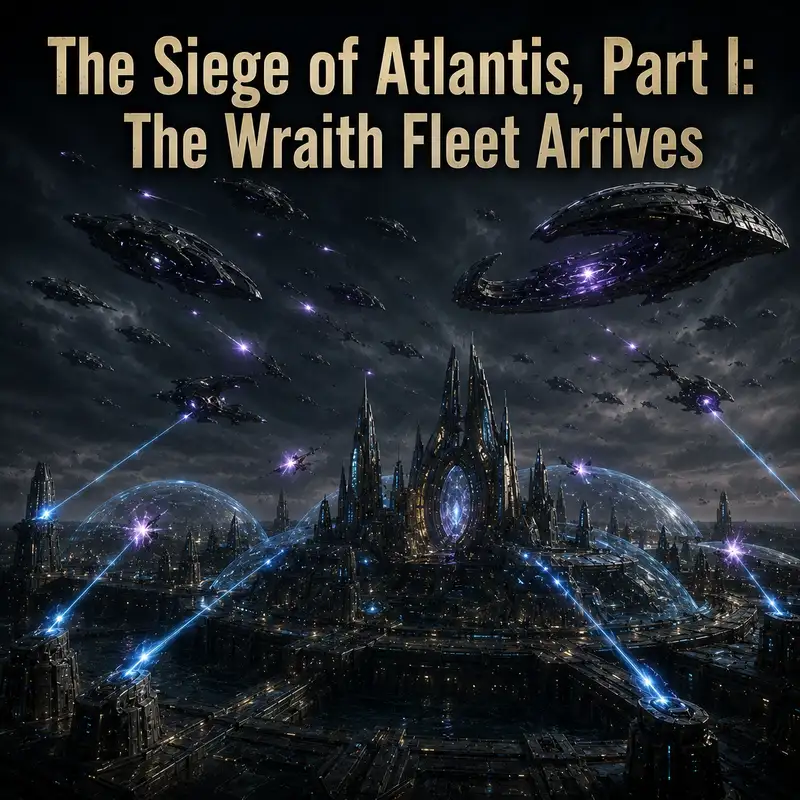
The Siege of Atlantis, Part I: The Wraith Fleet Arrives
Three Wraith hive ships emerged from hyperspace within range of a weapon that had been dead for ten thousand years. Inside the Ancient defensive satellite, Peter Grodin waited alone. The repair that restored the beam had disabled the air lock and docking system, leaving him no safe route back to the cloaked Puddle Jumper nearby. Atlantis needed the satellite to fire three times. Grodin understood that it might fire only once.
The first beam cut through the lead hive ship and destroyed it almost immediately. For a few seconds, the expedition’s impossible plan appeared to be working. Then the improvised power circuit overloaded. The weapon could not fire again. The two surviving hives identified the station, concentrated their weapons, and destroyed it with Grodin still aboard. The first engagement of the siege ended with one enemy capital ship lost, one defender killed, and the remaining Wraith force still moving toward Atlantis.
The central military question was not why the satellite failed. The more important question was why the survival of the most advanced city Earth had ever occupied depended on one damaged relic, one portable generator, and one technician who could not be recovered. The answer began with the condition of Atlantis itself. The expedition possessed an Ancient capital, but not the civilization that had once defended it.
The city had risen from Lantea’s ocean with its last original zero-point module nearly exhausted. Earth-built naquadah generators could support laboratories, computers, transporters, life support, and selected control systems. They could not sustain the citywide shield against orbital bombardment. They could not power the stardrive. They could not provide the reserve required to fight a fleet through repeated engagements. Atlantis was an extraordinary headquarters operating on emergency power.
The expedition had also arrived without a space fleet. Puddle Jumpers offered stealth, local transport, and a limited supply of Ancient drones, but they were not capital ships. Earth had no battlecruiser stationed in Pegasus and no routine method of opening an intergalactic wormhole. Reinforcements could not be requested by radio. Ammunition, medical supplies, personnel, and replacement parts remained finite. The Wraith were approaching a city whose technology was superior to theirs in many areas and whose garrison lacked the power and depth to use that superiority at scale.
The warning came in stages. Long-range sensors detected three hive ships on a direct course toward Atlantis. Teyla Emmagan’s access to the Wraith telepathic network clarified their purpose. The Wraith were interested in more than destroying the expedition. They knew that Earth existed, and they believed Atlantis could provide the route to reach it. Colonel Marshall Sumner’s capture during the first expedition mission had exposed enough information to make another galaxy and its billions of humans a strategic objective.
The expedition could count the three approaching hives, but it could not assume they represented the entire enemy commitment. Wraith society was divided among mobile hive factions, and Atlantis lacked a complete order of battle. Three capital ships were enough to destroy the underpowered base. Additional hives might awaken, join the attack, or exploit the result later. The first force on the sensors was therefore the threat commanders could measure, not necessarily the limit of Wraith interest.
That intelligence changed the meaning of the attack. Atlantis was not merely a defended position. It was a transportation node, an Ancient database, a possible source of intergalactic propulsion knowledge, and the only known Pegasus Stargate configured to reach Earth. The Wraith had good reason to preserve as much of the city as possible. The expedition therefore had to defend Atlantis while preparing to destroy it before the enemy could capture what made the city valuable.
The command problem divided into three missions. The expedition needed a way to stop or delay the incoming fleet. It needed an evacuation site where personnel and Athosian civilians might survive if the defense failed. It needed a denial plan that would destroy the city, erase its database, and prevent the Wraith from reconstructing a path to Earth. Each mission competed for the same small group of scientists, security personnel, pilots, power systems, and remaining hours.
Elizabeth Weir remained the overall civilian commander. Major Sheppard controlled military preparations, while McKay, Zelenka, Grodin, Carson Beckett, and other specialists managed systems no conventional staff could replace. That arrangement allowed different problems to be attacked at once, but it provided almost no redundancy. Sending McKay away to repair the satellite reduced the expertise available in Atlantis. Keeping Sheppard at the city meant the satellite mission lacked its most experienced Jumper pilot. Every personnel decision transferred risk from one part of the defense to another.
The search for a new zero-point module had already failed at the moment it mattered most. Sheppard’s team located a module hidden on Dagan and solved the safeguards protecting it, only to lose the device when the modern Brotherhood reclaimed it in the name of the Lanteans. The expedition could identify Ancient power sources, carry them, and connect them to Atlantis. It could not manufacture one, and it could not always persuade the people guarding one that Earth’s emergency outweighed their own obligations.
Rodney McKay found a narrower way to reach Earth. Instead of sustaining an intergalactic wormhole long enough for people to travel, Atlantis would open one briefly and transmit a heavily compressed data package. The message included intelligence on the Wraith, reports on the expedition, technical findings, and personal recordings for families. It informed Stargate Command that Atlantis had survived and that a hostile power was searching for Earth. It did not guarantee that Earth could answer before the fleet arrived.
The transmission also served as a final intelligence report. If Atlantis was destroyed, Earth would still possess what the expedition had learned about Wraith biology, fleet operations, Ancient systems, and the strategic danger of Pegasus. The personal messages mattered for morale, but the data burst was also continuity of command across a distance that normal communications could not cross. Earth finally knew the situation. Atlantis still had to survive with the resources already in Pegasus.
Sheppard and Teyla conducted reconnaissance against the approaching force while the transmission was prepared. They observed the Wraith culling a human world along the route to Lantea. The attack was not a diversion from the fleet’s advance. It was part of its sustainment. Hive ships carried warriors, Darts, prisoners, and the political leadership of their factions, but those crews still needed human life. The movement toward Atlantis was also a sequence of resupply operations conducted against inhabited worlds.
The reconnaissance confirmed that the fleet was not advancing as an empty formation focused only on a final battle. It was feeding, collecting intelligence, and preserving combat strength while closing on the objective. Atlantis could not expect hunger or distance to stop it. The human societies between the Wraith and Lantea were not neutral terrain. They were the logistical system supporting the attack.
Evacuation planning proved almost as difficult as defense. A useful Alpha Site needed a functioning Stargate, food, water, shelter, and enough isolation to avoid immediate Wraith attention. It also had to remain accessible while Atlantis was under attack. An apparently uninhabited world could contain predators, hostile forces, disease, or a political condition the Ancient address database did not record. The expedition did not need an ideal refuge. It needed one that would not kill the evacuees before the Wraith found them.
The Stargate made a mass withdrawal possible, but it also concentrated the entire operation at one chokepoint. Personnel, medical cases, supplies, Athosian families, and the control crystal needed for a possible future connection to Earth would all pass through the same room. One hostile incoming wormhole, one power failure, or one compromised destination could halt the movement. Once Atlantis was destroyed, the evacuees would have no city, no intergalactic gate, and no assured route back.
Security around the Alpha Site became contentious because Teyla’s telepathic link worked in both directions. She could obtain Wraith intelligence, but Sergeant Bates feared the Wraith might see what she saw and learn the evacuation address. His concern was not baseless. The connection remained poorly understood, and the location of the refuge was among the expedition’s most sensitive secrets. His suspicion became personally and politically damaging when it implied that Teyla, the expedition’s first Pegasus ally, might be serving the enemy.
Sheppard defended her place on his team. Bates continued to argue that uncertainty required restriction. The dispute became physical, and Bates was later found severely beaten near a power generator. For a time, the evidence appeared to support the worst interpretation. Teyla had no witness who could prove she remained in her quarters, and her earlier conflict with the security chief gave investigators an obvious suspect.
The forensic result revealed a more serious failure. Wraith genetic material was found on Bates’s uniform. The expedition did have an enemy agent inside Atlantis, but the infiltrator was not Teyla. A Wraith Dart that had scanned the city weeks earlier had used its culling system in reverse, placing its pilot inside Atlantis before the craft self-destructed. The apparent reconnaissance flight had also been an insertion operation.
The intruder had spent roughly two weeks moving through unused sections of the city. He had gathered intelligence, attacked the head of security, and approached a generator supporting the central tower. His exact mission was never fully recovered. He may have been preparing to disable power, prevent the self-destruct, transmit information, or perform several of those tasks. The uncertainty mattered because the fleet was almost in range and commanders could not know which systems had already been compromised.
Atlantis had a biometric sensor capable of distinguishing Wraith life signs from humans, but power shortages had limited its normal coverage to the gate room. That decision reflected a reasonable assumption that hostile visitors would enter through the Stargate. The Wraith had entered from the air. When Radek Zelenka expanded the sensor field, the intruder appeared inside the city’s occupied spaces. A limited electrical budget had created a limited security picture, and the enemy had been living beyond it.
Sheppard, Ford, and Teyla led the attempt to capture him. The Wraith used stunners, moved through Atlantis with surprising confidence, and nearly fed on Sheppard before the second team arrived. Captured and placed in the brig, he confirmed the strategic objective more clearly than his sabotage mission. The Wraith regarded Earth as a new feeding ground. Whether he had already sent the Alpha Site address or technical data to the approaching hives remained unresolved.
At the same time, Weir and Zelenka discovered that the existing denial plan was inadequate. Conventional explosives could break Atlantis apart and sink large sections beneath the ocean. They could not guarantee the destruction of the city’s distributed systems. Atlantis was not simply a group of towers. It was an intergalactic spacecraft with redundant data storage and technology the Wraith might study from wreckage on the sea floor.
The Ancient database was the greatest concern. Destroying visible terminals would not erase every copy. If the Wraith recovered even fragments, they might obtain propulsion research, Stargate information, Earth’s location, or technical knowledge that altered the balance of power. Zelenka began preparing a computer virus intended to destroy the database before the physical self-destruct fired. The expedition’s final defensive weapon might therefore be deliberate loss of the knowledge it had crossed a galaxy to recover.
That decision created a political and cultural conflict with the Athosians. Halling regarded Atlantis as the sacred surviving city of the Ancestors. To him, destroying it to protect Earth meant sacrificing the heritage and possible future of Pegasus for a distant world he had never seen. Weir understood the objection and rejected its conclusion. Faith that the Ancients might intervene could not substitute for a defense plan. If Atlantis fell intact, the Wraith might gain both the city and access to Earth.
The disagreement exposed the unequal burden of the expedition’s strategy. Earth personnel could evacuate with the hope of returning home someday. The Athosians had already lost Athos and might now watch the city central to their cultural memory destroyed by their allies. Denying Atlantis to the Wraith protected Earth and many human worlds. It also asked Pegasus civilians to accept the destruction of something they considered their own inheritance.
The remaining offensive option was the Ancient satellite. Teyla’s intelligence showed that the three hive ships would pass close to the last known station positioned along their route. McKay and Zelenka believed a portable naquadah generator could supply the low continuous charge required by its directed-energy weapon. The satellite was fifteen hours away by Puddle Jumper. The hives would enter range forty-nine hours after the mission briefing. There was no meaningful reserve in that schedule.
Weir sent McKay, Peter Grodin, and Lieutenant Miller. She kept Sheppard in Atlantis to continue searching for evacuation sites and organize the defense. The assignment showed how thin the expedition had become. Its chief scientist and one of its most experienced control-room specialists were committed to a damaged station on the far side of the system while its military commander searched for somewhere to retreat. A single failed mission could remove several people the base could not replace.
The repair crew found that the generator could charge the satellite’s energy buffer. The problem lay between the stored power and the weapon. Battle damage had severed the main conduit, forcing McKay to cross open space and reroute energy through secondary pathways. The solution restored the beam but did not restore the station. It was an emergency bypass expected to carry a discharge designed for intact Lantean hardware.
The rerouting also removed power from the docking system and air lock. Grodin had entered without a suit and could no longer transfer safely to the Jumper. McKay offered to reverse the work, but the hives were too close. Grodin chose to remain. His presence allowed the satellite to stay powered down until the Wraith entered the most favorable firing position, preserving surprise and reducing the chance that they would identify the trap from a distance.
The arrival of the fleet was therefore met by an improvised ambush rather than a conventional outer defense. Atlantis had no patrol line, no minefield, and no mobile task group protecting Lantea. It had one concealed Ancient emitter and a cloaked shuttle observing nearby. Grodin activated the station only after the hives emerged from hyperspace. The beam armed, tracked the lead vessel, and cut it apart.
The destruction of one hive was a major tactical success. A Wraith capital ship carried far more than weapons. It held warriors, Darts, prisoners, technical personnel, and possibly a queen or senior command element. The loss also proved that the Wraith had entered a system containing active Ancient defenses. The two surviving hives paused after the satellite’s destruction and reconsidered their approach. Grodin had bought Atlantis time even though the weapon failed to complete the mission.
The failure was logistical rather than conceptual. The Ancient design worked. The naquadah generator supplied sufficient energy. The improvised secondary circuit could not survive repeated firing, and no support network existed to repair it under combat conditions. One satellite had once belonged to a larger architecture of orbital stations, Lantean warships, city defenses, maintenance crews, and replacement components. Earth had recovered the weapon without recovering the system that made the weapon dependable.
The Wraith absorbed the loss exactly as their way of war allowed. One ship died, two remained, and other hives existed elsewhere in Pegasus. The survivors did not need to duplicate the beam or understand the repair. They needed to locate the emitter and destroy it before it fired again. Superior Ancient firepower won the first exchange. Wraith numbers and adaptation ensured that the exchange was not the battle.
McKay returned with the report that the satellite and Grodin were gone. Weir immediately ordered the evacuation plan into motion. She did not promise victory, and she could not promise that the Alpha Site would remain safe. Her message to the expedition was therefore less a rallying speech than an honest command assessment. The planned outer defense had failed. Two hive ships were intact. Atlantis would have to be abandoned and denied unless another option appeared.
Inside the brig, the captured Wraith maintained that flight would not save them and that Earth would eventually be found. Sheppard killed him after the interrogation produced no reliable account of what he had sabotaged or transmitted. The act removed an enemy inside the base but did not restore the missing intelligence. Atlantis still did not know whether its evacuation address, power systems, or denial plan had been compromised.
The Wraith fleet’s arrival mattered because it ended the expedition’s ability to treat every problem separately. Power shortage, alliance tension, counterintelligence, evacuation, database security, orbital defense, and contact with Earth had become one operation. A mistake in any category could expose the others. The city’s shield could not compensate for missing power. The Stargate could not provide a safe refuge. The self-destruct could not guarantee denial. The satellite could not fire twice.
The first phase of the siege was therefore decided before the Wraith bombarded Atlantis. It was a contest between an expedition trying to assemble a defense from incomplete Ancient systems and an enemy already conducting reconnaissance, infiltration, and logistical preparation. Earth’s people destroyed one hive and captured one infiltrator. They still entered the siege uncertain whether their escape route was secret and whether the city could be erased before capture.
When the two surviving hive ships turned toward Lantea, Atlantis was still standing. Its greatest outer weapon was gone, its evacuation order had been issued, and its commanders were preparing to destroy the base they had crossed a galaxy to find. The fleet had arrived, and the expedition was no longer deciding how to win. It was deciding what could still be saved before the enemy reached the city.