The Summit: SG-1 Strikes at the System Lords
Daniel Jackson stood inside a neutral Goa’uld space station with seven System Lords gathered in one chamber and enough poison in his hand to kill every symbiote among them. No assault team waited outside the door. No fleet was moving into firing position. The station’s defenses were considered impenetrable, and its scans had admitted no conventional weapons. The entire strike depended on one human attendant, one concealed vial, and the assumption that removing the rulers in the room would leave the Goa’uld weaker than before.
This was not a battlefield raid in the usual sense. It was a decapitation operation carried out through disguise, chemical warfare, and political timing. The Tok’ra had waited generations for an opportunity to place the System Lords inside one enclosed space. S G One helped create the opening, but the final decision belonged to Daniel. His most important act was not releasing the poison. The summit showed why intelligence must be allowed to change a mission, even when the target is already within reach.
The meeting followed the deaths of Cronus and Apophis. Their removal created a power vacuum across Goa’uld territory, and the surviving rulers spent months fighting over ships, worlds, Jaffa armies, and access to resources. They suffered heavy losses and consumed enormous military strength against one another. At the same time, an unidentified adversary attacked several domains while carefully concealing his identity. The System Lords could no longer tell whether every defeat came from a rival in the council or from a power outside it.
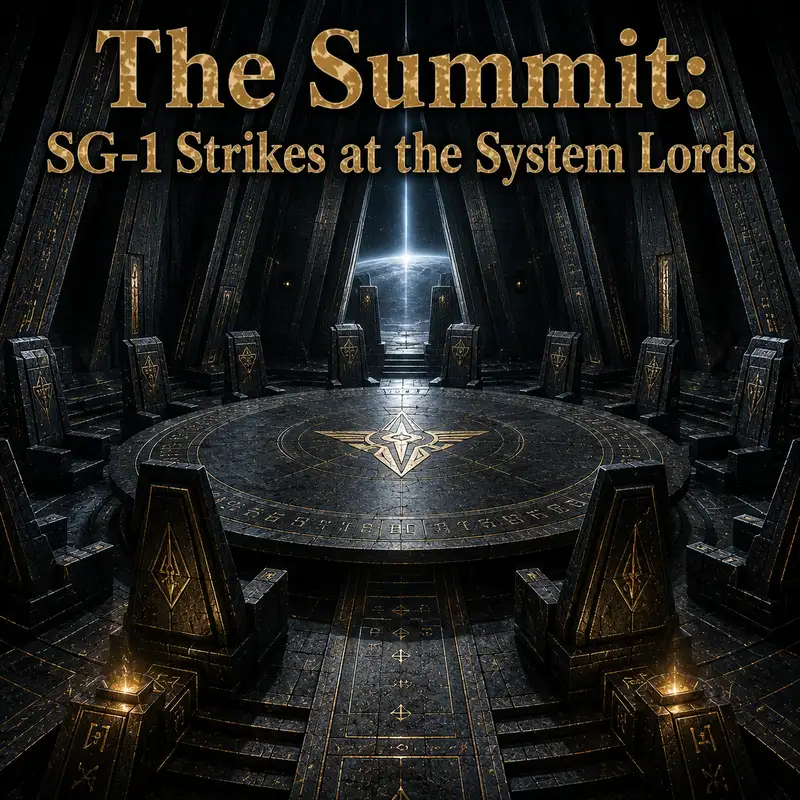
Seven major rulers therefore declared a truce and agreed to meet in the Hassara system. The location was a fortified space station recognized as neutral territory. Access was restricted to cargo ships, approaching vessels were scanned, and no weapons were permitted aboard. Each System Lord could bring one human Lo’taur, the highest-ranking personal attendant in a Goa’uld household. The arrangement was meant to reduce the chance of assassination. It instead created the narrow human access point the Tok’ra needed.
The delegates represented the remaining old order. Ba’al, Bastet, Kali, Morrigan, Olokun, Svarog, and Lord Yu arrived to negotiate the future distribution of power. These were not ministers representing durable states. Their domains were built around the ruler, subordinate Goa’uld, Jaffa commanders, and subject populations. Killing all seven would not erase every garrison or free every world, but it could fracture command across a large portion of the empire before successors were prepared.
Daniel was selected because the operative had to be human, fluent in Goa’uld, familiar with court ritual, and able to function without visible support. Teal’c knew the culture more intimately, but a Jaffa could not plausibly appear as a Lo’taur. Daniel could. His archaeological and linguistic expertise had often supported military missions from beside the firing line. At Hassara, language and behavior were the primary weapons. A wrong gesture, an incorrectly poured drink, or an answer delivered in the wrong register could expose him before the poison was armed.
The Tok’ra solved the identity problem with a modified form of the chemical produced by the Reol. The substance did not physically disguise Daniel. It altered perception and memory, allowing a target to accept a suggested identity as familiar and genuine. A ring device injected Lord Yu with the chemical when Daniel touched him. Daniel then identified himself as Jarren, Yu’s trusted Lo’taur. Yu accepted the claim even though Daniel did not resemble the real servant. The cover worked because the chemical changed the observer, not the operative.
The real Jarren was incapacitated at Yu’s palace, and Daniel took his place for the journey to Hassara. Jacob Carter and Selmak supported the insertion under a Goa’uld cover identity associated with Yu’s service. Once the cargo ship reached the station, the security system detected two life signs and no recognized weapons. The poison and the Reol delivery device passed through. The station’s defenses were excellent against an overt assault. They were less useful against an attendant whose master had already been manipulated into authenticating him.
The assassination device held two liquids in separate chambers. Pressing its control opened a valve, mixed the compounds, and produced a vapor that would break the seal and disperse within seconds. The chemical itself targeted Goa’uld symbiotes rather than human tissue. That distinction did not make the attack bloodless. A dying symbiote released toxins capable of killing its host, and many System Lord hosts had survived centuries of sarcophagus use and could not be assumed capable of independent survival. The mission was designed to kill rulers and hosts together.
The quantity in Daniel’s vial was enough to kill every Tok’ra at the Revanna base twice over. That fact illustrated both the weapon’s effectiveness and its danger to the people who created it. The Tok’ra intended the summit strike as more than a single assassination. Their long-term concept was to use the same agent against the wider Goa’uld population. They believed Goa’uld reproduction had reached zero population growth for reasons they did not yet understand, creating a rare chance to destroy a species-level enemy faster than it could recover.
The plan contained a severe unresolved problem. Jaffa depended on immature symbiotes for survival. A broad poison campaign would kill the larvae they carried and could therefore kill the very population whose rebellion the Tok’ra and Earth hoped to encourage. Jacob acknowledged that no solution had yet been found. The issue was treated as an operational complication because the Tok’ra believed another opportunity might never come. Daniel understood the calculation. He also understood that accepting the mission meant carrying a weapon whose effects extended beyond the seven people in the room.
Teal’c did not offer an easier alternative. He believed eliminating the System Lords could deal the Goa’uld a mortal blow, and Daniel accepted because no available plan promised comparable results. This was not enthusiasm for assassination. It was a judgment made after years of seeing forced hosts, enslaved populations, destroyed worlds, and Jaffa armies used to sustain rulers who claimed divinity. The burden remained with the person required to activate the device at arm’s length. Strategic language can make a target set sound tidy. The human being holding the vial receives a less convenient view.
The operation was already compromised before Daniel entered the station. Zipacna had captured a Tok’ra infiltrator and, through methods supplied by a hidden master, learned both the location of Revanna and the existence of the symbiote poison. His mission was to destroy the base, recover the formula, or capture someone capable of reproducing it. Osiris was sent to the summit while Zipacna led the attack. The political operation and counterintelligence raid were parts of the same campaign, although Earth and the Tok’ra did not yet know who commanded it.
Zipacna’s force established an incoming wormhole to block evacuation through the Stargate. The connection could not be held indefinitely, but his ships were scheduled to arrive before it ended. Orbital bombardment collapsed tunnels and destroyed facilities while Jaffa landed to search the surviving underground complex. The presence of ground troops revealed the intelligence objective. If simple destruction had been enough, the motherships could have continued firing from space. Zipacna wanted the formula, the research, and living prisoners.
The Revanna defense collapsed quickly. Most Tok’ra personnel were killed, along with Major Mansfield and the other members of S G Seventeen. Ren’al and Aldwin died during the bombardment and ground assault. Samantha Carter recovered the crystal containing the poison formula after Ren’al erased the base computers. Lieutenant Elliot survived a cave-in only because Lantash, the symbiote formerly blended with Martouf, entered him and used its remaining strength to keep both of them alive. The base was lost, but the critical research was denied to Zipacna.
Daniel knew none of this while serving drinks inside Hassara. What he could see was the political condition the Tok’ra hoped to exploit. The System Lords accused one another of weakness, disputed reports of captured ships, and described losses inflicted by an enemy none could identify. Their truce had not created trust. It had only placed mutual suspicion around the same table. Daniel’s task was to wait until all seven had arrived, confirm the target set, and release the agent before the summit dispersed.
A final guest then entered the chamber. It was Osiris, using the body of Sarah Gardner, Daniel’s former colleague and intimate partner. Sarah had become an unwilling host after opening an ancient containment vessel on Earth. Daniel had already confronted Osiris once and knew that Sarah remained trapped beneath the symbiote’s control. The appearance created a personal reason to hesitate, but it also raised an intelligence question. Osiris had not been counted among the seven delegates. Someone had arranged a late intervention in the meeting.
Osiris recognized Daniel and confronted him in Yu’s quarters. The Reol ring saved the operation a second time. Daniel made contact, released the chemical, and persuaded Osiris that he was merely Yu’s servant. He then told Jacob that he had delayed because releasing the poison would kill Sarah. Jacob reminded him that the mission concerned the entire Goa’uld leadership and ordered him to proceed. The exchange was harsh because the arithmetic was harsh. Saving one host could not automatically outweigh the chance to end a galactic ruling class.
Daniel prepared to carry out the order. Before he could, Osiris identified the power she represented. Anubis was alive. He had been banished from the System Lords long before, condemned for crimes considered unspeakable even by other Goa’uld, and believed dead for roughly a thousand years. Only Yu remained from the rulers involved in his expulsion. The mysterious adversary inflicting losses across Goa’uld territory was not a new competitor. It was an old one returning with unknown capabilities and a carefully concealed campaign.
That intelligence invalidated the original target logic. The Tok’ra had assumed that killing the seven major rulers would create fragmentation from which the Goa’uld might never recover. If Anubis remained outside the room with a growing army, the same strike could remove every organized rival capable of slowing him. Daniel contacted Selmak and stated the problem directly. A collection of warring System Lords was preferable to one ruler with uncontested power. Selmak knew Anubis’s history and agreed that the threat was worse than Daniel understood. The mission was called off.
Aborting the strike was not indecision. It was mission command under a changed intelligence picture. Daniel had been sent to achieve a strategic effect, not merely to activate a device. The purpose was to weaken Goa’uld power. Once the evidence indicated that releasing the poison might strengthen the most dangerous surviving Goa’uld, obedience to the original procedure would have defeated the original purpose. The target remained physically available. Strategically, it had changed.
Anubis’s proposal confirmed the danger. Osiris asked the council to restore him as a System Lord. In return, Anubis would destroy Earth before formally resuming his seat. The offer exploited the Protected Planets Treaty with the Asgard. Earth was protected against attacks by the System Lords, and the council was expected to enforce the agreement against Goa’uld under its authority. Anubis argued through Osiris that a ruler officially dead and still outside the council could act before those obligations attached to him. It was treaty interpretation by someone bringing a fleet as supporting documentation.
The seven rulers voted six to one to accept Anubis. Yu alone opposed his return. The majority did not trust him, and several described the damage he had already inflicted on their forces. They accepted because his accumulation of power had become impossible to ignore, because rebellion and Tok’ra infiltration were weakening Goa’uld authority, and because Earth had survived too many attacks. The vote transformed Anubis from a hidden aggressor into an acknowledged participant in the old order while giving him political permission to target Earth.
Daniel also observed a ritual that explained part of the Goa’uld demographic problem. Each night of the summit, live symbiotes were brought into the chamber and consumed by the assembled rulers. The act displayed hierarchy and excess while destroying potential members of their own species. Daniel could not prove that this custom alone caused zero population growth, but it supplied an important piece of the answer. The ruling class was not merely failing to reproduce. It was consuming the next generation as part of elite ceremony.
The Lo’taur system revealed another layer of Goa’uld control. Daniel questioned Ba’al’s attendant and discovered that the man understood the Goa’uld were parasites using technology and hosts to impersonate gods. He served anyway because he hoped faithful service would earn implantation, pleasure, power, and perhaps eventual elevation to System Lord. The empire did not depend only on deceived populations. It also rewarded selected collaborators who understood the fraud and wanted a place inside it. Daniel mistook shared knowledge for shared resistance. The attendant warned Yu that his replacement servant could not be trusted.
The summit then produced one more piece of intelligence. Osiris announced that Anubis’s forces were attacking Revanna at that moment and intended to end the Tok’ra rebellion. Daniel’s priorities changed again. He needed to preserve the poison, warn Jacob, escape the station, and help any survivors. He also attempted to capture Osiris, hoping the prisoner could lead the Tok’ra to Anubis and that Sarah might be separated from the symbiote. The idea had intelligence value and personal urgency. It had almost no planning behind it.
Daniel lured Osiris aboard Yu’s cargo ship and tried to trap her in the hold. Yu arrived after receiving the warning from Ba’al’s Lo’taur. Osiris stabbed Yu during the confrontation, and Daniel used the struggle to reach an escape pod. He left without Osiris but kept the poison. The extraction succeeded because Jacob was waiting outside the station and could recover the pod. The capture attempt failed because Daniel’s cover had already begun to collapse and because one linguist, operating alone, was not an assault force no matter how persuasive the mission briefing had become.
The summit strike therefore ended without a dead System Lord. It still produced intelligence of exceptional value. Earth and the Tok’ra learned that Anubis was alive, that he had orchestrated the recent attacks, that he controlled Zipacna and Osiris, that he sought formal readmission to the council, and that Earth was the price of his return. Daniel also preserved the only available dose of symbiote poison. A failed assassination had become a strategic warning and an emergency recovery mission.
Jacob and Daniel pushed the Tel’tak’s hyperdrive toward Revanna, but the journey still required approximately six hours. O’Neill, Carter, Teal’c, and Elliot used Tok’ra tunnel crystals to bypass collapsed passages, reached the surface, and reprogrammed a long-range warning sensor into a distress signal. Jacob detected the message and descended under cloak. Goa’uld gliders tracked the ship’s disturbance through the atmosphere, disabled the cloak, and forced it down. The two halves of the mission reunited in a forest beside a damaged cargo ship, surrounded by Jaffa and cut off from the Stargate.
The poison’s purpose changed for the third time. It had been built to kill the System Lords, preserved because killing them would aid Anubis, and was now the only weapon capable of clearing the Jaffa concentration around the gate. Releasing it near the team would also kill Selmak, Lantash, and Teal’c’s larval symbiote. Carrying it openly toward the gate meant crossing exposed ground against a force already searching for the formula. The device was powerful enough to change the balance of the war and too indiscriminate to use beside several of Earth’s closest allies.
Elliot and Lantash provided the solution because both were already dying. They volunteered to remain behind, claim knowledge of the formula, and allow the Jaffa to take them toward the gate complex. Once close enough, they would release the poison and clear the escape route. The plan depended on the enemy valuing intelligence more than immediate execution, exactly as Teal’c had inferred from the ground search. The newest officer on the mission and the wounded Tok’ra symbiote would complete the strike that the summit had transformed.
The original mission failed at the tactical point for which it had been designed. The seven System Lords survived, Anubis received recognition, Osiris escaped, and Revanna was destroyed. At the operational level, Daniel preserved the weapon and the surviving members of S G One escaped. At the intelligence level, the mission exposed Anubis before he could continue operating as an unnamed adversary. Strategically, Daniel prevented a decapitation attack that might have handed Anubis a nearly uncontested empire. Each level produced a different verdict.
The decision did not make the surviving System Lords allies or preserve a desirable political order. They remained slaveholding rulers whose armies continued to devastate subject populations. Their survival merely maintained competing centers of Goa’uld power that Anubis would have to intimidate, manipulate, or defeat. Later events confirmed that he possessed technology beyond the normal Goa’uld level and intended far more than restoration of his old title. Daniel’s judgment did not solve that threat. It avoided removing its remaining counterweights before Earth understood what it faced.
The poison also survived the destruction of Revanna through the formula crystal Carter recovered. That preserved a capability the Tok’ra considered essential and a danger they had struggled to control. A weapon that killed symbiotes could target Goa’uld rulers, Tok’ra allies, Jaffa soldiers, and unwilling hosts through the same mechanism. Its later history would demonstrate that possession of a selective agent does not create selective policy. The formula outlived its guardians, which is rarely comforting in intelligence work.
The summit was one of S G One’s boldest strikes against the System Lords because it came within seconds of removing nearly the entire senior leadership at once. Its deeper importance lies in why the attack was stopped. Daniel entered Hassara believing the choice was between killing seven tyrants and allowing their empire to continue. He discovered a third possibility: killing them could clear the way for something worse. The correct action was to preserve enemies he had been sent to destroy, escape with the weapon, and carry home the warning.
The System Lords left the station alive because the operative inside their chamber understood that a target list is not the same thing as a strategy. Anubis gained his seat, Revanna fell, and Earth remained marked for attack. Yet the hidden war was hidden no longer. S G One did not win the summit by releasing the poison. It won the only advantage still available by refusing to fire after the intelligence changed, and by ensuring that the people defending Earth knew whose war they had entered.