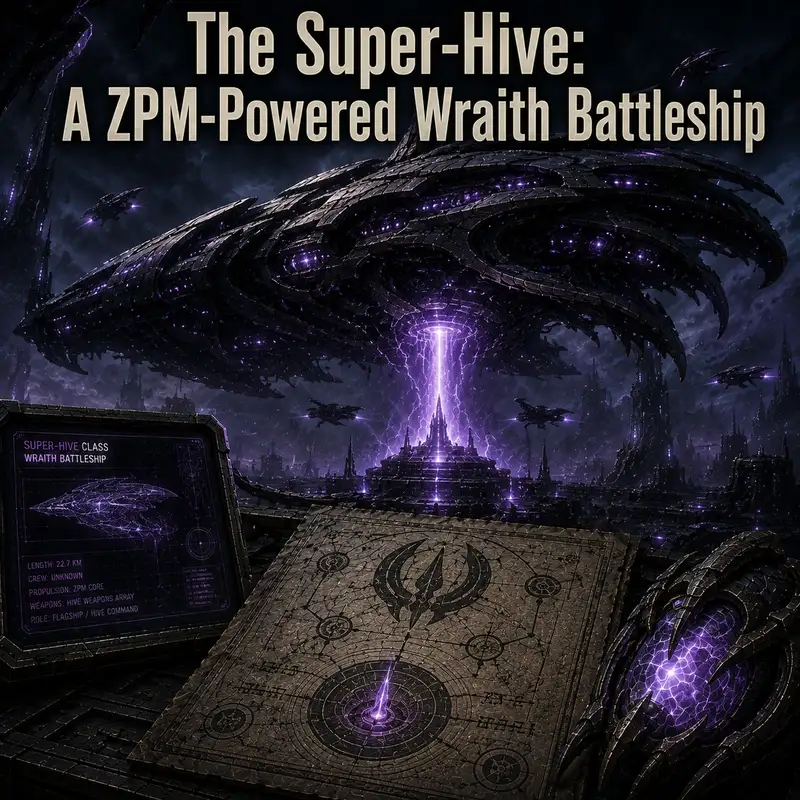
The Super-Hive: A ZPM-Powered Wraith Battleship
The Daedalus fired its Asgard plasma beam directly into the Wraith hull and waited for the target to disappear. Against an ordinary hive, that weapon had become a reliable ship-killer. The new vessel barely registered the impact. Seconds later, pulse fire erupted from weapons positions across its enlarged flank, collapsed the Daedalus shields, disabled the hyperdrive, and wrecked the main weapons. The Wraith ship could have finished the engagement. It did not. A faint transmission from another reality had just given its commander something more valuable than one damaged Earth battlecruiser: the coordinates to Earth.
The super-hive was the most dangerous expression of Wraith naval technology seen in the prime live-action record, but it was not a new class. It began as a hive ship integrated with one stolen zero-point module. That power source removed the limit governing normal Wraith vessels and allowed the ship to keep changing after launch. The result was larger, denser, faster, more perceptive, and more heavily armed than an ordinary hive. The question is why one power source changed the balance so dramatically, and why the resulting battleship still died from one nuclear weapon placed inside it.
A normal hive ship was already more than a warship. It was a living command center, carrier, troop transport, habitat, prison, and mobile feeding base. Organic hull systems could regenerate damage by drawing energy away from less important functions. Darts provided reconnaissance, culling, interception, and ground attack. The ship could cross interstellar distances, sustain a large crew, and remain away from any fixed industrial base for long periods. Its greatest strengths came from integration. Crew, hull, propulsion, and life-support systems operated as parts of one biological platform rather than as separate machines assembled in a conventional shipyard.
That integration also imposed a ceiling. Rodney McKay identified inefficient power generation as the Achilles heel of Wraith technology. A hive could grow only so large before mass, inertia, propulsion, and hyperspace stresses exceeded what its normal systems could manage. Weapons fire, sensors, hull regeneration, maneuvering, and life support all competed for the same limited energy. Wraith engineering was sophisticated enough to defeat the Ancients through numbers and adaptation, but it lacked a compact power source equal to the zero-point modules that supported Lantean cities and warships. The Wraith had the biology to grow a larger ship. They did not have the energy to make that ship operational.
The opportunity came during the destruction of Asuras. While Atlantis, Wraith hives, and Traveler vessels fought the Asuran fleet, Todd secretly sent Darts into the machine city and recovered several zero-point modules. He later used three modules at an ancient Wraith cloning facility, where a rival faction briefly seized the installation before Atlantis destroyed it. Todd allowed the expedition to believe the recovered power sources had been lost with the facility. More than a year later, he admitted that he had taken additional modules and concealed them. At least one entered the super-hive project. Two others remained hidden until Atlantis recovered them during the crisis.
Possessing the module did not create an immediate capability. Todd explained that the organic nature of a hive was incompatible with Ancient technology. His scientists spent more than a year trying to integrate systems designed by two civilizations with radically different engineering traditions. One treated a ship as a living organism able to grow and heal. The other built crystalline control systems around power drawn from an artificial region of subspace. Todd’s best scientist eventually succeeded, then betrayed him and kept control of the prototype. The super-hive was therefore not a standard upgrade package. It was one successful experimental conversion controlled by the specialist who understood how it worked.
The first visible use of the additional energy was growth. McKay’s sensors showed the hive consuming power to expand a much larger and significantly denser outer hull. A normal hive could not support that mass without becoming too slow to maneuver or tearing itself apart during acceleration and hyperspace transition. The zero-point module supplied enough energy for propulsion, structural control, and whatever Wraith equivalent of inertial management allowed the enlarged body to move. The ship was still growing when Atlantis found it. Todd warned that it had not reached full potential, which meant every delay improved the enemy’s armor while the underlying systems continued adapting to the new power source.
Its defense was not clearly shown as a conventional energy shield. The screen record instead emphasizes the dense organic hull and its ability to regenerate. That distinction explains the first engagement. The Daedalus beam weapon struck directly and produced only minimal damage, even though the same system had destroyed Aurora-class Asuran warships in earlier battles. External fire had to burn through enormous layers of reinforced living material while the vessel redirected energy into repair. McKay assessed that the completed hull might become nearly impenetrable. The super-hive was turning surplus power into armor that could keep replacing itself, which is an unpleasant combination for anyone responsible for ammunition planning.
The zero-point module also transformed offensive power. Ordinary hive weapons could batter shields through sustained fire, but the super-hive concentrated a massive discharge from positions across its flank and broke the Daedalus in one exchange. Shields failed, main weapons went offline, the hyperdrive was lost, and damage spread across multiple decks. Later, the ship crippled the Sun Tzu and disabled the Apollo while receiving little apparent damage. Against Atlantis itself, its blue energy projectiles drove the city into a lower orbit and drained the shield faster than Carson Beckett could both maneuver and return fire. This was not simply a larger ammunition reserve. It was a higher combat output available on demand.
Sensors improved as well. Sheppard’s team approached in a cloaked Puddle Jumper, expecting the normal Wraith inability to detect it. The super-hive tracked the craft and fired accurately enough to damage its drive systems. McKay concluded that the additional power had increased sensor sensitivity. The same enhancement later allowed the ship to detect an extraordinarily weak subspace transmission that other hives never heard. That transmission crossed from an alternate reality and contained Earth’s coordinates. The ship’s sensor upgrade therefore accomplished what years of Wraith searches had not. It found the richest human population known to their species without capturing Atlantis or decoding Earth’s address from a prisoner.
Propulsion completed the transformation. The ship left the damaged Daedalus and entered hyperspace toward the Milky Way. McKay predicted that it would still need to stop periodically so its living hull could regenerate after the stresses of travel, and Earth positioned the Apollo and Sun Tzu near the expected route. The interception failed. The super-hive disabled both vessels and continued. It then reached lunar orbit while Earth planners believed weeks remained before arrival. The record does not provide a measured velocity, but the operational result is clear. A Wraith vessel had crossed the intergalactic void quickly enough to defeat the timing assumptions behind Earth’s defensive plan.
The speed did not mean the ship was fully mature. It paused near the Moon while its systems continued adapting to the zero-point module. That pause suggests the conversion remained a biological and engineering process rather than a switch thrown once in the power room. Hull growth, weapons, sensors, and hyperdrive performance were still settling into a new balance. The commander had gained strategic surprise but had not removed every maintenance requirement. Todd’s warning that the ship was a work in progress was accurate. The danger came from a prototype already strong enough to defeat three Earth battlecruisers before reaching the condition its builders considered complete.
That society was politically unstable from the beginning. Todd had ordered the research, supplied the stolen power source, and expected the finished vessel to strengthen his alliance. The scientist who achieved integration used the result to overthrow him. Todd escaped an attack in a damaged shuttle and contacted Atlantis because he could not recover the ship alone. The prototype had created its own coup. Wraith factionalism meant that a breakthrough intended to unify one alliance instead armed a rival commander with enough force to threaten every hive. The super-hive was not only a technological revolution. It was a strategic asset without a secure chain of command.
Sheppard chose reconnaissance before committing the Daedalus. The Puddle Jumper entered the target system under cloak while the battlecruiser remained outside normal sensor range. This was sound doctrine against an experimental platform whose full capability was unknown. The plan failed at the point where intelligence met technology. The super-hive detected the cloaked craft, damaged it, and forced the Daedalus to expose itself while covering the withdrawal. Earth had intended to inspect the prototype and then decide how much force to use. The Wraith learned the reconnaissance team was present and made the engagement begin on their terms.
Colonel Steven Caldwell placed the Daedalus between the damaged Jumper and incoming fire, then ordered the main battery to full power. The beam hit and achieved little. The super-hive answered with a concentrated barrage that removed the Earth ship’s ability to fight or leave. This was the decisive technical demonstration. The Daedalus was not obsolete, poorly commanded, or surprised with shields down. It used one of Earth’s best weapons against a target in open space and lost the exchange. The super-hive had converted a stolen Ancient power source into a level of Wraith naval superiority that Earth could not counter through its normal fleet doctrine.
The Wraith commander did not finish the Daedalus because the alternate-reality transmission offered a larger objective. A Wraith stranded on another Earth had attempted to broadcast that planet’s location across subspace. The experiment instead pushed a weak coded signal through several realities. The super-hive’s enhanced sensors detected it, decoded the coordinates, and changed course. The damaged Earth ship ceased to matter. This decision was rational. Destroying one battlecruiser would remove a local opponent. Reaching Earth promised billions of humans, a feeding base large enough to transform Wraith demographics, and leverage over every rival faction in Pegasus.
The Apollo and Sun Tzu attacked during the super-hive’s predicted regeneration stop. Their mission was interception before the ship completed integration or reached Earth. The available record does not show the full engagement, but the outcome was decisive. The Sun Tzu was crippled and venting atmosphere. The Apollo lost its engines while taking aboard survivors. The super-hive sustained little damage and continued on course. Earth had now committed every immediately available battlecruiser except the damaged Daedalus and the unavailable Odyssey. The prototype had neutralized the conventional space defense without requiring escorting hives or a prolonged fleet campaign.
After reaching the Moon, the super-hive operated as a carrier and reconnaissance platform rather than immediately bombarding Earth. It scanned the planet, reviewed intelligence contained in the intercepted message, and launched Darts toward Area Fifty-One. The message warned that Earth possessed an Ancient control chair able to direct drone weapons. In the alternate reality, the chair had been moved to Nevada. By coincidence and international agreement, the prime Earth had made the same relocation less than a month earlier. Wraith Darts conducted a sacrificial strike that destroyed the facility before Sheppard could use the Ancient weapons against the ship.
This attack demonstrated that the super-hive was more than a large gun platform. Its commander combined long-range sensors, intelligence analysis, fighter operations, and strategic targeting. The Darts accepted heavy losses while F three-oh-two interceptors tried to stop them. Two broke through and crashed directly into the defense complex. The ship had used a small fraction of its embarked force to remove the one Earth weapon most likely to defeat it from outside. Once the control chair was gone, the Wraith could approach Earth orbit without facing the Antarctic drone arsenal. A battleship had created its own access by sending expendable aircraft against the defender’s critical node.
The super-hive carried another system for controlling the battlespace: a Pegasus-model Stargate. Wraith forces commonly blocked a threatened planet’s gate by maintaining an incoming connection. That was difficult across galaxies and unnecessary once they understood gate precedence. When Atlantis dialed Earth, the nearby Pegasus gate aboard the hive superseded the Milky Way gate at Stargate Command. The wormhole opened inside the enemy ship instead. Earth lost its easiest evacuation route, while the hive gained a guarded entry point through which any attempted connection could be trapped. The Wraith had turned gate mechanics into a portable blockade.
That same decision opened the vessel from the inside. Atlantis personnel recognized the Wraith energy signature returning through the wormhole and understood where the connection had gone. Teyla, Ronon, McKay, and Major Lorne crossed through after sending grenades ahead to clear the gate room. A full Marine assault would have moved too slowly through a vast organic ship. The smaller team could sabotage systems, find the internal dialing controls, and exploit local knowledge of Wraith corridors. The Stargate protected the super-hive from an isolated Earth. It also became a ready-made boarding route for the expedition that understood why the wrong gate had answered.
Sheppard created a second infiltration route with an F three-oh-two carrying a nuclear weapon. After the Darts destroyed the control chair, he climbed toward orbit, shut down most systems, and waited for the hive to approach. One external detonation was unlikely to penetrate the enlarged hull. His plan was to use a missile to open the Dart bay, fly the fighter inside, and detonate the weapon within the ship. This reversed the problem created by the zero-point module. The Wraith had made the outside exceptionally hard to destroy. They had not made every internal compartment equally resistant to a nuclear blast originating behind the armor.
The ship’s size worked against its defenders during the boarding action. Wraith patrols could control major corridors and the gate room, but they could not instantly search every organic passage, landing platform, and technical space. Ronon was shot and later restored for interrogation. Teyla, McKay, and Lorne continued toward the gate. Sheppard penetrated through the Dart bay and prepared the nuclear device. The super-hive had enough crew to defend itself, yet simultaneous entry at two distant points forced security to divide. A battleship designed for fleet combat had become a very large close-quarters battlefield.
Atlantis entered the final engagement because Todd revealed the location of two remaining zero-point modules. Those devices gave the city a full power complement and allowed it to launch from the Pegasus galaxy. The planned hyperdrive journey failed near the edge of the Milky Way, forcing Radek Zelenka to use an unstable wormhole drive that moved Atlantis to Earth almost instantaneously. The expedition had to mobilize an entire Ancient city-ship because no surviving conventional vessel could stop the super-hive. That fact is the best measure of the prototype’s strategic weight. Earth answered one Wraith battleship with the strongest platform it could possibly move.
Atlantis opened fire with Ancient drones while placing its shield between the super-hive and Earth. The drones struck hard enough to shake the Wraith vessel and buy time for the boarding parties. They did not destroy it before the return barrage began. The hive’s weapons drove Atlantis downward, reduced the shield rapidly, and forced Woolsey to choose between using power to climb away or continuing the attack. He ordered Beckett to keep firing. The duel showed that the super-hive could contest a fully powered city-ship in direct combat, even though Atlantis possessed Ancient shields, drone weapons, and three zero-point modules of its own.
The final destruction came from inside. McKay reconfigured the hive’s dial-home device for local coordinates, and the boarding team escaped through the Stargate to the Alpha Site. Sheppard left the nuclear weapon on a timer near the internal landing area. The ship exploded moments later. The record does not establish whether the blast destroyed the integrated zero-point module directly, triggered cascading failures in the living hull, or overwhelmed critical systems before regeneration could respond. It establishes the operational fact that external durability did not protect the interior. The super-hive survived beams, missiles, and drones. It did not survive a nuclear detonation behind its reinforced outer layers.
The loss should not be read as proof that the design was overrated. The prototype defeated or disabled the Daedalus, Sun Tzu, and Apollo, destroyed Earth’s Ancient defense platform through its Dart wing, crossed the intergalactic void ahead of prediction, blocked Earth’s gate, and fought Atlantis while still described as incomplete. It was destroyed only after multiple boarding operations, the arrival of a city-ship, and the sacrifice of a nuclear-armed fighter as an internal bomb. Few vessels in the setting required such a combination. The super-hive failed at the end of an operation it had already carried to Earth orbit without fleet support.
It also remained a prototype rather than the beginning of a new Wraith fleet. The Wraith could not manufacture zero-point modules. Todd’s faction depended on devices stolen from Asuras, and only a small number survived. Integration took more than a year and appears to have depended on one scientist whose betrayal transferred the result to another faction. The ship was destroyed before the method could be demonstrated as repeatable, and the remaining modules went to Atlantis. Wraith industry had proven it could adapt Ancient power to living technology. It had not proven it could reproduce the power source, train replacement specialists, or field the conversion at scale.
The super-hive revealed what Wraith technology had always been capable of if freed from its energy shortage. Their organic engineering was not primitive, stagnant, or inherently inferior to Ancient design. It had been constrained by power. Once a zero-point module entered the system, the hive grew armor that resisted Asgard beams, sensors that penetrated cloaking, weapons that broke battlecruisers, and a hyperdrive able to carry the vessel between galaxies at extraordinary speed. The breakthrough also magnified Wraith weaknesses. A living ship required time to adapt, a faction required political control, and stolen technology created one irreplaceable asset instead of a sustainable force.
The super-hive was therefore both a battleship and a warning about technological asymmetry. A single recovered component allowed one Wraith faction to leap beyond Earth’s naval defenses without building a new industrial civilization. Yet the same concentration of power produced a ship too valuable to share, too dangerous to tolerate, and too unique to replace. Its hull made external attack nearly futile. Its internal gate and landing bays gave small teams a route past that hull. The Wraith had solved the problem of power and nearly conquered Earth. They had not solved politics, security, or the old military truth that armor protects only the side facing the enemy.