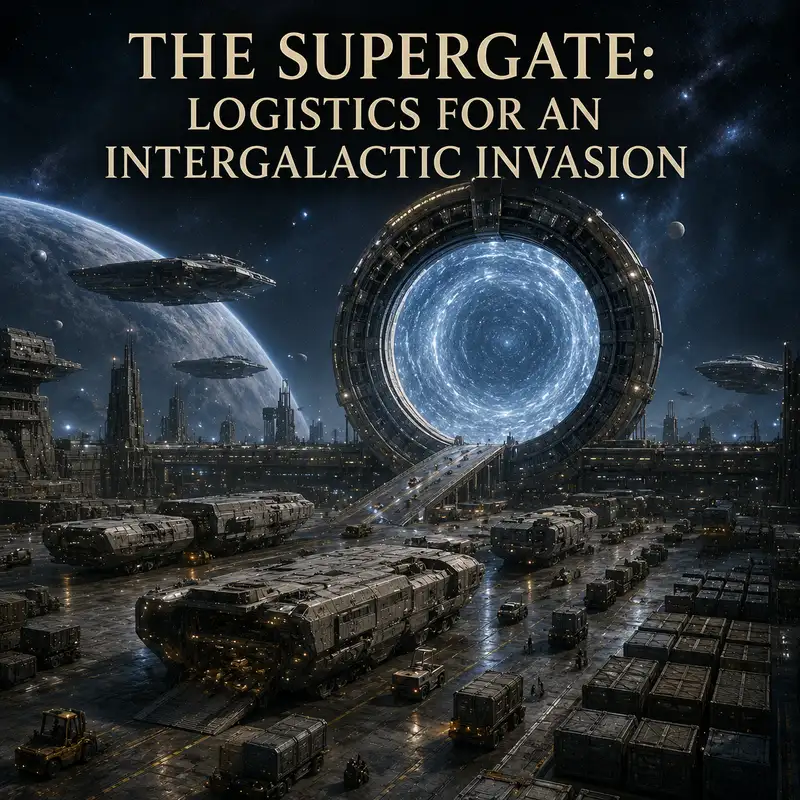
The Supergate: Logistics for an Intergalactic Invasion
Lieutenant Colonel Samantha Carter was outside the completed Supergate when it activated. Magnetic boots held her to one of the enormous segments while she replaced a control crystal intended to make the gate dial outward before the Ori could dial in. The allied fleet waited nearby with weapons ready. Then the ring came alive, the unstable vortex expanded across open space, and Carter was thrown clear. Four Ori warships emerged in rapid succession. An industrial mobilization in another galaxy had just arrived at the battlefield without crossing the intervening distance.
That was the Supergate’s true purpose. It was not merely a larger Stargate or an impressive piece of Ori engineering. It was the principal logistical system for an intergalactic invasion. Priors could travel through ordinary gates, spread Origin, identify targets, and prepare collaborators. They could not bring a capital fleet through a ring designed for people and small cargo. The Supergate converted a network built for limited movement into a corridor large enough for warships, armies, and the political machinery of conquest.
An ordinary Stargate provided extraordinary strategic mobility, but its physical opening imposed a practical limit. Personnel, equipment, and supplies had to fit through the event horizon. A unit arriving on foot still needed vehicles, heavy weapons, medical support, communications, food, power, and protection on the far side. The gate could move a team between planets almost instantly. It could not pass an Ori battlecruiser, its crew, its embarked forces, and the systems needed to dominate a star system as one intact formation.
The distance between the Ori home galaxy and the Milky Way created a second problem. Intergalactic space offered no captured ports, friendly worlds, or established supply chain. Even a civilization with advanced hyperdrive technology would have to consider transit time, navigation, maintenance, and the vulnerability of forces spread across an immense route. The Supergate removed most of that exposure. A ship could leave its home theater, enter a wormhole, and emerge beside the first operational objective. The line of communication became a doorway.
The Ori solution was modular. Components small enough to pass through a normal Stargate were sent into the Milky Way and assembled in space into a ring roughly several hundred meters across. The exact engineering remained beyond Earth’s ability to reproduce, but the operational concept was clear. A small advance element could build transportation infrastructure for a much larger force. The system resembled an expeditionary port assembled from prefabricated sections, except the harbor connected two galaxies and the arriving ships did not have to cross the ocean between them.
Power was the central constraint. Establishing a wormhole across intergalactic distance for a gate of that diameter required energy far beyond a normal dial-home device. The Ori used a black hole in their home galaxy and created a matching micro-singularity in the Milky Way. The gravitational systems supplied the energy and duration needed to support the connection. The Supergate therefore depended on more than the ring. It required celestial-scale power, precise control, a prepared terminus, and a planet that the Ori were willing to consume.
Kallana was the first attempt to create that terminus. One Prior entered through the planet’s ordinary gate, survived the local Jaffa response, and raised an expanding force field around the site. The barrier protected the construction area, held the wormhole open, and absorbed energy directed against it. Incoming segments traveled through the gate and assembled in orbit while the field began collapsing the planet. The Jaffa and Earth believed they were attacking a beachhead. Their weapons were feeding its power requirements.
The Mark Nine naquadria-enhanced warhead should have destroyed a normal Stargate and the surrounding region. At Kallana, its detonation supplied a large portion of the energy still needed by the Ori system. Combined fire from Prometheus and the Jaffa fleet accelerated the expansion further. The installation was designed around a reliable defensive assumption: people who see an enemy force field tend to shoot it. The Ori had turned that reflex into part of the construction plan.
Vala Mal Doran prevented the incomplete Supergate from stabilizing by flying a cloaked cargo ship into the position reserved for its final segment. The forming singularity destroyed the ship, the ring, and Kallana. The immediate invasion route was denied, but the battle revealed every major element of the design. A Prior could establish the lodgment. An ordinary gate could deliver the modules. Defensive fire could provide energy. The planet could become the power source. Once the final ring formed, capital ships could arrive from the Ori galaxy.
The defenders learned the method. They did not gain the ability to stop the next attempt before completion. The Ori selected another world, identified in Earth records as P three Y two twenty-nine, and collapsed it into a micro-singularity. This time the Supergate was finished before the allied powers could intervene. Locating it became an intelligence problem spread across an entire galaxy. Priors were active on dozens of worlds, former Goa’uld territory was politically fragmented, and the construction site did not need to be near Earth or any allied capital.
The completed ring was only the final visible part of a much larger logistics system. In the Ori home galaxy, human populations were building warships, training soldiers, gathering supplies, and organizing a crusade under religious authority. Vala’s warning from behind enemy lines confirmed that the ships were preparing to depart and that a working Supergate existed somewhere in the Milky Way. The Ori had mobilized labor and industry long before the first warship appeared. The gate linked that mobilization directly to the target theater.
This distinction matters because transportation capacity is not the same as military capacity. The Supergate could move a ship, but it could not design one, crew it, arm it, repair it, or train the soldiers aboard. Those functions belonged to the Ori war economy. Shipyards and human workers produced the vessels. Priors and the religious hierarchy generated obedience. Commanders such as Tomin organized the human forces. The Supergate compressed the distance between that system and the Milky Way, but the invasion still depended on an entire civilization supporting the movement.
The first wave consisted of four warships. That number was small compared with the populations the Ori intended to convert, but each vessel possessed shields and weapons far superior to most forces in the Milky Way. The Ori did not need to send hundreds of ships before opening the campaign. They needed enough to defeat the coalition at the entry point, establish freedom of movement, and support Priors already operating among potential converts. The Supergate allowed quality, surprise, and concentration to substitute for an immediately massive fleet.
Earth and its allies understood that the completed gate was the decisive chokepoint. The Odyssey, the Russian vessel Korolev, Jaffa Ha’taks, Tok’ra ships, an Asgard representative, and Lucian Alliance forces assembled near it. This was an extraordinary coalition and an awkward one. Its members did not share a single command structure, common doctrine, or complete trust. They did share the knowledge that allowing the Ori to establish an uncontested fleet corridor would make every later battle harder.
Carter and the Asgard scientist Kvasir located the dialing-control crystals in one section of the Supergate. Their plan was to replace a crystal and make the ring establish an outgoing wormhole before the Ori could create an incoming one. A Stargate cannot normally accept a second connection while already active. If the coalition could seize the channel first, it could deny the Ori access without destroying the ring. The plan treated the Supergate as communications and transportation infrastructure rather than an object to be bombarded.
The timing failed by minutes. Carter began the external replacement while the fleet maintained defensive positions. The Ori activated the gate from their galaxy before she finished. The opening vortex knocked her away, and the first ship emerged almost immediately. Three more followed. The Supergate had transformed the strategic warning into a tactical crisis faster than the coalition could change formations or recover its technician.
The battle demonstrated what the logistics system had purchased. Ori warships did not arrive exhausted from a prolonged intergalactic transit or dispersed along a vulnerable route. They emerged in formation, close to the objective, with weapons and shields ready. The coalition had already concentrated near the gate, which meant the Ori did not have to search for the principal opposing fleet. The doorway delivered them directly to the force attempting to close it.
The allied ships opened fire, but their weapons had little effect. Ori energy weapons cut through shields and hulls, destroyed the Korolev, crippled several vessels, and scattered survivors. The four warships then entered hyperspace and moved toward separate operational tasks. Tactical victory at the Supergate gave the Ori access to the wider theater. The ring did not conquer the Milky Way by itself. It delivered the force that could begin doing so.
Once inside the galaxy, the invasion used two transportation systems together. Ori warships provided orbital firepower, heavy forces, command presence, and rapid movement between star systems. Ordinary Stargates allowed Priors and smaller elements to reach settlements, spread doctrine, gather intelligence, and create local political control. The Supergate was the strategic entry port. The existing gate network was the distribution system. One moved the army into the theater. The other helped the occupation reach individual worlds.
This division reduced the burden on the fleet. A warship did not need to visit every village before conversion began. Priors had already offered Origin, identified resistant leaders, and recruited supporters. When a world refused, a ship could provide the punishment that made the next offer more persuasive. Religious conversion reduced the need for permanent garrisons, while orbital superiority protected the missionaries. Logistics, ideology, and firepower reinforced one another.
The first wave remained insufficient for total control. Four warships could defeat a coalition at one point and still be unable to occupy an entire galaxy. Priors promised reinforcements, which meant the Supergate had to remain available for repeated use. It was not a one-time launching device. It was the continuing line between the Ori industrial base and the expeditionary campaign. Replacement ships, additional armies, and new Priors could pass through whenever the Ori secured another connection.
That requirement created the Supergate’s greatest weakness. The route was fast, but it was fixed. Once discovered, the ring became a known strategic target. It could be watched, mined, blockaded, sabotaged, or denied through another wormhole. Every reinforcement had to pass the same point. The Ori had shortened their line of communication to almost nothing, but they had also concentrated it into one structure that could not move with the fleet.
Destroying the gate was not a practical option. Its segments were protected by advanced material and technology, and the power system was tied to a black hole. Direct attack had already failed at Kallana. Earth therefore returned to the more subtle idea Carter had attempted before the first wave: activate the ring from the Milky Way side and keep it occupied. The problem was that the Supergate had been designed to receive an intergalactic connection, and conventional efforts to dial outward failed.
Carter’s solution required two ordinary Stargates, two galaxies, nuclear devices, and a black hole. A normal gate was placed near the Supergate in the Milky Way. Another was moved near a black hole in the Pegasus galaxy. The Pegasus gate dialed the ordinary gate beside the Ori ring. Carefully timed nuclear detonations then forced the wormhole to jump from the smaller Milky Way gate to the Supergate. The maneuver adapted a dangerous gate anomaly from an earlier black-hole incident into a deliberate interdiction method.
The operation was technically demanding because the energy spike had to redirect the connection without destroying the gate that produced it. Time dilation complicated communications and timing. The black hole degraded sensors, shields, engines, and subspace contact aboard Odyssey. A Wraith hive ship approached while the Earth vessel was operating near the gravity well, creating a second battle inside an already unforgiving engineering problem. Logistics interdiction rarely remains a laboratory exercise once the enemy, or an entirely different enemy, notices the explosions.
The plan eventually succeeded. The wormhole jumped to the Supergate and remained active because the Pegasus-side black hole supplied the power needed to exceed the normal connection limit. The Ori could not dial in while Earth’s connection occupied the ring. Stargate Command had not destroyed the invasion corridor. It had placed the intergalactic equivalent of a vehicle across the only open tunnel and left the engine running.
This was an operational victory with continuing costs. The block depended on a rare combination of gates, celestial conditions, accurate calculations, nuclear warheads, and ships able to position the equipment. It could not be repeated casually at every threatened location. The connection also had to remain in place. If Earth terminated it, the Ori could use the Supergate again before the entire denial operation was rebuilt.
The dilemma became immediate when Daniel Jackson completed Merlin’s weapon against ascended beings. The Sangraal had to be delivered into the Ori home galaxy. The blocked Supergate was the only practical route large enough for the captured Ori warship carrying the device. Earth could preserve the blockade and prevent reinforcements, or release the gate long enough to attack the leadership sustaining the entire crusade. It was a choice between protecting the theater’s supply line and striking the enemy’s strategic center.
Stargate Command chose the larger risk. The Pegasus connection was shut down. Daniel used the Supergate to send the Ori vessel and the Sangraal into the home galaxy. The weapon appears to have destroyed the ascended Ori, but the transport corridor immediately resumed its original purpose. Six additional Ori warships emerged before Earth could restore the block. The mission may have removed the rulers at the top of the system. It also delivered substantial reinforcements to the armies still fighting in their name.
That exchange illustrates why the Supergate mattered more than any one battlecruiser. Ships were combat power. The gate controlled whether combat power could enter the theater at all. Keeping it blocked limited the enemy to the forces already present. Opening it for a strategic mission changed the force ratio in minutes. The decision could not be evaluated only by counting ships. It traded a near-term military disadvantage for the possibility of ending the ascended threat behind the entire war.
The Supergate was also reversible. Ori design did not make it permanently loyal to Ori traffic. With the proper control, power, and destination, Earth could send a vessel through it. Later, the Odyssey carried the expedition seeking the Ark of Truth into the Ori home galaxy through the same corridor. Infrastructure created for conquest became the route used to dismantle the political and religious system that supported the conquest. The gate did not distinguish between invader and counteroffensive. Control of the connection determined its allegiance.
Its reversibility made the ring both a strategic asset and a security problem. Defending it required ships, sensors, and constant awareness of activity at a fixed location. Using it risked opening a route in the opposite direction. Blocking it consumed unusual resources. Destroying it threatened interaction with a black hole and technology Earth did not fully understand. The Supergate was the most efficient line of communication in the war and one of the least forgiving pieces of infrastructure either side could operate.
The system also revealed the limits of technological superiority. The Ori possessed the knowledge to assemble a gate from modules, convert a planet into a power source, and move capital ships between galaxies. They still had to predict enemy behavior, protect a construction site, mobilize human labor, and maintain political obedience. Their first gate failed because Vala exploited an incomplete segment. Their completed gate was denied because Earth combined Ancient gate behavior, nuclear engineering, Pegasus resources, and a willingness to operate much too close to a black hole.
Earth could not build a Supergate of its own. It could identify control systems, alter crystals, redirect a wormhole, and use the finished structure under exceptional conditions. That was adaptation, not industrial parity. The distinction is central to Earth’s technological rise. Stargate Command repeatedly learned how to use one captured or abandoned system without acquiring the civilization that could manufacture another. The Supergate became an operational capability only while the existing ring survived and the required power conditions remained available.
For the Ori, the gate turned religious expansion into a militarily sustainable campaign. Priors prepared the population. The Ori home galaxy produced ships and soldiers. The Supergate delivered the heavy force. Warships secured space and punished resistance. Ordinary gates distributed missionaries and political control. Each component solved a different part of the invasion problem, and the entire system was far more dangerous than any single weapon aboard an Ori ship.
For the defenders, the same structure simplified the strategic problem. They could not protect every world or defeat every Prior immediately. They could identify the one corridor through which new capital ships had to pass. The war around the Supergate therefore became a contest of access, timing, intelligence, and engineering. Fleet combat mattered, but the decisive question was often whether the ring was active, who had established the wormhole, and what would be allowed through before the connection closed.
The Supergate made an intergalactic invasion possible by eliminating the distance between the Ori war economy and the Milky Way battlefield. It delivered concentrated force, supported repeated reinforcement, and connected a crusading state to its expeditionary armies. Its efficiency came from turning a line of communication into a single door. Its vulnerability came from exactly the same design. The Ori built a gate large enough to move an empire, and Earth learned that the most important battle was not always against the ships. Sometimes it was for control of the doorway that made the ships relevant.