The System Lords: An Empire Designed Never to Unite
The seven most powerful System Lords had declared a truce, traveled to a hidden summit, and agreed to discuss a new political order. Then Osiris arrived on behalf of Anubis, the outlaw who had already attacked each of them and inflicted losses none could explain. The delegates did not combine their fleets and destroy him. They voted on whether to welcome him back. Six accepted. Lord Yu alone refused. Anubis had demonstrated that he could threaten the entire Goa’uld order, and the response of that order was to offer him a seat at the table.
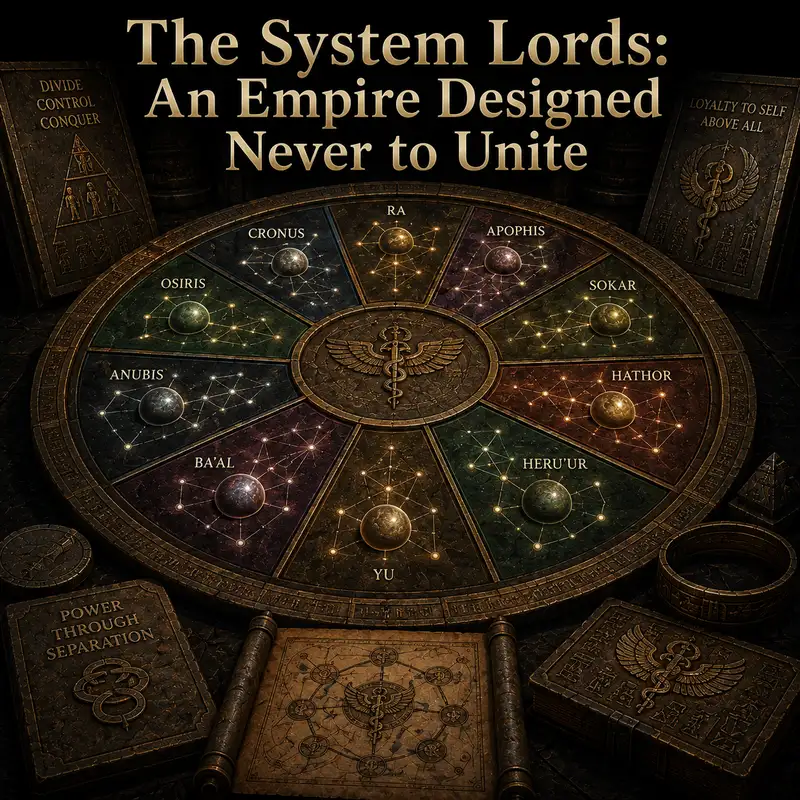
The decision appears absurd until the System Lords are understood as they actually were. They did not govern a unified empire with a permanent sovereign, a common army, and one chain of command. They formed a political class of rival territorial rulers who recognized shared customs while defending private domains. They could negotiate treaties, declare truces, recognize status, and assemble coalitions. They could not safely transfer lasting power to a central authority, because every System Lord believed that authority should eventually belong to him or her alone.
The result was an empire designed never to unite. That design was not written into a constitution. It emerged from the biology, military organization, economic interests, and political mythology of the Goa’uld. Fragmentation protected individual rulers from one another and made the wider system difficult to decapitate. It also ensured that every major crisis became a competition over who would command the response, who would pay for it, and who would benefit after the enemy was defeated.
Ra occupied the position closest to a supreme overlord during much of the old order, but even his dominance did not turn the Goa’uld into one centralized state. Other powerful rulers retained their own worlds, Jaffa, fleets, symbols, and ambitions. Ra’s position depended on strength, antiquity, prestige, and the ability to prevent rivals from becoming strong enough to challenge him. His death over Abydos did not cause a lawful succession. It removed the figure who had constrained the competition and opened space for every surviving ruler to improve his position.
The title System Lord identified membership among the most powerful Goa’uld, not the entire species. Beneath them were lesser Goa’uld, offspring, administrators, scientists, commanders, and subordinate rulers whose status depended on service or patronage. A minor Goa’uld could control a ship, a province, or a human population without possessing the resources or recognition of a System Lord. Advancement came through acquisition of territory, forces, technology, and political support. There was no neutral civil service evaluating applications. The usual evidence of qualification was that one had become too dangerous to ignore.
Each System Lord’s domain was a personal military economy. Naquadah mines, agricultural worlds, shipyards, Jaffa communities, human labor, hosts, and transport routes supplied the ruler’s forces. Tribute moved toward the center of that domain, where it financed war and court. The ruler’s religious identity justified extraction, while the Jaffa enforced it. Because the assets belonged to a person rather than a shared imperial treasury, contributing them to a coalition meant strengthening potential enemies with one’s own resources.
Information was as private as territory. A System Lord guarded gate addresses, fleet dispositions, secret laboratories, loyal underlords, and the condition of important worlds. Sharing that information with a council could improve collective planning, but it could also provide a rival with the map needed for the next invasion. Even accurate reporting from subordinate Jaffa was shaped by fear of displeasing the ruler. A coalition assembled from such domains began with an intelligence deficit of its own making. Every member knew something useful, none knew everything, and each had reasons to hold back the fact that might save the others.
The Jaffa military system deepened the division. Warriors bore the symbol of the Goa’uld they served. Their commanders received authority from that ruler, their families depended on access to symbiotes controlled within that domain, and their military traditions developed through service against the Jaffa of rival gods. A Serpent Guard did not belong to a common Goa’uld army temporarily assigned to Apophis. He belonged to Apophis. A coalition therefore assembled separate household forces whose first loyalty remained vertical, not collective.
This arrangement helped the empire survive internal violence. If one System Lord was killed, the others did not automatically collapse. Fleets remained in space. Garrisons remained on their worlds. Priests, underlords, and First Primes continued to exercise authority. A rival could absorb those assets, or local commanders could choose another patron. The lack of a single capital or unified command made the political order resilient. It also meant that the death of a tyrant did not necessarily liberate the people beneath him. Frequently, it only changed the emblem above the gate.
The High Council and the broader institution of the System Lords existed to manage that dangerous competition, not eliminate it. The council could recognize who belonged among the leading rulers, negotiate with outside powers, and establish rules useful to all. It offered a place where rivals could communicate without immediately opening fire. That was not a trivial achievement among personalities who considered compromise a temporary condition preceding someone else’s submission. Still, council decisions depended on the willingness and strength of members to enforce them.
The negotiations over Earth’s inclusion in the Protected Planets Treaty show the council at its most functional. Cronus, Yu, and Nirrti arrived as representatives of the System Lords to bargain with the Asgard and the Tau’ri. Their presence demonstrated that the Goa’uld could delegate authority, recognize treaty law, and accept restraints when confronted by a stronger external power. Teal’c explained the principle plainly. The System Lords reluctantly banded together against outside threats such as the Asgard and the Reetou, while continuing to fight one another for control of their individual domains.
The treaty was not evidence of trust. It was a negotiated balance of fear. The Goa’uld accepted protected planets because direct confrontation with the Asgard threatened their survival. In return, they sought limits on Asgard technological assistance and initially demanded that Earth surrender its Stargates. Even collective diplomacy remained focused on preserving the existing hierarchy. Human worlds could be protected only under conditions that prevented them from becoming powerful enough to challenge Goa’uld interests.
Nirrti’s conduct during the same negotiations exposed the limits of the arrangement. She used invisibility technology to attack Cronus and attempted to direct suspicion toward Teal’c. The murder of a fellow representative would have destroyed the talks and possibly triggered an attack on Earth. Nirrti was not behaving outside Goa’uld political culture. She was applying its normal logic inside a diplomatic mission. A rival’s vulnerability was an opportunity, even when exploiting it endangered a collective objective.
The other System Lords responded once her responsibility was exposed, and Cronus took her as a prisoner. This shows that the political order possessed sanctions. It does not show that it possessed impartial law. Punishment depended on the injured ruler surviving, the evidence becoming visible, and other powerful participants finding enforcement useful. A less influential victim or a more successful assassin might have produced a different result. Goa’uld law operated within power, not above it.
Balance-of-power politics prevented any ruler from remaining dominant without opposition. Centuries earlier, Sokar had ruled over the System Lords until an alliance that included Ra and Apophis defeated and banished him. When Sokar returned and began rebuilding, the Tok’ra considered his rise a strategic emergency. They did not believe a more unified Goa’uld realm would be easier to overthrow. They believed a single dominant ruler would concentrate fleets, intelligence, and repression so effectively that organized resistance might become impossible.
The destruction of Sokar demonstrated the problem of succession. His death removed a powerful enemy, but Apophis survived and seized much of Sokar’s domain. The assets of the defeated ruler did not disappear with him. Jaffa, ships, and territory could transfer to the victor. Apophis, previously weakened, returned as a major power because another System Lord’s military establishment was available for absorption. The political system rewarded survival more reliably than competent administration.
The proposed alliance between Apophis and Heru’ur created an even more dangerous concentration. Together they controlled two of the largest Goa’uld military forces. The Tok’ra judged that a merger could allow them to overpower the remaining System Lords. Their preferred outcome was not a stable peace. It was a war that would damage both sides and preserve the balance. S G One helped sabotage the meeting in the Tobin minefield, hoping to provoke mutual destruction before an alliance could form.
The immediate plan prevented the alliance, but the operational result was worse. Heru’ur was killed while Apophis survived. Apophis then absorbed Heru’ur’s remaining forces and emerged stronger than either partner would have been alone in the short term. The incident revealed a recurring danger in campaigns against the System Lords. Removing one node could transfer its resources to another. Tactical decapitation was not automatically strategic reduction.
The Tok’ra built much of their long war around this reality. Their strategy was to undermine individual Goa’uld power, protect resistance networks, and keep the System Lords fighting until a means of eliminating the wider system became available. Jacob Carter warned that killing rulers one at a time could create more chaos and allow more warlike successors to take their place. The Tok’ra were not defending the System Lords. They were trying to prevent consolidation while attacking the foundations that made succession possible.
Earth’s approach was more direct and often more disruptive. Stargate Command destroyed ships, killed rulers, liberated prisoners, and encouraged Jaffa resistance whenever an opportunity appeared. These operations produced real gains, but they also changed the balance faster than Earth could predict. The deaths of Cronus and Apophis created a power vacuum. The surviving System Lords spent months fighting for advantage, suffering heavy losses and consuming enormous resources. From a resistance perspective, that attrition was welcome. From a strategic perspective, the resulting disorder was difficult to control.
The great summit was called because the disorder had become dangerous even to its beneficiaries. Seven leading System Lords declared a truce and met to discuss a new order. The gathering itself was proof that the political system could respond to crisis. It was also proof of how narrow its leadership had become. The delegates represented the strongest surviving domains, not a population, a legislature, or a common military service. They met as sovereign predators trying to establish rules that would preserve each of them.
The unknown attacks preceding the summit made cooperation even harder. Anubis had concealed his role while striking the domains of multiple System Lords. Each ruler suffered losses without knowing whether the attacker was an old rival, a new power, or one of the other delegates. Secrecy amplified suspicion, and suspicion increased the value of Anubis’s eventual offer. He was not asking to join from weakness. He was revealing that he could continue hurting them unless they recognized his place.
The vote admitting Anubis was therefore collective appeasement disguised as institutional procedure. Six rulers accepted him. Yu refused, remembering why Anubis had been banished and recognizing the danger of his return. Unanimity was not required. The council could confer the status of System Lord without resolving whether its newest member intended to obey any common limit. Anubis gained legitimacy, access, and time. The others gained the hope that his attacks might be redirected somewhere less personally inconvenient.
A durable union would have required more than a vote. It would have required a permanent commander, shared intelligence, coordinated logistics, standardized authority over Jaffa formations, and rules governing the division of conquered territory. Every one of those measures threatened the independence of the members. A common commander could become an emperor. Shared intelligence could expose secret bases and weak fleets. Joint logistics could reveal production capacity. Standardized command could teach Jaffa to obey an institution rather than a god. The reforms needed to create unity would have weakened the political foundations of System Lord rule.
The coalition led by Yu against Anubis showed how much could still be achieved. Yu assembled the collective forces of the System Lords and confronted Anubis over Abydos. The fleet possessed enough numerical strength to threaten him before he completed his objective. Yet it hesitated. Anubis understood that the other rulers feared both his capabilities and the losses an attack would impose. He gained time, completed the weapon formed from the Eyes, and destroyed much of the coalition. The force had concentrated. Its confidence and command authority had not.
Anubis broke the balance because he possessed knowledge and technology the other System Lords could not match. His shields, weapons, Kull warriors, and research infrastructure reduced the military value of their traditional parity. Once he could defeat several rivals in succession, council recognition no longer constrained him. The remaining rulers either resisted, submitted, concealed themselves, or searched for an outside weapon capable of restoring the balance. The empire’s safeguards against ordinary Goa’uld ambition were not designed for a partially ascended exile with access to knowledge beyond the established order.
Ba’al adapted more successfully than most. He fought Anubis, survived him, acquired forces, and eventually brought much of the remaining System Lord coalition toward submission. His methods were flexible enough to include deception, technological experimentation, political bargaining, and temporary cooperation with Earth. Yet even Ba’al’s apparent rise concealed another layer of divided authority. For a time he secretly served Anubis while presenting himself as the leading power among the surviving Goa’uld. The coalition could not tell whether its commander was protecting the system or managing it for someone else.
When Yu, Amaterasu, and Camulus approached Earth during Ba’al’s campaign, they did not arrive as representatives of a confident empire. They came because Ba’al’s forces were defeating the collective armies and threatening their remaining domains. They wanted access to the Ancient weapon that had destroyed Anubis’s fleet over Antarctica. Their appeal demonstrated how far the balance had shifted. System Lords who had once negotiated restrictions on Earth now sought Earth’s military technology to survive another System Lord.
Even this crisis did not produce a stable common strategy. Each representative carried separate interests, different levels of desperation, and reasons to suspect the others. Camulus sought asylum. Ba’al destroyed the ship sent to test Earth’s defenses. The negotiations became another arena for maneuver rather than the foundation of a combined war effort. The System Lords could identify the shared danger. They could not stop calculating how the crisis might improve an individual position.
The final collapse came when several threats struck different foundations at once. Replicator forces attacked Goa’uld ships and command centers, using captured technology against its owners. The High Council was destroyed, including Yu and the other council members gathered with him. Fleets that had spent years fighting one another were forced into a war against an enemy that did not negotiate, fear religious authority, or care who possessed the more ancient title.
At the same time, the Jaffa rebellion attacked the manpower and legitimacy of the entire political class. Fear of the Replicators briefly drove many Jaffa back to their former gods, showing that the old belief system could still function during catastrophe. Teal’c and Bra’tac answered by seizing Dakara, the sacred center associated with Jaffa servitude. The operation was aimed less at territory than at confidence. If rebels could hold the holiest site while the gods failed to defend it, obedience became harder to justify.
Ba’al then cooperated with Earth and the rebel Jaffa to use the Ancient device on Dakara against the Replicators. He did so while delaying the fleet Anubis had ordered him to use against the rebellion. This was Goa’uld politics in its purest form. Ba’al betrayed his superior, assisted his enemies, preserved his own chance of survival, and helped destroy a threat to everyone. The act was strategically useful and completely consistent with a system in which loyalty lasted only as long as the superior remained able to enforce it.
The destruction of the Replicators removed the immediate machine threat, but it did not restore the System Lords. Their council had been killed, their fleets shattered or captured, their Jaffa authority broken, and Anubis’s final plan prevented. Rebel forces boarded Ba’al’s command ship and took control of much of the remaining fleet, though Ba’al escaped. A political order that had survived the death of individual rulers could not survive the simultaneous loss of leadership, military assets, religious legitimacy, and the obedience of its warrior caste.
The aftermath confirms that the System Lords had governed a network of possessions rather than a unified state. Freed Jaffa inherited ships and worlds but struggled to build common political institutions. Former subject populations faced local power vacuums. Smugglers, mercenaries, and organizations such as the Lucian Alliance moved into abandoned trade routes and territories. The disappearance of the ruling class ended one empire without creating one successor capable of administering everything it had controlled.
The System Lords remained divided because division was the price of membership. Each ruler accepted a council only while retaining a private army, private territory, private intelligence, and the right to pursue supremacy. Their rivalries prevented one tyrant from easily commanding the entire Goa’uld military system, and that helped the order survive repeated assassinations and defeats. The same rivalries prevented sustained concentration against enemies who threatened them all.
Their empire was therefore not weakened by an accidental failure to cooperate. It was stabilized by controlled noncooperation until the threats exceeded what that arrangement could absorb. The council chamber could recognize a new System Lord, negotiate with the Asgard, and declare a truce. It could not make its members trust one another, surrender command, or place collective survival above personal power. Every throne was built on the claim that one god stood above all others. An empire of such gods could share a table. It could never share sovereignty.