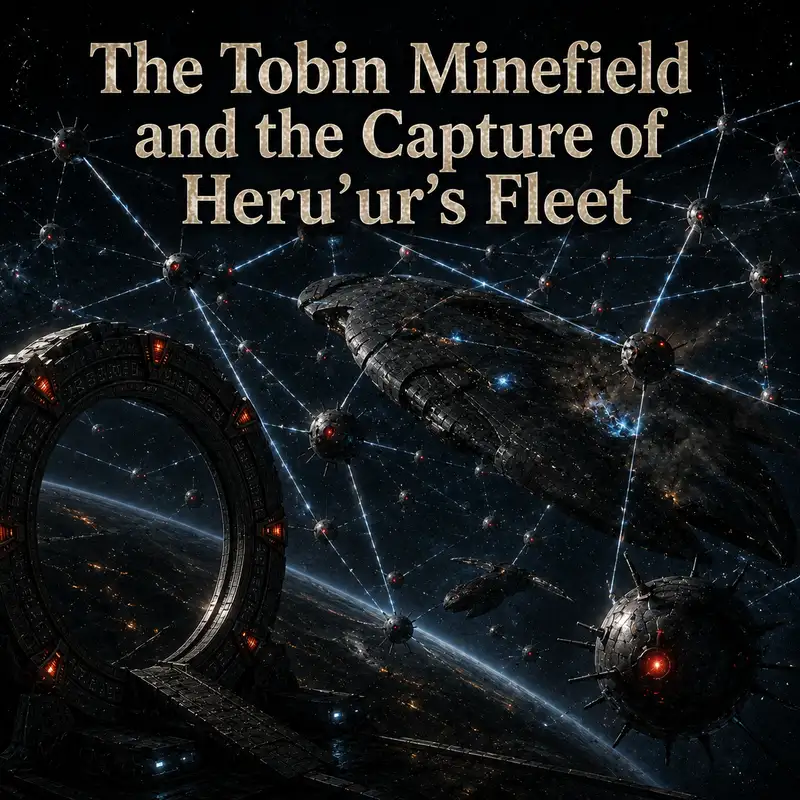
The Tobin Minefield and the Capture of Heru’ur’s Fleet
The Tobin mine entered the Tel’tak through a ring transporter and stopped in the cargo hold without touching the deck. That last detail was the difference between a covert operation and a very short after-action report. The mine’s inertial system continued trying to follow its original motion through space, forcing Jacob Carter to fly the cargo ship in exact sympathy with a weapon now hovering inside it. S G One had captured the device successfully. They still had to open it, translate it, reprogram it, and release it before it destroyed them.
The mine was never intended to kill Apophis. Its purpose was more ambitious. The Tok’ra wanted to manufacture an act of war between Apophis and Heru’ur, the two Goa’uld rulers commanding the largest armies of the period. A single explosion against Apophis’s ship was supposed to look like betrayal by Heru’ur. Apophis would withdraw, retaliate against Heru’ur’s worlds, and begin a prolonged conflict that weakened both sides. The device was tactical. The desired effect was strategic, political, and almost entirely psychological.
The operation became one of the clearest examples of a technically successful mission producing the worst possible strategic result. The team captured and reprogrammed the mine. The planted beacon worked. The alliance between the two System Lords collapsed. Heru’ur died. Yet Apophis did not enter the long war the Tok’ra had planned. He destroyed his rival immediately, then absorbed Heru’ur’s surviving forces. The minefield meant to preserve a divided Goa’uld order helped create the most powerful Goa’uld army then operating in the Milky Way.
Apophis had reached the Tobin system after an extraordinary recovery. Earth destroyed his original invasion force above the planet, and Sokar later captured and tortured him. Apophis survived, escaped Netu, and seized the armies Sokar had assembled for a campaign against six System Lords. He no longer commanded the diminished organization that had failed over Earth. He controlled a military structure large enough to alarm every rival and to make older assumptions about his capabilities dangerously obsolete.
Heru’ur represented the strongest available counterweight. He was aligned with the other System Lords against Apophis, but that alignment offered no guarantee of survival. Goa’uld coalitions formed around immediate danger and dissolved when the balance changed. Heru’ur therefore explored a private agreement with the enemy he was publicly helping to contain. His proposed terms were direct. He would support Apophis against the collective System Lords, retain his existing domain, and receive territory controlled by Cronus after victory. This was not a plan for shared government. It was an advance division of conquered property.
The Tok’ra learned of the meeting through Tanith, a Goa’uld double agent who believed he had penetrated their organization. Because the Tok’ra had already identified him, his channel could be watched and manipulated. The intercepted communication provided the time and place of the negotiations, but not the complete enemy order of battle. That gap became decisive. Intelligence had revealed what Apophis intended to discuss. It had not revealed what he intended to bring.
The chosen site was the Tobin system, where an extinct human civilization had left hundreds of thousands of autonomous mines around its world. The Tobin people had originated from Earth thousands of years earlier and developed technology independently before disappearing. Their defensive field survived them by centuries. The mines remained in constant motion, repositioned themselves with sophisticated inertial engines, and could home on several kinds of energy emission, including Goa’uld weapons fire. The civilization was gone. Its rules of engagement continued on automatic.
That persistence made the minefield useful as neutral territory. Neither System Lord needed to trust the other’s promises if opening fire would attract the surrounding weapons. The arrangement was deterrence without diplomacy, inspection, or law. It relied on both parties believing that aggression would produce unacceptable danger. The Tobin had built the field to protect a planet. Long after their extinction, Goa’uld rulers used it to protect a negotiation. Automated defenses are wonderfully impartial once the people who wrote the access policy are no longer available for questions.
The Tok’ra plan exploited that impartiality. Jacob and Selmak would take a cloaked Tel’tak into the field with Jack O’Neill, Samantha Carter, and Daniel Jackson. A Tok’ra operative aboard Apophis’s Ha’tak would activate a beacon broadcasting a selected energy signature. The team would capture one mine, erase its existing targeting frequencies, and program it to recognize only that beacon. Once released, the mine would identify Apophis’s ship as the source of hostile energy and detonate against it.
Every element depended on access that could not be replaced. Daniel was needed because the technical manual used symbols related to Phoenician writing. Carter was needed to translate the instructions into engineering action. Jacob and Selmak understood the Tok’ra plan, the cargo ship, and the Goa’uld political situation. O’Neill supplied mission command and an additional pilot when the work demanded Jacob’s attention. The operative aboard Apophis’s ship supplied the final signal. Losing any one part could leave the mine uncontrolled, the deception unconvincing, or the team trapped inside the field.
The Tel’tak had been modified before departure. A bulkhead was removed to create enough open space around the captured mine. That change was not comfort or convenience. If the device touched the ship, the crew expected it to detonate. Escape pods would have been irrelevant at that distance. The cargo hold became a moving work area around a live autonomous weapon whose operating principles were only partly understood. Earth and the Tok’ra possessed a manual, but possession of documentation is not the same thing as having a qualified maintenance section.
Jacob maneuvered among the mines and used the ring transporter to bring one aboard. The rings solved the first physical problem by moving the device without requiring a docking operation or external handling equipment. They did not cancel its motion. The mine continued responding to its own inertial system, so Jacob had to match the cargo ship’s movements to keep it centered in the hold. Nearby mines also had to be avoided. A collision outside could be as fatal as contact inside.
The mine’s control panel was located underneath the hovering device. Carter and Daniel had to work while lying beneath it, with little room to move and no reliable method for making the weapon safe. The Tok’ra had attempted a similar operation before. That operative had never returned. Jacob disclosed this after Carter had already begun looking for the access control, which was not the strongest moment in allied mission briefing. It did, however, clarify that the procedure was experimental rather than established Tok’ra capability.
The symbols inside the mine appeared to describe sensitivity to different frequencies. Daniel translated a sequence as three movements toward blue, four toward orange, and three toward blue. Carter entered it. The mine responded by activating a five-minute failsafe. The instructions were related to Phoenician notation, but the Tobin numerical system was not identical. Daniel had assumed that the sequence began with one because ancient Phoenician numbers had no zero. Carter recognized that technology of this sophistication would require the concept. Every value in the sequence was therefore displaced by one.
The corrected sequence was two toward blue, three toward orange, and two toward blue. It worked with seconds remaining. This was not Carter replacing archaeology with mathematics or Daniel rescuing engineering with translation. The solution required both. Daniel identified the language and the apparent instructions. Carter identified the mathematical assumption that made the translation operationally wrong. The mine did not care which discipline received credit. It only cared whether the correct control positions were entered before the timer expired.
The team then removed the mine’s other target sensitivities and entered the beacon frequency. The device was ringed back into space and left waiting for the Tok’ra operative. At that point, the technical operation had succeeded. S G One had captured a weapon from an active field, modified its targeting logic, and returned it without triggering the surrounding defenses. Earth did not gain a Tobin mine, a manufacturing process, or a repeatable weapons program. The only modified example was now committed to the deception.
While the team worked, Apophis and Heru’ur arrived in separate Ha’taks and began formal negotiations. Heru’ur argued that Apophis’s forces were powerful but insufficient to defeat all the System Lords without assistance. Apophis demanded compensation terms. Heru’ur requested Cronus’s territory and offered a personal gift to demonstrate loyalty. That gift was Teal’c, captured on Chulak while attempting to organize Jaffa resistance.
Teal’c’s presence changed the operation without changing its stated objective. The Tok’ra still needed to prevent the alliance, and operatives were already exposed aboard enemy ships. Jacob and Selmak argued that attempting a rescue could reveal the Tel’tak and sacrifice the larger mission. O’Neill and Carter understood the strategic argument. They also understood what Apophis would do to his former First Prime. Alliance warfare frequently becomes most uncomfortable when everyone agrees about the stakes and disagrees about who is expendable.
The team identified one possible extraction method. Heru’ur intended to transfer Teal’c to Apophis using ring transporters. The Tel’tak could decloak, enter the path between the two ships, and intercept the matter stream. Teal’c had used the same principle to recover personnel from Netu. This time, the maneuver failed. Jacob placed the cargo ship in the beam, but Teal’c did not materialize aboard. The attempt exposed an unidentified vessel inside the supposedly neutral meeting area and alerted Heru’ur that another actor was present.
The failed interception was caused by events the team could not see. Rak’nor, one of the Jaffa responsible for Teal’c’s capture, had watched him endure torture without renouncing his belief that the Goa’uld were false gods. When Terok tried to kill Teal’c before the transfer, Rak’nor turned on the Goa’uld. Terok was sent through the rings instead. Rak’nor moved Teal’c toward a death glider and prepared to escape Heru’ur’s ship. The rescue team missed because the person in the matter stream was no longer the person they were trying to recover.
The substitution created a second sign of betrayal at exactly the wrong moment for Heru’ur. Apophis had accepted the alliance and expected Teal’c as the ceremonial proof of loyalty. His guards received Terok instead. Then the Tok’ra operative activated the beacon, and the reprogrammed mine accelerated toward Apophis’s ship. It struck the Ha’tak and exploded. Heru’ur denied responsibility, but his denial now competed with a failed prisoner transfer, a detected cargo ship, and an apparent attack from the minefield.
From the Tok’ra perspective, this was the desired decision point. Apophis was supposed to interpret the mine as an ambush, withdraw, and begin attacking Heru’ur’s domain after leaving the system. The deception had been designed around his suspicion, pride, and existing hatred. It worked. Apophis believed he had been betrayed. The failure came from assuming that his only immediate response would be retreat.
Ten Ha’taks then decloaked around Apophis’s ship. Jacob and Selmak had believed the Goa’uld incapable of cloaking even one mothership. Apophis had brought an entire concealed force into the minefield. Whether he knew the details of the Tok’ra operation is not established. The available evidence does not require that conclusion. He may simply have expected treachery from Heru’ur and prepared an overwhelming response. In Goa’uld diplomacy, bringing ten invisible capital ships to a private meeting probably qualified as prudent scheduling.
The hidden fleet changed the engagement from an attempted provocation into an ambush. Heru’ur’s visible ship had no time to organize a wider battle or escape behind the minefield’s deterrent effect. Apophis ordered the attack. His ships fired, Heru’ur’s Ha’tak was destroyed, and the System Lord died with it. The surrounding mines created danger for the attackers, but Apophis’s fleet screened his damaged command ship and allowed him to withdraw. The surviving record does not establish how many of the ten Ha’taks were lost or damaged during that protection.
One death glider escaped Heru’ur’s ship before its destruction. The Tok’ra initially considered the possibility that Heru’ur had survived. The pilot answered Jacob’s challenge with a Tok’ra recognition phrase and identified himself as Rak’nor. Teal’c was aboard, alive but badly injured. The rescue objective had succeeded through a Jaffa defection rather than the team’s interception maneuver. The minefield operation gained a future rebel and recovered Teal’c, even as its strategic purpose collapsed around them.
Heru’ur’s fleet was not captured through boarding actions in the Tobin system. Only his command ship is shown being destroyed, and no detailed transfer ceremony or fleet surrender appears in the surviving record. The phrase capture of his fleet describes the political and military absorption that followed. With Heru’ur dead and no successor able to hold the organization together, Apophis was positioned to take control of the surviving ships, Jaffa formations, bases, and territory associated with his rival.
Goa’uld armed forces were personal instruments of rulers rather than national fleets with durable civilian institutions above them. Command authority flowed through the System Lord, subordinate Goa’uld, First Primes, and Jaffa officers. Once the ruler was killed, surviving commanders faced a practical decision. They could resist the largest army in the region without a recognized patron, submit to another System Lord, or attempt to seize part of the domain for themselves. Apophis possessed the force, prestige, and immediate proximity required to make submission the least fatal option.
Absorption did not necessarily mean every Jaffa became loyal in a single moment. Some officers may have resisted, fled, or shifted allegiance to other rulers. The screen continuity does not provide a ship-by-ship account. What it does establish is the strategic result. Apophis added Heru’ur’s forces to the army he had already taken from Sokar and became a greater threat than before the operation. The political decapitation of one Goa’uld strengthened another because the coalition had no plan to secure the defeated organization.
The capture therefore involved more than hulls. A fleet required trained Jaffa crews, navigation knowledge, maintenance personnel, supply access, command codes, staging locations, and worlds capable of supporting operations. A System Lord’s domain connected those elements through personal authority and fear. Apophis’s victory allowed him to claim that authority before rivals could dismantle the network. The exact administrative process remains unrecorded, but the strategic effect was similar to capturing an intact military institution after eliminating its senior commander.
This was the second time in a short period that Apophis benefited from an enemy’s destruction. Sokar’s fall gave him one great army. Heru’ur’s fall gave him another. Neither transfer resulted from Apophis defeating the full organization in a long campaign. He survived the removal of the ruler, reached the command structure quickly, and converted political vacancy into military power. His most important capability was not a weapon. It was his ability to inherit other people’s victories.
The Tok’ra had planned around a different model. They expected two independent organizations to survive the initial incident and spend their strength against one another. Their desired outcome required both rulers to remain alive, angry, and capable of sustaining war. Heru’ur’s immediate death removed one side of the equation. The same action that prevented alliance also prevented attrition. There was no Heru’ur left to command a countercampaign, rally his Jaffa, or deny Apophis the spoils.
The intelligence failure was narrow and devastating. The Tok’ra correctly assessed the rulers’ hostility, the danger of their alliance, and Apophis’s probable willingness to betray Heru’ur later. They successfully placed an operative aboard Apophis’s ship and intercepted the negotiations through Tanith. Yet they did not detect the cloaked reserve force. Intent was analyzed well. Capability was not. A plan that depended on the enemy retreating could not survive the discovery that he had already surrounded the meeting with ten hidden motherships.
The Tobin minefield also proved less controlling than it appeared. It discouraged ordinary weapons fire, but it did not prevent concealed movement, covert modification of a mine, ring transport between vessels, or a concentrated attack by a force prepared to accept the risk. The field was an environmental constraint, not a peacekeeping institution. It could punish energy signatures. It could not investigate responsibility, preserve a treaty, or decide who inherited a dead ruler’s army.
Technologically, the mission showed both the reach and the limits of Earth’s alliance with the Tok’ra. A small joint team manipulated a centuries-old automated weapon inside hostile space using a cloaked cargo ship and incomplete documentation. That was an impressive special operation. It did not give Stargate Command control of the minefield or the ability to reproduce Tobin technology. The weapon worked once, destroyed itself as intended, and left no operational stockpile. Successful improvisation remained a mission result, not a procurement program.
Politically, the outcome demonstrated the danger of using balance of power as the only measure of success. The Tok’ra preferred several competing System Lords to one dominant ruler because fragmentation created room for resistance. That calculation was strategically rational. It also meant attempting to start a war expected to kill Jaffa and devastate subject worlds under both domains. When the plan failed, those populations did not gain peace. They received a stronger Apophis with fewer rivals capable of restraining him.
At the individual level, the operation produced one result that Apophis could not absorb. Rak’nor had entered the crisis believing resistance caused only suffering and that Apophis’s survival proved divinity. Teal’c’s refusal to submit broke that belief. Rak’nor escaped with him and joined the rebellion. Apophis captured ships and Jaffa formations, but one Jaffa chose freedom in the middle of the victory. The contrast mattered because the Goa’uld system could transfer military property faster than it could repair lost faith.
The Tobin operation can therefore be judged four different ways. The mine was captured and reprogrammed successfully. Teal’c was recovered. The Apophis and Heru’ur alliance was prevented. The strategic mission still failed. Heru’ur’s immediate destruction spared Apophis the war intended to weaken him and opened the way for him to absorb another major force. Tactical success, rescue success, and political disruption combined into strategic defeat.
The mine did exactly what S G One programmed it to do. It found Apophis’s ship, exploded, and convinced him that Heru’ur had attacked. The error was not inside the weapon. It was inside the prediction of what would happen afterward. The Tok’ra treated the mine as the beginning of a long civil war. Apophis treated it as the justification for an ambush he had already prepared. In the Tobin system, an extinct civilization’s defenses stopped being neutral territory for a few decisive minutes, and Heru’ur’s fleet passed from one false god to another without ever being defeated as a fleet.