The Tollan–Goa’uld Crisis and the Fall of Tollana
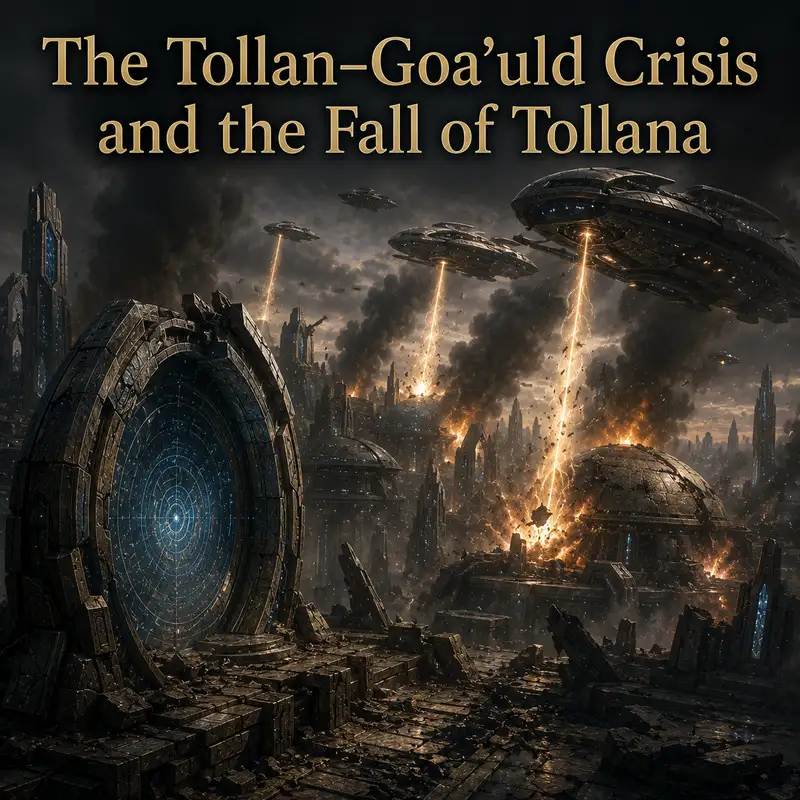
The Goa’uld mothership entered Tollana’s orbit, waited for the ion cannons to fire, and then did something more frightening than attack. It left. The weapons that had once destroyed Goa’uld capital ships struck shields they could not penetrate. The enemy had proven that Tollana’s principal defense was obsolete, demonstrated that fact to the government, and withdrawn before the public understood what had happened.
That was the opening move in the Tollan–Goa’uld crisis. The destruction of Tollana did not begin with a surprise bombardment. It began with a controlled demonstration intended to reshape political behavior. One ship, one failed defensive salvo, and one deliberate withdrawal were enough to turn an advanced neutral state into a coerced weapons supplier. The central question is not why Tollan technology failed. It is why the failure of one system caused the government, military defense, alliance network, and political order to fail together.
Tollana had been designed as a secure replacement for a lost homeworld. Its people had survived planetary catastrophe, rebuilt their institutions, constructed a Stargate where none had existed, and fielded technology far beyond Earth’s ability to reproduce. Their phase-shifting devices could pass through solid barriers. Their security systems could disable unauthorized weapons. Their medical implants monitored citizens continuously. Their ion cannons gave the planet a defense capable of destroying known Goa’uld motherships.
That defense had already shown one dangerous weakness. During the legal dispute over Skaara and the Goa’uld Klorel, Zipacna used the proceedings as cover to identify Tollan weapon sites. His Jaffa marked the cannons for destruction before the attack began. Tollana survived because Lya of the Nox concealed one cannon from the reconnaissance effort, allowing Teal’c to fire it after the others were neutralized. The event demonstrated that the defense grid could be defeated through infiltration even when its weapons remained technologically superior.
The Tollans did not respond by building a visible interstellar fleet or by entering a collective-defense alliance. The surviving record shows continued confidence in fixed planetary defenses, legal institutions, and political distance from less advanced societies. That policy had serious justification. Tollan technology had once been transferred to the people of Serita, who converted an energy system into weapons and destroyed their world. Earth officials later attempted to seize Tollan devices through a rogue National Intelligence Department operation. Caution was not paranoia when the evidence kept volunteering to support it.
The crisis became visible to Earth at the memorial for Omoc, one of the strongest defenders of the old nonproliferation policy. The gathering was small because Omoc had requested the attendance of people he respected rather than a large public ceremony. S G One had earned that distinction despite years of disagreement. Omoc’s manner had rarely suggested affection, but the invitation revealed that he had recognized the team’s actions on behalf of the Tollan people.
After the ceremony, Narim secretly passed Samantha Carter a holographic message. Omoc had warned him before dying that Earth was in grave danger. Narim did not know the full reason, and he did not know whom he could trust. The message converted a diplomatic visit into an intelligence problem. Omoc’s death, a sudden policy change, and a warning directed at Earth were now part of the same unexplained pattern.
High Chancellor Travell then announced that the Curia was reconsidering its traditional refusal to share technology. Tollana needed trinium, she explained, because population growth had depleted local supplies. In exchange, the government would provide Earth with an ion cannon. The explanation was plausible. Trinium was important to several Tollan systems, and Earth had access to an off-world source. The offer was still extraordinary because it reversed a policy the Tollans had defended through law, diplomacy, and considerable irritation.
Stargate Command responded by increasing the request. Earth planners calculated that a planetary defense network would require thirty-eight ion cannons rather than one. Travell accepted a phased exchange as trinium deliveries arrived. That willingness became a stronger warning than a refusal would have been. A state does not normally surrender dozens of its most important weapons unless the weapons have lost value, the state is under pressure, or the proposed trade conceals another purpose.
The temptation to accept was enormous. Earth still lacked a reliable fleet capable of defeating a major Goa’uld assault in orbit. A Tollan defense grid could provide the kind of planetary protection Stargate Command had spent years seeking. General Hammond therefore had to balance an extraordinary opportunity against the possibility that the opportunity was bait. O’Neill’s suspicion, usually a difficult quality at a diplomatic reception, became useful professional equipment.
Narim supplied the first evidence that the crisis involved internal wrongdoing. Every Tollan carried a health implant linked to a central monitoring network. When a serious medical condition appeared, health officers were dispatched automatically. Omoc’s records showed no obvious chronic weakness before his reported heart attack. More important, the emergency response took more than twice the normal maximum time. In a system designed to be immediate, the delay looked less like chance than interference.
The political motive was equally clear. The Curia had been divided over whether to relax isolationist policy. Omoc strongly supported the old position. His death changed the voting balance in favor of those willing to trade. Narim suspected murder, although the surviving evidence never provides a complete forensic account or formal confession. Travell’s later defense of the Curia strongly implies that extraordinary measures were taken. What exactly happened to Omoc remains unresolved. Why his death mattered does not.
Investigating the Curia placed Narim in an impossible position. He had warned Earth, but warning an ally was not the same as breaking into government records. Tollan society treated public trust as an organizing principle, and unauthorized access to Curia systems amounted to treason. O’Neill and Teal’c approached the problem as an intelligence mission. Narim experienced it as the possible collapse of the civic order on which his entire society depended.
The team divided its effort. Carter, Daniel Jackson, and Narim used Omoc’s access credentials to search restricted government records. O’Neill and Teal’c followed the trinium shipments using Tollan phase-shift devices. The operation had no formal authorization from the host government, limited extraction planning, and depended on technology borrowed from the people being investigated. It was not an ideal liaison mission. It was, however, better than accepting thirty-eight unexplained weapons and asking questions after installation.
The records showed an unscheduled ion-cannon test several months earlier and a formal protest from Omoc. Narim remembered that Omoc had returned angry from the relevant Curia meeting, yet the public record ended hours before he arrived home. Two hours of government activity had been removed. In a political system that regarded official deception as a profound offense, missing records were not routine administrative untidiness. They were evidence that the Curia was concealing an event large enough to justify corrupting its own archive.
A private communication revealed the event. A Goa’uld mothership had entered orbit. Tollana’s ion cannons had fired in defense and failed. The ship then withdrew peacefully. That last detail made the incident more alarming. An attacker able to defeat the defenses had no military reason to leave unless conquest was not yet the objective. Carter recognized that the ship had not come to fight. It had come to prove that resistance was no longer credible.
This was coercive diplomacy conducted through a live-fire demonstration. The Goa’uld did not need to destroy a city, occupy the Stargate, or land Jaffa. They needed the Curia to understand that the next visit could be different. By leaving, the mothership preserved Tollan infrastructure, gave the government time to deliberate, and made every later decision appear voluntary enough to obscure the threat behind it. Fear was cheaper than bombardment, and it kept the factories intact.
The trinium led O’Neill and Teal’c to a hidden production facility. Inside were devices unlike the known Tollan weapons. Narim identified them as explosives of extraordinary power housed in systems that generated phase-shift effects. Trinium was required to contain the mechanism. Once activated, the weapons could pass through solid matter before detonating. The technology that had allowed Narim to walk through Earth’s closed iris had been scaled into a strategic weapon.
Narim initially tried to interpret the devices as replacements for the failed ion cannons. The explanation would have preserved the legitimacy of the Curia and placed the project within planetary defense. Carter rejected it. A Goa’uld commander would not reveal improved shields, withdraw, and then politely allow Tollana time to build a countermeasure. The production schedule made sense only if the Goa’uld wanted the weapons and had left Tollana alive to manufacture them.
Tanith confirmed the assessment. He had survived the destruction of Apophis’s fleet and entered the service of a more powerful master whose name he refused to reveal. At the time, Stargate Command did not know who that master was. Later events identify him as Anubis, a returning Goa’uld whose access to advanced knowledge was already changing the balance among the System Lords. Tollana became one of the first places where that change was demonstrated in operational terms.
The Curia had accepted a bargain. Tollana would manufacture phase-shifting weapons for the Goa’uld, and the attacking force would postpone planetary destruction. Travell described the decision as necessary to preserve her people. That explanation cannot be dismissed. The ion cannons had failed, the enemy controlled orbit, and no allied fleet stood ready to intervene. The government faced an immediate threat to an entire civilian population.
The bargain was still collaboration under coercion. It transferred Tollan scientific skill into an imperial weapons program and concealed the project from the people whose survival supposedly justified it. The Curia also appears to have removed Omoc because he opposed the policy. Emergency necessity may explain why officials believed the bargain unavoidable. It does not erase murder, deception, or the decision to produce weapons intended for use against other worlds.
Tanith then changed the terms. Before accepting delivery, he demanded a live demonstration. One weapon would be activated and sent through the Stargate to Earth. The Curia had thirty minutes. Travell had apparently expected to manufacture weapons without personally selecting the first victim. Tanith removed that comfort. The coerced supplier would now become the visible attacker and prove that the technology worked against a real protected target.
Earth’s status under the Protected Planets Treaty made it an ideal test. A direct Goa’uld attack risked Asgard retaliation. A device sent by Tollana created distance between the System Lord and the act. The weapon could pass through the iris, the physical barrier that normally destroyed incoming matter before it could rematerialize. The same design therefore bypassed both Earth’s principal gate defense and the diplomatic deterrent surrounding the planet.
The exact explosive yield was never established publicly, and there is no need to inflate it. A phase-shifting weapon detonating inside Stargate Command could destroy the gate complex, kill the command personnel present, and create consequences extending well beyond the mountain. More important, successful delivery would prove that fortified installations, buried facilities, and defensive barriers could be penetrated by similar weapons. The first attack on Earth was also a demonstration for every later target.
The thirty-minute deadline compressed ethics into operations. Travell argued that she had no choice. Carter rejected that claim because another choice existed, even if it endangered Tollana. Narim also hesitated once the consequences became immediate. He had condemned the Curia for accepting the bargain, but destroying the weapons meant inviting the attack the government had been trying to prevent. Moral certainty becomes more difficult when the lives at risk belong to one’s own neighbors.
O’Neill framed the decision in strategic terms. Preserving Tollana by providing the Goa’uld with phase-shifting weapons would not save only one world at the expense of Earth. It would create an arsenal capable of threatening additional planets. The bargain had no stable endpoint. Each delivery would strengthen the power holding Tollana hostage and reduce the chance that resistance would ever become possible. Compliance purchased time by making the coercing force more dangerous.
Narim escaped custody using phase technology and joined O’Neill and Teal’c. The team developed a simple deception. Tollan security planned to locate Narim through his medical implant. O’Neill carried the implant instead, drawing security personnel toward the attempted sabotage of the weapons. While the authorities followed the signal, Narim moved freely to an ion cannon and targeted the production facility.
The cannon strike destroyed the known stockpile and prevented the immediate attack on Earth. It also removed the object of the bargain. Whether every phase-shifting device was destroyed could not be proven, but the principal production site was lost before Tanith received the weapons. Tactically, the operation succeeded. Earth remained safe, and the Goa’uld were denied a major new capability.
Operationally, the strike initiated the final battle for Tollana. The Goa’uld no longer had a reason to preserve the planet’s government or industrial base. Explosions began before S G One reached the Stargate. Narim directed the team toward extraction and refused to leave. He believed his actions had brought his people into a war they might lose and considered it his duty to remain with them.
His decision was personal, political, and military. Narim had no command authority over the planetary defense, but he had knowledge of the conspiracy and had fired the weapon that ended compliance. Remaining allowed him to assist the defense or evacuation and prevented him from surviving as a witness while others paid the cost. It also meant giving up the one secure route available through Earth’s gate. Courage did not improve the strategic situation. It determined who would face it.
S G One escaped before the Stargate was destroyed. Earth had no interstellar fleet capable of reaching Tollana in time, contesting Goa’uld control of orbit, and evacuating a population under fire. The gate had been the only rapid line of communication and movement. Once it was lost, Tollana became isolated behind enemy space superiority. Strategic mobility disappeared at the exact moment it was most necessary.
Narim’s final long-range transmission reached Stargate Command through heavy interference. He reported that the Stargate was gone, all defenses were failing, and ships attempting to escape were being shot down. The message ended before he could complete his final statement. The surviving record suggests that at least some people may have escaped, but no confirmed number, destination, or organized Tollan government reappeared.
It is therefore more accurate to describe the fall of Tollana than the proven extinction of every Tollan. The planet’s state, defensive system, Curia, and visible civilian order were destroyed or dispersed. Narim’s survival was never confirmed. Travell’s fate is unknown. Isolated individuals or evacuation craft may have survived. What did not survive was Tollana as the advanced neutral power Earth had known.
The immediate military cause was the defeat of the ion cannons by improved shields. The deeper cause was dependence on a single defensive concept. Tollana had multiple cannons, but they shared the same underlying effect and the same assumption about enemy shields. Redundancy in weapon count did not create redundancy in capability. When one mothership invalidated the technology, the entire planetary defense architecture lost credibility at once.
The crisis also exposed the limits of fixed defenses. Ion cannons could deny orbit to known Goa’uld vessels, but they could not gather intelligence across enemy territory, escort evacuation ships, strike production centers beyond Tollana, or create strategic depth. No Tollan fleet appears capable of forcing the attacker away after the cannons failed. A fortress can be formidable while its weapons work. When they do not, every road leading away from the fortress becomes more important than the wall.
Counterintelligence failed beside deterrence. The Curia concealed the shield demonstration, erased public records, monitored dissent, and redirected the economy toward a secret weapons program. Those actions protected the bargain from public opposition but also prevented broader analysis and contingency planning. Information that should have triggered alliance consultations became compartmented inside the government. Secrecy preserved political control while reducing the number of people who could help solve the strategic problem.
The alliance structure offered no recovery mechanism. Earth and Tollana had diplomatic relations, but no standing mutual-defense commitment, joint command arrangement, shared early-warning network, or evacuation plan. The Nox had helped the Tollans relocate before, but their pacifism made a conventional intervention unlikely. The Asgard were occupied by the Replicator war and had not guaranteed Tollana’s defense. Friendship existed. Military integration did not.
Travell and Narim represented the final political divide. Travell accepted collaboration to preserve the population in the immediate term. Narim accepted resistance even though it exposed that population to attack. Neither possessed a solution capable of defeating the enemy. Travell’s policy sacrificed other worlds and strengthened the Goa’uld. Narim’s decision preserved moral and strategic resistance but helped bring the threatened destruction forward. The tragedy was that earlier policy had left only those choices available.
Earth learned several lessons at Tollana. An offer of advanced technology could be a warning rather than a gift. An ally’s secrecy might conceal coercion rather than betrayal for profit. The iris could not be treated as absolute protection against every form of matter transmission. Most important, planetary defense required more than a powerful weapon. It required intelligence, alliances, mobile forces, redundant systems, and a government able to confront bad news without falsifying its own records.
The unidentified master behind Tanith was the larger intelligence consequence. His shields had defeated the weapon that made Tollana secure and gave him leverage over a civilization the established System Lords had avoided attacking directly. Later, Anubis would challenge other technologies once considered decisive. Tollana was not an isolated anomaly. It was an early demonstration that the strategic environment had changed before most of the galaxy knew who had changed it.
The Tollan–Goa’uld crisis ended with a tactical victory for S G One and a strategic catastrophe for Tollana. The phase weapons were denied to the enemy, Earth survived, and the conspiracy was exposed. None of those successes restored the ion cannons, created an evacuation fleet, or returned legitimacy to the Curia. The mission achieved its immediate objective while the allied state around it collapsed.
The final image is not an ion cannon firing or a Goa’uld mothership descending. It is a damaged transmission crossing space after the Stargate had already been destroyed. Narim reported defenses failing and escape ships being shot down, then disappeared into static. Tollana fell because technological superiority had been concentrated into one brittle deterrent, neutrality had produced too little strategic depth, and a frightened government tried to purchase survival from an enemy whose price could only increase.