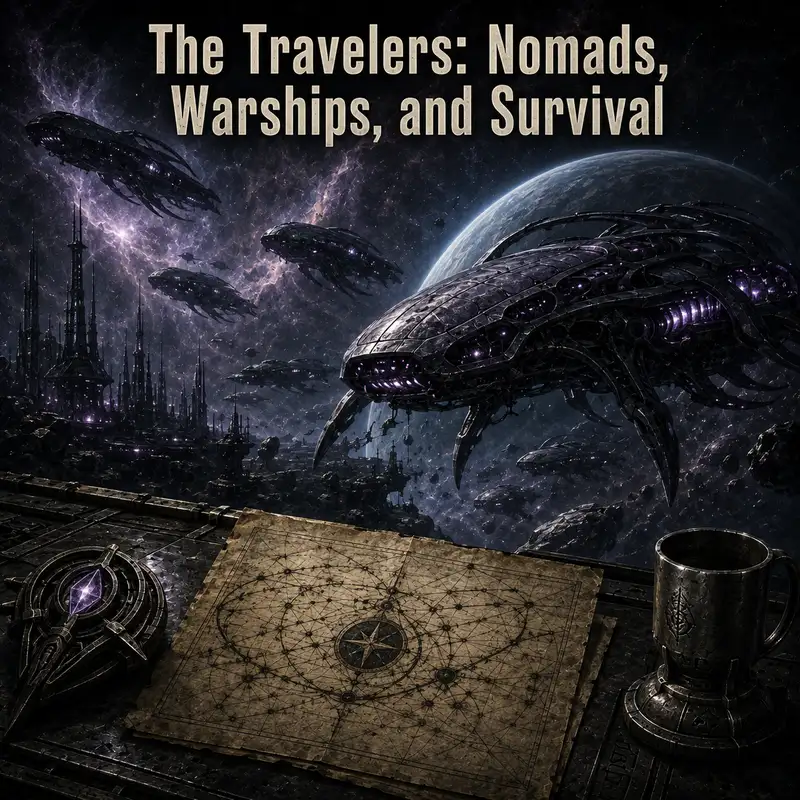
The Travelers: Nomads, Warships, and Survival
For a hundred generations, the Travelers had avoided permanent settlement. When they finally built a new colony on a planet, an active Stargate exploded and erased it from orbit. Three thousand people died. Two ships were lost, including the Ancient battleship that had apparently become the most powerful vessel in their fleet. The destruction was not a Wraith culling, and the colony had not been located through ordinary reconnaissance. It was collateral damage from a weapon activated somewhere else in Pegasus. For a civilization founded on the belief that survival required constant movement, the lesson could hardly have been more severe.
The Travelers were one of the clearest examples of strategic adaptation in the Pegasus galaxy. They had neither the numbers of the Wraith nor the inherited infrastructure of Atlantis. They survived by turning their civilization into a fleet. Their ships were homes, military platforms, schools, workshops, and political communities moving between worlds that could provide trade or supplies. This arrangement denied the Wraith the fixed population center their culling system expected. It also meant that every mechanical failure threatened civilians, every battle risked irreplaceable living space, and every attempt to stop moving concentrated dangers the Travelers had spent generations learning to evade.
Their nomadism appears to have begun as a response to the Wraith, but it did not remain merely an emergency measure. Larrin explained that her people landed when they needed supplies or trade and spent the rest of their lives in space. By the time Atlantis encountered them, movement had become identity. Planet-bound communities looked to many Travelers like herds waiting to be found. That judgment was harsh, but it came from a long historical experience. The Wraith could return to a known world, study its recovery, and cull it again. A fleet that changed systems, routes, and trading partners was a far more complicated target.
Life aboard the fleet imposed logistical costs that were visible even during a short captivity. Fresh food was uncommon. The preserved meals provided every required nutrient, which is a medically respectable achievement and not the same thing as lunch anyone would volunteer to repeat. Ships had to recycle air and water, manage waste, provide medical care, educate children, and maintain propulsion while remaining ready to move. The surviving record does not establish the size of the fleet or its total population. It does establish that a single additional ship capable of housing one thousand people was considered a major strategic prize.
Trade connected the Travelers to the wider human economy of Pegasus. They visited planets for supplies and exchanged goods with communities that knew them well enough to maintain continuing relationships. This made them less isolated than their name suggested. They could obtain food, materials, information, and perhaps components their own ships could not produce. It also created exposure. Trade routes could be watched, partners could be destroyed, and rumors could reveal new technologies. The Travelers survived by remaining difficult to locate, not by disappearing from the galaxy. Their fleet depended on contact while carefully controlling how much outsiders learned from it.
Maintenance culture was therefore as important as weapons. Traveler ships showed layers of modification, exposed machinery, improvised wiring, and systems kept operational by people who had learned them from childhood. Katana Labrea’s chief engineer, Mila, was fifteen and had worked on ships since the age of four. That does not prove every Traveler child entered technical service so young. It does show how knowledge was reproduced inside a society without relying on a fixed academy or industrial city to absorb the burden. A shipboard civilization could not wait until adulthood to explain which cable kept the atmosphere on the correct side of the hull.
Their political structure reflected the same preference for distribution. A governing council could approve major policy, but individual ship captains retained authority over whether their vessels joined a military operation. Larrin was a commander and influential representative, not an absolute ruler of every Traveler ship. This arrangement protected the fleet from a single disastrous decision and made political decapitation more difficult. It also complicated coalition warfare. Atlantis could persuade Larrin and still lack the ships it needed. The council could endorse a campaign and still depend on captains whose first obligation was to the families and crews living inside their commands.
The Travelers also maintained a serious intelligence capability. After hearing reports of humans using Ancient technology against the Wraith, they placed spy satellites around dozens of worlds with space gates. The network was designed to find Atlantis personnel without revealing Traveler bases or fleet routes. When John Sheppard flew alone toward one of those gates, a Traveler vessel intercepted his Puddle Jumper, disabled it, and carried both pilot and craft away before Atlantis could respond. The operation combined signals collection, long-term surveillance, rapid interception, and a willingness to exploit the first suitable target.
Sheppard’s capture showed that Traveler survival did not produce gentle diplomacy. Silas beat him during interrogation. Nevik took a blood sample. Larrin threatened to expose him to vacuum and made clear that cooperation was not optional. She already knew he carried the genetic trait required to activate many Lantean systems. Her scientists were developing an interface that used the necessary genetic material, and they wanted initialized Ancient technology to reverse-engineer the process. The Travelers had found a strategic opportunity, but they lacked the biological access needed to use it. Sheppard was both prisoner and missing component.
The opportunity was a derelict Lantean warship of the design Atlantis called the Aurora class. Its logs revealed why the original crew had abandoned it. Wraith attack had damaged the engines, communications, and shields. The ship escaped into hyperspace, only for the main drive to begin releasing lethal radiation. The crew left the vessel rather than die inside it. Thousands of years later, the warship remained powerful enough to alter the Travelers’ future and dangerous enough to remind everyone that advanced technology can retain both capability and failure long after the instruction manual has become archaeology.
For the Travelers, the ship offered more than firepower. It had shields, drones, a hyperdrive, large internal spaces, and the capacity to house roughly one thousand men, women, and children. A functioning Ancient battleship could protect weaker vessels, escort trade, deter limited Wraith attacks, and provide living space without requiring a surface colony. It could also become a fleet flagship and a political symbol. The challenge was control. Traveler technicians had spent two months trying to activate its systems. Without a compatible operator, the finest warship in their possession was an extremely large object they could tow, study, and admire.
Sheppard activated the command chair and began moving the vessel while Nevik recorded the control inputs. The test revealed the gap between possessing Ancient equipment and understanding its operation. Nevik asked Sheppard to move the ship before initializing the inertial dampeners. Sheppard did exactly what he had been told, throwing the standing Travelers across the bridge and creating an opportunity to seize their weapons. The event was partly deliberate mischief and partly a practical demonstration. Familiarity with hyperdrives and shields did not automatically provide the procedural knowledge needed to operate a Lantean warship safely.
Sheppard escaped with the Ancient vessel but could not return directly to Atlantis. Larrin threatened to let radiation flood the bridge where her own people were held, forcing him to stop. He disabled propulsion and navigation before surrendering control, leaving the Travelers stranded until they could repair what he had shut down. Then his attempt to contact Atlantis exposed the warship to the Wraith. The entire sequence was an intelligence contest conducted through machinery. Each side concealed information, created technical leverage, and discovered that control of one system did not mean control of the ship.
The Wraith vessel that answered the signal immediately tested the value of the salvage. Its fire reduced the Ancient ship’s already weakened shields. A direct strike killed Nevik and Silas on the bridge. Sheppard restored power to the command chair and used drones to destroy the attacking ship, but additional Wraith boarders remained inside the vessel. He and Larrin then cooperated because neither could survive alone. The prisoner had the gene and combat experience. The commander knew the ship’s damaged systems and the location of her people. Their alliance began not with trust, but with the narrower military virtue of having no useful alternative.
Three Traveler ships eventually located them. Their crews had monitored communications, predicted that Sheppard would try to reach a space gate, and deployed probes around nearby gates until one detected the Ancient ship’s energy signature. This recovery demonstrated why the fleet had survived for so long. The Travelers did not depend on a single commander’s plan. Other captains analyzed the likely movement of a captured vessel and built a search pattern from limited evidence. Their sensor network, probes, and distributed ships gave them options even after the original mission had broken down and its senior technical personnel were dead.
Sheppard argued that one additional warship would only delay a slow decline. The Wraith were under pressure from the Asurans, and the resulting conflict offered a rare chance for advanced human forces to influence the balance of power. The Travelers had hyperdrives, weapons, intelligence networks, and crews accustomed to independent action. Atlantis had access to Ancient systems, Earth support, and a reason to oppose both enemies. Hiding had preserved the fleet, but it could not guarantee that the Wraith, Asurans, or another power would never locate its routes. Survival by avoidance had reached diminishing returns.
Larrin released Sheppard and kept the Ancient ship. That decision was neither surrender nor sudden friendship. She had obtained the capability her people needed and accepted that future cooperation might be more valuable than one captive operator. Atlantis did not receive permanent access to the vessel, and the Travelers did not reveal the fleet’s bases or routes. Their first agreement was an informal strategic understanding between partners who had kidnapped, threatened, deceived, and saved one another within the same operation. Pegasus diplomacy often moved quickly because the alternatives tended to arrive with hive ships.
The alliance became operational when the Asurans began destroying human settlements to deprive the Wraith of food. One of the Travelers’ trading partners was not culled but leveled, alerting Larrin that a different enemy was attacking human worlds. When her ship detected seven hive ships gathered around one planet, she stopped to collect intelligence and encountered Sheppard again. Atlantis needed additional vessels to prevent the Asuran fleet from escaping while Rodney McKay’s plan drew the Replicator nanites back toward their homeworld. The Travelers now faced a threat that mobility alone could not solve.
Larrin agreed to seek support, but she could not simply order the entire fleet into battle. The governing council had to consider the plan, and each captain would decide whether to participate. Fighting beside Wraith hives was especially unpopular. The same predators who had forced the Travelers into space were now proposed as temporary allies. Larrin nonetheless secured several vessels, including the recovered Ancient battleship. Atlantis scientists helped make it combat-ready, and Sheppard took the drone-control chair because Traveler operators still could not use that weapon as effectively as a natural carrier of the Ancient gene.
At Asuras, the Travelers joined Earth warships and Wraith hives against a larger Asuran fleet. Their role was operationally specific. They helped hold the enemy ships in orbit long enough for McKay’s plan to affect the nanites aboard them. One Traveler vessel was destroyed. The Ancient battleship used drones to stop an Asuran ship that was powering its hyperdrive, while placing the recovered vessel under heavy fire. The Travelers did not win the battle alone. Their ships provided the additional mass the coalition needed to prevent an incomplete victory.
The political significance was as important as the tactical result. A civilization built on dispersed, independent ships had committed part of its fleet to a combined operation with two powers it had reason to distrust. The Wraith alliance ended as soon as Asuras was destroyed. The relationship with Atlantis lasted longer because each side had capabilities the other lacked. The Travelers brought mobility, regional intelligence, and experienced crews. Atlantis brought Ancient access, specialized scientists, and connections to Earth’s growing fleet. Cooperation worked because it remained limited. Neither side had to place its survival entirely under the other’s command.
The fleet’s next major decision appeared to challenge that doctrine. For the first time in a hundred generations, the Travelers established a surface colony. The reasons are not stated in full, but the pressure is easy to see. Permanent settlement offered agriculture, living space, stable institutions, and relief from generations spent maintaining aging hulls. It could support children and civilians without requiring every corridor to serve both domestic and military functions. The recovered Ancient vessel and the alliance with Atlantis may also have made limited territorial security appear more realistic than it had been before.
The colony was destroyed when the Attero device was activated by the Pegasus Asgard exiles. The device disrupted Wraith hyperdrives, but its radiation destabilized active Stargates across the galaxy. When the colony’s gate was used, it overloaded and exploded with enough force to be seen from orbit. Three thousand Travelers and two ships died, including the Aurora class vessel. The attackers had not selected the colony as a target. That distinction offered no comfort. A civilization that avoided planets to escape deliberate culling had lost its first settlement to the side effect of somebody else’s strategic weapon.
Katana Labrea arrived at Atlantis seeking an explanation because Stargates were exploding. Larrin could not come herself while the Travelers dealt with the disaster. Katana’s appearance showed that the alliance with Atlantis had developed practical value. Atlantis had lost its own gate and could not reach Rodney McKay and Daniel Jackson, who were being held near the Attero device. Katana supplied the ship. Atlantis supplied coordinates, scientific support, and personnel. The Travelers had just suffered catastrophic losses, yet they still committed a vessel to stop the device responsible. Retaliation and collective survival pointed in the same direction.
Katana’s ship revealed the difference between appearance and capability in the Traveler fleet. Its engineering compartment was crowded with cables, machinery, and decades of modification. Radek Zelenka regarded the arrangement with understandable concern. Mila regarded it as normal. The vessel could outrun most ships in the fleet, and its crew knew how to push the hyperdrive beyond conservative limits. The Travelers had not preserved an untouched technological inheritance. They had preserved function through adaptation. Their ships survived because engineers treated every system as something that might have to be repaired with limited parts while already underway.
That ship reached the Attero facility ahead of the Wraith and fought the Asgard exiles in orbit. When the stolen Daedalus was locked onto a collision course with the planet, Sheppard used the Traveler vessel to open a hyperspace window large enough for both ships. They entered just before impact and emerged on the far side of the planet. The maneuver depended on Katana’s trust, Mila’s hyperdrive work, Zelenka’s assistance, and a ship capable of precision under damage. The Travelers then destroyed an enemy vessel and fired on the Attero facility after McKay shut the device down.
The operation displayed the strengths of Traveler warfare. Their ships could arrive without relying on a Stargate, conduct independent reconnaissance, accelerate rapidly, fight in space, and improvise with crews who understood their vessels intimately. Political decentralization let captains respond when communications with the wider fleet were difficult. Mobility protected the population from fixed-pattern culling and allowed the Travelers to appear where neither the Wraith nor Atlantis expected them. Their technology was not as advanced as fully functioning Lantean systems, but it was integrated into daily life and maintained by the people who depended on it.
The weaknesses were equally severe. The surviving record does not show that the Travelers could manufacture large warships at the rate they lost them. Every vessel combined military capability with civilian shelter, so battle damage reduced both fleet strength and population security. Trade created supply opportunities but also intelligence trails. Decentralized command protected autonomy but limited rapid concentration. A permanent colony offered strategic depth and industry, yet created a fixed target. An Ancient battleship increased combat power, but depended on rare biological access, scarce drones, specialized repairs, and systems its new owners did not fully understand.
Nomadism also shaped the people inside the hulls. Children grew up knowing machinery, emergency procedures, and movement as ordinary life. Captains commanded communities, not crews that could simply disembark after deployment. A failed engine threatened grandparents and technicians as surely as weapons officers. This helps explain the Travelers’ suspicion, their aggressive protection of information, and their reluctance to surrender a useful person or ship. Their methods could be coercive and sometimes brutal. They were also the methods of a society in which one disclosed route or failed shield might expose several generations at once.
The decision to build another settlement after the Attero disaster is therefore important. Katana did not say the Travelers would abandon the idea of living on a planet. She expected them to begin again. The fleet had learned that mobility could preserve life, but not necessarily create a future people wanted indefinitely. A civilization can survive by remaining ready to flee and still decide that survival alone is insufficient. The Travelers were trying to move from evasion toward a balance of settlement, alliance, and mobile defense. The destruction of the first colony made that transition more costly. It did not make it irrational.
That was the contradiction defining the Travelers. Movement kept them alive, but every major step beyond mere survival required them to stop hiding, concentrate force, trust outsiders, or place people on the ground. The Ancient battleship gave them power and was lost beside their first colony. The alliance with Atlantis gave them support and exposed them to wider wars. Their ships let them escape the Wraith, yet could not carry an unlimited civilization forever. The Travelers’ achievement was not finding perfect safety. It was preserving enough people, knowledge, and freedom to keep choosing where the next home might be.