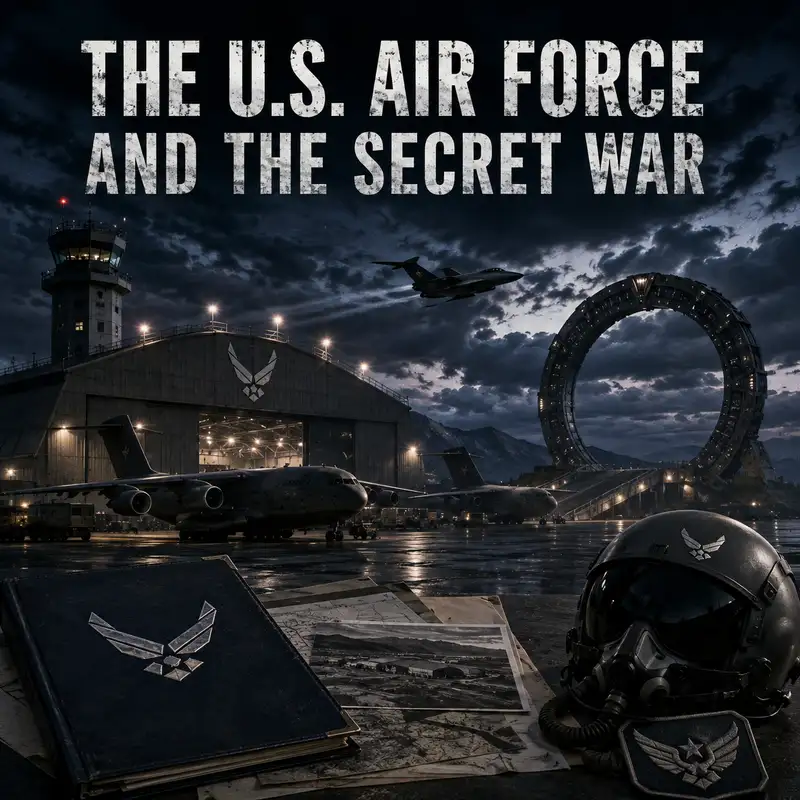
The U.S. Air Force and the Secret War
The first shots of Earth’s second war against the Goa’uld were fired inside a United States Air Force facility whose personnel had been told the danger was over. The Stargate activated without warning beneath Cheyenne Mountain. Armed Jaffa came through, killed the guards, and carried one airman back through the wormhole. General George Hammond had inherited what appeared to be a dormant research site scheduled for closure. Within minutes, it had become the only known invasion route onto the planet and the forward headquarters of a war the American public did not know existed.
That contradiction defined the United States Air Force’s role in the Stargate Program. It was expected to defend Earth from an interstellar enemy while hiding the existence of the battlefield, the enemy, the allies, the casualties, and most of the weapons being developed for the fight. The Air Force did not merely guard a machine. It became the military institution that turned the Stargate from an archaeological discovery into a functioning system of reconnaissance, diplomacy, intelligence collection, special operations, technological acquisition, and planetary defense.
The choice of the Air Force was partly deliberate and partly the result of custody. The Stargate had been moved from Egypt into the American national-security system, studied under extreme classification, and installed in a hardened underground complex. The first modern expedition to Abydos had already been organized as a military operation under General West, with Colonel Jack O’Neill commanding the field element. When the program was reactivated after Apophis’s raid, Hammond replaced West, O’Neill returned to active duty, and the existing chain of command remained in place.
A Stargate is not an aircraft, and traveling through one is not an air operation in the normal sense. The Air Force nevertheless offered the closest institutional match available. It already managed strategic warning, aerospace defense, long-range strike systems, nuclear command relationships, advanced research programs, and highly classified facilities. It understood how to combine operators, scientists, intelligence personnel, engineers, and security forces under one commander. No service had doctrine for a doorway connecting Earth to thousands of inhabited worlds. The Air Force at least possessed a bureaucracy accustomed to being told that an impossible technical problem had become an urgent operational requirement.
The President authorized nine SG teams, known only at the highest levels of the executive branch and the Joint Chiefs. That authorization was not a declaration of war, a public treaty, or a normal military deployment. It was a classified order creating a force whose missions could affect the survival of the planet without passing through ordinary public debate. Stargate Command was buried physically beneath a mountain and politically inside the most restricted compartments of the government. The arrangement gave Hammond extraordinary responsibility and remarkably little room for error.
The early command was small enough that one general could know the principal teams, review the mission reports, approve deployments, and stand in the control room when they returned. The structure was recognizably military. Hammond commanded the installation. O’Neill led S G One. Other SG teams specialized in combat, science, engineering, archaeology, diplomacy, and medical support. Air Force personnel formed the institutional core, while Marine teams provided heavier ground-combat capability and civilian experts supplied knowledge no conventional military staff possessed.
S G One itself showed why the command could not operate as a purely military unit. O’Neill brought special-operations experience and field command. Samantha Carter was both an Air Force officer and a theoretical astrophysicist. Daniel Jackson was a civilian archaeologist and linguist whose work made routine gate travel possible. Teal’c was a former First Prime of Apophis who carried intelligence about the enemy that no Earth agency could have collected. The flagship team was therefore military, scientific, diplomatic, and intelligence-oriented at the same time. Its composition was irregular because the war was irregular.
Most missions began with procedures that looked less dramatic than the consequences they were meant to prevent. A mobile analytic laboratory probe went through first. Sensors checked atmosphere, temperature, radiation, terrain, and signs of habitation. Radio contact was established when possible. Security forces covered the gate room. Identification codes controlled whether the iris opened for a returning team. Medical personnel prepared for injuries and contamination. These routines were Air Force discipline applied to a transportation system whose failure modes included hostile invasion, biological infection, time distortion, and the occasional object that should not have been brought home.
The Stargate gave Earth almost instantaneous strategic mobility, but it did not eliminate logistics. A team could cross the galaxy in seconds and still be trapped because the local dial-home device was damaged, the enemy controlled the gate, or the extraction route had become a firing position. Ammunition, batteries, medical supplies, food, explosives, and replacement equipment still had to fit through the gate and be carried on the far side. The Air Force learned that a four-person team could change the politics of a world, but it could not occupy one without local allies, reinforcements, and a plan for getting home.
Secrecy initially served several defensible purposes. Earth had no fleet, no planetary shield, and little understanding of the Goa’uld. Public knowledge of an alien empire capable of reaching Earth might have produced panic, political instability, or demands for military action that the United States could not perform. Disclosure could also reveal classified defenses, expose friendly alien societies, accelerate competition for recovered technology, and alert infiltrators that Earth understood more than they believed. The safest public explanation for the program was that it did not exist.
The problem was that secrecy protected more than operational security. It also concealed strategy from democratic scrutiny. Stargate Command conducted armed raids, negotiated with foreign civilizations, transferred technology, made promises to resistance movements, and sometimes decided the fate of entire populations. Those actions were reviewed by the President, the Pentagon, selected legislators, and a narrow circle of officials. They were not debated by the citizens whose planet was being represented. The war may have required classification. The classification also gave a handful of people authority that no ordinary combatant command would possess.
The first major budget confrontation exposed that weakness. Senator Robert Kinsey learned that the unofficial project called Area Fifty-Two cost roughly seven point four billion dollars a year. He considered the program wasteful, provocative, and strategically reckless. Some of his analysis was badly wrong. He minimized the Goa’uld threat and helped shut down Stargate Command shortly before Apophis’s ships approached Earth. S G One stopped the attack without official support. The timing did not improve Kinsey’s reputation as a defense analyst.
His underlying question was still legitimate. How much money should one classified command spend, and who should judge whether its missions made Earth safer? The answer could not simply be that successful officers should be trusted because their work was secret. A program with access to alien weapons, interstellar transportation, and direct presidential authority required oversight precisely because its mission was important. Stargate Command survived the hearing, but the conflict between operational necessity and political accountability never disappeared.
The pressure to justify the budget created a second mission alongside planetary defense. SG teams were expected to recover technology that could narrow the gap between Earth and its enemies. Area Fifty-One studied captured weapons, propulsion systems, control crystals, power sources, materials, and medical devices. Scientists and engineers converted some discoveries into usable capabilities. Others remained poorly understood, dependent on rare materials, or dangerous to activate. The device that worked once in the field often arrived at the laboratory without the civilization that had manufactured its spare parts.
Technology acquisition could protect Earth, but it could also corrupt the mission. A rogue faction associated with the National Intelligence Department concluded that negotiation was too slow and that advanced societies should be robbed for their own good. Stolen devices were moved through a separate off-world base. Colonel Makepeace, a respected officer inside Stargate Command, participated in the network. O’Neill entered the operation undercover, and the Air Force dismantled it only after the Asgard, Tollan, and Nox threatened to sever relations.
That episode demonstrated the strategic value of restraint. Earth’s strongest allies did not cooperate because the Tau’ri could compel them. They cooperated because Hammond’s command usually treated agreements as binding and recognized that possession was not the same as entitlement. A phase-shifting device stolen from an ally might offer a short-term advantage. Losing the trust of several civilizations with superior technology would impose a much larger cost. In an alliance system, reputation was a military asset, even if it could not be stored at Area Fifty-One.
The rogue network did not disappear with one arrest. Political figures and intelligence officials continued to press for more aggressive acquisition. Hammond was forced from command after threats were made against his family. General Bauer replaced him, broke apart S G One, and redirected the command toward weapons development. His first major project was a naquadah-enhanced nuclear device tested on another world despite Carter’s warnings. The explosion interacted with local naquadah deposits and sent dangerous energy back through the wormhole toward Earth.
Bauer’s tenure was brief, but it revealed how much the command depended on leadership judgment. The same Air Force structure that allowed Hammond to balance exploration, diplomacy, and defense could be used by another commander to prioritize weapons at the expense of caution. Uniforms and regulations did not guarantee sound strategy. The institution needed officers willing to refuse political pressure, scientists able to challenge commanders, and civilian authorities capable of distinguishing oversight from control for personal advantage.
The National Intelligence Department itself was not identical to its rogue elements. It performed legitimate intelligence and oversight functions, and officers such as Richard Woolsey sometimes raised necessary questions even when Stargate personnel resented the inquiry. The difficulty was compartmentalization. Cells knew only portions of the larger mission. Private interests exploited classified technology. Political patrons used secrecy to hide coercion. Enemy infiltration later reached organizations that believed they were manipulating the Stargate Program for Earth’s benefit. A secret war creates excellent conditions for counterintelligence work and equally excellent conditions for people who prefer not to be audited.
Foreign governments posed another challenge. The United States had been acting in the name of Earth while withholding the Stargate’s existence from most of Earth’s major powers. Russia eventually recovered the original Giza gate from the Pacific and operated its own program. The result was not a clean division of responsibility. It produced competing security compartments, incomplete information, and a second route through which events beyond Earth could affect the planet. The Russians possessed a Stargate. The Americans possessed more operational experience. Neither side could ignore the other.
A negotiated arrangement followed. Russia closed its independent program, received access to information and technology, and placed personnel within the broader effort. Russian officers and SG team members became part of the operational picture. The partnership was unequal, occasionally hostile, and strategically unavoidable. It also proved that the Stargate could not remain a purely American national asset. Once another government possessed a gate and understood the threat, secrecy became an alliance-management problem rather than a domestic classification decision.
The pressure widened when alien incidents became too large to conceal from other major governments. Representatives of Britain, France, and China were called to the Pentagon, joining the United States and Russia for a classified disclosure. They learned that the Stargate was real, that hostile fleets had approached Earth, and that the United States had used recovered technology to develop aerospace fighters and the Prometheus. Their anger was not irrational. They were being asked to help defend a planet after years of being excluded from the most important defense program on it.
Kinsey attempted to use the dispute to transfer control from the Air Force to the National Intelligence Department. Hammond argued that Stargate Command’s record justified continued military leadership. The decisive endorsement came from Thor of the Asgard, who appeared before the representatives and supported Hammond’s command. It was an extraordinary diplomatic advantage. The Air Force retained operational control because one of Earth’s most advanced allies testified, in person, that it trusted the organization more than the proposed alternative.
The agreement did not make the program fully international overnight. It created a gradual system of shared knowledge, negotiated access, technology distribution, and later oversight through the International Oversight Advisory. The advisory gained influence over funding and policy, while Stargate Command remained a military installation. The arrangement generated constant friction. Air Force officers worried that diplomats would delay urgent operations. International representatives worried that American commanders treated consultation as something performed after the aircraft had already departed.
Both concerns had evidence behind them. The Air Force had repeatedly acted quickly enough to prevent disaster. It had also made decisions affecting other nations and worlds without meaningful participation from them. The International Oversight Advisory could be bureaucratic, political, and self-protective. It could also ask the question military commands naturally dislike: who authorized this? In a program where one mission could begin a war, that question was not administrative decoration.
The chain of command expanded as Earth’s capabilities grew. Homeworld Security placed Stargate Command, the Prometheus program, and the Antarctic Ancient outpost under a broader defense structure led by Hammond. Homeworld Command later coordinated gate operations, starships, off-world installations, planetary defense, and communication with distant expeditions. O’Neill and then other senior officers operated at a level far beyond the original underground command. The Air Force was no longer running one secret base. It was providing the command framework for an interstellar defense establishment.
The institution also proved capable of accepting nontraditional leadership when politics required it. Elizabeth Weir, a civilian diplomat, briefly took command during a crisis involving the Ancient outpost and the System Lords. O’Neill later commanded Stargate Command as a general, followed by Major General Hank Landry. The personalities and priorities changed, but the Air Force structure remained. Civilian scientists, foreign personnel, Marines, intelligence officers, and international overseers all worked inside or alongside it. The secret war was American-led, but it could no longer be described honestly as an American-only operation.
Public secrecy became harder to maintain with every technological advance. Journalists discovered pieces of the budget. Satellites recorded battles in orbit. The Prometheus existed as a physical object that required construction crews, engineers, pilots, security personnel, and industrial suppliers. Businessman Alec Colson publicly announced evidence of alien life and displayed what appeared to be a living Asgard. The government discredited him while the Trust attacked his company and pressured those around him. The truth remained classified, but keeping it classified increasingly required active deception rather than simple silence.
The human cost was hidden with equal care. Personnel killed on other planets could not receive public accounts of where they died or what they had prevented. Families received limited explanations. Survivors returned from battles that officially never occurred. When a presidentially authorized documentary team entered Stargate Command, the project was meant to create a record for a future disclosure. It instead encountered the death of Doctor Janet Fraiser during an off-world rescue and the reluctance of people who had spent years protecting both the planet and the secret.
That record captured the moral weight of the program better than any budget hearing. Secrecy protected operations, but it denied public recognition to the people who carried them out. Hammond had written letters to families without being able to explain the full meaning of the loss. Medals could be classified. Memorials could be restricted. The Air Force could honor its dead inside the mountain, while the society they defended remained unaware that a war had claimed them.
The secrecy also complicated relations with the public the program claimed to protect. Officials argued that disclosure might create panic or destabilize governments. That possibility was real, but it was never tested in the prime timeline through an orderly public process. Instead, every attempted revelation was treated as a security emergency. Over time, the policy became self-reinforcing. The larger the hidden fleet, alliance network, and technology base became, the more disruptive disclosure would be. Secrecy created the conditions used to justify continued secrecy.
Operationally, the Air Force’s record was remarkable. It built a command able to send teams across the galaxy, defend the gate room, develop authentication procedures, coordinate off-world bases, integrate alien allies, and turn recovered technology into fighters and starships. It survived political interference, enemy infiltration, scientific accidents, and command failures. Most importantly, it learned. Procedures changed after casualties. Defenses improved after breaches. Alliances deepened after mistakes were acknowledged. That adaptability mattered more than any single weapon.
Its record was not clean. Stargate Command sometimes intervened without understanding local politics, offered protection it could not guarantee, and brought dangers back to Earth. Rogue American organizations stole technology, manipulated foreign governments, and used the secrecy surrounding the program as cover. Senior officials attempted to capture the command for political or commercial purposes. The Air Force often stopped those abuses, but the abuses were possible because the system concentrated extraordinary power behind locked doors.
The United States Air Force remained at the center of the secret war because it did something no other Earth institution had yet demonstrated it could do. It converted discovery into operations. It created teams, procedures, command relationships, laboratories, security systems, alliances, and eventually a fleet. It gave the impossible a duty roster and a maintenance schedule. That may not be the most poetic form of human progress, but civilizations are rarely defended by poetry alone.
The deeper legacy is more complicated. The Air Force protected Earth while representing people who had never authorized it to speak for them. Secrecy gave commanders the freedom to act before enemies reached the planet. It also sheltered bad decisions, political manipulation, and private ambition. The program’s success made Earth stronger, yet each new ship and alliance made the old explanation that the public was not ready harder to sustain.
Far above Cheyenne Mountain, ordinary life continued without knowledge of the iris, the alert lights, or the teams waiting for permission to return home. Beneath the mountain, airmen watched a ring of alien metal and carried responsibility for a planet that did not know their names. The United States Air Force’s greatest achievement in the secret war was not that it kept the Stargate hidden. It was that, despite everything secrecy allowed to go wrong, it built a command disciplined enough to keep opening the gate and cautious enough, most of the time, to remember why it had been opened.