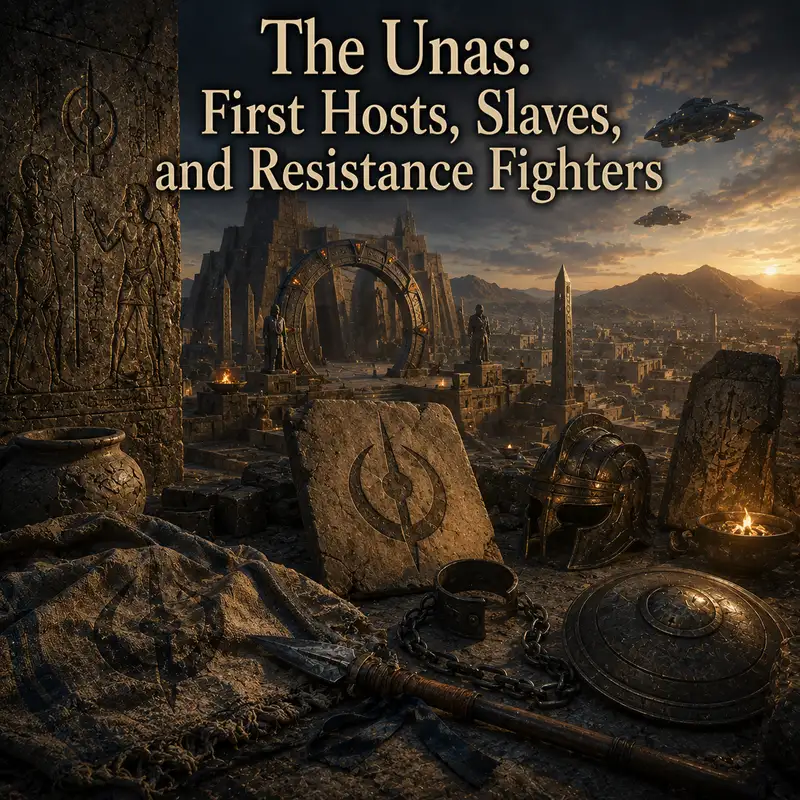
The Unas: First Hosts, Slaves, and Resistance Fighters
Colonel Edwards had spent months searching for enough naquadah to support Earth’s growing space program. When hundreds of Unas appeared above his mining camp, that industrial objective became irrelevant. His teams had rifles, automatic weapons, defensive positions, and a clear route toward the Stargate. None of it changed the local balance. Daniel Jackson told the colonel to order every armed human onto the ground and kneel before the Unas leader.
The moment reversed almost every assumption Earth had made about the species. The Unas had first entered Stargate Command’s records as a monstrous host used by the Goa’uld. Later, humans found them chained in barns, worked as draft animals, and traded according to bloodline. On P three X four-oh-three, the same species surrounded an armed expedition and dictated the terms of peace. Their history was a movement from bodies controlled by others toward communities capable of defending land, memory, and political choice.
The Unas were not a branch of the Goa’uld and were never simply an early version of the Jaffa. They were a separate intelligent species whose physical strength made them attractive hosts and laborers. The confusion began because Earth’s first confirmed encounter involved an Unas already occupied by a mature Goa’uld symbiote. That blended being spoke with the authority of the parasite and called himself the first one. The body and the ruler inside it were not the same person.
That first encounter occurred inside the Asgard labyrinth on Cimmeria. Thor’s defensive system trapped Goa’uld hosts and offered a passage that destroyed the symbiote while allowing the host to leave. One Goa’uld-possessed Unas had survived inside for an extraordinary period, feeding on other prisoners and waiting for an opportunity to escape. He attacked Jack O’Neill and Teal’c with strength that made conventional gunfire only a temporary inconvenience.
The regenerative ability displayed there was not a normal measure of every Unas. The Goa’uld symbiote inside the body supplied enhanced healing and prolonged survival. Once Thor’s Hammer destroyed the symbiote, accumulated wounds killed the host. That distinction matters because later Earth reports often treated the Cimmerian encounter as the biological standard. A naturally powerful species had been observed through the additional capabilities of the parasite that controlled it.
Teal’c knew the Unas mainly through Jaffa legend. They were remembered as the first hosts, beings born from the same primordial waters as the Goa’uld and associated with an ancient stage of imperial history. The story sounded mythological because the Goa’uld had long preferred human hosts and had concealed their own origins beneath claims of divinity. P three X eight eight eight transformed the legend into an archaeological and biological record.
Daniel and an S G Eleven survey found fossilized Goa’uld on that planet without the naquadah normally present in later symbiotes. The evidence suggested that the earliest Goa’uld evolved as aquatic predators and only later became parasites using intelligent hosts. The planet also supported an indigenous Unas population. Some of those Unas had been taken, and Goa’uld operating through their bodies eventually learned to use the Stargate and leave the world.
That transition was one of the most consequential events in Milky Way history. A waterborne predator acquired the senses, hands, mobility, and intelligence of a powerful land-dwelling host. The Stargate then converted a local biological relationship into an interstellar political system. The first Goa’uld rulers did not build an empire because the symbiote alone was physically dominant. They did so because the Unas body gave the parasite access to tools, territory, and eventually the gate network.
Not every Unas was taken. Independent populations remained on the homeworld and developed behavior specifically suited to surviving alongside symbiotes. They lived primarily in caves, avoided dangerous waters, recognized the threat of blending, and killed Goa’uld they encountered. Cave markings showed an understanding of the parasite’s life cycle. Their society was technologically simple by Earth standards, but it had preserved the essential intelligence required to resist possession for generations.
The S G Eleven mission failed to appreciate the difference between an unblended Unas and a Goa’uld using one as a host. A young Unas attacked the archaeological camp, killed one member, and carried Daniel away. Stargate Command launched a search-and-rescue mission expecting a large predatory enemy. The rescue force soon discovered a second threat. The rivers contained living symbiotes able to enter human hosts without immediate detection.
Major Hawkins and Robert Rothman were taken and continued operating beside their own teammates until the Goa’uld revealed themselves. Both men were killed during the confrontation. The security failure illustrated the older evolutionary relationship in reverse. The visibly dangerous Unas was not the infiltrator threatening the rescue team. The true counterintelligence danger was the symbiote concealed inside a familiar human body.
Daniel survived because he treated captivity as a communication problem rather than proof of mindlessness. He identified words through repetition, food, gestures, cave drawings, and immediate consequences. The young Unas understood bargaining, recognized danger, expressed anger, and responded to attempts at trust. Daniel called him Chaka and learned enough of his language to move beyond the assumption that every growl represented the same intention, which is a modest but useful starting point for field diplomacy.
Chaka had apparently taken Daniel as part of a rite of passage connected to status within his group. When an older Unas challenged him, Chaka defended the captive he had begun to treat as more than prey. Daniel declined a chance to kill Chaka, and Chaka eventually allowed him to return to his people. The encounter did not make either participant harmless. It established that the Unas possessed social obligations, individual judgment, and the ability to revise a relationship.
Daniel continued observing P three X eight eight eight after the rescue. Surveillance cameras and carefully placed food allowed him to study behavior without moving a permanent human presence into Unas territory. He developed a working vocabulary and a better understanding of their social structure. The arrangement was imperfect, but it was considerably less intrusive than building a base and announcing that the local population would be introduced to archaeology whether it requested the service or not.
That limited contact ended when armed humans came through the Stargate, trapped Chaka, and dragged him to another world. They carried Goa’uld weapons but were not Jaffa. Their society had inherited enough knowledge to use the gate and enough memory to recognize the value of an Unas. Daniel persuaded S G One to follow, not because Chaka was a specimen belonging to Earth, but because he was an intelligent person who had been abducted.
The destination revealed a historical reversal. Generations earlier, Unas serving the Goa’uld had helped enslave the local human population. After the Goa’uld departed, the humans learned to use their abandoned weapons and fought a long uprising remembered as the Beast Wars. The former slaves defeated the Unas and then reproduced the institution they had overthrown. The old masters became draft animals, field laborers, household property, and commodities.
That history explained local fear without justifying the system built from it. People remembered Unas violence through family tradition and treated domination as preventive security. Slaveholders argued that control allowed both species to coexist. In practice, the arrangement relied on cages, chains, punishment devices, armed guards, and the threat of death. The Unas were valued for physical strength and lineage while being denied the intelligence required to object to their condition.
Burrock, the trader who captured Chaka, considered him unusually valuable. Daniel and O’Neill attempted a purchase before turning to escape. That approach exposed the limits of a small off-world team. S G One could free several prisoners, but it could not dismantle a planet-wide slave economy through one raid. O’Neill understood that changing the entire system by force would require an army, sustained logistics, and a political plan for what followed.
Chaka made the immediate decision more difficult by refusing to leave without other imprisoned Unas. His choice turned a hostage recovery into a collective escape. Carter and Teal’c created a diversion, the team opened the cages, and several Unas moved toward the Stargate. The operation ended in fighting, and Chaka killed Burrock. He then refused evacuation to his homeworld.
Chaka remained because his own freedom was no longer the only objective. He intended to release the Unas still held across the planet. Later reports showed that he led an uprising and eventually brokered a fragile peace between humans and formerly enslaved Unas. The sequence matters. Resistance did not end with revenge or the replacement of one ruling species by another. Chaka moved from captive to insurgent leader and then toward negotiation.
His experience made him the only known intermediary capable of helping when Earth encountered another Unas society on P three X four-oh-three. The planet contained a large naquadah deposit needed for battle-cruiser construction. Geological teams had already established a camp and begun exploration. From the Pentagon’s perspective, the resource supported planetary defense. From the Unas perspective, armed outsiders had entered their territory and begun cutting into ground containing the remains of their ancestors.
Earth’s first intelligence assessment relied too heavily on what could be seen from the air. The expedition had operated for months without identifying a large indigenous population. Unas communities lived in caves, moved through difficult terrain, and revealed themselves only after survey activity reached sensitive areas. Absence from reconnaissance imagery became evidence of absence, a familiar analytic error made more expensive when the supposedly empty landscape began attacking the camp.
Daniel found a heavy yoke in the mine and recognized it as equipment built for Unas labor. The Goa’uld had once forced their ancestors to extract naquadah there, working many of them to death. The mine was therefore not merely a resource site. It was a burial ground, a record of enslavement, and sacred territory. Earth’s operation had entered the same ground with machinery, armed security, and an urgent demand for ore.
An Unas killed Lieutenant Ritter and displayed his body as a warning. Human forces responded with search teams, weapons, and defensive preparations. A skirmish produced casualties on both sides. Colonel Edwards viewed the Unas as hostile creatures obstructing an authorized mission. Daniel viewed the violence as a territorial response shaped by incomplete contact and a history the mining teams had not known existed.
The command dispute was genuine. Edwards had responsibility for his personnel and a strategic requirement to produce naquadah. He could not ignore a lethal attack on one of his officers. Daniel was equally correct that pursuit into unknown cave terrain would favor the Unas and widen the conflict. O’Neill halted retaliation because an expeditionary force should not begin a war simply because its initial assumptions had failed.
Senior command accepted Daniel’s proposal to negotiate, but the fallback plan remained forced relocation if diplomacy failed. That decision revealed how easily Earth could repeat the logic used by older empires. The Unas had not attacked Earth, threatened the Stargate, or requested contact. Their land contained a resource Earth needed. Strategic urgency was beginning to turn indigenous resistance into a removal problem.
Chaka agreed to serve as liaison. His arrival also exposed the attitudes inside the mining camp. Some soldiers regarded him as an animal, a threat, or an inconvenient tool Daniel claimed could speak. Chaka read posture and attention more accurately than they expected. A prolonged stare from Edwards registered as a challenge. A large armed escort looked less like protection than preparation for attack.
Daniel therefore went forward with Chaka without weapons. The negotiation did not operate according to Earth’s schedule. Chaka waited beside a fire, chanted, and allowed the local Unas to decide when contact would occur. The leader known as Iron Shirt arrived with several companions and required ritual signals of hierarchy and respect before substantive discussion could begin. A military headquarters would have preferred a timetable. The Unas had survived long enough to distrust people arriving with timetables.
Through language, gestures, and exchanged objects, Daniel learned why the mine mattered. The local tribes remembered the Goa’uld as killers and the mine as ground containing their dead. Earth’s promise to fight the Goa’uld created a possible common interest, but it did not erase the immediate fact that humans were occupying the site. Trust depended on behavior, not on a briefing about Earth’s intentions.
That trust nearly disappeared when a human soldier killed an Unas in the forest. The soldier believed he was stopping an attack. The dead Unas had returned for a necklace left at a warning site. To the local tribes, the killing confirmed that humans spoke of peace while continuing to kill Unas. The distinction between accident and policy mattered to Earth. It mattered less to a community judging the bodies in front of it.
Hundreds of Unas then surrounded the mining camp. Aerial scans had missed them because they lived underground. The force inside the perimeter had automatic weapons and prepared fields of fire, but it lacked the numbers, terrain knowledge, and extraction time required to survive a mass assault. Reaching the Stargate was no longer a simple withdrawal option. Moving would expose the column before it could escape.
Iron Shirt approached alone and offered the humans a chance to surrender. In Unas social terms, kneeling would signal submission and remove the challenge represented by armed posture. Edwards initially rejected the act because commanders are not trained to place an entire unit on its knees before a force that has killed one of their own. Daniel understood that refusing the ritual would produce a battle the expedition could not win.
Edwards lowered his weapon and knelt. His personnel followed. The gesture was not capitulation to Goa’uld rule or abandonment of Earth’s objectives. It was recognition that the Unas controlled the local tactical situation and possessed a political system through which an agreement could still be reached. Once respect had been demonstrated, Iron Shirt sat with Daniel and exchanged a necklace for a lighter. Negotiation replaced target acquisition.
The agreement protected sacred ground and allowed the Unas to decide how the naquadah would be removed. Iron Shirt proposed that his people work the deposit themselves and provide ore to Earth. Their purpose was to honor ancestors by helping fight the Goa’uld who had enslaved and killed them. Earth gained access to a strategic resource. The Unas avoided displacement and converted labor once imposed by the Goa’uld into a voluntary contribution against them.
The arrangement carried an obvious historical tension. The Unas were again entering a naquadah mine for the benefit of an off-world military power. The difference was agency, control, and purpose. They proposed the work, retained their land, established the conditions, and connected the effort to their own war against the Goa’uld. Respectful treatment would determine whether the agreement remained an alliance or became exploitation with more diplomatic paperwork.
As fighters, the Unas did not resemble a conventional army. They had no observed fleet, heavy weapons, electronic communications, or centralized galactic command. They possessed strength, endurance, cave networks, local intelligence, coordinated tribes, and a willingness to mass rapidly when sacred territory was threatened. In close terrain, those advantages could neutralize much of Earth’s technical superiority before it became useful.
Their most effective weapon was often misclassification. Goa’uld rulers saw bodies suitable for occupation. Human slaveholders saw labor. Earth survey teams initially saw wildlife or an obstacle to extraction. Each assessment underestimated language, memory, political choice, and the ability to organize. The Unas survived partly because outsiders repeatedly noticed their strength before recognizing the society directing it.
Daniel’s contribution was not that he made the Unas intelligent. He learned enough to stop Earth from behaving as though they were not. Language collection turned warning displays into messages, ritual submission into a diplomatic option, and sacred geography into a negotiable security requirement. Chaka’s contribution was equally important. He translated human promises through the credibility of someone who had been captured, rescued, enslaved, and still chose cooperation.
The history of Unas resistance therefore began before any uprising. On their homeworld, independent communities avoided the symbiotes that had taken others of their species. On Burrock’s world, enslaved Unas fought for release and later pursued peace. On P three X four-oh-three, local tribes defended ancestral ground against an armed industrial expedition. These were different societies facing different threats, not one unified Unas nation. The connecting principle was refusal to remain a resource controlled by someone else.
Earth’s encounters with them also became a test of Tau’ri policy. Stargate Command claimed to fight slavery and Goa’uld domination, yet its personnel used a proposed purchase as cover to recover Chaka, raided a slaveholding settlement, and prepared to relocate an indigenous population from valuable land if diplomacy failed. Some of those actions arose from operational necessity rather than imperial ambition. That did not remove their consequences. Principles become meaningful when they survive contact with resources, casualties, and deadlines.
Chaka stands at the center because he crossed every category others imposed on his species. He was first treated as a predator, then became a source of intelligence, then a kidnapped commodity, a resistance leader, a peace broker, and a diplomat between worlds. He never acquired advanced technology or formal rank. His authority came from experience and from trust earned separately among humans and Unas.
The surviving record does not establish what happened to every liberated community or how long the agreement on P three X four-oh-three lasted. It does not describe a unified Unas government, population, or later military role in the fall of the System Lords. Their history remains visible through a small number of encounters. Those encounters are sufficient to overturn the original image of an animal-like host waiting for a stronger mind.
The Unas were the first bodies through which the Goa’uld learned to extend power beyond the water. They later became labor for Goa’uld mines and property in human economies shaped by memories of occupation. Their resistance did not follow one path. It used caves, language, escape, uprising, territorial defense, ritual diplomacy, and finally an alliance built around a shared enemy.
The image that best defines them is not the possessed creature inside Thor’s labyrinth. It is an armed human mining force kneeling before Iron Shirt because the people it had mistaken for obstacles controlled the ground and had chosen to negotiate. The species first used by the Goa’uld as a means of conquest reclaimed its history by deciding for itself when to fight, when to work, and on whose terms either would be done.