The Ursini: A Brief Alliance Against the Drones
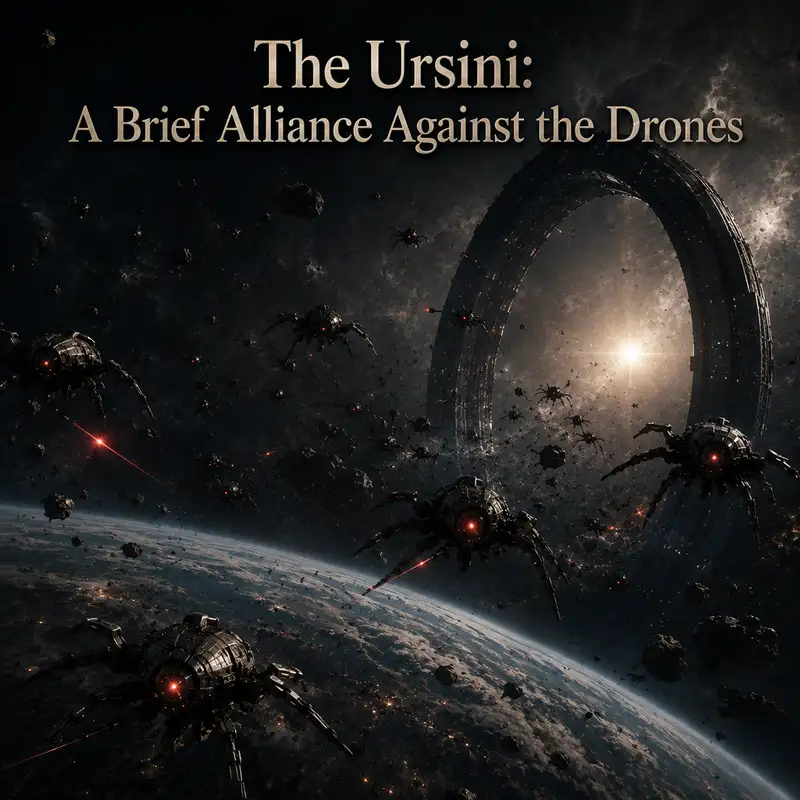
The Ursini seed ship broke formation and accelerated directly toward the drone command vessel. Its shields were already too weak to survive the approach, and its weapons could not clear a path through the machines swarming around it. Colonel David Telford received one final message. The Ursini were apologizing for drawing Destiny into their war. The maneuver was a suicide run. Their ship disappeared beneath drone fire before it reached the target, but enough machines followed to give Destiny a few more minutes. The alliance had lasted only briefly. Its final act was complete commitment.
The Ursini were among the least understood allies encountered by the Destiny expedition. Their government, homeworld, population, and wider civilization were never observed directly. No formal ambassador arrived, and no treaty was recorded in a language both sides could read. Almost everything known about them came through Telford, whose understanding had been assembled from images transmitted through alien neural equipment. The available evidence supports a narrow description. They were an advanced spacefaring people, trapped aboard an Ancient seed ship, fighting an automated enemy that had already devastated their civilization.
Their alliance with Destiny formed because each side possessed something the other could not replace. The Ursini had control of a seed ship capable of carrying Destiny during a coupled faster-than-light jump. They also understood the drone threat better than the human crew. Destiny had heavier weapons, a functioning main gun, and specialists capable of analyzing Ancient systems. The Ursini needed those capabilities to destroy a drone command ship and reopen a route toward their colony. The humans needed the seed ship to escape a battlefield after Destiny’s own faster-than-light drive had been disabled. Cooperation was not idealism. It was mutual dependence under fire.
The relationship began much less promisingly. Destiny caught up with a damaged seed ship that had been traveling ahead of it, placing Stargates and gathering information along the Ancient route. The two vessels docked automatically and began exchanging data. Human teams crossed to investigate and found an industrial bay containing completed Stargates, control systems older than those aboard Destiny, and a group of unfamiliar stasis pods. One occupant awakened weak and disoriented. Others were already moving through the darkened vessel.
The humans initially treated the strangers as possible boarders or hostile squatters. The Ursini had better reasons than most to view the new arrivals with equal suspicion. Armed personnel had entered the ship where they had been stranded, activated its systems, explored its compartments, and begun modifying its power network. The Destiny crew intended to use the combined reserves of both vessels to dial Earth. From the human perspective, this was a rescue opportunity. From the Ursini perspective, strangers were draining the platform that had kept them alive and preparing to use it for an objective they did not understand.
The Ursini responded by stunning personnel, taking control of the seed ship, and reversing the planned energy flow. Power began moving out of Destiny instead of toward its Stargate. The human crew could not stop the transfer, and continued loss would have left the Ancient vessel unable to resume faster-than-light travel. Nicholas Rush secretly ordered the ships disconnected. Destiny escaped with most of its people, but Telford remained aboard the seed ship as it fell behind.
That separation created the possibility of diplomacy. Telford was surrounded, isolated from Destiny, and unable to communicate verbally with the aliens. The Ursini could have killed him. Instead, curiosity appears to have replaced immediate hostility. Their stasis chambers included neural stimulators intended to keep a brain active during prolonged suspension. By connecting Telford to the system, they exposed him to a flood of images associated with their history and experiences. The process did not give him a complete language or a clean archive. It gave him fragments that gradually formed a usable picture.
The method was an extraordinary diplomatic instrument and a poor substitute for ordinary conversation. Telford described the experience as absorbing an enormous library in less than a day, with most of it passing too quickly to understand. He learned the name Ursini, gained a basic account of their war, and developed enough shared technical understanding to work beside them. He could not verify every image, question every interpretation, or build the kind of precise vocabulary needed for a binding agreement. The entire relationship depended on one officer translating impressions between two crews.
That arrangement created a serious command vulnerability. Destiny could not authenticate an Ursini message without Telford, and the Ursini had no independent way to determine whether Telford actually spoke for Young. The humans never identified a formal Ursini commander or learned how decisions were made aboard the seed ship. A gesture that one side understood as an order might reach the other as advice, warning, or threat. The alliance therefore had communications, but not a shared command-and-control system. In coalition warfare, those are very different achievements.
Telford learned that the Ursini had awakened the automated drones years earlier. The machines belonged to a weapons system whose builders were believed to have disappeared long ago. Their operating logic was brutally narrow. Detect alien technology and destroy it. The Ursini had fought the drones ever since, but the enemy did not negotiate, tire, or reconsider its objectives. Destroying individual drones achieved little while command ships could activate and coordinate replacements.
The Ursini had boarded the Ancient seed ship for long-term reconnaissance, hoping that its sensors, route, or technology might provide an advantage. Their stay was supposed to be temporary. No recovery force returned. Whether the colony abandoned them deliberately, lost the ability to reach them, or was already under attack remained unknown. The team entered stasis and survived through systems that supplied basic nutrients. By the time Destiny found them, they were not an expedition conducting a planned survey. They were survivors occupying an aging foreign vessel because every other support arrangement had failed.
Telford spent almost a month with them. Together, they restored enough seed-ship functionality to move, navigate, and pursue Destiny. The partnership was practical before it was political. The Ursini needed a person familiar with Ancient controls. Telford needed food, water, protection, and a way back to his own people. Working on the same consoles created trust in small increments. Neither side had to agree about the past before repairing the ship in front of them.
Destiny encountered the drones while investigating a field of wrecked vessels. The machines had remained dormant until the Ancient ship’s presence awakened them. Their attack damaged Destiny and disabled its faster-than-light drive. The shuttle carrying Scott, Greer, and Brody barely returned before the ship lost maneuver freedom. Destiny could fight, but it could not disengage. Against an automated force able to concentrate around one stationary target, that was a rapidly shrinking tactical position.
The seed ship arrived at the moment the drones appeared ready to finish the battle. Telford and the Ursini led Destiny through the outer layers of a star, using the stellar environment to destroy many of the pursuing machines. The maneuver was more than a rescue. It demonstrated that the Ursini understood how the drones behaved and were willing to expose their own vessel to protect Destiny. It also brought Telford back into direct contact with Young and made him the only person able to explain what the aliens wanted.
The proposed alliance had three connected objectives. The seed ship would dock with Destiny and carry the larger vessel during a coupled faster-than-light jump. Once both ships reached a safer area, the humans would repair their defenses. The combined force would then return to the drone battlefield and destroy the command ship. In return, the Ursini would regain a path toward their colony and help Destiny use the seed ship’s energy to dial Earth. Each side saw the agreement as a route home.
The technical plan carried serious risk. Destiny was far larger than the seed ship and had not been designed to depend on it for propulsion. The vessels had to remain physically coupled while entering faster-than-light travel, including during a period when the transition placed unusual stress on their structures. A failed connection could tear the docking mechanism apart or damage both hulls. The science team could calculate that the maneuver might work. It could not offer the warranty, which had expired sometime before human civilization developed writing.
The political plan was even weaker. The Ursini communicated through Telford, and the Destiny command could not speak with them independently. No shared procedures existed for target selection, withdrawal, damage reporting, or dispute resolution. The humans knew the Ursini had already taken power from Destiny. The Ursini knew Rush had disconnected the ships and left Telford behind. Each side had evidence that the other would place its own survival first. The agreement rested on necessity without enough time to become trust.
That weakness appeared as soon as the coupled jump began. The Ursini were supposed to carry Destiny to a safe location for repairs before the combined attack. Instead, the ships emerged directly beside the drone command vessel and its defensive screen. The seed ship transmitted an instruction to target the command ship, then separated and entered the battle. The humans interpreted the maneuver as a betrayal. Later information suggested the Ursini feared that Destiny would leave once its own drive had been repaired. They forced the battle while the alliance still had no practical way to withdraw from it.
Their suspicion was understandable and strategically disastrous. Rush openly regarded the drone war as an Ursini problem rather than Destiny’s responsibility. Young was willing to consider the common threat, but his first obligation remained his own crew. The Ursini had been abandoned once already and were unwilling to gamble their survival on another partner’s promise. By removing the safe repair phase, they ensured Destiny could not depart without fighting. They also sent a damaged ally into combat before its shields and propulsion had recovered.
The first engagement exposed the limits of both vessels. Drones formed a screen between Destiny and the command ship, preventing the Ancient main weapon from reaching the target. The seed ship could maneuver and contribute fire, but it lacked the protection and destructive power to break the formation alone. The alliance possessed one platform with the heavier weapon and another with better knowledge of the enemy. It did not possess enough time or coordination to combine those advantages cleanly.
Chloe Armstrong changed the tactical balance by summoning the Nakai vessels that had been hunting Destiny. Their arrival drew part of the drone force away. Rush and Eli Wallace then disrupted the signal linking the command ship to its drones for a few seconds. With the machines temporarily dormant, Destiny closed the distance and destroyed the command vessel. The engagement showed why the Ursini had needed human help. Their war could not be won by shooting individual drones faster. The command architecture had to be attacked.
The apparent victory encouraged the Ursini to contact their colony. The reply came in machine language from another drone command ship. Telford and the Destiny leadership drew the most likely conclusion: another drone cluster had discovered the colony and destroyed it. The transmission also revealed the allied ships’ position. A second command vessel was already sending another wave toward them. The Ursini had fought to reopen a route home and learned that home was probably gone.
That intelligence changed the alliance from a joint military operation into a final-survivor crisis. The exact number of Ursini elsewhere remained unknown, so the screen record does not prove that the seed-ship group represented the entire species. The evidence available to Telford suggested they might be the last survivors of their known community. They had no confirmed colony, no supporting fleet, and no industrial base able to repair their captured Ancient vessel. Their long reconnaissance mission had become a lifeboat operation without a destination.
Destiny was little better positioned. Its shield network had suffered extensive damage, the faster-than-light system remained unreliable, and a new drone wave was closing. The seed ship could no longer solve the problem by carrying Destiny away. Its own propulsion and defensive capability were too limited after the battle, and extending protection around both ships was not a realistic option. The alliance had achieved its immediate objective and lost the strategic purpose that had justified it.
The human crew began studying a dormant drone recovered from the battlefield. Eli and Rush hoped to rewrite the machine’s identification logic, causing one drone group to treat another as hostile. It was a dangerous plan. Activating the device inside Destiny could have placed an armed autonomous weapon in the middle of the ship. It was also the only available way to create enough confusion for escape. While the scientists worked, the Ursini stopped responding.
Their silence could be interpreted as despair, preparation, or another attempt to conceal a plan. Telford believed they had fought the drones before and might know something the humans did not. Young noted the less comforting part of that experience. The Ursini had been losing. Their knowledge was genuine, but it came from a war in which retreat routes, colonies, and recovery forces had disappeared one after another.
When the second drone wave arrived, the remaining Nakai vessel withdrew and the machines redirected their fire toward Destiny. The shield repairs were incomplete, and the drone-reprogramming effort needed more time. At that point, the seed ship accelerated toward the new command vessel. Drones peeled away from Destiny to intercept it. The Ursini transmitted an apology for forcing the earlier battle and identified the maneuver as a suicide attack.
The seed ship did not have the firepower or shields required to reach and destroy the command vessel. The Ursini almost certainly understood that. Their objective was no longer victory in the conventional sense. It was to draw away enough drones for Destiny’s scientists to finish their work. The ship vanished from the sensors under concentrated fire, taking its crew, its Stargate factory, and the remaining evidence of its long reconnaissance mission with it.
The diversion succeeded. Rush and Eli activated the captured drone and uploaded their altered program. Drones orphaned by the destroyed first command vessel began attacking the new wave. The machines turned on one another long enough for Destiny to recover its shuttle, restore partial shield coverage, and attempt a dangerously underprotected faster-than-light jump. The Ancient ship escaped with shields operating far below the level previously considered safe. The Ursini did not survive to see the result, but the window they created was the difference between an uncertain escape and immediate destruction.
Measured as diplomacy, the alliance was deeply flawed. There was no direct communication between governments, no verified chain of command, and no durable mechanism for resolving suspicion. Telford served as translator, liaison, and proof of good faith at the same time. When either side doubted the other, it had no independent channel through which to test that doubt. The Ursini answered fear by forcing the engagement. The humans considered abandoning a war they had not chosen. Both responses followed their interests, and together they nearly destroyed the partnership before it could achieve anything.
Measured as a military coalition, it performed better. The seed ship rescued Destiny from the first drone attack, carried it through a coupled faster-than-light jump, and supplied intelligence about the enemy’s command structure. Destiny provided the heavy weapon needed to destroy the first command ship and the technical team that eventually turned one drone formation against another. Neither force could have produced the same outcome alone. The alliance failed politically while succeeding tactically, which is a familiar result in coalition warfare and usually a very expensive one.
The Ursini were not passive victims. They seized power from Destiny during the first encounter, concealed their immediate battle plan, and deliberately placed the human crew in a fight before promised repairs were completed. Those decisions endangered people who had not agreed to accept the risk. Their later sacrifice does not erase that coercion. It does reveal that their conduct changed as the relationship changed. At the end, they accepted the cost themselves rather than imposing another solution on Destiny.
Their brief contact also showed the strategic limits of advanced technology. The Ursini operated stasis systems, neural interfaces, warships, and an Ancient seed ship. None of those capabilities could replace a destroyed colony, recover an abandoned expedition, or sustain a war against machines able to replenish and coordinate without negotiation. Technology kept the isolated team alive long enough to make an alliance. It could not rebuild the political and logistical system that should have supported them.
Telford was the human center of the relationship because he had experienced both sides of the first encounter. Destiny had left him behind, and the Ursini had chosen not to kill him. He learned their history through an imperfect neural exchange and then trusted them enough to help fly the seed ship. His reports did not turn the Ursini into familiar allies. They made cooperation possible before mutual comprehension was complete. In a more stable campaign, that would have been the beginning of diplomacy. Here, the entire relationship had to mature between one battle and the next.
The Ursini alliance remained brief because it was created too late. By the time trust began to form, the drones had already reduced their civilization, isolated their reconnaissance team, and probably destroyed the colony they hoped to recover. Mutual need brought the two ships together. Fear broke the agreement’s original terms. Shared combat restored enough trust for one final decision. The Ursini could not save their own future, but they used the last movement of their ship to preserve Destiny’s. Their alliance lasted only as long as the battlefield required. Their sacrifice ensured that its effect lasted much longer.