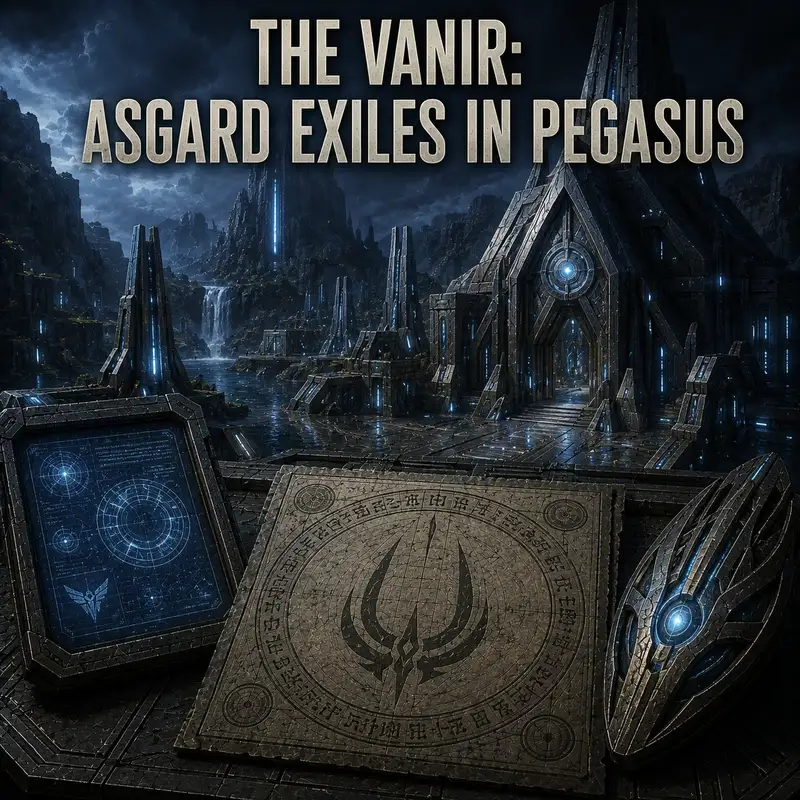
The Vanir: Asgard Exiles in Pegasus
The explosion above the Traveler colony was visible from orbit. A settlement built after a hundred generations of nomadic life vanished when its active Stargate overloaded, taking three thousand people and two ships with it. No Wraith fleet had found the colony. No enemy commander had selected it as a target. The inhabitants died because a hidden branch of the Asgard had activated an Ancient weapon elsewhere in Pegasus and accepted the destruction of the gate network as collateral damage. The lost tribe had survived ten thousand years in exile. Its return began by making survival impossible for people it had never met.
One continuity point should be clear from the beginning. The live-action record never gives these exiles the formal name Vanir. It identifies them only as a lost or rogue group of Asgard. Vanir became a later shorthand used by fans and reference works, borrowed from another family of gods in Norse tradition. The title is useful because it distinguishes them from Thor’s civilization, but their own political name remains unknown. What the screen record does establish is more important. They were Asgard who rejected the limits imposed by the High Council, moved their research to Pegasus, and built a separate history around survival at almost any cost.
The crisis that divided them began with the Asgard method of extending life. Instead of ordinary biological reproduction, Asgard minds were transferred into cloned bodies. The process delivered extraordinary longevity, but repeated copying introduced genetic degradation. Each generation inherited damage from the one before it, and the range of viable solutions narrowed over time. The Asgard who worked with Earth eventually concluded that the decline could not be reversed. Their civilization chose collective death rather than leave weakened bodies and advanced technology to fall into hostile hands. The Pegasus exiles followed a different path. They prolonged the problem by abandoning the ethical restrictions governing the search for a cure.
Their leader admitted that research on humans had produced significant progress, though not a complete solution. Human physiology resembled the ancestral form from which the Asgard clone line had declined, making human subjects valuable biological material. Daniel Jackson immediately recognized the comparison to Loki, the Asgard scientist who had conducted unauthorized experiments on Earth until the High Council stopped him. The exiles regarded that intervention as proof of moral weakness. In their view, the mainstream Asgard had protected human autonomy and died as a result. The lost tribe had violated it and remained alive. That contrast became the foundation of their political justification.
The exact moment of the split is not recorded, but the strategic timing is. The exiles came to Pegasus during the war between the Ancients and the Wraith. With both major powers occupied, they expected room to conduct experiments without interference. This was a calculated use of somebody else’s war. The mainstream Asgard had already condemned human experimentation. The exiles appear to have assumed the Ancients might object but would not exterminate them, and that the technologically superior Lanteans would probably survive the conflict. Both judgments proved dangerous. The Wraith won, and the exiles were stranded in the worst possible theater.
When the Ancients withdrew from Pegasus, the Wraith turned against the new advanced society in their galaxy. The exiles reported that their intergalactic ships were lost in the first battle. They lacked the resources to build replacements and could no longer return to the Asgard centers beyond Pegasus. This was not total technological collapse. They retained interstellar vessels, hyperspace capability, energy weapons, shields, subspace communications, and sophisticated armor. What they lost was strategic mobility between galaxies. A people who had crossed intergalactic space by choice became a trapped regional minority after one unsuccessful campaign.
Their answer was withdrawal to a planet the Wraith would not willingly search. Its atmosphere was toxic. At first, simple breathing equipment made settlement possible. Over the following millennia, the environment became harsher until even armored exoskeletons could no longer provide a permanent solution. The suits concealed the exiles’ identity when they finally reappeared, but concealment was only a secondary function. The armor was life support, environmental protection, sensor interference, powered mobility, and battlefield equipment wrapped around a body that could not safely exist outside it for long. Exile had become a condition worn on the body.
Surviving there for roughly ten thousand years was an extraordinary achievement. It also consumed the future. The exiles continued cloning, continued research, and delayed the genetic decline without curing it. Their leader spoke of a civilization with a hundred thousand years of history facing final extinction. By the time they encountered Atlantis, Thor’s Asgard were already gone. The lost tribe had outlived the branch that condemned its methods, but only as a shrinking population on a dying refuge. Their unethical program had purchased time. It had not purchased a sustainable home, secure reproduction, or the industrial capacity to leave Pegasus.
Very little is known about their internal government. One unnamed leader spoke for the group, directed prisoners, and defended the decision to activate the Attero device. The record does not establish a council, military ranks, population total, succession system, or number of settlements. It would be a mistake to imagine a second Asgard empire hidden behind one laboratory. The available evidence supports a technically advanced but resource-constrained remnant with several ships, specialized troops, and at least one functioning community. Their secrecy preserved them from the Wraith and left every outsider uncertain about how much strength remained.
Their operational inventory reflected both Asgard inheritance and long isolation. A vessel under their control entered Atlantis’s shield, crossed the city, and escaped into hyperspace from within the atmosphere. Armored troops used compact thrusters, energy shields, stunners, and an extraction platform capable of lifting prisoners through multiple tower levels. A fallen suit disrupted scanners and resisted cutting tools before destroying itself. Their ships could fight a Traveler vessel at close range, but they were not shown dominating Pegasus the way later Asgard warships once dominated Goa’uld forces. Advanced technology had survived. The immense scientific and industrial system that normally supported it had not.
Contact began when Daniel Jackson and Rodney McKay found Janus’s secret laboratory inside Atlantis. Activating the concealed room also activated a device that sent a subspace signal to an Ancient installation on another world. The exiles had been monitoring that connection. They understood what had awakened and knew that the missing component needed to operate the larger system was now accessible. Atlantis personnel saw a historical discovery. The exiles saw the return of the one weapon capable of changing the balance between their dying refuge and the Wraith-controlled galaxy.
Their raid on Atlantis was a model of limited-objective special operations. One ship arrived without a recognized identification signal, penetrated the city shield, and delivered three armored personnel near the hidden laboratory. The raiders ignored the control room, zero-point module, database, and other valuable targets. They moved directly to Janus’s lab, stunned McKay and Jackson, seized the control component, and extracted both scientists. One operative remained behind to cover the withdrawal and was killed by Atlantis fire. The fallen suit then self-destructed rather than allow the expedition to examine the body and equipment. The mission achieved surprise, collection, denial, and concealment in minutes.
The suit’s destruction was especially revealing. The exiles possessed enough technological confidence to penetrate Atlantis and enough insecurity to erase their own biological and technical evidence. Their armor emitted an electromagnetic field that confused scanners, while the final blast denied the expedition a useful forensic result. This was not the behavior of a civilization seeking diplomatic recognition. It was the behavior of an intelligence service protecting a compartmented program. The lost tribe did not announce its survival to the last known inheritors of Asgard technology. It kidnapped the people required to finish a weapon and tried to leave no useful corpse behind.
McKay and Jackson were taken to the Ancient facility housing the Attero device. Janus had separated its control key from the main system and returned the key to Atlantis after shutting the project down. The exiles had found the installation, understood its purpose, and remained unable to activate it without that component and operators familiar with Ancient systems. Their raid solved both problems at once. The prisoners supplied technical expertise. The stolen key supplied authorization. The exiles had discovered a civilization-level weapon, but possession of the building had not created the knowledge needed to use it. Even the Asgard sometimes required contractors.
The Attero device attacked a specific feature of Wraith hyperdrive technology. It generated subspace turbulence along the frequencies used by Wraith ships. A hive could still engage its hyperdrive, but the attempt would tear the vessel apart during transition. If word spread, surviving hives would be confined to sublight movement and isolated across immense distances. Ancient ships operating on different hyperdrive frequencies could then destroy them individually or leave them stranded. For the exiles, the effect promised something even more immediate. It could make the galaxy navigable again by removing the enemy that had trapped them.
The side effect was catastrophic. Radiation generated by the subspace disturbance interfered with every active Stargate in the Pegasus network. A gate establishing a wormhole could destabilize and explode with extraordinary force. The exiles knew the danger and proceeded because they did not use Stargates. Their ships and their refuge lay outside the logistical system upon which most human societies depended. The calculation was brutally coherent. Destroy Wraith strategic mobility, accept millions of possible human deaths, and preserve the last Asgard population able to act. Everyone excluded from the calculation lived near a gate.
The first operational results confirmed both sides of the weapon. Two hive ships allied with Todd attempted to enter hyperspace and disintegrated. Todd assumed Atlantis had betrayed him, seized the Daedalus, and demanded the facility’s location. In Atlantis, the local Stargate overloaded. The city contained the blast inside its shield, but the gate itself was destroyed and the command center was exposed to intense energy and radiation. The device had begun changing the war before most of the participants knew who had activated it. Wraith, Earth forces, and human settlements received the same warning in different forms.
The Travelers paid the largest documented civilian cost. Their first surface colony in a hundred generations was erased when its gate exploded. Three thousand people died, along with two ships, including the Ancient warship that had strengthened the fleet at Asuras. The exiles had not selected the colony or even known it existed. That absence of intent does not reduce responsibility. They activated a system whose operating principle converted every used gate into a potential strategic weapon. A civilization claiming necessity had imposed its own extinction crisis on populations that had no voice in the decision.
The lost tribe should not be reduced to a darker costume worn by familiar Asgard. Their fear was real. Their homeworld was failing, their intergalactic ships were gone, the Wraith had already tried to eliminate them, and the death of the mainstream Asgard proved that genetic time was running out. These facts explain why the Attero device appeared necessary. They do not justify human experimentation or knowingly sacrificing millions. Survival pressure can narrow policy options. It does not eliminate moral agency, especially for a civilization advanced enough to understand exactly who will die.
Their strategy also contained a serious contradiction. Activating the device might cripple the Wraith, but it would simultaneously destroy the transportation network connecting human settlements, Atlantis, trade partners, and possible future allies. The exiles would emerge into a galaxy filled with dead worlds, isolated populations, and governments that knew who had caused the destruction. They could gain freedom of movement while eliminating the political and logistical environment needed for long-term recovery. A weapon that removed every nearby threat also removed nearly everyone who might provide sanctuary, resources, or cooperation afterward.
The countercoalition formed from the very interests the exiles had dismissed. Todd needed the device destroyed before more hives attempted hyperspace. Atlantis needed its prisoners recovered and the gate network saved. The Travelers wanted justice for their colony and possessed a ship capable of reaching the facility after Atlantis lost its gate access. These groups did not trust one another. Todd had just hijacked the Daedalus because he believed Earth had activated the weapon. The Travelers had spent generations hiding from the Wraith. The exiles nevertheless created a threat broad enough to align all three.
Todd’s seizure of the Daedalus complicated the rescue. He used hidden stun devices, locked out the Earth crew, and redirected the battlecruiser toward the Attero facility. His objective was destruction, even if that required ramming the ship into the planet and killing everyone aboard. Ronon and Keller sabotaged engineering systems while Woolsey and the crew retook compartments. The Wraith eventually withdrew into their smaller craft after programming the Daedalus for collision. The exiles had intended to destroy Wraith mobility. Instead, their weapon placed an Earth battlecruiser under Wraith control and aimed it at their own installation.
The Travelers provided the flexible force Atlantis lacked. Katana brought one of the fleet’s faster ships, with a crew willing to push an already temperamental hyperdrive beyond normal limits. Sheppard and Radek Zelenka used it to reach the target ahead of the Wraith. The rescue had become a three-sided operation. Traveler weapons engaged the Asgard ships. Atlantis personnel tried to recover McKay and Jackson. Todd attempted to guarantee destruction of the facility. None of the forces shared a command structure. They cooperated through overlapping objectives, which is often enough until someone starts discussing the postwar settlement.
Three exile vessels were present near the facility. Two engaged Katana’s ship while a third later launched carrying the stolen control key. The Traveler vessel destroyed one attacker during the initial fight. The third escaped into hyperspace with the key, preserving at least one ship and the possibility that the lost tribe could attempt another operation elsewhere. After the Daedalus crisis was contained, the Traveler ship destroyed the remaining attacker. The exiles lost multiple vessels and control of the site, but the battle did not establish the destruction of their entire population.
Inside the facility, McKay and Jackson used empty Asgard exoskeletons to move through the complex, defeat the guards, and enter the device chamber. The suits adapted internally to the wearer, making them usable by humans despite the difference in body size. This was another example of the exiles’ technological strength becoming available to an enemy who captured the equipment. McKay could not shut the Attero device down through the workstation after the control key was removed, so he entered the radiation-filled antenna chamber and pulled the main control crystal manually. Jackson absorbed a severe electrical discharge while helping him reach it.
The same minutes brought the Daedalus toward a collision with the planet. Its shields and major systems were damaged, and the crew regained flight control too late to pull away conventionally. Sheppard used the Traveler vessel to open a hyperspace window large enough for both ships and carried the Daedalus through the planet to the far side. Once McKay removed the control crystal and the prisoners were recovered, Woolsey ordered the Ancient facility destroyed. The target was eliminated by Traveler fire, not captured for study. After the deaths already caused, no commander present was interested in preserving Janus’s experiment for a better day.
The immediate campaign ended with the device destroyed, two exile ships lost, and at least one escaping with the control key. The live-action record does not return to the lost tribe and does not establish its later population, refuge, leadership, or military plans. It therefore cannot support claims that the Vanir were exterminated, reconciled with Atlantis, or solved the cloning crisis. They survived the battle in some form because one vessel escaped. How many remained on the dying planet, aboard other ships, or in additional settlements is unresolved.
Their survival created an uncomfortable Asgard legacy. Earth had inherited the knowledge and technology of Thor’s people after their extinction, and many Atlantis personnel remembered Asgard officers as allies. The Pegasus exiles possessed the same ancient intelligence without the same political relationship. They saw the mainstream Asgard’s ethics as a failed strategy and humanity as research material or collateral population. Species identity did not determine policy. Two branches facing the same genetic decline reached different moral conclusions, and only the branch willing to violate humans remained physically alive after the other was gone.
Operationally, the lost tribe was dangerous because scarcity made it precise. It could not conquer Atlantis or fight the Wraith fleet directly, so it used surveillance, hidden infrastructure, shield penetration, specialized armor, prisoner exploitation, and stolen Ancient systems. Its personnel understood when to self-destruct equipment, when to abandon a facility, and when to preserve the one component needed for a later attempt. These were the methods of a small advanced power avoiding a war of attrition. The Wraith had greater numbers. Atlantis had allies. The exiles had secrecy and technology, resources that remained valuable only while nobody understood them.
Strategically, those methods kept them alive and kept them alone. Human experimentation prevented alliance with Atlantis. The Attero plan made every gate-using civilization a potential enemy. The decision to treat Todd’s hives, Traveler civilians, and Pegasus settlements as expendable created a coalition capable of destroying the facility they needed. The exiles had spent ten thousand years hiding because exposure invited Wraith attack. When their refuge failed, they emerged with a plan that made exposure inevitable and diplomacy nearly impossible. Survival had become the only policy their institutions still knew how to conduct.
The Vanir were Asgard exiles in more than geography. They had separated themselves from the High Council’s ethics, from intergalactic mobility, from the gate network, and eventually from every society that might have recognized them as kin or ally. Their armored suits preserved bodies that could no longer tolerate the world beneath them, while their strategy treated the rest of Pegasus as another hostile environment to be endured or removed. They survived longer than Thor’s civilization. The price was becoming a lost tribe whose greatest victory would have left it alive in a galaxy of broken gates, dead settlements, and no one willing to open a door.