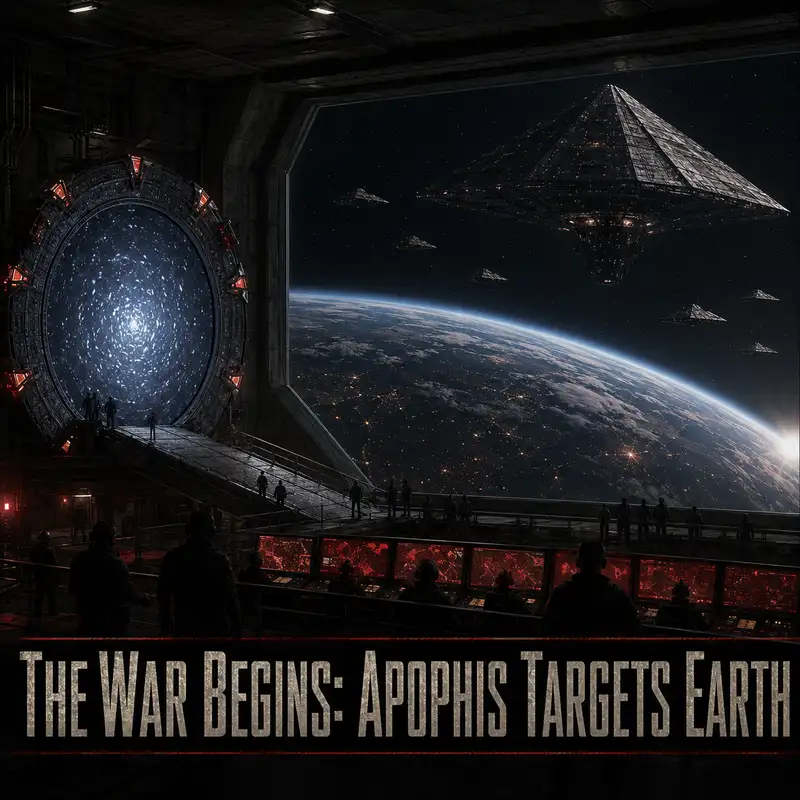
The War Begins: Apophis Targets Earth
The first warning was not an intelligence report. It was the Stargate activating inside Cheyenne Mountain while the personnel assigned to watch it treated the gate room like a secure storage area. No identification code arrived. No reconnaissance probe came through. Armored Jaffa crossed the ramp, staff weapons filled the room with fire, and the guards were caught at close range. Apophis entered behind his soldiers, inspected the installation, seized a female service member, and withdrew through a newly established outbound wormhole. The attack lasted only minutes. It proved that Earth’s most secret facility was also an unlocked front door.
This was not yet a planetary invasion. Apophis brought no occupation force, issued no demand, and made no attempt to seize Cheyenne Mountain. It was a raid conducted with surprise, local superiority, and a limited objective. A raid can still begin a war when it kills military personnel, takes a prisoner, and identifies an enemy that believed itself hidden. Before Apophis arrived, Earth considered the Stargate threat contained. After he left, commanders knew that an alien power possessed Earth’s address and could send armed troops through the gate at a time of its choosing.
More than a year earlier, Colonel Jack O’Neill had led the first military expedition to Abydos. His orders were to identify any threat and, if necessary, destroy the Stargate on the far side with a nuclear weapon. The mission instead became an uprising against Ra, the Goa’uld ruler who had transported humans from ancient Earth and presented himself as a god. O’Neill’s team and the people of Abydos defeated Ra. The bomb destroyed Ra’s spacecraft, not the planet. Daniel Jackson remained with Sha’re and her people. O’Neill then filed a false account implying that Daniel, the Abydonians, and the gate had been destroyed.
That deception protected Abydos from renewed Earth intervention, but it left the chain of command with a dangerously incomplete picture. General George Hammond inherited a record in which the mission objective had been accomplished and the route had been closed. The attack made that account impossible to accept without review. Hammond recalled O’Neill, questioned the surviving members of the expedition, and prepared a contingency that could have sent another nuclear device through the gate. O’Neill finally admitted that Abydos remained intact. A lie intended to save one world had become an obstacle to defending another.
Apophis held the advantage that dominates the opening phase of many unequal wars. He understood the operational environment. Earth believed the Stargate connected two locations. Apophis knew it was one node in a network spread across the Milky Way. Earth had improvised a dialing computer after years of research. Goa’uld forces used dial-home devices and inherited route knowledge to move warriors, captives, resources, and rulers among established worlds. Earth had one expedition report. Apophis operated inside an imperial transportation system. The difference was not merely technological. It was geographic, political, and institutional.
Apophis was a Goa’uld System Lord protected by Jaffa who wore the serpent symbol of his domain. He was not sovereign of a unified Goa’uld state, because the System Lords competed, raided one another, and seized openings created by weakness or death. Ra’s destruction therefore did not end Goa’uld power. It removed one ruler and unsettled territory associated with him. The surviving record does not establish every calculation behind Apophis’s visit to Earth, but the pattern fits an opportunistic ruler probing routes that became available after a rival disappeared. He knew how to reach Earth. He did not yet understand what Earth had become.
His immediate purpose was more personal and disturbing than territorial conquest. Apophis was searching for human hosts. Goa’uld symbiotes required bodies through which they could act, speak, and rule. Hosting in Apophis’s domain was not a voluntary partnership. It was seizure of a person’s body and suppression of that person’s control. The captured service member was taken as a possible host for Apophis’s queen, Amaunet. When she was rejected, she was killed. To Apophis, the raid gathered biological material. To Earth, it was the abduction and murder of one of its people. Only one description recognizes the victim as a person.
The Jaffa gave the raid its military force. Their armor, staff weapons, discipline, and confidence were intimidating, especially against guards who had not been warned that the gate could open from outside. Their decisive advantage was surprise. The gate room had no defensive barrier across the event horizon when Apophis arrived. Personnel stood within immediate weapons range of the ramp. There was no mature incoming authentication procedure because Stargate Command had not accepted the existence of unknown incoming travelers. The facility was deep underground, but the Stargate bypassed every mountain, fence, radar screen, and national border above it.
Hammond’s first response was investigative rather than offensive. He needed to determine whether the attackers had come from Abydos and whether O’Neill’s report remained credible. O’Neill returned to active duty. Captain Samantha Carter joined the mission as an Air Force officer and theoretical astrophysicist who had studied the gate before Daniel’s breakthrough. Majors Charles Kawalsky and Louis Ferretti brought experience from the first expedition. The group combined combat leadership, technical knowledge, and familiarity with Abydos. That mixture would become characteristic of Stargate operations, though it began as an emergency arrangement rather than established doctrine.
The return to Abydos answered one question and created a larger problem. Daniel was alive, the Abydonians had survived, and the attack on Earth had not originated there. Daniel then revealed a chamber containing a vast collection of Stargate destinations. Carter recognized the implication. Earth’s earlier calculations had been incomplete because stellar positions changed over time. With corrected information, the gate could reach many worlds. The machine beneath Cheyenne Mountain was not a single bridge to one desert planet. It was access to an interstellar network whose political map, military geography, and hazards Earth did not possess.
That discovery transformed Apophis’s raid from an isolated security incident into evidence of a strategic system. Every valid address might lead to an inhabited planet, an abandoned installation, an ally, a disease, a hostile army, or another Goa’uld domain. The network offered extraordinary mobility to both sides. Earth could send a small force across interstellar distance in seconds. An enemy could do the same if it knew Earth’s address. The Stargate eliminated distance while concentrating risk into one doorway. It was simultaneously Earth’s best reconnaissance asset and its most immediate avenue of attack.
Apophis struck Abydos while O’Neill, Carter, Daniel, and the others were away from the gate examining the address chamber. Serpent Guards emerged, opened fire, and overwhelmed the small group left nearby. Abydonian civilians were killed. Ferretti was badly wounded. Sha’re and her brother Skaara were captured. The attack repeated the method used on Earth, but its purpose was clearer. Apophis was not attempting to govern Abydos that day. He was collecting candidates for implantation from a population with little ability to resist Goa’uld weapons. A force large enough to dominate the gate area was sufficient for the mission.
Ferretti provided the first actionable intelligence of the war. Though wounded, he had watched the symbols used when Apophis’s party dialed away. His memory gave Stargate Command a destination. No intelligence service had penetrated Apophis’s court. No satellite had tracked the withdrawal. No captured database explained the enemy’s organization. A wounded officer had simply kept his eyes open during an attack. That observation turned an unknown raider into a target that could be pursued. The difference between retaliation in principle and a mission in practice was one remembered sequence of symbols.
Earth’s political response followed quickly. The President authorized nine covert SG teams under the military command at Cheyenne Mountain. Their duties included reconnaissance, threat assessment, and peaceful contact where possible. O’Neill received command of S G One. Kawalsky received S G Two. This was not a public declaration of war or the creation of an interstellar army. It was the classified expansion of a special-access program known at the highest level to the President and the Joint Chiefs. Earth entered the conflict with a handful of teams and almost no public awareness that the conflict existed.
A titanium iris was installed close to the inner surface of the Stargate. When closed, it prevented incoming matter from fully reintegrating. Returning teams carried remote transmitters and sent identification codes before the iris opened. This changed the gate from an uncontrolled portal into a defended checkpoint. It did not make Earth secure. Codes could be lost, stolen, or transmitted under coercion. The iris protected against arrival through the gate, not attack by spacecraft. Even so, it corrected the failure Apophis had exploited. The door now had a lock, and the people using it finally had procedures.
The mission to Chulak carried purposes that were difficult to reconcile. Officially, S G One and S G Two were pursuing the attackers, collecting intelligence, and attempting to recover captives. Personally, Daniel wanted Sha’re back, and O’Neill intended to save Skaara. Urgency did not change the operational facts. The teams were entering an enemy world with limited ammunition, no local allies, no orbital support, and no alternate extraction route. Their return depended on reaching the same Stargate, operating its dial-home device, transmitting the correct code, and doing so before Hammond’s deadline closed the iris.
O’Neill assigned S G Two to secure the gate while S G One moved toward a nearby settlement. The division protected the only route home but reduced the force available inside a hostile political center. Chulak was a populated world shaped by service to Apophis. Religious ceremony, political authority, and military control reinforced one another. Residents bowed because the ruler they had been taught to worship was present with armed servants. Earth’s personnel entered that system without a source network, reliable local intelligence, or a clear understanding of who might resist.
They soon saw the result of Apophis’s host selection. Sha’re had been implanted with Amaunet and displayed as his queen. The woman Daniel knew remained trapped within a body controlled by a Goa’uld symbiote. Skaara was selected as host for Klorel, Apophis’s son. The abductions were not incidental trophies. They served biological and dynastic purposes within the Goa’uld ruling system. Apophis used conquered humans to reproduce political authority. The host gave a symbiote a body, a voice, and an appearance of divinity. The Jaffa army ensured that unwilling people could be delivered to that system.
S G One’s attempt to intervene ended in capture. In the prison, the team found Skaara and many other people gathered as possible hosts. Apophis’s First Prime, Teal’c, was ordered to oversee the selection and later kill those who remained. Teal’c held one of the highest military positions in Apophis’s service, but his doubts had developed long before Earth arrived. His mentor, Bra’tac, had taught him that the Goa’uld were false gods. Teal’c understood the cruelty of the system he served. What he lacked was evidence that resistance might survive its first day.
O’Neill offered Teal’c a possibility rather than a treaty or a detailed plan for Jaffa liberation. He asked for help and claimed that Earth could defeat the Goa’uld, a promise considerably larger than Earth’s available force. Teal’c judged the people making it. They had crossed the gate in pursuit of captives, resisted Apophis openly, and carried unfamiliar weapons. His defection was activated, not created, in that moment. Teal’c turned against the guards and helped free the prisoners. Apophis still held Sha’re and Skaara, but he lost a senior commander who became an intelligence source, cultural interpreter, and proof that Jaffa loyalty was not absolute.
The escape created an immediate logistical problem. S G One was no longer moving only its own personnel toward the gate. Teal’c had freed captives who would be killed or recaptured if abandoned. Refugees slowed movement, complicated command and control, and increased the number exposed to enemy fire. They also changed the mission’s moral character. A narrow rescue attempt became an evacuation. Earth’s teams could not liberate Chulak, but they could refuse to leave prisoners behind. That choice increased tactical risk while producing the first civilians rescued from Apophis’s direct control.
Goa’uld aircraft attacked the column near the gate, showing how exposed Earth remained beyond the immediate gate area. S G Two had retained heavier weapons and a defensible position, allowing the teams to contest the aircraft and cover the withdrawal. Earth’s automatic weapons and explosives were effective in close combat, particularly from prepared positions and with surprise. They did not erase the enemy’s armor, numbers, air mobility, or access to spacecraft. The fight was not proof that Earth had matched Goa’uld power. It was proof that disciplined troops could survive a local engagement long enough to escape.
Apophis reached the gate with Amaunet and Klorel before O’Neill could recover the people inside their hosts. Skaara’s body turned against the man who had tried to protect him, demonstrating Goa’uld control at the most personal level. Apophis withdrew, and approaching Jaffa forced the Earth teams into an extraction under pressure. Daniel worked the dial-home device as mines and small arms delayed pursuit. Refugees moved through first. At Cheyenne Mountain, Hammond delayed sealing the iris long enough for the identification signal to arrive. The gate offered him no view of the battlefield, only silence followed by a code. He gave his people the final margin they needed.
The mission returned with Teal’c, freed captives, and valuable intelligence, but not with Sha’re or Skaara. Against the rescue objective, it failed. As reconnaissance, it revealed the host system, the role of the Jaffa, and the political structure surrounding Apophis. Strategically, it delivered Earth’s first major enemy defector. It also exposed a severe force-protection failure. A larval Goa’uld entered Kawalsky during the retreat and crossed into Earth undetected. The iris could stop unauthorized matter against its surface, but not a symbiote inside an authorized returnee. Gate security would require medical screening, quarantine, intelligence review, and attention to coercion or possession.
Apophis did not attempt to destroy Earth in this opening exchange. His raids achieved much of what they were designed to achieve. He penetrated two gate sites, killed defenders, took captives, secured hosts for Amaunet and Klorel, and escaped. His error was strategic rather than tactical. He treated Earth and Abydos as sources of bodies and pieces of former rival territory. He did not anticipate that the attacks would compel Earth to reactivate the Stargate, map the network, create permanent teams, recruit his First Prime, and begin collecting the knowledge required to resist him.
Earth did not enter the war as a galactic power. It had no interstellar fleet, planetary shield, reliable map of Goa’uld territory, or means to protect distant populations from orbit. Its striking force consisted of small teams carrying only what fit through the gate. Ammunition, medical supplies, explosives, and every casualty had to move through the same chokepoint. A team could sabotage a facility, gather intelligence, or support local resistance. It could not occupy a world alone. Earth’s early advantages were initiative, mixed military and scientific expertise, and a willingness to learn faster than Apophis expected.
The Goa’uld political system gave Earth room to learn. Apophis was powerful, but he was one System Lord among rivals. His conflict with the Tau’ri did not automatically mobilize every Goa’uld fleet. Rival rulers had reasons to let one another absorb losses. That fragmentation prevented technological superiority from becoming perfectly coordinated strategy. Earth did not understand this at first. To the personnel beneath Cheyenne Mountain, the armored raiders appeared to represent a single alien power of unknown size. Teal’c’s knowledge would reveal that the enemy’s internal divisions mattered as much as its weapons.
Secrecy shaped the war from its first day. The public could not be warned that an alien ruler knew Earth’s location. Industry could not openly mobilize for planetary defense. Foreign governments were not yet full partners in gate operations. Decisions involving contact, rescue, technology, and retaliation were concentrated inside a narrow command structure. Secrecy protected the program and limited panic, but it also meant that a threat to the planet was initially managed by a small number of officials and two newly designated teams. Earth’s first interstellar war began without a declaration because almost no one was allowed to know there was an enemy.
Apophis targeted Earth because he believed he could enter, take what he wanted, and leave. On the evidence available to him, that belief was reasonable. Earth had comparatively primitive weapons, no space force, and no understanding of the wider network. What he misjudged was the consequence of giving that isolated world a specific enemy, a recoverable trail, and proof that the threat would return. His raid supplied political urgency that scientific curiosity alone had not. It transformed the Stargate from a dormant artifact into a standing military responsibility.
The war began through reciprocal escalation rather than formal decision. Apophis opened the gate as a raider. Earth reopened it as a reconnaissance and rescue force. Apophis took hosts. Earth took his First Prime and freed his prisoners. He exposed Earth’s vulnerability, but he also exposed the structure of his own power. Neither side won decisively. Both acquired reasons to continue. Apophis expected another compliant human world. Earth discovered that survival required becoming an active participant in a conflict it had barely begun to understand.
After the survivors returned, the gate room could no longer be treated as a chamber holding an archaeological curiosity. It became an armed border beneath a mountain, watched by controllers, protected by an iris, and used by teams carrying identification codes and uncertain intelligence. Sha’re and Skaara remained in enemy hands. Apophis remained beyond Earth’s immediate reach. Earth remained dangerously weak. Yet the strategic condition had changed. Apophis had targeted a planet that did not know it was at war, and his attack ensured that it would never again mistake isolation for safety.