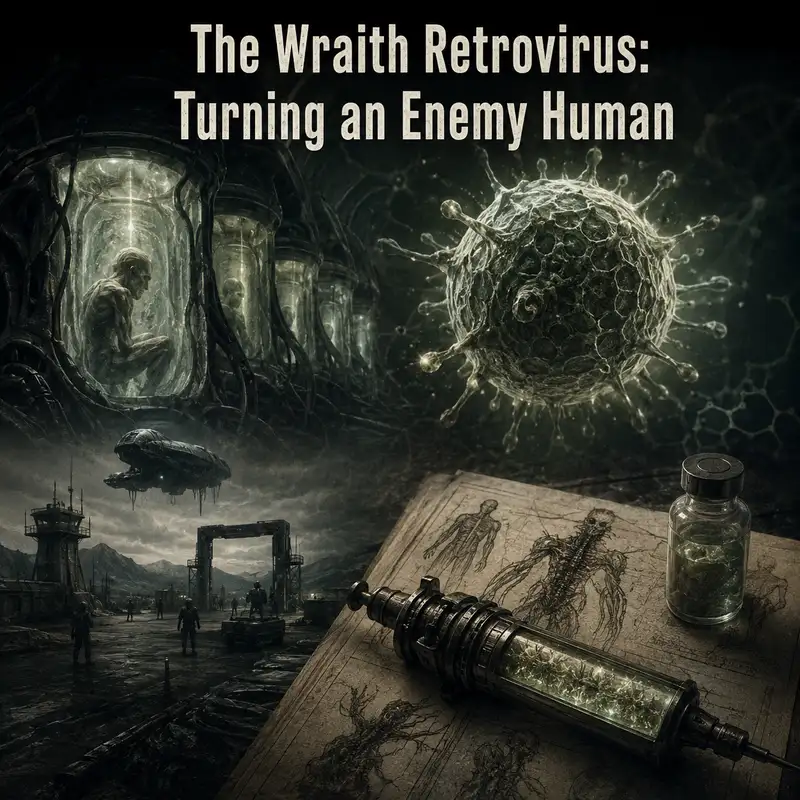
The Wraith Retrovirus: Turning an Enemy Human
A man woke in the Atlantis infirmary with no memory, a military rank he had never earned, parents who did not exist, and a daily injection described as insulin. The personnel around him called him Lieutenant Michael Kenmore. They said he had been captured by the Wraith and rescued after sacrificing himself for his team. The room, the medical chart, the photographs, and the carefully rehearsed concern all supported the same story. Nearly every part of it was false. Michael had not been rescued from the Wraith. He had been captured by Atlantis, chemically transformed, and given a human identity before anyone knew whether that identity could survive.
The Wraith retrovirus was one of the expedition’s boldest attempts to solve the central military problem in Pegasus. Atlantis faced an enemy with greater numbers, powerful warships, and a biological need to feed on human beings. Conventional victory required destroying hive ships faster than the Wraith could replace them, a contest the expedition could not sustain. Carson Beckett’s alternative was to attack the enemy’s biology. If the Wraith could be turned into humans, a hive might be neutralized without being destroyed. The unanswered question was whether changing a body could also change an enemy.
Within the expedition’s understanding of Wraith evolution, the species had developed from the Iratus bug after that predator fed on human beings and gradually incorporated human characteristics. Wraith physiology therefore contained both human and Iratus-derived elements. Beckett designed a retrovirus to suppress the Iratus components of the genetic code while leaving the human aspects behind. The concept forced one side of a hybrid biology to dominate the other. It sought to remove the feeding mechanism, enhanced strength, telepathy, and the other traits that made a Wraith recognizably Wraith.
The name retrovirus made the project sound narrower than it was. This was not a vaccine that prevented a disease or a temporary combat stimulant. It was an attempt to rewrite the operating balance of a sentient organism. Even after the main transformation, the process required a combination of drugs to keep the Wraith characteristics from returning. Beckett had not developed a permanent lifetime treatment. A transformed subject needed another injection every day. That was manageable for one closely watched patient. Across a hive carrying hundreds or thousands, it became a medical supply chain, detention system, and security mission.
The attraction to Atlantis was obvious. A weaponized aerosol could, in theory, pass through a hive’s air-handling system and affect the crew without breaching every compartment. The expedition might capture a ship intact, recover its database, and remove a military threat without a prolonged boarding action. It also offered a possible answer to Wraith feeding itself. If a Wraith became human, the transformed individual could survive on ordinary food rather than human life. The project sat at the intersection of medicine and warfare, where ethical language becomes both necessary and inconvenient.
The first field exposure should have encouraged greater caution. On an isolated world, Beckett encountered Ellia, a young Wraith raised by a human named Zaddik. She had learned human language, affection, and restraint, though she secretly continued to feed. Beckett hoped that studying a cooperative subject could accelerate research that had so far produced little success in laboratory cell cultures. Ellia overheard that the retrovirus might make her human and injected herself before the treatment was ready. She was not coerced, but she was frightened, isolated, and acting on a promise no physician could guarantee.
The result was the reverse of what Beckett intended. Ellia’s human characteristics receded while her Iratus-derived traits became more pronounced. She grew stronger, more aggressive, and physically less human. During the resulting confrontation, a wound she inflicted transmitted the Iratus bug retrovirus to John Sheppard, beginning a transformation that nearly killed him and required another improvised medical solution. The incident showed that the retrovirus could produce rapid systemic change, that its direction was not reliably controlled, and that its effects could escape the original subject. In a conventional weapons program, any one of those findings would have delayed operational deployment. Pegasus did not offer conventional timelines.
Beckett continued the work and eventually produced a viable treatment. Atlantis then moved from a volunteer who had taken an unfinished drug to a captured Wraith who had not consented at all. The expedition’s rationale was wartime necessity. The Wraith culled human worlds, fed on prisoners, and represented an existential threat to Atlantis and potentially Earth. That context explains why Elizabeth Weir approved the experiment. It does not make the subject’s consent irrelevant. The operation was designed to transform an enemy prisoner, conceal what had been done, and test whether a fabricated human life could replace his identity.
The transformed Wraith awoke physically stable and apparently human. He could eat ordinary food, move through the city, and interact without immediately attacking anyone. Atlantis personnel gave him the name Michael Kenmore, assigned him the rank of lieutenant, and built a biography around a supposed military career. A photograph supplied him with parents in Texas, and a cowboy hat helped furnish invented quarters. Teyla told him they had been friends. Psychologists explained his blank memory as trauma. The deception was institutional, involving command, medicine, security, and people Michael was encouraged to trust.
The daily injections were described as insulin for diabetes. In reality, they contained the drugs required to prevent reversion. The lie created an immediate intelligence problem. Michael noticed that people watched him carefully, that Ronon treated him with open hostility, and that familiar Wraith technology stirred knowledge he supposedly did not possess. Dreams and instincts contradicted the identity Atlantis had constructed. Every security measure told him he was dangerous, while every official explanation insisted he was one of them. The cover story’s inconsistencies became increasingly suspicious.
When Michael discovered the truth, the retrovirus had already succeeded biologically and failed politically. He was not grateful to have been made human. He understood himself as a Wraith who had been captured, altered, and deceived. He asked what right Atlantis had to do this and whether human conduct was truly more compassionate than Wraith conduct. The comparison did not erase the Wraith practice of feeding on sentient people. It exposed a narrower contradiction. Atlantis claimed moral distinction while denying this prisoner control over his body, history, and identity.
The command response deepened the failure. Michael refused further treatment. Beckett considered increasing the dosage, and the expedition decided that it would insist if he did not cooperate. The alternative was effectively death, either by execution or uncontrolled reversion into a captive enemy. Atlantis had created a condition that only Atlantis could maintain, then treated dependence on that maintenance as justification for continued control. A treatment requiring daily administration had become a weapon enforced through custody.
Michael escaped, killed Sergeant Cole during the attempt, and took Teyla hostage. His actions confirmed that he remained dangerous, but they did not prove that the original experiment had been justified. They showed that the expedition had combined a hostile prisoner, unstable biology, recovered memory, and access to a sensitive base. As the maintenance drugs wore off, his reversion accelerated. He rapidly recovered much of his Wraith physiology without losing memory of what Atlantis had done. When he returned to his own kind, he carried the knowledge that Atlantis still existed and whatever additional intelligence he had gathered inside the city.
That outcome turned a medical experiment into a strategic security breach. The expedition had spent considerable effort preserving the illusion that Atlantis had been destroyed during the siege. Michael could compromise that deception. He knew the city’s personnel, internal procedures, medical capabilities, and interest in biological warfare. Even incomplete recollections were valuable. The retrovirus had failed to remove the enemy’s identity, but the experiment had given that enemy access to Atlantis under conditions no ordinary infiltrator could have achieved.
Michael’s return to the Wraith did not restore his former place. His transformation marked him as contaminated and suspect. To many Wraith, he looked like one of them again but no longer belonged fully among them. Atlantis had not converted him into a human ally. It had made him politically homeless. That isolation became one of the project’s most consequential products. Michael possessed Wraith knowledge, human experience, and a grievance against both societies. A biological weapon intended to simplify the war had created an actor whose interests no longer aligned cleanly with either side.
The Wraith civil war soon gave the retrovirus another role. A hive faction approached Atlantis through Michael and proposed using the treatment against rival hives. The faction did not seek peace with humans or liberation from feeding. It wanted to convert competing Wraith into defenseless humans and then feed on them, reducing both the rival population and the immediate shortage of prey. The offer showed how quickly a supposedly humane alternative could become an instrument of extermination. It also showed why Atlantis considered cooperation. A divided enemy offered opportunities that a united Wraith fleet did not.
The operational plan was technically plausible. Atlantis would package the retrovirus as a gas and use Asgard transport technology to place a canister inside a target hive’s carbon-dioxide processing chamber. The ship’s circulation systems would distribute the agent. The method avoided fighting through organic corridors against telepathically linked defenders. Yet it depended on accurate schematics, working transporters, defeated jamming, enough time for the transformation, and a follow-on force prepared to secure the result. The retrovirus took roughly ten hours to complete its work. In combat, ten hours is not an effect. It is a scheduling problem with enemies.
The alliance collapsed before the planned strike. Wraith-provided schematics contained a computer worm that penetrated Atlantis systems and copied sensitive information, including gate addresses and data that helped the Wraith improve intergalactic travel. Two hive ships then moved toward Earth. The partnership had become a counterintelligence operation against Atlantis. Michael later helped Sheppard’s people escape and oppose the hives, but the damage was already done. Trust had been extended to a faction whose strategic objective remained predation, and technical access had been granted before the intelligence relationship was secure.
The first mass use of the retrovirus came not as part of the original plan, but as an emergency aboard the crippled Daedalus. After the battle between Earth and Wraith ships, life support was failing. The only breathable atmosphere within reach was aboard a surviving hive. Michael had disabled the relevant jamming codes, allowing the Daedalus to beam the gas into the enemy ship. The crew then waited while air supplies declined and the retrovirus worked. It was an improvised boarding preparation conducted because every conventional alternative promised death.
Tactically, the gas succeeded. The Wraith aboard the hive transformed, resistance collapsed, and the survivors from the Daedalus gained control of an enemy vessel. The official count was just under two hundred. Many Wraith had died during the battle, while others killed one another as the change began. The number was small compared with the thousands a hive might carry, but it was far beyond anything Beckett had treated before. Atlantis had demonstrated that the retrovirus could be dispersed through a ship and produce a ship-wide effect. It had not demonstrated what to do the morning after.
The captured hive was valuable but difficult to operate. Its organic systems and neural interfaces were designed for Wraith users. Teyla could guide the vessel, but even straightforward flight was exhausting, and complex maneuvering or weapons control remained uncertain. The transformed crew had to be placed in stasis during transit, consuming power on a damaged ship. Atlantis had gained a platform, prisoners, and an urgent biomedical obligation at the same time. Capturing enemy technology is useful. Capturing its crew with a requirement to medicate everyone indefinitely complicates the inventory.
The expedition moved the transformed Wraith to a planet without a Stargate. Isolation prevented an easy escape and reduced the chance that they could reveal Atlantis or Earth. They were told that a plague had destroyed their community and damaged their memories. Beckett’s daily injections were presented as treatment for the illness. The prisoners were taught to administer the medication and were expected eventually to support themselves through farming. On paper, the settlement converted combatants into civilians. In practice, it was a guarded colony built on a false history and dependent on Atlantis’s drug supply.
No permanent solution existed. Missing doses risked reversion, renewed hunger, and telepathic contact with nearby Wraith. Keeping everyone compliant required medical stocks, trained personnel, observation, and confidence that the cover story would hold. It also required Atlantis to decide what legal and political status these people possessed. They were biologically altered captives, experimental subjects, potential civilians, and intelligence threats at once. No category resolved the others. International oversight did not create a durable destination for nearly two hundred people who could neither leave safely nor be abandoned.
Michael was transformed a second time and placed among them. He argued that erasing his consciousness would be indistinguishable from killing him. Atlantis proceeded because he knew too much to release and was too dangerous to keep as a Wraith. The second transformation served less as therapy than containment. It also repeated the first experiment’s central mistake. The expedition treated memory loss as proof of a new identity rather than evidence that a person had been deprived of the old one.
The colony began to unravel even while the medication continued. Some subjects experienced flashes of memory and recognized that the injections were maintaining their condition rather than curing a plague. Michael organized those who were recovering. He killed Lathan when the other man threatened to expose the plan, demonstrating that resistance to Atlantis did not make Michael benevolent toward his own followers. Reverting Wraith captured Beckett and killed the military team sent to support him. Those still in human form became potential victims of those who could feed again.
A distant hive altered course toward the planet, apparently drawn by the combined telepathic reach of the reverting group. Choosing a world without a gate protected the gate network, but not the planet from space. Atlantis had treated the absence of a doorway as containment while dealing with an enemy that traveled by starship. That was a gate-centered security assumption applied to a spacefaring threat. Once the hive arrived, the colony could become a rescue point for Michael, a feeding ground for the Wraith, and a source of intelligence about Atlantis.
Sheppard had placed a Mark Nine nuclear device beneath the camp as a failsafe. Michael anticipated that some secondary measure existed, forced Beckett to help locate it, and disabled the weapon before Atlantis could detonate it. The bomb revealed the actual limits of the humanitarian settlement. Atlantis hoped the transformed Wraith could live as human beings, but it had also prepared to destroy the entire community if control failed. The failsafe was militarily understandable. It was also a confession that the expedition never trusted its own cure enough to accept the people it created.
After Beckett was rescued, Sheppard used the captured hive’s weapons against the camp. More than one hundred individuals still appeared human and believed Atlantis had saved them. They were nevertheless considered unacceptable security risks because Michael might have restored their memories and told them how to find Atlantis or Earth. The bombardment’s exact effectiveness remained uncertain, though the Daedalus later detected no life signs. A program conceived as an alternative to killing Wraith ended with Atlantis firing from orbit on people it had made human.
Measured tactically, the retrovirus worked. It could neutralize a hive crew, enable capture of a warship, and reduce the need for a costly compartment-by-compartment assault. Operationally, it was slow, dependent on specialized delivery, vulnerable to jamming, and followed by a detention burden larger than the assault force. Measured strategically, it failed. It did not produce allies, end culling, or create a sustainable way to manage transformed Wraith. It compromised intelligence, consumed scarce resources, and helped create Michael as an independent enemy with knowledge of both human and Wraith systems.
The moral assessment is no simpler than the military one. The Wraith fed on sentient populations and would have destroyed Atlantis if given the opportunity. Defending human lives did not require the expedition to pretend otherwise. Yet the subjects of the retrovirus were also sentient beings whose bodies and identities were altered without consent. War can justify lethal force against combatants. It does not automatically convert every possible experiment into medicine. Calling the process a cure assumed that Wraith identity was itself a disease and that human form was the only acceptable outcome.
The deeper failure was conceptual. Beckett’s work proved that Wraith biology could be changed. Atlantis then assumed that biology was the decisive source of allegiance, memory, culture, and moral choice. Michael disproved that assumption. He retained enough continuity of self to understand what had been done, and every attempt to suppress that continuity intensified his hostility. The transformed colony did the same at scale. Human physiology did not erase Wraith memory, and amnesia did not create human loyalty. A new digestive system could change what the subjects ate. It could not tell them whom to trust.
The retrovirus also changed the war after the formal experiment ended. Michael later used his knowledge of human and Wraith biology to pursue a program of engineered hybrids. His methods were brutal and his objectives were his own. Yet the program extended the same premise Atlantis had introduced into his life: Wraith identity could be treated as manipulable material, and biology could be redesigned for military ends. The expedition had intended to remove the Wraith from an enemy. Michael instead sought to build a species that belonged fully to neither society and answered only to him.
The Wraith retrovirus was neither a simple failure nor a lost path to peace. It was a genuine technological achievement that solved a narrow battlefield problem and created larger human, political, and strategic problems immediately behind it. Atlantis learned how to turn an enemy’s body into something human. It never developed a reliable lifetime treatment, a workable system of consent, a secure settlement, or a political future for those transformed. The project answered the biological question and exposed the one the war had encouraged its designers to ignore. Human physiology could be imposed by injection. Humanity could not.