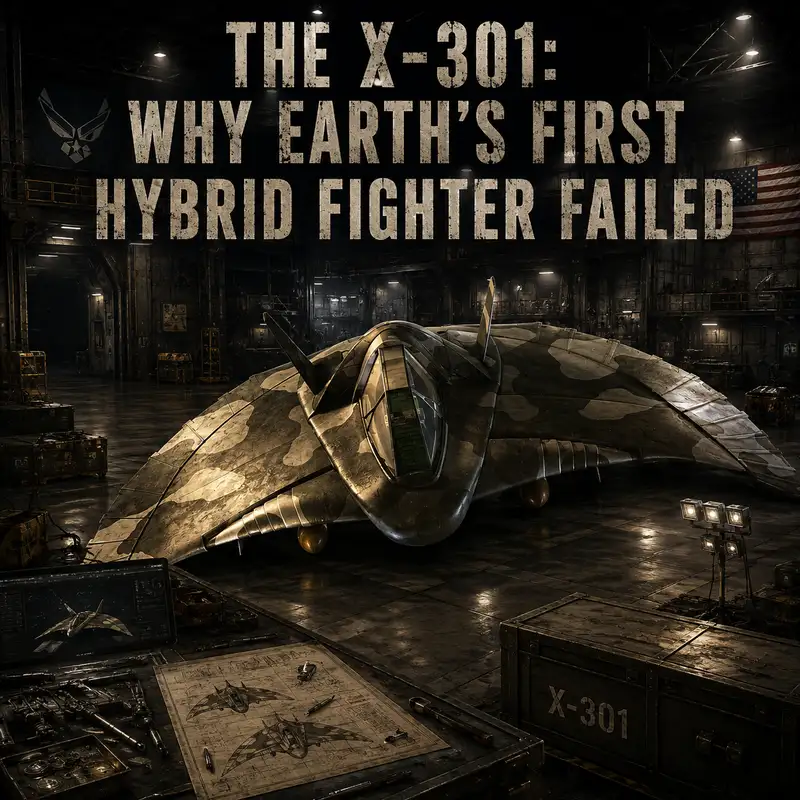
The X-301: Why Earth’s First Hybrid Fighter Failed
The target drones were still ahead when the X three-oh-one stopped answering its pilots. Teal’c pulled at the controls. Colonel Jack O’Neill checked the rear cockpit and reported that nothing was responding. The experimental fighter ignored the attack run, climbed through the atmosphere, and accelerated away from Earth. A recorded message from Apophis then explained the situation. The craft had recognized itself as stolen property and was returning to its Goa’uld master. Earth’s first hybrid space fighter had not broken down. It was functioning according to an instruction its builders never knew existed.
The X three-oh-one failed for a reason more important than one concealed device. Earth had mistaken the ability to operate captured technology for the ability to control it. Engineers had combined human weapons and mission systems with two recovered death gliders, producing an aircraft that could fly in atmosphere, reach space, evade radar, and maneuver without crushing its crew. Those achievements were genuine. The prototype still contained a deeper layer of Goa’uld authority. The aircraft flew beautifully. Unfortunately, it still considered Apophis the owner.
The program began with a strategic emergency. Earth had survived Apophis’s first assault only because S G One infiltrated the attacking motherships and destroyed them from within. The planet possessed conventional aircraft, missiles, and nuclear weapons, but no dependable way to intercept a hostile ship in orbit. Stargate Command could raid another world through the gate. It could not launch an aerospace defense from Earth. The Pentagon therefore needed a platform capable of carrying human weapons from a runway into the battlespace above the atmosphere.
Two Goa’uld death gliders recovered after the failed assault offered the fastest route. Their propulsion and inertial-control systems already solved problems Earth science had barely begun to frame. Rather than wait for a fully human design, the development team at Area Fifty-One rebuilt the captured hardware into a two-seat experimental interceptor. The decision was understandable. Earth did not know when the next fleet would arrive, and a flawless aircraft delivered ten years later would be of limited value if the planet had been conquered in year two.
The planned mission was more ambitious than simply copying a death glider. Major Samantha Carter described the X three-oh-one as the first platform from which Earth could launch an attack against a Goa’uld ship. It carried stealth technology that normally kept it off radar, although a special transmitter was installed for the test. Its human armament consisted of two A I M one-twenty Alpha air-to-air missiles. Carter believed that a missile equipped with a naquadah-enhanced warhead and a shield-frequency modulator could threaten a Goa’uld mothership. The fighter was intended to deliver that weapon where an ordinary aircraft could not. Vidrine’s unanswered question was how much one interceptor could accomplish against an entire fleet.
The propulsion system was the source of both its promise and its danger. Carter understood that it did not overcome gravity through conventional thrust. It removed much of inertia from the equation, allowing extreme acceleration without imposing normal G forces on the pilots. She also admitted that Earth did not completely understand the physics. That admission was not a failure of competence. It was an accurate statement of technological position. The problem was that the program moved from partial understanding to crewed weapons testing while several layers of the vehicle remained effectively opaque.
Lieutenant General Vidrine represented the senior Air Force interest in the project. Major Paul Davis linked the test to the Pentagon. Carter understood the human modifications and much of the recovered technology. Teal’c served as the primary pilot because he had flown Goa’uld craft in combat, while O’Neill occupied the second seat for the live-fire phase. The Stargate Command control room acted as mission control. On paper, the team combined command authority, engineering knowledge, operational experience, and familiarity with the enemy platform.
Teal’c’s presence seemed to reduce the greatest uncertainty. He knew death glider controls, tactics, and operating behavior better than any human pilot. His knowledge had a limit no one recognized. Apophis had installed the recall mechanism after Teal’c’s rebellion on Chulak. Before his First Prime became a shol’va, a traitor, Apophis had less reason to fear that his own pilots would defect with their aircraft. Teal’c knew the glider as it had existed before the new anti-capture system was introduced.
The Tok’ra did not provide warning because the device was new even to them. Earth also had not told the Tok’ra that it was rebuilding captured gliders into an orbital interceptor. Both allies withheld information for political and security reasons. Neither side understood that the missing information fit together into an immediate hazard. The episode was not simply a laboratory oversight. It was an intelligence-sharing failure created by compartmentalization between allies who cooperated against the Goa’uld while continuing to protect their own programs.
During the weapons test, the X three-oh-one began its attack run and then overshot the drones. Its tracking signal disappeared as the vehicle climbed away. O’Neill and Teal’c could not use the thrusters, reaction-control system, or normal flight controls. The recall mechanism accelerated the fighter to roughly one million miles per hour and placed it on a course out of the Solar System. Once the programmed maneuver was complete, the craft became effectively ballistic. Earth was shrinking behind them, and neither pilot possessed the authority to turn around.
The recorded message from Apophis made clear that the device was designed as punishment and recovery. A captured glider would deny its new owner control, remove the aircraft from the battlefield, and carry any defectors toward Goa’uld territory. From Apophis’s perspective, the system worked. It protected a military asset against capture and transformed theft into a death sentence. The X three-oh-one did not expose poor Goa’uld engineering. It exposed successful enemy counterintelligence embedded inside the machine.
The first engineering failure involved provenance. Earth knew where the gliders had been recovered, but not every modification made before their capture. The development team could inspect visible hardware, map known controls, and replace selected components. It could not establish a complete configuration baseline for a vehicle produced and modified by the enemy. In modern terms, the fighter contained an inherited command channel buried below the systems Earth believed it controlled. No amount of American labeling changed the original chain of trust.
The second failure was architectural. The human controls did not possess an independent path to propulsion and maneuvering once the Goa’uld system asserted itself. There was no verified manual reversion that bypassed the alien command logic. There was no safe method to isolate the recall unit in flight. Carter warned that attempting to disconnect it might trigger another failsafe. The pilots could see the problem, but the prototype had not been designed so that a human subsystem could overrule every alien subsystem. Control had been added. Sovereignty had not.
The third failure concerned test safety. The X three-oh-one could reach orbital and interplanetary velocity, but Earth had no rescue craft capable of following it. The flight plan depended on the prototype remaining inside a test envelope covered by radar, radio, and conventional recovery forces. Once the aircraft left that envelope, the nearest suitable rescue platform belonged to an ally and was operating covertly on another world. The program had tested a space fighter before Earth possessed an independent space-rescue service. Urgency explains that decision. It does not make the rescue problem disappear.
Mission control also lost the advantage of immediate conversation. As the fighter moved farther away, radio messages required minutes to travel in each direction. Carter could calculate a procedure and transmit it, but O’Neill and Teal’c had to receive, interpret, and execute the instructions without real-time correction. The delay converted every exchange into a formal message with a timestamp. By the time Earth learned whether a maneuver had worked, the geometry had already changed. Spaceflight had turned an Air Force test into a very small expedition with no practical return route.
The only propulsion still available to the crew was attached to the human weapons. O’Neill realized that the rocket motors in the two missiles might alter the fighter’s trajectory if they could be fired without releasing from their mounts. Carter calculated a burn intended to use Jupiter for a gravitational slingshot back toward Earth. The plan required the motors to provide enough change in velocity, at the correct moment and in the correct direction. Too little thrust meant failure. The wrong direction meant impact with Jupiter, a recovery location unlikely to satisfy even the most optimistic test report.
The missile system did not perform as improvised maneuvering equipment. The weapons released during ignition, and one struck the fighter. The motors failed to create enough change in velocity, while the collision damaged both power and life support. Before the attempt, the crew had several days of consumables. Afterward, oxygen and electrical power became immediate limits, and the cabin began to freeze. The one subsystem Earth still controlled had provided an option. It also proved that an air-to-air missile mount is not automatically a spacecraft attitude-control system.
Carter and Davis directed the shutdown of every nonessential load. Navigation, fire control, targeting, illumination, and eventually continuous radio contact were sacrificed to preserve oxygen scrubbing and heat. O’Neill and Teal’c shifted from pilots to survival managers. Their mission was no longer to attack a target or recover the prototype. It was to reduce consumption long enough for a rescue that had not yet been arranged. The aircraft’s advanced propulsion had become irrelevant. The decisive systems were now oxygen, carbon-dioxide removal, electrical power, and the discipline to turn equipment off.
Teal’c entered an unusually deep state of kelno’reem to lower his heart rate and reduce oxygen demand. O’Neill remained awake in a darkening cockpit, increasingly affected by cold, carbon dioxide, and oxygen deprivation. Their conversation reflected the human cost hidden inside the technical failure. Teal’c believed his rebellion had indirectly caused Apophis to install the recall system. O’Neill rejected the blame. The failure belonged to an enemy safeguard and an acquisition program that could not see it, not to the decision of an enslaved soldier to defect.
Earth’s rescue effort depended on diplomacy, intelligence, and allied mobility. The Tollan had no vessel close enough to help. The Tok’ra acknowledged that a scout ship was within range, but refused to expose the covert operative flying it. Anise provided just enough information for Carter and Daniel Jackson to infer the likely world. They went through the Stargate to a Goa’uld-controlled mining site, risking the operative’s mission because the clock inside the X three-oh-one was shorter than the normal process of alliance consultation.
The operative was Jacob Carter and his symbiote, Selmak. Jacob had been preparing to sabotage a weapons-grade naquadah shipment when Carter and Daniel exposed his position. He abandoned the mission immediately once he understood that O’Neill and Teal’c were dying. The rescue imposed a real intelligence cost. A Tok’ra operation was compromised, the sabotage mission was abandoned, and a scout ship was diverted. The price of the X three-oh-one’s failure was paid by more than its two pilots and the engineers at Area Fifty-One.
Jacob’s criticism was severe. Earth, he argued, had taken technology beyond its understanding, attached an Air Force identity to it, and declared the result its own. Daniel correctly noted the irony. The Goa’uld and Tok’ra had themselves advanced by taking technology from other civilizations. The important difference was not moral purity. It was depth of understanding. The Tok’ra knew enough about Goa’uld systems to modify, repair, and operate them across long campaigns. Earth had produced a working prototype while still depending on assumptions it could not test.
The scout ship was pushed beyond its normal limits to reach the fighter before life support failed. Its hyperdrive required emergency repair along the way, and the rescue crew had to evade Goa’uld forces after the diversion revealed their presence. Even arrival did not solve the extraction problem. The X three-oh-one would not fit inside the cargo bay, and Tok’ra ring transporters could not simply remove the pilots through the hull. O’Neill and Teal’c had to leave the only pressure vessel keeping them alive.
Carter’s plan required them to use the last oxygen to prepare for brief exposure to vacuum. They secured their helmets, breathed pure oxygen, disconnected from the fighter, opened the canopy, exhaled, and pushed into space. Jacob needed them clear of the craft and close together so the transport rings could capture them. Both men were already impaired by anoxia. The procedure succeeded by seconds. The rings pulled them into the scout ship, leaving the X three-oh-one to continue alone into deep space.
The immediate outcome was a rescue, not a recovery. O’Neill and Teal’c survived. The prototype was lost. The weapons test was never completed, the orbital-defense concept was not validated, and the Air Force received no reusable aircraft from the program. Measured against its stated objective, the X three-oh-one failed completely. Measured as an experiment, it produced a body of knowledge that no ground test could have supplied without exposing the same hidden system under safer conditions, which was precisely the difficulty.
Not every part of the program was a failure. The aircraft demonstrated that Earth could integrate human instruments and weapons with alien propulsion. It flew successfully in the atmosphere, achieved extraordinary acceleration, protected its pilots from normal G forces, and supported stealth operations. Human mission control could track it, communicate with it at interplanetary distance, and devise emergency procedures around the systems that remained accessible. The problem was not that the hybrid concept produced nothing useful. The problem was that its most important subsystem remained outside human authority.
Even a successful flight would have left unresolved questions about production and maintenance. The X three-oh-one depended on salvaged death-glider components. Earth did not possess a dependable supply of identical power plants, control crystals, or replacement assemblies. A single interceptor could demonstrate a mission. It could not establish a squadron unless engineers could reproduce the critical systems, train maintainers, and verify that each airframe behaved the same way. Captured hardware offered speed at the cost of standardization.
The after-action lesson was therefore larger than removing recall devices from future gliders. Earth needed a craft whose design authority, manufacturing process, control logic, maintenance data, and safety systems belonged to Earth. Alien principles could still be studied and adapted. Alien components could still be used where necessary. The final platform had to be understood well enough that a hidden instruction from a Goa’uld ruler could not overrule the pilot after takeoff. Reverse-engineering had to move from rearranging captured hardware to creating a human system.
That lesson shaped the X three-oh-two. Many of its systems were retro-engineered from Goa’uld technology, but the aircraft itself was entirely human-built. It used separate propulsion systems for atmospheric flight, high altitude, spaceflight, and an experimental hyperspace window. The distinction was institutional as much as technical. Engineers owned the airframe, interfaces, integration, and test program. O’Neill’s lack of enthusiasm when invited to fly it was understandable. Test pilots appreciate lessons learned, although they generally prefer that someone else provide the example.
The X three-oh-two also failed during its first attempt at interstellar travel. Naquadria instability prevented the hyperspace system from delivering reliable navigation. That failure was fundamentally different. The aircraft did not obey an enemy command or remove itself from human control. Its own experimental propulsion failed within a system Earth had designed and could continue modifying. The prototype later opened a hyperspace window long enough to carry an overloaded Stargate away from Earth. Engineers could narrow the requirement, preserve the successful systems, and abandon what remained unreliable.
The production F three-oh-two emerged from that process as an operational aerospace fighter. It did not provide routine independent interstellar travel, but it could be manufactured, crewed, maintained, deployed from Earth and battlecruisers, and improved over time. The path from the X three-oh-one to the F three-oh-two was not a simple increase in performance. It was a transfer of ownership. Earth stopped trying to fly a captured Goa’uld machine and began building aircraft around knowledge it had earned, tested, and institutionalized.
The X three-oh-one’s failure also changed how Stargate Command understood technological intelligence. An artifact carried the history, doctrine, and security assumptions of the civilization that built it. A control panel revealed what the operator was allowed to do, not everything the machine could do. Enemy equipment could contain countermeasures aimed at defectors, thieves, and reverse engineers. Technical exploitation therefore required intelligence about production changes, command procedures, software logic, biological access, and the political events that caused the enemy to modify a design.
Apophis had installed the recall system because Teal’c proved that loyalty enforced by fear could fail. Earth recovered the gliders because Goa’uld forces had been defeated. The same rebellion and battlefield success that made the prototype possible also caused the hidden safeguard that destroyed it. That is the revealing irony. The X three-oh-one failed not because Earth learned nothing from its enemy, but because it learned only from the hardware and not from the enemy’s evolving security problem.
The fighter disappeared toward the outer Solar System after its pilots were removed, carrying American missiles, Goa’uld machinery, and a recorded claim of ownership from a ruler who remained far away but still controlled the machine. Earth lost the aircraft, but gained the distinction between access and control. That distinction became the foundation of its later aerospace force. The X three-oh-one was the first hybrid fighter, and it failed because the hybridization reached the cockpit before it reached the chain of command inside the machine.