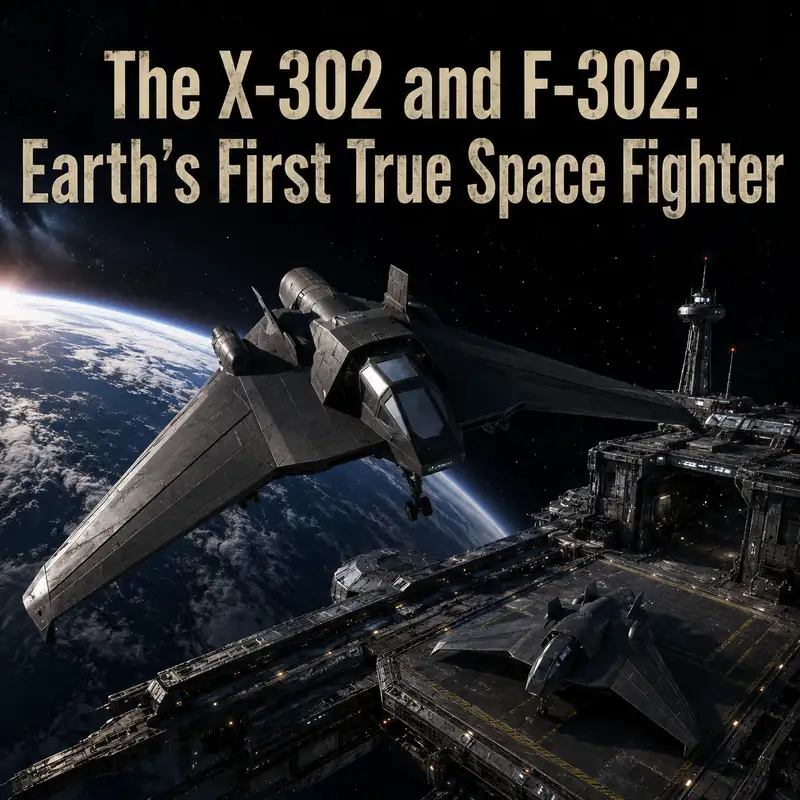
The X-302 and F-302: Earth’s First True Space Fighter
The X three-oh-two was aimed at a hyperspace window that refused to stay still. Colonel Jack O’Neill held the aircraft on course while Major Samantha Carter watched the navigation solution collapse. The destination was Abydos, and the mission was supposed to prove that Earth had built its first spacecraft capable of interstellar travel. Instead, fluctuations from the naquadria power source prevented the craft from locking onto the target. The autopilot took control, aborted the jump, and returned the prototype safely to Earth. The flight had failed. That was the first sign that the program might succeed.
Earth’s first true space fighter did not earn that description because every system worked. Its most ambitious system did not work reliably at all. The X three-oh-two became important because it was human-built, human-controlled, and capable of failing in ways human engineers could study. Its predecessor, the X three-oh-one, had been a pair of captured Goa’uld death gliders wrapped around American controls and weapons. When a hidden recall device activated, the pilots lost the aircraft completely. The X three-oh-two failed under its own safety logic. That difference was the foundation of the F three-oh-two fleet.
The requirement had emerged from a strategic weakness exposed by Apophis. Earth could send four-person teams across the galaxy through the Stargate, yet it had almost no ability to defend the space above its own atmosphere. Conventional fighters could not reach a Ha’tak in orbit. Ground-launched missiles could threaten targets only under favorable conditions, and alien shields made even nuclear weapons uncertain. S G One had stopped the first invasion by infiltrating the enemy ships. It was a remarkable special operation and a poor substitute for a standing aerospace defense.
The X three-oh-one had been the fastest possible answer. Engineers recovered two death gliders, joined them into a two-seat interceptor, added familiar instruments, and armed the craft with human missiles. The resulting aircraft flew, maneuvered in space, and appeared to give Earth a platform from which to attack a Goa’uld mothership. Then Apophis’s hidden anti-theft system overrode every human control and carried O’Neill and Teal’c away from Earth. The prototype demonstrated that captured hardware could preserve an enemy chain of command long after the enemy crew was gone.
The next design requirement was therefore not simply greater speed or firepower. Earth needed ownership of the machine. Area Fifty-One built the X three-oh-two under Doctor Larry Murphy’s direction using systems reverse-engineered from Goa’uld technology, but the aircraft itself was constructed by human industry. Engineers controlled the airframe, wiring, software, cockpit, safety mechanisms, and integration. They did not understand every physical principle as completely as the civilization that had first developed it. They did understand enough to know where the controls led and who had authority after takeoff.
The X three-oh-two used four propulsion systems because no single engine could perform every part of the mission. Air-breathing jets handled conventional flight in the lower atmosphere. Modified aerospike engines supported the climb through thinner air at high altitude. A rocket booster accelerated the craft into space. A compact hyperspace generator was intended to provide interstellar movement. The architecture was inelegant compared with a death glider’s seamless alien propulsion, but it matched Earth’s actual knowledge. Human engineers combined technologies they could manage across separate flight regimes instead of pretending one recovered system solved everything.
Inertial dampeners made that combination survivable. Without them, the accelerations required for space combat would injure or kill the crew before the enemy had to participate. The system reduced the forces experienced inside the cockpit and gave the fighter maneuverability far beyond a conventional aircraft. The design still retained ejection seats, oxygen, familiar flight controls, and hundreds of automated protections. It was an alien-derived spacecraft built around the assumption that human pilots would eventually encounter a problem and need a recognizable way out.
The most ambitious component was the naquadria-powered hyperspace generator. A normal Goa’uld hyperdrive was too large for a fighter-sized craft. Naquadria offered far more energy than naquadah and allowed engineers to shrink the system. It also became increasingly unstable as more energy was drawn from it. That gave the X three-oh-two a compact engine with a power source least cooperative at the moment of greatest demand. The program had solved the size problem by creating a control problem.
The maiden flight exposed that limitation without destroying the aircraft. O’Neill and Carter took the craft through its atmospheric climb and prepared to open a hyperspace window toward Abydos. The window formed, but naquadria fluctuations made the destination lock unstable. The onboard safety systems recognized the error and aborted before the fighter entered hyperspace on an uncertain course. A successful test would have opened a new form of strategic mobility. The failed test produced something almost as valuable. It identified the system that was not ready while returning the crew and prototype for another attempt.
The distinction from the X three-oh-one could not have been clearer. The earlier aircraft had performed according to an enemy instruction no one on Earth could inspect or cancel. The X three-oh-two refused a dangerous jump because human engineers had designed it to protect the crew when navigation failed. In both cases, the pilot lost permission to continue. In the first case, Apophis made the decision. In the second, an Earth safety system did. A military service can correct an overcautious autopilot. Negotiating with a dead System Lord’s anti-theft software is a less promising maintenance procedure.
The failed hyperdrive test immediately became a strategic crisis because Anubis attacked Earth’s Stargate. His weapon transmitted energy through a locked wormhole and forced the gate to absorb an increasing charge. If the buildup continued, the naquadah ring would detonate with enough force to devastate the planet. The active wormhole blocked normal gate travel, which meant Earth could not ask the Asgard or other allies for help. The X three-oh-two had been the only independent interstellar option available. Its failed jump left the planet with a spacecraft that could reach orbit but not the ally it had been built to contact.
The solution was to stop treating the prototype as an interstellar courier and use it as a one-way launch vehicle. Crews removed the Stargate from Cheyenne Mountain, transported the sixty-four-thousand-pound ring to the surface, and attached it beneath the X three-oh-two. The combined load was carried to altitude on the back of a modified seven forty-seven. Radar, landing gear, and several safety systems had to be removed or disabled to accommodate the clamping arrangement. The aircraft had gone from experimental fighter to improvised planetary bomb-disposal system in less time than most programs require to approve a revised checklist.
O’Neill piloted the mission alone because the fighter could not be expected to return intact. After separation from the carrier aircraft, the overloaded X three-oh-two accelerated through the atmosphere, shifted from jet propulsion to aerospikes, and prepared for rocket ignition. An engine failure reduced power during the climb. The craft reached space, but it lacked the velocity needed to release the gate into a safe trajectory. Without another option, the aircraft and its explosive cargo would fall back toward Earth.
The rejected hyperdrive became the final option. Engineers overrode the safety protections that had aborted the earlier test and commanded the generator to open a window for approximately one second. No one could guarantee where the craft would emerge, whether the window would form inside the atmosphere, or whether the unstable fuel would fail before activation. O’Neill held the crippled vehicle on course, initiated the jump, and ejected as the X three-oh-two and Stargate entered hyperspace. The aircraft emerged more than three million miles away, where the gate detonated without destroying Earth.
The prototype was lost, but the mission preserved the program. The X three-oh-two had still not demonstrated dependable interstellar travel. It had demonstrated atmospheric launch, high-altitude transition, rocket-powered spaceflight, human control, emergency modification, and a brief hyperspace event under extreme conditions. More importantly, engineers understood why the normal mission had failed and why the improvised mission had worked. The aircraft had become a test article in the most literal possible sense. It gave its life to the data set.
Development continued because the failed system was only one part of the design. The operational aircraft received the designation F three-oh-two, marking the transition from experimental prototype to fighter service. Earth did not wait for reliable fighter-sized interstellar travel. It fielded the capabilities that were mature and restricted the hyperdrive to short controlled bursts when a mission justified the risk. This was an important act of discipline. Procurement programs often fail by demanding that every ambitious requirement survive. The F three-oh-two succeeded because Earth accepted a useful space fighter instead of waiting for a perfect miniature starship.
Production required an industrial network larger than Area Fifty-One. Colson Aviation developed the multiple-engine control system while remaining compartmented from the complete purpose of the aircraft. Other contractors supplied materials, avionics, structural components, and software without being told how their work fit into a hybrid space fighter. Secrecy protected the Stargate Program, but it also meant that no civilian company possessed the whole design picture. The F three-oh-two became human-manufactured through a distributed supply chain whose members were trusted with functions rather than the truth.
The arrangement carried political consequences. After Earth’s Stargate was destroyed during the Anubis attack, the United States negotiated for use of the Russian gate and shared plans associated with the X three-oh-two and X three-oh-three programs. The fighter was no longer merely a laboratory project. It had become a bargaining instrument between governments and a symbol of who benefited from alien technology. A craft intended to defend Earth was built inside an American command structure, financed through classified budgets, and increasingly connected to an international program whose partners wanted more than assurances.
Operational status required more than aircraft. The Air Force needed pilots, instructors, maintenance crews, simulators, spare parts, weapons procedures, rescue planning, and units capable of launching several fighters together. Training missions such as Blue Phoenix tested pilots against simulated death-glider attacks. Fighter personnel adopted the Snakeskinners identity and built a service culture around a mission that had not existed when Stargate Command opened. Earth’s first true space fighter became real when a new crew could fly one without Doctor Murphy or Samantha Carter standing beside the runway.
The production aircraft retained the design’s central strengths. It could take off from a relatively short runway, climb from atmosphere into space, maneuver under inertial dampening, carry two crew members, and return to a planetary surface. It could launch from the pressurized hangars of Earth battlecruisers and serve as an interceptor, escort, strike aircraft, reconnaissance platform, or emergency escape craft. Its weapons remained recognizably human, centered on missiles and projectile weapons rather than miniature Goa’uld energy weapons. The aircraft combined alien mobility with an American understanding of fighter employment.
Its limitations were just as important. The F three-oh-two could not maintain a hyperspace window long enough for routine interstellar travel. It depended on a carrier, a nearby planet, or a Stargate-based deployment system to reach distant theaters. It lacked the protective margins of a capital ship and could be destroyed by glider fire, collision, or heavier weapons. Its endurance, life support, and ammunition were finite. The fighter extended a commander’s reach. It did not become a self-sufficient warship simply because the cockpit had a view of orbit.
That dependence shaped its logistics. F three-oh-twos could be disassembled, carried through a Stargate in sections, and reassembled at an off-world base. This allowed Earth to deploy aerospace power to a planet without sending a battlecruiser across interstellar distance. The method required engineers, lifting equipment, parts, fuel, a runway, and time during which the destination gate and work site had to remain secure. The Stargate shortened the journey. It did not assemble the aircraft, train the ground crew, or persuade the enemy to postpone its attack until the torque checks were complete.
The first major operational use of the F three-oh-two exploited exactly that flexibility. Earth needed to disable Anubis’s new mothership weapon before it gave him dominance over the remaining System Lords. The fighter was broken down, sent through the gate to Vis Uban, and reassembled beside a makeshift runway. O’Neill and Carter would fly the strike mission while Daniel Jackson and Jonas Quinn infiltrated the mothership to locate the weapon’s external cooling shaft. The aircraft was only one part of a plan combining deception, intelligence collection, ground security, and an expected attack by rival Goa’uld forces.
Anubis’s shields created the tactical problem. The F three-oh-two’s weapons could not reach the cooling system while the shield remained between the fighter and the hull. Carter proposed using the unreliable hyperdrive for a controlled burst just long enough to move the aircraft into subspace, cross the shield boundary, and reemerge inside the defensive envelope. The calculation carried several possible outcomes, including missing the ship entirely or materializing inside it. The plan was approved because every safer option left the superweapon operational.
The burst worked. The fighter crossed the shield, received targeting data from the infiltration team, and struck the cooling shaft as the weapon powered up. The damaged system overheated, forcing Anubis to shut down his strategic advantage. The mission did not destroy the mothership, defeat every escort, or rescue every participant immediately. It achieved the specific objective for which the fighter had been deployed. That precision matters. The F three-oh-two’s first combat success came not from winning a dogfight, but from placing a small human weapon at the one point an advanced enemy could not afford to lose.
The maneuver did not become routine doctrine. It required exact intelligence on the target, a predictable shield boundary, a brief and carefully timed hyperspace event, and acceptance of a navigation error that could kill the crew instantly. The fact that the technique worked once did not transform the F three-oh-two into a shield-penetrating weapon available for every battle. It remained an exceptional use of an unreliable system under conditions that justified the risk. Earth had learned to distinguish a capability from a trick, which is a useful distinction for any air force and an essential one when subspace is involved.
The arrival of Prometheus and the later B C three-oh-four class gave the fighter its natural operational home. Earth’s battlecruisers carried F three-oh-twos in internal hangars and transported them between star systems. The larger ship provided strategic movement, sensors, command and control, maintenance, medical support, and recovery. The fighters extended the ship’s defensive perimeter, intercepted smaller attackers, escorted vulnerable craft, and allowed commanders to distribute weapons and sensors across a wider area. Earth had created the beginnings of carrier aviation in space, although the carrier could also fly between galaxies and occasionally required help from an Asgard engineer.
The Battle of Antarctica showed the value of that relationship. Prometheus and its fighter complement moved against Anubis’s fleet to protect S G One’s approach to the Ancient outpost. Cameron Mitchell led one of the F three-oh-two elements under the call sign Blue Leader and was critically wounded during the engagement. The fighters attacked death gliders and Al’kesh, drew enemy attention, and helped keep the airspace contested. They could not destroy the Ha’tak force by themselves. Their mission was to buy time for the team beneath the ice, and in that limited objective they succeeded.
This became the fighter’s recurring strategic role. F three-oh-twos accompanied Earth ships into the Pegasus galaxy, where they provided an aerospace option alongside Puddle Jumpers and battlecruiser weapons. They fought during the defense of Atlantis and in later operations against Wraith forces. In the Milky Way, they deployed against Goa’uld remnants, the Lucian Alliance, and the Ori invasion. At the supergate, fighters joined an allied fleet confronting Ori warships whose defenses and firepower were far beyond anything the X three-oh-two program had been designed to face. The aircraft remained useful even when it was not decisive.
The F three-oh-two also supplied components and mission options beyond air combat. Its inertial dampener, stealth-related systems, and ability to carry objects into orbit made it valuable to engineers planning unusual operations. That flexibility reflected the strength of a human-built platform. Earth could remove a subsystem, modify software, change a weapons load, or assign the aircraft to a new role without asking whether an enemy anti-theft program would object. Adaptability became a form of technological independence even when the underlying physics still came from alien discoveries.
The fighter did not erase the advantages of enemy craft. Death gliders were supported by mature Goa’uld production and long-established doctrine. Wraith darts combined high maneuverability with culling transport technology. Ori forces operated behind shields the F three-oh-two’s normal weapons could not reliably penetrate. Earth pilots survived through training, teamwork, carrier support, and tactical creativity rather than automatic technical superiority. The F three-oh-two gave them access to the battlefield. It did not promise control of it.
Its greatest achievement was institutional. The X three-oh-one had been a captured artifact with an American cockpit. The X three-oh-two was a prototype designed, tested, modified, and lost by a human program. The F three-oh-two was a fleet aircraft supported by squadrons, contractors, bases, battlecruisers, instructors, and doctrine. Earth could build another one after a loss. It could train another pilot, revise another component, and apply a lesson from one battle to the next production aircraft. That repeatability, not the hyperspace generator, made it Earth’s first true space fighter.
The irony is that the aircraft became operational only after Earth stopped insisting that it fulfill its original promise. The X three-oh-two was meant to cross interstellar distance on its own. The F three-oh-two usually reached war aboard a larger ship or in pieces passing through the Stargate. Its hyperdrive remained unreliable, its weapons remained limited, and its survival depended on forces around it. Yet squadrons of those imperfect fighters defended Earth, supported distant expeditions, and gave human commanders a controllable aerospace arm.
On its first flight, the prototype turned away from an unstable hyperspace window because its own systems knew the jump was unsafe. Years later, F three-oh-twos launched from human battlecruisers into wars across two galaxies. Earth’s first true space fighter was not defined by a flawless engine or a single dramatic victory. It was defined by ownership of the design, acceptance of its limits, and the ability to build the next aircraft after the first one failed.