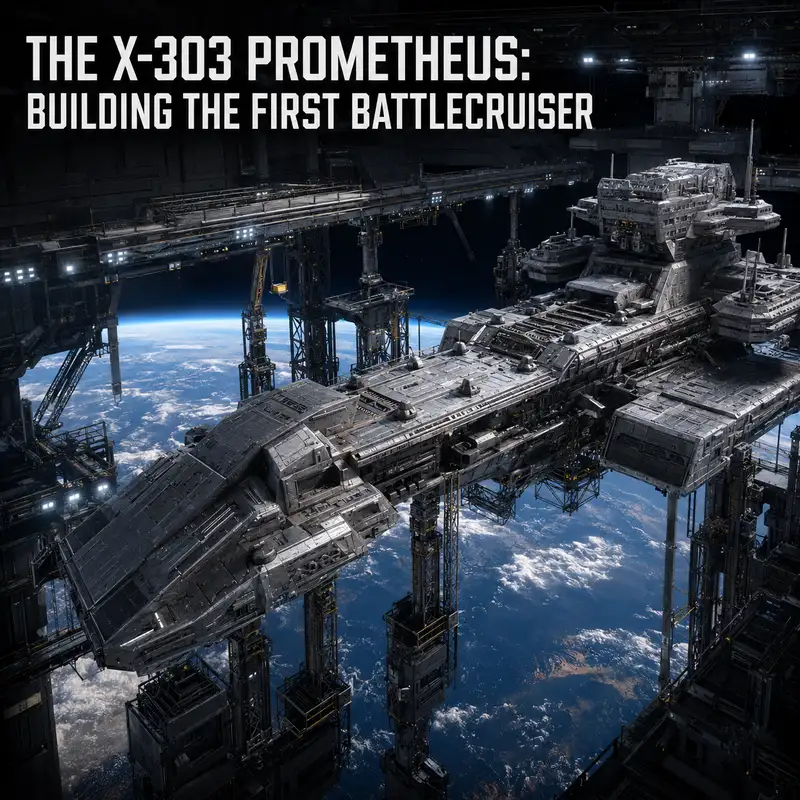
The X-303 Prometheus: Building the First Battlecruiser
The X three-oh-three rose from a hidden Nevada hangar before its builders had finished installing the support systems. Its radar was incomplete, portions of the interior remained under construction, and the people at the controls were not the assigned crew. Rogue National Intelligence Department operatives had seized the ship during a controlled media tour. Earth’s first battlecruiser entered service by being stolen. That was not the launch ceremony the Pentagon had planned, but it revealed the central truth of the Prometheus program. Building the ship was only one problem. Understanding, securing, crewing, and controlling it were four more.
Prometheus answered the weakness exposed by every early attack on Earth. Stargate Command could send small teams across the galaxy, sabotage an installation, or infiltrate a mothership. It could not hold orbit over its own planet. Conventional aircraft could not reach a Ha’tak, and conventional missiles could not be trusted against advanced shields. The X three-oh-two fighter provided an aerospace interceptor, but lacked the endurance, sensors, command facilities, and firepower required for independent operations. Earth needed a capital ship that could leave the Solar System, carry fighters, survive enemy fire, and operate when the destination Stargate was unavailable.
That requirement was far beyond Earth’s industrial experience. No human shipyard had built an interstellar warship. No logistics command maintained crystal-based systems, inertial dampeners, artificial gravity, ring transporters, or a hyperdrive. Scientists understood fragments of technologies recovered through the Stargate Program, but fragments do not automatically become a vessel. Prometheus was designed as a hybrid. Human engineers would provide the structure, controls, crew spaces, weapons procedures, and manufacturing system. Alien principles would provide the capabilities conventional engineering could not reach in time.
The program consumed several billion dollars over roughly two years and operated behind extraordinary secrecy. That money supported underground construction, specialized materials, prototype power systems, software integration, security, testing, and a supply chain whose participants often knew only the component assigned to them. The ship sat hundreds of feet beneath the Nevada desert behind an entrance that looked considerably less expensive than the project below. This was useful camouflage. It was also a reminder that a capital ship could not be built by a handful of scientists in one laboratory.
Secrecy created an engineering cost. Contractors could solve individual problems without knowing how their work interacted with the whole vessel. Technicians could be cleared for one compartment but not another. Failures crossing program boundaries were harder to diagnose because the people holding one piece of the answer might not know the other existed. The compartmentalization that protected Prometheus also helped a rogue network learn enough to seize it. A project of this size created thousands of decisions, and every decision produced another access point that had to be trusted.
The ship’s structure relied on materials such as trinium and naquadah that Earth could acquire but not treat as ordinary stock. Trinium offered strength at low weight, while naquadah supported power systems and alien-derived components. Critical functions used control crystals rather than familiar wiring and silicon electronics. The bridge, however, was built around standard human controls. The crew should not have to think like a Goa’uld to fly the ship, but the interface still had to command systems based on physics and materials developed by other civilizations.
Compatibility was the hardest part. A crystal-based propulsion control did not naturally communicate with an Air Force display. A Goa’uld ring transporter had to operate within a human security procedure. Alien inertial technology had to work with a hull and flight-control system built on Earth. Prometheus was a collection of technologies forced to cooperate inside the same vessel. When that cooperation failed, the crew could not call the original manufacturer. They usually called Samantha Carter, which was effective but not a sustainable fleet-maintenance doctrine.
Prometheus could move rapidly from the surface into space, land on a planet, and operate independently of a Stargate. Its sublight engines gave it tremendous acceleration, while inertial dampeners protected the crew from forces that would otherwise make the first launch its last. Artificial gravity allowed personnel to work through long missions without adapting every corridor and tool for weightlessness. These systems gave the ship alien-style mobility while preserving a human operating environment. They also consumed power and required constant coordination with structural and flight controls.
The original hyperdrive was the most ambitious and unstable system aboard. Earth lacked a compact, mature power source equal to the requirement, so engineers used naquadria as a shortcut to interstellar travel. Naquadria delivered enormous energy from a small quantity, but its output was difficult to regulate. The ship could open a hyperspace window and travel between stars. It could not do so with the reliability expected from a mature military transport. Prometheus had strategic mobility in principle and a significant chance of turning that mobility into an engineering emergency in practice.
The battlecruiser was also a carrier, designed to deploy eight X three-oh-two fighters, later redesignated F three-oh-twos. Those aircraft extended its sensors, defended it against smaller craft, escorted friendly vessels, and struck targets that did not justify placing the larger ship directly in danger. Prometheus could transport the fighters across interstellar distance, provide command and maintenance support, and recover pilots after battle. A carrier wing does require the carrier to remain intact, an assumption later operations tested with some enthusiasm.
Its own weapons initially reflected Earth’s transitional position. Human missiles and railguns offered familiar ammunition, targeting logic, and maintenance. Alien-derived systems improved defensive and offensive capability, but Prometheus was never built as a pure copy of a Ha’tak. It carried shields, sensors, communications, and later Asgard-designed systems while retaining weapons Earth could manufacture. This limited its performance against the strongest enemies, yet it reduced dependence on captured ammunition. A weapon that cannot be replaced after one campaign is an artifact. A weapon supported by factories, crews, and doctrine is a military capability.
Ring transporters gave Prometheus another advantage. The ship could place teams on a surface, retrieve personnel, move equipment, or board compatible vessels without landing. Later Asgard beaming technology expanded that flexibility. These systems made the battlecruiser valuable even when no fleet engagement was expected. It could conduct rescue, reconnaissance, special operations, and emergency logistics. The Stargate remained faster for movement between known addresses, but Prometheus could reach locations without an accessible gate and could remain overhead while the mission below developed into the sort of situation that usually improved after a heavily armed ship arrived.
Commanding the vessel required Earth to invent doctrine as quickly as hardware. Prometheus belonged to the United States Air Force, yet many missions resembled naval operations. A colonel commanded a self-contained ship with departments, damage-control teams, fighter operations, engineering spaces, and a bridge watch. The vessel might remain beyond direct communication with Washington and confront diplomatic as well as military decisions. Its captain needed authority to fight, withdraw, negotiate, rescue, or risk the ship without instructions for every change. Earth had built a strategic asset whose commander could also become the planet’s senior representative in an unfamiliar system.
The first launch provided an unusually thorough test of that problem. Rogue operatives posing as members of a television crew captured portions of the unfinished ship and demanded the release of Colonel Frank Simmons and Adrian Conrad, a human controlled by a Goa’uld symbiote. Carter warned that the incomplete vessel might lose structural integrity, but also admitted that it could fly. Conrad used Goa’uld knowledge to activate the unfinished hyperdrive. The hijackers lifted Prometheus from its underground bay, reached orbit, and departed Earth before its official crew had conducted a proper shakedown.
O’Neill and Teal’c boarded using modified gliders and helped retake the ship. Conrad’s symbiote transferred into Simmons, who was eventually expelled into space. The immediate threat ended, but Prometheus emerged from hyperspace at least twelve hundred light-years from Earth with limited supplies and no reliable route home. The maiden flight had confirmed that the hull, propulsion, and artificial gravity worked. It had also shown that one Goa’uld prisoner understood the hyperdrive better than the engineers who had built it. Earth owned the ship. It did not yet own all the knowledge required to operate it.
Thor’s arrival turned the failed hijacking into the ship’s first interstellar mission. The Asgard needed a vessel technologically primitive enough to pass through Replicator-controlled space without attracting the machines’ interest. Prometheus qualified. S G One used it to reach Hala and help restore a time-dilation trap around the Replicators. The assignment was a revealing reversal. Earth had built the ship because it was advanced by human standards. The Asgard selected it because it was too unsophisticated to be worth consuming. Military usefulness depends on the enemy’s requirements, not on the pride of the procurement office.
As thanks, the Asgard installed improved shields and weapons. The upgrade made Prometheus far more survivable, but it also deepened dependence on allied expertise. Human crews could operate the systems and integrate them into their own procedures. Earth still lacked the Asgard industrial base that had designed them. A damaged component might require assistance unavailable during combat. The refit was strategically valuable because it closed part of the gap with the Goa’uld. It was not proof that Earth could reproduce every system on the ship or equip an unlimited number of vessels with the same capability.
Colonel William Ronson commanded the first formal deep-space shakedown. The mission quickly demonstrated why a successful launch is not the same as an operational platform. A gravity wave from a collapsing star disrupted the naquadria regulation system while Prometheus was in hyperspace. The safety controls stopped the drive, leaving the ship more than forty light-years short of its destination. A short jump carried it to Tagrea, but the unstable reactor then had to be jettisoned before it went critical. Earth’s first battlecruiser had reached another civilization and lost the power source that made the journey possible.
The crew survived because the ship could land and because Jonas Quinn identified evidence that Tagrea once possessed a Stargate. The Tagreans had erased much of their history after Goa’uld occupation and regarded the gate as myth. Recovering it required diplomacy inside a divided government, not simply a sensor sweep. Once the gate was found, Earth could send parts and technical support to the stranded ship. Prometheus had been built to operate independently of the network. Its first shakedown was rescued by the network and by a local government that had good reason to distrust an armed vessel descending from the sky.
The temporary replacement hyperdrive came from an Al’kesh far smaller than Prometheus. It could move the battlecruiser only in short jumps separated by cooling periods. During the return voyage, an unknown ship attacked, forcing Prometheus into a corrosive gas cloud. Most of the crew were transported away, leaving Carter injured and alone. She used a partial hyperspace shift to restore the sublight engines long enough to pull both ships from the cloud and recover the crew. The vessel survived through technical improvisation, but that survival still depended on one expert understanding several incompatible systems at once.
Later Asgard refits provided a more capable hyperdrive and beaming technology, allowing Prometheus to perform missions that the original design could not have sustained. The ship moved from experimental designation X three-oh-three to operational designation B C three-oh-three. Colonel Lionel Pendergast eventually became its regular commander. The change in letters mattered less than the institutional change behind it. Prometheus now had a trained crew, established procedures, a fighter complement, maintenance cycles, and a headquarters that could assign it as a standing military asset rather than an experiment that happened to contain weapons.
Its most important battle came above Antarctica. General George Hammond took command as Anubis’s fleet attacked Earth. Prometheus and F three-oh-twos could not defeat the invading force, but they could protect S G One’s approach to the Ancient outpost beneath the ice. The ship engaged Al’kesh, gliders, and capital vessels while the team reached the control chair. As damage accumulated, Hammond prepared to continue the attack rather than withdraw. The Ancient drones activated before Prometheus had to test how much collision damage a Ha’tak could absorb. Earth’s first battlecruiser had not won the battle. It had made the decisive action possible.
That became the ship’s most reliable operational role. Prometheus was often less powerful than the enemy it faced, but it could carry specialists, fighters, weapons, and sensors to the point where they mattered. It intercepted the Trust’s Al’kesh near Earth, supported recovery of the stolen Stargate, and later helped destroy the Goa’uld-controlled vessel after the Trust had been infiltrated. It could patrol orbit, transport S G teams, and provide a command post beyond the gate room. Earth finally possessed a platform able to connect planetary defense, intelligence operations, and space combat in one mission.
The improved hyperdrive gave Prometheus intergalactic reach and led to an attempted mission to Atlantis. Under Hammond, the ship departed with Daniel Jackson and a rescue force after the expedition had gone silent. It never reached Pegasus. Vala Mal Doran used a false distress situation and Kull armor to board, incapacitate the crew, and steal the vessel. The crew was left aboard a failing Al’kesh while Daniel remained on Prometheus. The ship was recovered, but it returned to Earth for repairs. For the second time, boarding and deception had accomplished what an enemy fleet had not.
The incident was embarrassing, but it was also instructive. Prometheus had powerful shields and intergalactic propulsion, yet a small infiltrating force could neutralize it by exploiting rescue procedures and internal security. A battlecruiser is not protected merely because its hull can withstand weapons fire. Its crew must authenticate distress calls, control transport access, isolate compartments, and retain manual authority over essential systems. Prometheus had become more advanced, but the human security problem remained stubbornly familiar.
During the Ori crisis, the ship’s flexibility became even more valuable. Prometheus carried the Mark Nine naquadria weapon to Kallana when the planet’s Stargate became inaccessible. It monitored the expanding force field, transported S G One, and survived the failed attempt to prevent a supergate. Soon afterward, it supported the operation against Ba’al’s network on Earth and beamed a bomb-rigged building into space before detonation. Neither mission resembled the fleet battle for which the ship had been designed. Both depended on a large mobile platform with power, sensors, transporters, and a crew able to improvise.
Prometheus also became the engineering ancestor of the B C three-oh-four class. Daedalus and later ships incorporated lessons learned from the prototype into a cleaner design. The newer class benefited from Asgard systems planned into the vessel rather than added through repeated refits. It had better intergalactic performance, stronger integration, and a more sustainable operational architecture. Prometheus was not made obsolete because it had been a mistake. It was made obsolete because its failures had become design data. The first ship paid the development cost so later crews would not have to discover every weakness in combat.
That distinction did not make Prometheus expendable. Earth still possessed only a small number of capital ships, and every vessel carried trained personnel, rare materials, classified systems, and years of industrial effort. Losing one meant more than replacing a hull. It meant losing a command team, maintenance expertise, fighter capacity, and strategic presence. Prometheus remained the principal battlecruiser assigned to Milky Way operations even after Daedalus entered service in Pegasus. The prototype had become a working warship because demand arrived faster than a replacement fleet.
Its final mission took it to Tegalus, where the Rand Protectorate and Caledonian Federation were again moving toward war. The Ori had supplied Rand with plans for an orbital satellite weapon. Daniel Jackson attempted a diplomatic solution on the surface while Prometheus prepared to destroy the satellite if negotiations failed. Earth relied on incomplete early schematics and assumed the weapon lacked defenses capable of stopping a first strike. That intelligence was wrong. By the time Prometheus fired, the satellite had raised a shield that absorbed the missiles.
The satellite’s return fire cut through the Asgard-designed shields and tore into the ship. Prometheus launched F three-oh-twos and returned fire with its remaining weapons, but the engagement had already turned. Engines, shields, and major systems failed. Pendergast attempted to surrender, hoping to save his crew. Rand’s leadership chose to destroy the disabled vessel. Pendergast ordered evacuation toward Caledonian territory and remained aboard while the crew escaped. Seventy-six of more than one hundred fifteen personnel survived. Pendergast and those unable to leave died when the next shot destroyed Prometheus.
The loss was not caused by one defective component. It resulted from intelligence failure, political pressure, technological surprise, and the decision to place the ship within range before the satellite’s full capability was known. Prometheus had survived Goa’uld weapons, Replicator territory, an unstable reactor, an unknown attacker, hijackings, and the Battle of Antarctica. It died to a fixed weapon built from Ori knowledge and employed by a human government. Advanced shields were valuable only against threats they could withstand. Reputation offered no additional protection.
Strategically, the mission failed beyond crew rescue. The satellite survived. Daniel’s negotiations did not produce lasting peace. The Tegalan powers eventually devastated one another, and Earth lost both a battlecruiser and much of its influence on the planet. Pendergast’s evacuation order prevented a greater loss, but tactical professionalism could not reverse a bad intelligence picture. The destruction showed that Earth’s ships could now be defeated by technologies transferred to other human societies, not only by established alien empires.
Prometheus left no long production line of B C three-oh-three vessels. Its true descendants were the shipyards, crews, doctrines, and B C three-oh-four battlecruisers that followed. It proved Earth could construct a capital ship, integrate alien systems, deploy fighters, cross interstellar distance, and conduct sustained operations beyond the Stargate. It also proved that every borrowed capability carried a maintenance burden, every refit created another compatibility problem, and every powerful vessel attracted missions beyond the assumptions of its original design.
The ship’s name was appropriate. Prometheus brought alien fire into human hands, and the gift was neither simple nor safe. The battlecruiser began as a secret experiment, entered space under hostile control, survived through allied assistance, and became the prototype for Earth’s fleet. It was never the strongest ship in the galaxy. It was the first ship Earth could truly call its own, even while much of what made it fly had been learned, borrowed, or gifted. Building Prometheus did not make Earth secure. It gave Earth the experience required to keep building after Prometheus was gone.