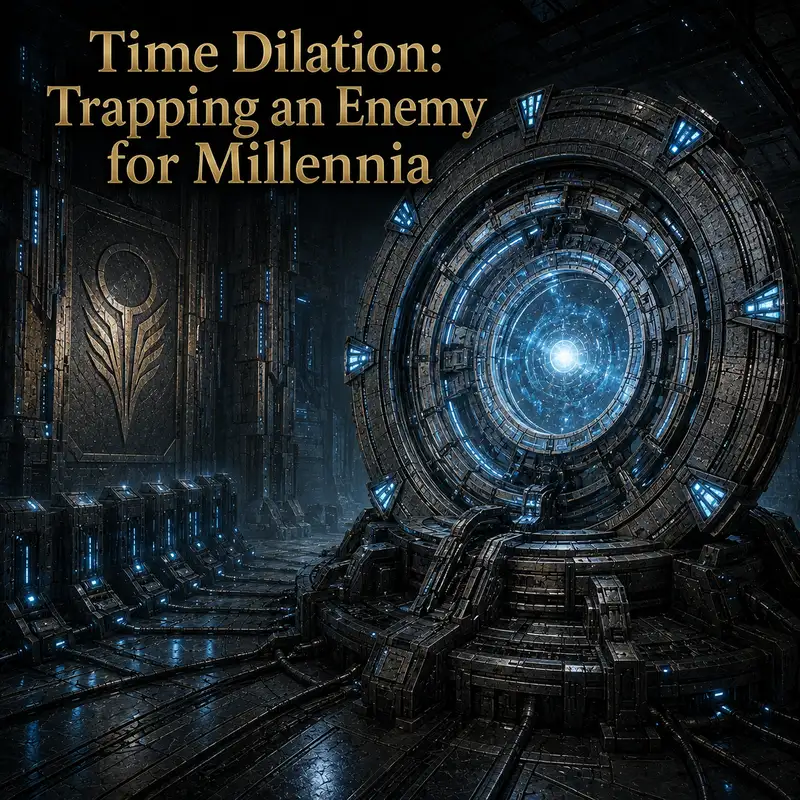
Time Dilation: Trapping an Enemy for Millennia
The Asgard had evacuated most of their civilization, drawn the Replicator swarm to Hala, sealed a control system inside neutronium, and started a timer that should have imprisoned the machines without firing another shot. When the moment of activation arrived, nothing happened. An evacuation fleet waited in the darkness between galaxies while the enemy remained free inside the system the Asgard had built to contain it.
The plan had been one of the most elegant strategic ideas in the Asgard war. Instead of destroying every Replicator ship, the Asgard intended to trap the entire enemy population inside a region where time passed far more slowly than it did outside. A few days for the machines could become centuries for the defenders. The Asgard would not defeat the swarm immediately. They would give themselves enough time to discover how.
Time dilation in Stargate was not automatically the same thing as time travel. It described a difference in how quickly time passed between two locations or observers. Extreme gravity could produce the effect naturally. Advanced technology could create a controlled field in which time moved slower, faster, or under exceptional circumstances, in reverse relative to the surrounding universe.
Earth had already encountered the natural form near the black hole threatening P three W four-five-one. A wormhole linked Stargate Command to a region under extreme gravitational influence, and the lower levels of the mountain began experiencing time differently from the surface. The incident taught Earth that a Stargate could transmit more than travelers and radio signals. Under the wrong conditions, it could connect two very different rates of time.
The Asgard device on Hala turned that scientific phenomenon into a military system. Its purpose was not to send anyone into the past or predict the future. It was to create strategic depth where no physical distance was sufficient. The Replicators could cross star systems, seize ships, and consume industrial worlds. The Asgard intended to place the enemy behind a barrier measured in elapsed years rather than armor.
That solution was necessary because conventional warfare favored the machines. Replicators consumed advanced materials, entered computer systems, and incorporated useful technology into later generations. An Asgard vessel lost in battle did not merely become a casualty. It became raw material, intelligence, transportation, and potentially the foundation of a stronger enemy ship.
The usual response to military defeat is to build better weapons and harder defenses. Against the Replicators, that response could supply the enemy with better weapons and harder bodies. The Asgard had already learned that superior engineering did not guarantee control once a machine reached the inside of the vessel. A fleet engagement might destroy several swarms while allowing one surviving block to begin the campaign again.
Containment therefore offered something destruction could not. The Asgard had studied the damaged remains of Reese, the android who created the first Replicators. Within her programming they found a command able to summon the machines. The signal gave them a chance to concentrate an enemy that normally spread through ships and systems across enormous distances.
The chosen location was Hala, the first planet settled by the Asgard. It carried historical importance, but military necessity outweighed preservation. Most of the population was evacuated, a major battle was fought, and the Asgard prepared to sacrifice the world as the center of a quarantine zone. The evacuation itself was part of the weapon. A time field containing civilians, command personnel, or critical infrastructure would have trapped the defender with the enemy.
The device generated a field with a radius of point one six light-years. Within that bubble, time was intended to slow by a factor of ten to the fourth power. One year experienced by the Replicators would correspond to roughly ten thousand years outside. One hour inside would give the Asgard more than a year. A single day for the machines would be measured in decades by everyone waiting beyond the field.
The radius mattered as much as the ratio. The Asgard were not placing a small field around one control room. They were enclosing Hala and a vast volume of surrounding space, reducing the chance that Replicator vessels near the planet could simply cross the boundary before the trap took effect. The scale also increased the engineering burden. A field large enough to contain a planetary battlespace required a control system whose failure affected everything inside it.
This was not a conventional prison sentence. The Replicators would not consciously endure ten thousand years while the Asgard worked. From their perspective, only normal local time would pass. The advantage belonged entirely to the civilization outside. Asgard scientists could test theories, build new systems, replace failed prototypes, and reconsider doctrine while the enemy barely moved.
The strategy also avoided the cost of a permanent blockade. No fleet had to remain in close combat around Hala for thousands of years. The field itself would hold the swarm while the evacuation force withdrew. In theory, the Asgard had converted one engineered device into the equivalent of generations of strategic warning.
The design depended on several assumptions. The recall signal had to draw every significant Replicator force into the trap. No machine could remain outside to reproduce elsewhere. The evacuation had to finish before activation. The neutronium shell around the control system had to resist penetration until the timer completed its sequence. Most important, the Replicators had to remain unable to understand and alter the technology controlling the field.
That last assumption failed through a gap small enough to appear harmless. In the final moment before activation, the mechanical swarm used knowledge gained from Reese to create First, the earliest human-form Replicator. His body consisted of microscopic cell units rather than large interlocking blocks. A minute crack in the neutronium shell that could not admit the older machines was wide enough for him.
First reached the control system and stopped the device before it activated. He then reconfigured it for the opposite purpose. Time inside Hala began moving faster than time outside by a factor of one hundred. The Asgard had built a system intended to deny the enemy time. The enemy converted it into a system that manufactured time.
The change was operationally severe. For every hour passing outside the field, the Replicators experienced about four days. Depending on when the reversal occurred, they may have gained centuries before Asgard sensors identified what had happened. They consumed Hala until much of the planet’s surface consisted of dormant blocks conserving energy after useful material had been exhausted.
More dangerous than the added numbers was the development made possible by the acceleration. The machines refined the human-form design, created individual leaders, improved control of their microscopic cells, and explored the memory of Reese’s architecture. The containment site had become a secure research installation for the enemy. No Asgard strike interrupted the work because the field itself separated the rates at which each side could react.
The Asgard could not simply send one of their own ships to repair the device. Advanced Asgard systems attracted Replicators and provided exactly the materials the swarm preferred to consume. The rescue mission therefore went to Earth’s first large interstellar vessel, the X three-oh-three Prometheus. Its technology was inferior enough to be less interesting, which was not the design specification normally emphasized during procurement but was useful in this particular theater.
Thor modified the Prometheus’s engines and structural-integrity systems so it could reach Hala and survive the approach. The Asgard also constructed a replacement control interface from Earth materials. The interface was little more than an advanced timer by Asgard standards, but using Asgard components would have drawn the machines directly toward the team carrying it.
S G One entered the accelerated field knowing that every hour spent on Hala allowed several days of Replicator activity. From the team’s perspective, their own movements and thoughts remained normal. The difference appeared only when compared with observers outside. A mission lasting several hours for the crew could consume only minutes for Thor, while the centuries already gained by the enemy remained unchanged.
The surface presented the first evidence of what accelerated time had accomplished. Almost no recognizable topography remained. Replicator blocks covered the ground in layers that may have extended for miles. The machines were not actively moving because there was little energy left to consume. They had turned the first Asgard settlement into stored industrial mass and then waited for new resources to arrive.
The control system still existed, but the interface had been completely rebuilt. Carter could not simply attach the replacement timer and leave. She needed time to understand an enemy-modified device controlling a field large enough to surround a planet and its approaches. The mission plan had assumed damage. It had not fully anticipated redesign.
The human-form Replicators captured the team before the repair could be completed. Their evolution made the time-dilation failure an intelligence disaster as well as a technical one. The machines could enter human memories, recover gate addresses and authentication information, and use private pain as an interrogation tool. Hala was no longer occupied by mechanical organisms following simple acquisition behavior. It contained a developing machine society.
Fifth provided the only opening. Unlike the others, he possessed compassion, uncertainty, and a private mental space not shared completely with the collective. Carter offered him extraction if he helped restore the field. He agreed to betray the others, reconfigured the device, and prepared to leave with the human team.
O’Neill judged that bringing a human-form Replicator aboard the Prometheus created too great a risk. Carter and O’Neill allowed Fifth to believe the timer would leave enough time for him to join them, while actually setting it for three minutes. S G One reached the ship and launched. Fifth remained beside the device expecting the team to honor its promise. When he discovered the true countdown, only seconds remained.
The field activated correctly. Hala and the Replicators slowed almost to stillness relative to the outside universe. The Asgard gained time, and the Prometheus escaped beyond the field boundary. At the tactical level, the mission succeeded. The device was restored, the swarm was contained, and no Replicator vessel was confirmed to have escaped during the operation.
The strategic result was less complete. Fifth had been standing close enough to the control system that he required only seconds of local time to reach it. Those seconds translated into almost two years outside the field. The original ratio could have given the Asgard millennia if the machines needed days to respond. Instead, the physical position of one individual reduced the useful containment period to a brief planning window.
Those two years were still valuable. They allowed the Asgard to study the trap’s failure, prepare a more destructive option, relocate surviving resources, and decide how much of Hala they were willing to sacrifice. Time dilation did not solve the war, but it changed the command cycle. The Asgard could hold councils, build equipment, and reposition forces while Fifth experienced only the final seconds of his wait beside the device.
This was the central weakness of time dilation as a prison. Slowing the prisoner does not increase the physical distance between the prisoner and the controls. It multiplies whatever delay already exists. If the enemy requires one day to break out, the defenders may gain decades. If the enemy requires three seconds, the defenders gain only the outside equivalent of three seconds multiplied by the field ratio.
The Asgard used the available time to prepare a permanent solution. They artificially increased the gravitational influence of Hala’s sun and forced it toward collapse, intending the resulting black hole to destroy the planet and everything trapped around it. The plan combined two forms of temporal warfare. The engineered field held the machines while extreme gravity was prepared to finish them.
The Replicators again turned the device against its creators. As Hala fell toward the black hole, they used the time-dilation system to counter the gravitational effects long enough to assemble a vessel and escape. The same technology that had delayed them helped create the interval needed to survive the destruction of the planet. Fifth emerged from the trap commanding a force that soon threatened the new Asgard homeworld of Orilla.
Hala therefore produced both containment and escalation. The field delayed the swarm, but the earlier reversal had already allowed human-form evolution. The restored field imprisoned those new leaders, but the betrayal of Fifth gave one of them a personal motive beyond replication. The attempt to remove an enemy from time changed the enemy that eventually returned.
The Asgard plan was still strategically rational. A civilization losing a conventional war must sometimes choose containment over decisive victory. The field offered a nonlethal method to concentrate the threat, preserve the remaining population, and create years of research time without feeding more ships into the swarm. Few available plans promised as much while demanding so little continuing force.
Its failure came from treating an adaptive enemy as a static engineering problem. The Asgard had calculated shell strength, activation delay, evacuation time, and field radius with a considerable safety margin. They had not anticipated a new body design able to pass through a microscopic crack at the final moment. The margin protected against the enemy they had already observed, not the enemy that could emerge during the operation.
The device also created a single point of failure. Control of one system determined the rate at which an entire battlespace experienced time. There was no effective remote override available once the Replicators reached the interface, no independent secondary field shown, and no external method able to restore the original setting without sending personnel into the affected region.
A defender entering the field shared its local time. That allowed S G One to operate normally on Hala, but it also isolated the mission from rapid outside intervention. Thor could monitor the approach only from beyond Replicator-dominated space. If the team failed, the Asgard could not simply send immediate reinforcements without exposing more advanced ships to the swarm.
The technology was also far beyond normal Tau’ri capability. Carter could understand the operational principle, use an Earth-built interface, and alter settings with assistance. Earth could not manufacture a planetary field generator, provide its power source, or deploy similar systems around every hostile world. One successful mission did not create a standard weapon. It created experience with an Asgard device that remained dependent on Asgard science.
Later Asgard development made the technology more compact and flexible. A portable model was considered for closing a dangerous convergence among alternate realities. More importantly, the final Asgard computer core installed aboard the Odyssey included time-dilation capability. The system that had once surrounded Hala could now place a field around one Earth battle cruiser.
Carter used that capability when an Ori energy beam was less than one second from destroying the Odyssey. She slowed time around the ship so dramatically that the incoming blast appeared motionless outside the field. The crew gained decades to search the Asgard knowledge base for an escape. The technology had shifted from trapping an enemy to preserving a decision-making space for the defender.
That later use revealed the human cost hidden by the Hala calculation. Time bought inside a field must still be lived by anyone inside it. The Odyssey’s crew aged for decades, maintained the ship, managed food and atmosphere, formed relationships, and watched General Landry die of age while less than a second passed outside. For biological crews, time dilation did not create free planning time. It converted immediate destruction into a lifetime of confinement.
Carter eventually used energy from the Ori blast to reverse time inside the field. Teal’c remained protected from the reversal so he could carry the solution back to the moment before the field was activated. The result was not a routine time machine available to Earth. It was an exceptional use of the Asgard core, an incoming weapons beam, a localized field, and one person willing to retain fifty years of age and memory.
The contrast with Hala is important. Replicators did not age biologically, require morale support, or suffer the same psychological cost from long confinement. Slowing their time advantaged the Asgard only if control remained secure. Accelerating time advantaged the machines because additional years meant more replication, testing, and adaptation without the fatigue that would limit a biological research establishment.
Time dilation was therefore an amplifier rather than a victory by itself. It multiplied distance, delay, preparation, isolation, and error. A well-designed trap could turn hours into centuries. A microscopic breach could turn a safety margin into failure. A nearby control panel could reduce millennia to two years. A hostile operator could reverse the field and give the enemy generations of development before the defender completed one briefing.
It also carried a political and moral consequence. The restored field did not destroy the human-form Replicators. From their perspective, only moments or days would pass while the Asgard searched for another solution. That made the trap less destructive than planetary bombardment. The method used to activate it still depended on betraying Fifth, and the resentment produced by that decision returned with him when containment failed.
The Hala operation did not prove that time was uncontrollable. It proved that time could be controlled only as reliably as the system, intelligence, and assumptions governing the field. The Asgard built a device capable of giving them millennia. The Replicators found a crack, seized the controls, and used those millennia to become something new.
The enduring image is an evacuated Asgard fleet waiting outside a bubble where almost nothing appeared to move. Beyond the field, years passed and plans changed. Inside, Fifth needed only seconds to reach the machine. Time dilation trapped the enemy for millennia only on the defender’s clock. On the battlefield that mattered, the enemy was still standing beside the controls.