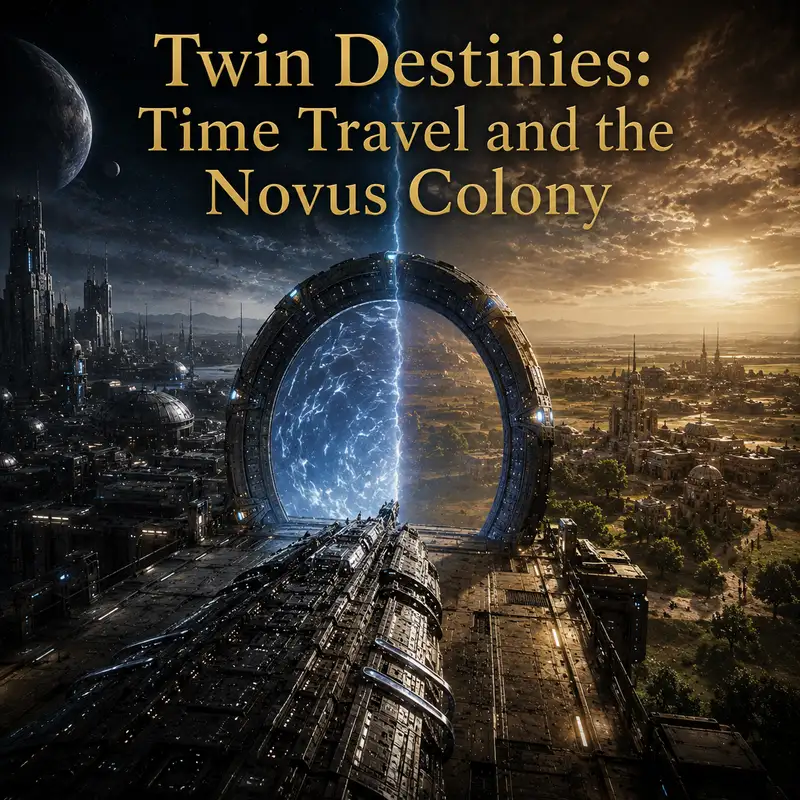
Twin Destinies: Time Travel and the Novus Colony
Destiny was approaching a star when its sensors found a second shuttle on an intercept course. The pilot identified himself as Nicholas Rush, although another Rush was already standing on Destiny’s bridge. The man in the shuttle was burned, exhausted, and roughly twelve hours ahead of the crew he was calling. He carried one warning. Do not attempt the ninth-chevron connection to Earth. In his version of events, the wormhole had opened, the ship had begun tearing itself apart, and almost everyone who entered the gate had disappeared.
That warning created the twin destinies of the episode’s title. One was literal: two versions of the same Ancient ship existed in the same region, one still operational and the other dying from a failed experiment. The second was historical. Most of the people believed lost in the wormhole had not died. They had been thrown two thousand years into the past, where they founded the human civilization of Novus. A failed evacuation therefore created both a duplicate ship and an alternate human future.
The crisis began after battle damage had pushed Destiny close to systemic failure. Life support, shields, weapons, and power distribution were operating with almost no redundancy. The crew lacked replacement parts and understood only portions of the machinery they were trying to preserve. Eli Wallace and Ginn had developed a possible escape. Destiny could use the energy available while recharging inside a star to open a nine-chevron connection back to Earth. The mathematics worked in simulation, and specialists at Homeworld Command agreed that the plan was possible.
Possible was not the same as controlled. Nicholas Rush argued that a star was an unstable environment for a wormhole. Magnetic fields, enormous pressure, solar activity, and the ship’s degraded systems introduced variables that no simulation could model completely. Eli believed his power-flow program could compensate. Rush believed the attempt might destroy the ship or damage space-time itself. Both men understood part of the problem. Eli had calculated how to establish the connection. Rush understood that the environment might change faster than the program could respond.
The proposed evacuation also divided the crew over purpose. Colonel Everett Young believed his first responsibility was to bring people home if a credible opportunity existed. Rush believed abandoning Destiny would end an Ancient mission that could never be restarted. Young agreed to remain with a minimum operating crew if enough people volunteered, while everyone else prepared to cross to Earth. The decision was unusually honest. It acknowledged that survival and mission completion were separate objectives, and that people who had never volunteered for Destiny deserved some choice between them.
In the first timeline, Destiny entered the star and locked the ninth chevron. Colonel David Telford went through first so he could warn Earth that the rest were coming. The connection immediately destabilized. A primary power system failed, Eli’s program could no longer regulate the flow automatically, and Rush began adjusting the levels by hand. Young could have halted movement, but the gate could not be shut down and the ship was already overloading. He ordered the evacuation to continue.
Telford reached Earth. Everyone who followed entered the same event horizon and vanished from Earth’s perspective. Rush remained aboard long enough to maintain the connection while Young, Greer, Eli, and the others crossed. The wormhole then collapsed, leaving Rush alone on a crippled ship. At almost the same moment, Destiny passed close to a solar flare. The resulting temporal event displaced the entire vessel about twelve hours into its own past. Rush later abandoned it in a shuttle and encountered the undamaged Destiny before the experiment had occurred.
This was not routine Stargate time travel. Solar flares had redirected wormholes through time before, but the event aboard Destiny produced several different outcomes at once. The ship moved backward by hours. Telford reached Earth normally. Most of the evacuees were redirected to another Stargate and sent backward by roughly two millennia. The exact reason for those different displacements was never established. The only safe conclusion is that the unstable wormhole, the solar flare, and the stellar recharge combined into an anomaly that could not be reproduced as a controlled transportation method.
The alternate Rush’s arrival allowed the surviving crew to cancel the experiment. That decision preserved the operational Destiny but did not erase the damaged duplicate. Both ships now occupied the same history. The dying vessel carried spare parts, supplies, equipment, and systems identical to those the crew was struggling to maintain. A catastrophe had created the nearest thing Destiny would ever receive to a depot stocked with manufacturer-approved components.
Young organized a salvage operation before the duplicate fell into the star. Teams crossed by Stargate and stripped working components from consoles, power relays, life-support systems, shield equipment, food stores, and medical spaces. The operation had a fixed deadline set by the failing shields and the ship’s degrading orbit. The crew did not need to understand every component. They needed to recognize what still worked and move it before the deck beneath them became part of the star. It was logistics through time travel, which is not a recognized procurement category but solved several immediate maintenance problems.
The duplicate also produced a difficult continuity of personnel. The Telford who crossed first in the failed timeline remained alive on Earth. The Telford aboard the surviving Destiny entered the doomed duplicate during the salvage mission and was accidentally killed by the alternate Rush. The alternate Rush then used the neural-interface chair and died with the duplicate ship. The original Rush returned to the surviving Destiny and concealed part of what had occurred. Afterward, the Earth-based Telford from the failed branch effectively occupied the place left by the Telford who died during salvage.
The larger mystery remained the missing evacuees. Earth had received no one except Telford, and the damaged Destiny contained no bodies. The alternate Rush assumed the others had died in transit because there was no evidence of another destination. The truth emerged only when Destiny later encountered English-speaking humans in a distant galaxy. These people recognized Scott and Greer from historical recordings and called the crew their ancestors.
The evacuees had emerged from a Stargate approximately two thousand years before Destiny reached that region. They did not arrive on Earth, and Rush was not with them. They possessed limited personal items, the knowledge in their own memories, and at least one kino that Eli had carried through during the emergency. Their first destination was not suitable for long-term settlement, so teams used the local gate network to search for another world. They eventually selected a habitable planet and named it Novus.
The first generation faced a problem more severe than ordinary colonization. They had modern scientific knowledge but almost none of the industrial system that made modern life possible. Knowing how electricity works does not produce insulated wire, generators, machine tools, mines, refineries, and replacement parts. The settlers had to secure water, food, shelter, medicine, sanitation, and agriculture before advanced knowledge could become advanced capability. Their education gave them a head start. It did not exempt them from building the tools needed to build better tools.
Their most fragile resource was trained human knowledge. A broken tool could sometimes be replaced by a simpler one. A dead specialist could take an entire field of practice with her. Johansen carried the community’s medical experience. Eli, Brody, Volker, Park, Wray, and the military personnel held different pieces of engineering, administration, education, and security. Preserving those skills required written records and apprentices, not merely survival of the original experts. The kino archive became important because it captured methods, decisions, and explanations that children could study after the founders were gone.
The surviving kino records showed that they did build. Temporary shelters became wooden structures. Irrigation supported agriculture. Children were born, families formed, and practical skills were taught before they could be lost. Young and Tamara Johansen had a son named Steven. Eli became a teacher and an archivist, preserving the knowledge of the founders for children who had never seen Earth or Destiny. Wray moved from civilian representative to institution builder. The accidental expedition became a settlement because its members stopped organizing only for the next crisis and began planning for people who did not yet exist.
Government emerged from the same pressures. Young served as the settlement’s leader and was later reelected. Wray drafted a constitution and eventually served two terms as mayor. Her authority became more durable on Novus than it had aboard Destiny because the community could finally create procedures, schools, elections, and offices not defined entirely by emergency military command. The settlement still inherited the disagreements of the ship. Isolation did not erase conflict. It gave conflict land, descendants, and time.
The small founding population also made private choices strategically significant. Partnerships, childbirth, health, and family conflict affected whether the settlement would possess another generation large enough to continue. The records show the founders building families across former military, civilian, scientific, and Lucian Alliance divisions. That did not erase old grievances, but it made permanent separation costly. A community born from fewer people than many Earth military units could not afford to treat every disagreement as grounds for exile. Novus survived because former factions gradually became one demographic future, even when their descendants later divided politically.
Two major political traditions developed. Tenera, a name associated with Young, followed the teachings preserved in a founding text called the Testament. Another movement blamed Eli for the failed return attempt and believed Rush remained aboard Destiny and would someday rescue them. That movement formed the country of Futura, with Rush gradually transformed into a savior figure. The split demonstrated how quickly incomplete operational history can become political mythology. A technical failure became a story of responsibility, abandonment, and promised return.
The founders knew what had happened aboard the ship, but later generations inherited recordings, edited memories, family traditions, and political institutions built around those interpretations. The original kino became a revered artifact. Familiar personalities became historical founders. Rush, who never reached Novus, became central to the identity of a nation. Young’s authority became embedded in the name and political tradition of another. History did not preserve the crew exactly as they had been. It preserved the versions useful to the societies that followed.
Novus eventually grew far beyond the first settlement. Its population reached into the millions. Cities, electronic communications, public institutions, archives, medical research, and spaceflight emerged over the centuries. The descendants benefited from inherited scientific knowledge, but their progress still required generations of labor and industrial development. They did not reproduce Destiny or develop faster-than-light travel. They did build large conventional spacecraft, maintain a regional Stargate program, and establish colonies on other gate-accessible worlds.
That expansion became necessary when Novus entered a period of severe geological instability. Earthquakes and volcanic activity damaged cities and threatened the planet’s habitability. Expeditions moved through the Stargate to prepared settlements elsewhere. One such group had lived on a colony world for about thirty years when Destiny found them. The colony was small compared with Novus, but its people carried the language, technology, historical memory, and political divisions of the civilization founded by the alternate crew.
The meeting was one of the strangest first-contact situations in Stargate history. The descendants were human, spoke English, and knew the visitors’ names. Jason and Ellie recognized Scott and Greer from old kino images. An elder named Yaozu greeted Camile Wray using words connected to her family and cultural heritage. To the descendants, the Destiny crew were not alien explorers. They were living historical figures who had stepped out of a foundational record.
For the prime crew, the encounter was not proof of an inevitable future. These were descendants of alternate versions whose lives had changed after the failed evacuation. The records showed relationships and decisions that had not occurred aboard the surviving Destiny. Scott and Chloe built a family. Greer and Lisa Park did the same. Wray became a constitutional founder. Young and Johansen shared a life that the prime timeline had denied them. The archive revealed possibilities, not obligations.
The reunion quickly became another military emergency. Automated drones detected the active Stargate, attacked the colony, and destroyed the gate before everyone could evacuate. Some descendants reached Destiny, while Scott, Greer, Eli, Wray, and others were stranded on the surface with the remaining colonists. Eli improvised a low-power signal through the damaged gate’s status transmitter, using a pattern Destiny could recognize. The ship returned with a shuttle and recovered them. The descendants had spent generations waiting for Destiny, and its arrival nearly drew an automated army onto their settlement. Historical fulfillment has a habit of arriving with operational complications.
Destiny then carried the survivors toward Novus. The homeworld’s Stargate was no longer functioning, so the ship approached by faster-than-light travel and entered orbit. The surface appeared beneath ash and cold. A modern city remained largely intact but empty, its streets buried under the effects of extreme volcanic activity. The crew found no active population and no communications. Novus had not been destroyed in one battle. Its environment had failed over time, forcing a civilization founded by castaways to become an evacuation society.
An underground archive preserved the record. It contained thousands of kino recordings, political documents, scientific knowledge, medical research, and a detailed history of the civilization. The prime crew watched alternate versions of themselves building shelters, raising children, arguing over leadership, aging, and dying. The experience turned time travel into something more personal than a technical anomaly. They were reviewing the lives of people genetically and psychologically identical to themselves until one failed decision separated the timelines.
The archive also carried immediate medical importance. The alternate Johansen developed symptoms resembling A L S several years after settlement and died not long afterward. The prime Johansen understood that the condition was not an infection acquired on Novus and believed she carried the same underlying illness. Novan researchers had discovered a cure more than two hundred years later. That cure existed somewhere in the archive, but geological collapse interrupted the data transfer after only part of the repository had reached Destiny. The descendants had solved a disease their ancestor could not survive, yet the answer remained trapped inside a dying planet’s damaged storage system.
Novus had not simply waited for extinction. Most of the population evacuated before the final collapse. Once earthquakes destroyed or disabled the Stargate, Tenera and Futura set aside enough of their rivalry to pool resources and build enormous ships. Those vessels lacked faster-than-light drives but could carry the remaining population toward a previously established colony. Their journey would take roughly two centuries. When Destiny recovered the archive, those ships were still somewhere in interstellar space, beyond practical search and not scheduled to arrive for generations.
The prime expedition therefore inherited two populations from the same alternate history. One group of descendants was physically aboard Destiny after the drone attack. A much larger population was traveling slowly between stars. The ship could carry the nearby colonists toward safety, but it could not overtake every evacuation vessel or restore Novus. Time travel had created a civilization, and ordinary distance still governed whether that civilization’s branches could help one another.
The material value of the encounter was substantial. The Novan colonists provided food and other supplies. The archive gave Destiny scientific and historical information developed independently across two thousand years. Even the incomplete transfer included medical knowledge the expedition might eventually use. Earlier, the duplicate Destiny had supplied compatible parts from the same ship. The failed dialing attempt had produced assistance in two forms: a second vessel from twelve hours away and a human civilization from two millennia away.
The event did not establish time travel as a strategic capability. No commander could repeat the conditions safely, select the temporal destination, or guarantee which gate would receive the travelers. The experiment killed a version of Destiny, stranded almost an entire crew in the distant past, and left only one person at the intended destination. Its later benefits came from survival and adaptation after failure, not from successful planning. Calling it a transportation method would be generous. Calling it a controlled method would require a sense of humor normally discouraged in gate operations.
The twin timelines remained connected without becoming identical. The alternate crew founded Novus because the first dialing attempt occurred. The prime crew survived because the alternate Rush returned and stopped them from repeating it. The descendants later met the people whose duplicates had founded their society, while records from that society affected decisions aboard the surviving ship. The screen record does not settle every question about whether this was a branching universe or one self-consistent temporal structure. It does establish that the alternate history remained real enough to leave people, ships, data, and political consequences in the prime crew’s path.
The deepest consequence was human rather than technological. Destiny’s crew had defined itself through loss of home and uncertainty about return. Novus showed that the same people could stop being passengers and become ancestors. They could create schools, governments, marriages, rival nations, scientific institutions, and mistakes large enough to occupy history books. They could also pass knowledge back to versions of themselves who had not lived those lives.
Twin Destinies was therefore not merely a story of duplicate machinery. One Destiny continued the Ancient search across the universe. The other was destroyed near a star, but its failed evacuation created a separate human destiny on Novus. The wormhole did not take most of the crew home. It made them responsible for building a new one. Two thousand years later, their descendants returned the favor by supplying the ship, preserving its people’s possible lives, and proving that an operational disaster can become a civilization when the survivors have enough time.