Understanding the Goa’uld: Parasites Who Built an Empire
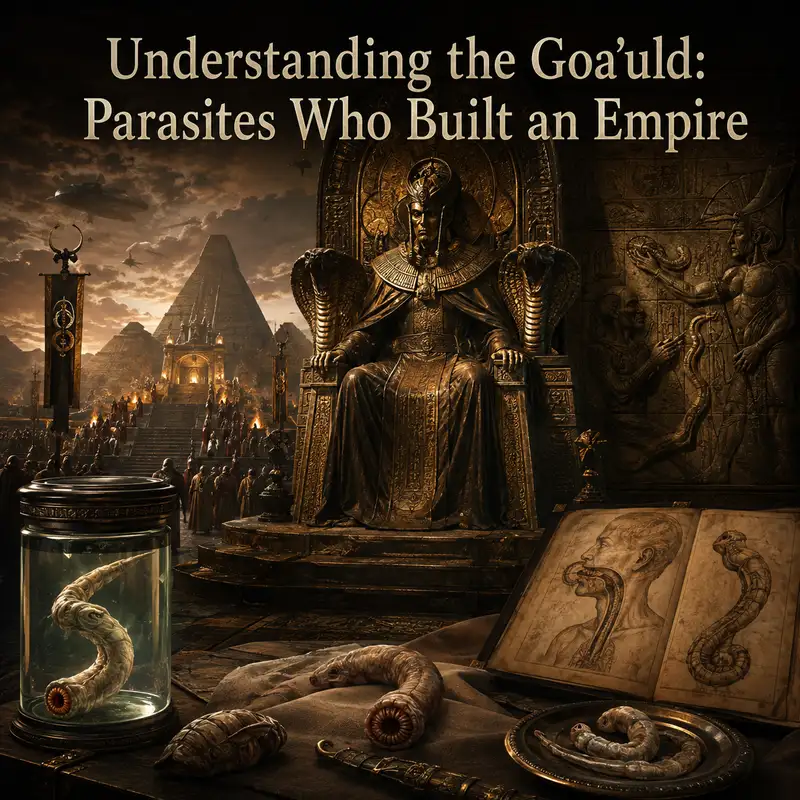
The guards around the Stargate do not see a monster. They see a king. He wears a human face, speaks with a human mouth, and stands beneath banners proclaiming that he has ruled since before their grandparents’ grandparents were born. When his eyes flare and the Jaffa lower their weapons, the performance is complete. The ruler appears immortal, the soldiers appear loyal, and the population appears obedient. Hidden inside that human body, however, is a small aquatic symbiote whose natural form could not command a village, much less an interstellar empire. The central question is how it did exactly that.
The Goa’uld did not conquer the Milky Way through biology alone, and they did not rule merely because they possessed advanced weapons. Their power came from combining several systems that reinforced one another. They seized hosts and extended their lives. They inherited knowledge across generations. They monopolized transportation and military technology. They turned religion into political authority. They transformed the Jaffa into both an army and a reproductive system. They divided territory among rival god-kings, creating an empire that was rarely unified yet difficult to destroy. The result was a network of personal dominions held together by fear, dependence, and managed ignorance.
The species originated on the world later designated P three X eight-eight-eight, where primitive Goa’uld lived in water and entered the bodies of the Unas. The Unas were physically strong, durable, and already capable of serving as hosts. That early relationship established the basic Goa’uld advantage. A symbiote could acquire the senses, mobility, and physical strength of another species while retaining its own intelligence and identity. It did not need to evolve hands to build tools or lungs to speak commands. It could take those capabilities from a body that already possessed them.
The discovery of humans changed the scale of Goa’uld ambition. Ra found Earth and recognized that human beings made unusually useful hosts. Humans were adaptable, physically easier to present as refined rulers than the Unas, and numerous enough to support armies, labor systems, and colonies. Goa’uld rulers transported human populations through the Stargate network and seeded them across many worlds. Those populations became miners, farmers, artisans, soldiers, servants, worshippers, and future hosts. Earth eventually rebelled and buried its gate, but the wider human population of the Milky Way remained the demographic foundation of Goa’uld power for thousands of years.
Calling the Goa’uld parasites is accurate in the political and moral sense, but their biology is capable of more than parasitism. A symbiote can strengthen a host, heal injuries, extend life, and share knowledge. The problem is control. A Goa’uld normally suppresses the host’s will and takes command of the body. The host may remain conscious, able to see and hear what occurs, while being unable to stop it. That is not a partnership. It is occupation at the level of the nervous system. The glowing eyes and altered voice are symbols of authority, but the real instrument of power is the removal of another person’s agency.
The sarcophagus made that claim more convincing. It could repair catastrophic damage, restore the recently dead under some conditions, and preserve a ruler far beyond a normal human lifespan. Repeated use also carried psychological costs, encouraging dependence and behavioral degradation. The device did not create every Goa’uld vice, and it should not be used as a universal explanation for tyranny. It did, however, shield elite rulers from consequences that killed ordinary soldiers and subjects. A commander who expects resurrection approaches risk differently from the Jaffa ordered to hold the gate until the last warrior falls.
The second great advantage was genetic memory. Goa’uld queens could pass extensive inherited knowledge to their offspring. A newly matured symbiote did not begin as an empty mind. It could receive language, technical understanding, political memory, and the accumulated experience of earlier generations. This allowed the species to preserve expertise across enormous spans of time. It also helped transmit grudges, assumptions, and patterns of domination. Genetic memory was not perfect omniscience. A Goa’uld could still misread an enemy, misuse technology, or make a poor command decision. Inherited knowledge reduced the cost of education. It did not eliminate the need for judgment.
The Tok’ra are the most important evidence that Goa’uld political behavior was not an unavoidable result of their biology. They were the same species, descended from the queen Egeria, but they rejected claims of divinity and sought voluntary hosts. Tok’ra host and symbiote shared the body rather than treating one identity as disposable. Their existence proves that the benefits of blending did not require enslavement. It also explains why the System Lords regarded them as more than political rebels. The Tok’ra challenged the central ideological claim of the empire: that domination was natural, necessary, and therefore beyond moral judgment.
Goa’uld rule depended on presenting possession as divinity. Individual rulers adopted the names and appearances of gods drawn from human cultures. The purpose was not merely theatrical vanity, although vanity was rarely in short supply. Divine identity solved several practical problems. It justified taxation as tribute, military service as sacred duty, obedience as religious obligation, and defeat as blasphemy. It allowed a Goa’uld to govern distant populations through priests, local elites, and Jaffa commanders without maintaining a modern civil service on every world. A temple could serve as courthouse, intelligence post, recruiting station, and propaganda center at the same time.
The empire deliberately preserved extreme technological inequality. Many subject populations remained agrarian or preindustrial while their rulers possessed spacecraft, energy weapons, force shields, transport rings, and healing devices. This was not evidence that every Goa’uld lacked scientific understanding. They operated shipyards, modified inherited systems, developed specialized weapons, and supported advanced infrastructure. The inequality was political. A population that understood the machinery behind the miracles would become harder to govern. A village that could manufacture rifles, radios, or explosives would become harder to punish with a small Jaffa garrison. Keeping subjects dependent was a security policy.
That policy produced a patchwork empire rather than one uniform civilization. Some worlds were directly occupied. Others paid tribute through local rulers. Some supplied naquadah, food, labor, or recruits. Others held symbolic value because they supported a ruler’s divine identity. Populations could experience Goa’uld authority as constant military presence, periodic collection, religious supervision, or the distant threat of destruction from orbit. Control of the local Stargate mattered, but it did not automatically mean control of an entire planet. A gate could be guarded, buried, moved, or bypassed by ships. The Goa’uld understood that strategic mobility required both ground forces and space power.
Naquadah was central to that power. It supported energy generation, weapons, shields, and much of the technology that made Goa’uld rule possible. Mining worlds therefore had military importance far beyond their population. The empire’s economic system moved raw material, tribute, and labor toward the domains of individual rulers, where shipyards and arsenals converted resources into coercive power. The arrangement was efficient for extraction and poor for broad development. Goa’uld economics did not seek prosperity for subject populations. It sought enough production to sustain fleets, palaces, armies, and the political independence of the ruling symbiote.
No institution illustrates this combination of biology, religion, and military necessity better than the Jaffa. The Goa’uld altered human beings so that they could incubate immature symbiotes. During the prim’ta ceremony, a larval Goa’uld was placed within a Jaffa, replacing normal immune function and making continued survival dependent on the symbiote. The arrangement created warriors with enhanced strength, healing, and longevity. It also created a controlled population that could not simply leave imperial service without medical consequences. Every Jaffa army was therefore more than a military force. It was part of the reproductive infrastructure of the Goa’uld species.
From the ruler’s perspective, the system was brutally elegant. Jaffa protected young symbiotes until maturity, enforced imperial authority, and received religious status in return. Their families and communities were organized around service to particular gods. Marks of allegiance identified ownership as much as honor. First Primes commanded in the ruler’s name, while priests reinforced the belief that obedience maintained cosmic order. A Jaffa who doubted his god risked more than court-martial. He risked exile, the loss of his community, and eventually death when his symbiote matured or was removed without a replacement for the immune function it provided.
Jaffa forces were often disciplined, physically formidable, and experienced. They could conduct raids, seize gates, defend ships, occupy settlements, and suppress revolts. Their staff weapons were effective energy arms with great psychological impact, especially against populations that lacked firearms or armor. The weapon’s ceremonial role also shaped its battlefield use. Against modern troops employing automatic fire, grenades, optics, cover, and coordinated small-unit tactics, Jaffa formations could discover that intimidation was not the same as fire superiority. That weakness was real, but it should not be exaggerated into universal incompetence. Jaffa performance varied with leadership, training, terrain, and mission.
Above the Jaffa stood a fleet designed for imperial movement and punishment. Ha’tak motherships carried troops, fighters, shields, and heavy energy weapons. Al’kesh bombers supported strikes against ground and space targets. Death gliders provided tactical air and space capability. Tel’tak cargo ships moved personnel, supplies, and covert teams. Ring transporters connected ships, bases, and surface positions. This was not a collection of isolated relics. The Goa’uld could build, repair, crew, and deploy complex systems across many domains. Much of the underlying science had been inherited or appropriated, but operational mastery still required engineers, industrial sites, trained crews, and reliable sources of naquadah.
The Stargate network gave the Goa’uld a second transportation system with different strengths. A gate allowed rapid movement between known addresses without committing a starship. It was ideal for reconnaissance, raids, political visits, small reinforcements, and the movement of valuable cargo. It was also a chokepoint. Defenders could fortify the destination, disable the dial-home device, observe the approach, or cut off extraction. Heavy formations and large-scale occupation still depended on ships, local supply, and control of the surrounding terrain. The Goa’uld empire was powerful because it combined gate mobility with fleets, not because the gate made logistics disappear.
The political structure was commonly described as the rule of the System Lords, but that title can imply a unified imperial cabinet. Each major Goa’uld held personal territory, fleets, Jaffa, subordinate rulers, and economic resources. Alliances formed when interests aligned and dissolved when an opportunity for betrayal appeared. A dominant figure such as Ra could claim supremacy, while later councils tried to manage common dangers without eliminating rivalry. Lesser Goa’uld served greater ones, sometimes loyally and sometimes until a better opportunity emerged. The empire functioned through hierarchy, but the hierarchy was personal rather than constitutional.
This fragmentation was both a weakness and a survival mechanism. Rivalry prevented the System Lords from concentrating all available power against a new threat. They concealed intelligence from one another, sabotaged allies, and sometimes preferred a rival’s defeat to a collective victory. At the same time, there was no single capital whose fall would end Goa’uld rule everywhere. The death of one System Lord usually created a succession struggle, not immediate liberation. Fleets changed allegiance. Underlords seized territory. Jaffa commanders chose among competing claimants. Subject worlds could exchange one god for another without gaining meaningful independence.
Goa’uld commanders also differed more than their common rituals suggested. Some relied almost entirely on inherited prestige and terror. Others experimented, negotiated, infiltrated, or adapted enemy technology. Ba’al repeatedly demonstrated political flexibility and technical competence. Yu often behaved with greater caution than his rivals. Nirrti pursued biological research with little regard for the people used as test subjects. Anubis combined Goa’uld imperial methods with knowledge that exceeded the normal technological base of the System Lords. Arrogance remained a recurring institutional problem, but it was not a substitute for analyzing the actual commander, resources, and objectives in any specific campaign.
The empire’s command culture nevertheless encouraged bad information. A ruler claiming divine perfection could not easily admit error. Subordinates had strong incentives to report success, conceal losses, and blame failure on disloyalty. Rival officials guarded access to the ruler. Jaffa commanders could be punished for initiative that appeared disrespectful, even when it was operationally sound. This is a familiar problem in personal dictatorships. The leader may possess excellent surveillance and still receive a distorted picture because everyone below understands that unwelcome facts can be fatal. A glowing pair of eyes is not a reliable substitute for an honest intelligence estimate.
Fear compensated for many of these weaknesses. Goa’uld punishment was public, disproportionate, and often directed at entire communities. A destroyed village could suppress resistance on several nearby worlds. An orbital bombardment could make the survival of one rebellious settlement irrelevant. The purpose was not always to win a battle. It was to shape expectations. If subjects believed resistance would bring annihilation and obedience would preserve daily life, a small occupation force could control a much larger population. This made Goa’uld rule economical in manpower. It also made the system vulnerable when resistance movements proved that punishment could be survived and gods could be killed.
Earth’s return to the gate network threatened the empire in an unusual way. Stargate Command did not begin with fleets capable of challenging Ha’taks in open battle. It began with small teams, limited intelligence, conventional weapons, and a heavily defended doorway in a mountain. Those teams survived by exploiting the gaps between Goa’uld institutions. They allied with local populations, shared intelligence with the Tok’ra, encouraged dissident Jaffa, captured equipment, and struck command nodes that had been designed to intimidate subjects rather than resist infiltration by technologically inferior specialists.
The advantage was not that a P ninety was magically superior to every Goa’uld weapon. Earth forces combined compact automatic weapons, radios, explosives, medical support, reconnaissance, and mission command in ways many Jaffa units had not been trained to counter. They also treated enemy technology as a collection target rather than a sacred object. A disabled glider became an engineering problem. A captured communication device became an intelligence opportunity. A Goa’uld fortress built to display divine authority often contained predictable ceremonial spaces, centralized control rooms, and commanders accustomed to unquestioned access. Architecture can become a tactical vulnerability when the enemy declines to be impressed.
Earth’s successes were also enabled by allies who had been fighting the Goa’uld far longer. Tok’ra infiltrators supplied strategic intelligence and access. Jaffa dissidents explained military culture, command relationships, and the limits of religious loyalty. The Asgard imposed constraints that Earth could not have enforced. Human resistance movements provided guides, recruits, concealment, and legitimacy. Describing the collapse of Goa’uld power as a sequence of victories by S G One alone would miss the larger war. Small teams mattered because they connected existing resistance, exploited imperial division, and repeatedly turned local opportunities into wider political shocks.
The most dangerous shock was the erosion of belief among the Jaffa. Goa’uld military power depended on warriors who accepted that their rulers were gods and that their own biological dependence confirmed the arrangement. Each defeated System Lord weakened that claim. Each Jaffa who survived without submission became evidence. Tretonin eventually offered a way to replace dependence on larval symbiotes, but political liberation began before medical independence was secure. The rebellion required networks, leaders, sanctuary, weapons, and proof. Faith did not collapse in a single moment. It fractured as experience contradicted doctrine.
This helps explain why destroying individual Goa’uld did not immediately end the empire. The institutions of coercion remained. Jaffa units still needed supplies and symbiotes. Human worlds still feared orbital attack. Local elites had built careers around collaboration. Rival System Lords could absorb abandoned territory. Even after the old order weakened, liberation created hard questions about borders, authority, justice, and economic survival. Removing a parasite from a host is a medical act. Removing a parasitic political system from hundreds of worlds is a campaign followed by a generation of reconstruction.
The final collapse came through several pressures acting together. Repeated Tau’ri operations killed or weakened major rulers. Tok’ra sabotage damaged the empire from within. The rise of Anubis disrupted the balance among the System Lords and introduced capabilities many could not match. The Jaffa rebellion attacked the military foundation of Goa’uld rule. The Replicator offensive then devastated fleets and command structures already divided by war. No single cause explains the result. The empire failed when its political rivalry, military dependence, and legitimacy crisis met enemies capable of striking all three at once.
The Goa’uld empire endured because it linked every level of control. The symbiote dominated the host. The ruler dominated the Jaffa. The Jaffa dominated subject populations. Religion explained the hierarchy, technology enforced it, naquadah financed it, and gates and ships connected it. Genetic memory preserved expertise, while rivalry distributed power across many rulers. A relatively small species could therefore command populations and territory far beyond its own numbers without occupying every settlement directly.
The same design contained the causes of failure. A political system built around divine personalities struggled to cooperate without threatening those personalities. A military system built on enslaved Jaffa became vulnerable when the warriors withdrew consent. A technological monopoly discouraged broad education and innovation among subject populations, but it also narrowed the empire’s own sources of talent. A culture that punished unwelcome intelligence made surprise more likely. A ruler who treated every subordinate as a potential traitor eventually received loyalty measured mostly by fear, and fear is dependable only while defeat appears impossible.
Understanding the Goa’uld therefore requires looking past the spectacle. They were not gods, but neither were they merely animals hiding inside stolen bodies. They were experienced political actors who built a durable imperial system from biological possession, inherited knowledge, advanced technology, religious legitimacy, economic extraction, and military coercion. Their greatest achievement was making those systems appear natural to the people trapped within them. Their greatest vulnerability was that none of it was natural. The host could resist. The Jaffa could rebel. The subject world could remember life before the god arrived.
The Goa’uld host was the empire in miniature. One will occupied another body, claimed its strength, extended its usefulness, and denied its right to choose. That model could command armies and survive for millennia, but it could never produce genuine loyalty because it offered no place for another person’s freedom. Once enough hosts, Jaffa, and human worlds understood that the voice of a god belonged to an occupant, the empire’s most important weapon stopped working. The weapons and ships remained dangerous. The illusion of inevitability did not.